
 100% FREE ACCESS
10th Standard Syllabus & Materials
10th Standard
TN 10th English Prose - 4 - The Attic Important Questions And Answers Study Material - QB365 Set A
NEW10th Standard
TN 10th English Supplementary - 3 - The Story of Mulan Important Questions And Answers Study Material - QB365 Set A
NEW10th Standard
TN 10th English Poem - 3 - I am Every Woman Important Questions And Answers Study Material - QB365 Set A
NEW10th Standard
TN 10th English Prose - 3 - Empowered Women Navigating The World Important Questions And Answers Study Material - QB365 Set A
NEW10th Standard
TN 10th English Supplementary - 2 - Zigzag Important Questions And Answers Study Material - QB365 Set A
NEW10th Standard
TN 10th English Poem - 2 - The Grumble Family Important Questions And Answers Study Material - QB365 Set A

Published on: 06/12/2019
Coordinate Geometry
Download Tamil Nadu 10th Standard Maths question papers, model tests, one-mark questions, important questions, and public exam papers in PDF format. Free study materials and answer keys for TN State Board students.
Questions + Answers key
Take MCQ Maths Test1.
Find the area of the quadrilateral whose vertices, taken in order, are (-4, -2), (-3, -5), (3, -2) and (2, 3).
2.
Find the area of a triangle vertices are(1, -1), (-4, 6) and (-3, -5).
3.
If the points A(6, 1), B(8, 2), C(9, 4) and D(P, 3) are the vertices of a parallelogram, taken in order. Find the value of P.
4.
Find the coordinates at the points of trisection (i.e. points dividing in three equal parts) of the line segment joining the points A(2, -2) and B(-7, 4).
5.
Find the equation of a line whose intercepts on the x and y axes are given below. -5, \(\frac 34\)
6.
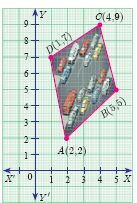
The given diagram shows a plan for constructing a new parking lot at a campus. It is estimated that such construction would cost Rs. 1300 per square feet. What will be the total cost for making the parking lot?
7.
If A (-5, 7), B (-4, -5), C (-1, -6) and D (4, 5) are the vertices of a quadrilateral, find the area of the quadrilateral ABCD.
8.
Show that the points (1, 7), (4, 2), (-1,-1) and (-4,4) are the vertices of a square.
9.
Find a relation between x and y such that the point (x, y) is equidistant from the points (7, 1) and (3, 5).
10.
Show that the given points are collinear: (-3, -4) , (7, 2) and (12, 5)
11.
In each of the following, find the value of ‘a’ for which the given points are collinear. (2, 3), (4, a) and (6, –3)
12.
(2, 1) is the point of intersection of two lines.
x - y - 3 = 0; 3x - y - 7 = 0
x + y = 3; 3x + y = 7
3x + y = 3; x + y = 7
x + 3y - 3 = 0; x - y - 7 = 0
13.
When proving that a quadrilateral is a parallelogram by using slopes you must find
The slopes of two sides
The slopes of two pair of opposite sides
The lengths of all sides
Both the lengths and slopes of two sides
14.
A straight line has equation 8y = 4x + 21. Which of the following is true
The slope is 0.5 and the y intercept is 2.6
The slope is 5 and the y intercept is 1.6
The slope is 0.5 and the y intercept is 1.6
The slope is 5 and the y intercept is 2.6
15.
1.
We have Area of the quadrilateral
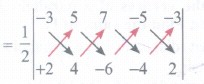
=\(\frac { 1 }{ 2 } \) [(-12 - 30 - 28 -10) - (+ 10 + 28 + 30 + 12)]
\(\frac { 1 }{ 2 } \) [-80 - (80)]
\(\frac { 1 }{ 2 } \)[-160] = -80 = 80 square units.
(∵ Area is always +ve).
2.
The area of the triangle formed by the vertices A(1, -1), B(-4, 6) and C(-3, -5), by using the formula above, is given by
= \(\frac { 1 }{ 2 } \)[1(6 + 5) +(-4) (-5 + 1) + (-3)(-1 - 6)]
= \(\frac { 1 }{ 2 } \)[11 + 16 + 21] = 24 square units.
3.
We know that diagonals at a parallelogram bisect each other.
So, the coordinates of the mid-point at AC = coordinates of the mid-point at BD.
i.e., \(\left[ \frac { 6+9 }{ 2 } ,\frac { 1+4 }{ 2 } \right] =\left[ \frac { 8+P }{ 2 } ,\frac { 2+3 }{ 2 } \right] \)
\(\left[ \frac { 15 }{ 2 } ,\frac { 5 }{ 2 } \right] =\left[ \frac { 8+P }{ 2 } ,\frac { 5 }{ 2 } \right] \)
\(\frac { 15 }{ 2 } =\frac { 8+P }{ 2 } \)
P = 7
4.
Let P and Q be the points of trisection at AB.
i.e., AP = PQ = QB
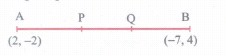
Therefore, P divides AB internally in the ratio 1:2. Therefore, the coordinates at P, by applying the section formula, are
\(\left[ \frac { 1(-7)+2(2) }{ 1+2 } ,\frac { 1(7)+2(-2) }{ 1+2 } \right] \) i.e., (-1,10)
Now, Q also divides AB internally in the ratio 2:1, so, the coordinates at Q are
\(\left[ \frac { 2(-7)+1(2) }{ 2+1 } ,\frac { 2(4)+(-2) }{ 2+1 } \right] \) i.e., (-4,2)
Therefore, the coordinates at the points at trisection of the line segment joining A and B are (-1, 0) and (-4, 2).
5.
Given intercepts are -5, \(\frac 34\)
\(a=-5, b=\frac{3}{4}\)
Equation of the line in the intercepts form is
\(\frac{x}{a}+\frac{y}{b}=1
\)
\(\frac{x}{-5}+\frac{y}{\left(\frac{3}{4}\right)}=1
\)
\(\frac{x}{-5}+\frac{4 y}{3}=1
\)
3x - 20y = -15
3x - 20y + 15 = 0
6.
The parking lot is a quadrilateral whose vertices are at A(2, 2), B(5, 5), C(4, 9) and D(1, 7).
Therefore, Area of parking lot
= \(\frac{1}{2}\) {(10 + 45 + 28 + 2) - (10 + 20 + 9 + 14)}
= \(\frac{1}{2}\) {85 - 53}
JPG.JPG)
= \(\frac{1}{2}\) (32) = 16.units.
So, area of parking lot = 16 sq feet
Construction rate per square feet = Rs. 1300
Therefore, total cost for constructing the parking lot = 16 x 1300 = Rs. 20800
7.
By joining B to D, you will get too triangles ABD and BCD.
Now, the area of ΔABD
=\(\frac { 1 }{ 2 } \)[ -5(-5 - 5) + (-4)(5 -7) + 4(7 + 5)]
=\(\frac { 1 }{ 2 } \)(50 + 8 + 48)
=\(\frac { 106 }{ 2 } \) = 53 square units.
Also, the area of ΔBCD
=\(\frac { 1 }{ 2 } \) = [-4(-6 - 5) - 1(5 + 5) + 4(-5 + 6)]
=\(\frac { 1 }{ 2 } \)(44 - 10 + 4)
= 19 square units.
So, the area of quadrilateral ABCD
= 53 + 19 = 72 square units.
8.
Let A(1, 7), B(4, 2), C(-1, -1) and D(-4, 4) be the given paints. One way at showing that ABCD is a square is to use the property that all its sides should be equal and both its diagonals should be equal.
Now,
AB = \(\sqrt { (1-4)^{ 2 }+(7-4)^{ 2 } } =\sqrt { 9+25 } =\sqrt { 34 } \)
BC = \(\\ \sqrt { (4+1)^{ 2 }+(2+1)^{ 2 } } =\sqrt { 25+9 } =\sqrt { 34 } \)
CD = \(\sqrt { (-1+4)^{ 2 }+(-1-4)^{ 2 } } =\sqrt { 9+25 } =\sqrt { 34 } \)
DA =\(\sqrt { (1+4)^{ 2 }+(7-4)^{ 2 } } =\sqrt { 25+9 } =\sqrt { 34 } \)
AC = \(\sqrt { (1+1)^{ 2 }+(7+1)^{ 2 } } =\sqrt { 4+64 } =\sqrt { 68 } \)
BD = \(\\ \sqrt { (4+4)^{ 2 }+(2-4)^{ 2 } } =\sqrt { 64+4 } =\sqrt { 68 } \)
Since, AB = BC = CD = DA and AC = BD, all the four sides at the quadrilateral ABCD are equal and its diagonals AC and BD are also equal. Therefore, ABCD is a square.
9.
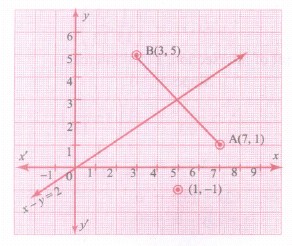
Let P(x, y) be equidistant from the points A (7, 1) and B (3, 5).
We are given that AP = BP. So, AP2 = BP2
(x - 7)2 + (y - 1)2 = (x - 3)2 + (y - 5)2
x2- 14x + 49 + y - 2y + 1 = x2- 6x + 9 + y -10y + 25
x - y = 2
Which is the required relation.
10.
Given points (- 3, - 4), (7, 2) and (12, 5)
Let the points be A (- 3, - 4),8 (2, 2) and C (12, 5)
Slope of a line = \(\frac{y_{1}-y_{2}}{x_{1}-x_{2}}\)
Slope of AB = \(\frac{-4-2}{-3-7}=\frac{-6}{-10}=\frac{3}{5}
\)
Slope of BC = \(\frac{2-5}{7-12}=\frac{-3}{-5}=\frac{3}{5}
\)
Slope of AB = Slope of BC
The points A, B and C are collinear
11.
Given points are (2, 3), (4, a) and (6, - 3)
Since the points are colinear, Area of triangle is zero
\(\text { i.e., } \frac{1}{2}\left[x_{1}\left(y_{2}-y_{3}\right)+x_{2}\left(y_{3}-y_{1}\right)+x_{3}\left(y_{1}-y_{2}\right)\right]=0\)
2(a + 3) + 4(- 3 -3) + 6(3 - a) = 0
2a + 6 - 24 + 18 - 6a = 0
-4a + 0 = 0
-4a = 0
a = 0
12.
(b)
x + y = 3; 3x + y = 7
13.
(b)
The slopes of two pair of opposite sides
14.
(a)
The slope is 0.5 and the y intercept is 2.6
15.
(b)

10th Standard Syllabus & Materials
10th Standard
TN 10th English Prose - 2 - The Night the Ghost Got in Important Questions And Answers Study Material - QB365 Set A
NEW10th Standard
TN 10th English Supplementary - 1 - The Tempest Important Questions And Answers Study Material - QB365 Set A
NEW10th Standard
TN 10th English Poem - 1 - Life Important Questions And Answers Study Material - QB365 Set A
NEW10th Standard
TN 10th English Prose - 1 - His First Flight Important Questions And Answers Study Material - QB365 Set A



Tamilnadu Stateboard 10th Standard Subjects
Tamilnadu Stateboard Standards





