
 100% FREE ACCESS
10th Standard Syllabus & Materials
10th Standard
TN 10th English Prose - 4 - The Attic Important Questions And Answers Study Material - QB365 Set A
NEW10th Standard
TN 10th English Supplementary - 3 - The Story of Mulan Important Questions And Answers Study Material - QB365 Set A
NEW10th Standard
TN 10th English Poem - 3 - I am Every Woman Important Questions And Answers Study Material - QB365 Set A
NEW10th Standard
TN 10th English Prose - 3 - Empowered Women Navigating The World Important Questions And Answers Study Material - QB365 Set A
NEW10th Standard
TN 10th English Supplementary - 2 - Zigzag Important Questions And Answers Study Material - QB365 Set A
NEW10th Standard
TN 10th English Poem - 2 - The Grumble Family Important Questions And Answers Study Material - QB365 Set A

Published on: 20/01/2020
Download Tamil Nadu 10th Standard Maths question papers, model tests, one-mark questions, important questions, and public exam papers in PDF format. Free study materials and answer keys for TN State Board students.
Questions + Answers key
Take MCQ Maths Test1.
If the radii of the circular ends of a conical bucket which is 45 cm high are 28 cm and 7 cm, find the capacity of the bucket. (Use π = \(\frac{22}{7}\))
2.
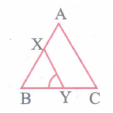
In figure the line segment XY is parallel to side AC of \(\Delta ABC\) and it divides the triangle into two parts of equal areas. Find the ratio \(\cfrac { AX }{ AB } \)
3.
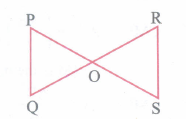
In figure if PQ || RS Prove that \(\Delta POQ\sim \Delta SOQ\)
4.
The marks scored by 5 students in a test for 50 marks are 20, 25, 30, 35, 40. Find the S.D for the marks. If the marks are converted for 100 marks, find the S.D. for newly obtained marks.
5.
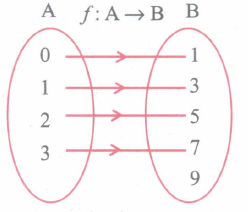
Let A = {0, 1, 2, 3} and B = {1, 3, 5, 7, 9} be two sets. Let f : A \(\rightarrow\)B be a function given by f(x) = 2x + 1. Represent this function as an arrow .
6.
Using quadratic formula solve the following equations.
p2x2 + (P2 -q2) X - q2 = 0
7.
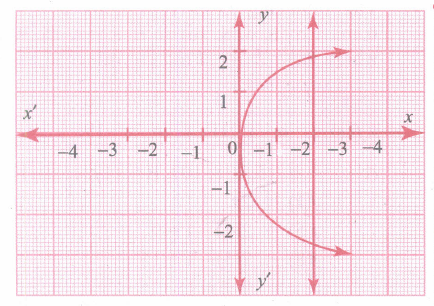
State whether the graph represent a function. Use vertical line test.
8.
In the matrix A = \(\left[ \begin{matrix} 8 \\ -1 \\ \begin{matrix} 1 \\ 6 \end{matrix} \end{matrix}\begin{matrix} 9 \\ \sqrt { 7 } \\ \begin{matrix} 4 \\ 8 \end{matrix} \end{matrix}\begin{matrix} 4 \\ \frac { \sqrt { 3 } }{ 2 } \\ \begin{matrix} 3 \\ -11 \end{matrix} \end{matrix}\begin{matrix} 3 \\ 5 \\ \begin{matrix} 0 \\ 1 \end{matrix} \end{matrix} \right] \), write The order of the matrix
9.
calculate \(\angle \)BAC in the given triangles ( tan 69.4° = 2.6604 )
.JPG)
10.
Determine the nature of the roots for the following quadratic equations
\(\sqrt { 2 } { t }^{ 2 }-3t+3\sqrt { 2 } \) = 0
11.
Find the square root of \(1+\frac { 1 }{ { x }^{ 6 } } +\frac { 2 }{ { x }^{ 3 } } \)
12.
Find the range and coefficient of range of the following data.
43.5, 13.6, 18.9, 38.4, 61.4, 29.8
13.
Find the equation of a line through the given pair of points (2, 3) and (-7, -1)
14.
In fig. if PQ || BC and PR || CD prove that
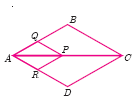
\(\frac { QB }{ AQ } =\frac { DR }{ AR } \)
15.
Find the equation of a straight line parallel to Y axis and passing through the point of intersection of the lines 4x + 5y = 13 and x - 8y + 9 = 0
16.
\(\triangle\) LMN is a right angled triangle with \(\angle\)L = 90o. A circle is inscribed in it. The lengths of the sides containing the right angle are 6 cm and 8 cm. Find the radius of the circle.
17.
prove the following identity.
\(\sqrt { \frac { 1+sin\theta }{ 1-sin\theta } } =sec\theta +tan\theta\)
18.
If the three points (3, - 1) , (a, 3) and (1, - 3) are collinear, find the value of a.
19.
If f(x) = 3x - 2, g(x) = 2x + k and if f o g = f o f, then find the value of k..
20.
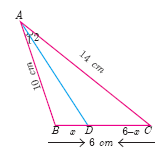
In the Figure, AD is the bisector of \(\angle\)BAC, if A = 10 cm, AC = 14 cm and BC = 6 cm. Find BD and DC.
21.
A plane is flying at a speed of 500 km per hour. Express the distance travelled by the plane as function of time t in hours.
22.
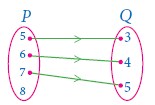
The arrow diagram shows a relationship between the sets P and Q. Write the relation in
(i) Set builder form
(ii) Roster form
(iii) What is the domain and range of R.
23.
If A x B = {(3,2), (3, 4), (5,2), (5, 4)} then find A and B.
24.
1.
Clearly bucket forms frustum of a cone such that the radii of its circular ends are r1 = 28 cm, r2 = 7 cm, h = 45 cm
Capacity of the bucket = volume of the frustum
\(\Rightarrow \frac { 1 }{ 3 } \times \pi h[{ r }_{ 1 }^{ 2 }+{ r }_{ 2 }^{ 2 }+{ r }_{ 1 }{ r }_{ 2 }]\)
\(\Rightarrow \frac { 1 }{ 3 } \times \frac { 22 }{ 7 } \times 45[{ 28 }^{ 2 }+{ 7 }^{ 2 }+28\times 7)]\)
= 22 x 15 x (28 x 4 + 7 + 28)
\(\Rightarrow 330\times 147{ cm }^{ 2 }\Rightarrow 48510{ cm }^{ 2 }\)
2.
Given XY IIA C
So,
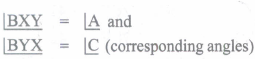
\(\therefore \Delta ABC\sim \Delta XbY\) (AAA similarity criterion)
So, \(\cfrac { ar(ABC) }{ ar(XBY) } =\left( \cfrac { AB }{ XB } \right) ^{ 2 }\) ...(1)
ar(ABC) = 2ar(XBY)
\(\cfrac { ar(ABC) }{ ar(ABC) } =\cfrac { 2 }{ 1 } \) ...(2)
From (1) and (2),
\(\left( \cfrac { AB }{ XB } \right) ^{ 2 }=\cfrac { 2 }{ 1 } i.e.,\cfrac { AB }{ XB } =\cfrac { \sqrt { 2 } }{ 1 } \)
\(\cfrac { XB }{ AB } =\cfrac { 1 }{ \sqrt { 2 } } \)
\(1-\frac{X B}{A B}=1-\frac{1}{\sqrt{2}}\)
\(\cfrac { AB-XB }{ AB } =\cfrac { \sqrt { 2 } -1 }{ \sqrt { 2 } } \)
\(\cfrac { AX }{ AB } =\cfrac { \sqrt { 2 } -1 }{ \sqrt { 2 } } =\cfrac { 2-\sqrt { 2 } }{ 2 } \)
3.
PQ II RS
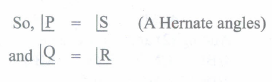
Also

\(\angle \therefore \Delta POQ\sim \Delta SOR\) (AAA similarity criterion)
4.
Let assumed mean A = 30
C = 5
| x | d' = \(\frac { x-30 }{ 5 } \) | d'2 |
| 20 | -2 | 4 |
| 25 | -1 | 1 |
| 30 | 0 | 0 |
| 35 | 1 | 1 |
| 40 | 2 | 4 |
| Σd' = 0 | Σd'2 = 10 |
σ =\(\sqrt { \left( \frac { \Sigma d'^{ 2 } }{ n } \right) -\left( \frac { \Sigma d' }{ n } \right) ^{ 2 } } \) x c
=\(\sqrt { \frac { 10 }{ 5 } -0 } \) x 5
=\(\sqrt { 2 } \) x 5
= 5\(\sqrt { 2 } \)
To convert the values for 100, all the values will be multiplied by 2. Therefore the new values are 40, 50, 60, 70, 80.
Let A = 60, C = 10
| x | d' = \(\frac { x-60 }{ 10 } \) | d'2 |
| 40 | -2 | 4 |
| 50 | -1 | 1 |
| 60 | 0 | 0 |
| 70 | 1 | 1 |
| 80 | 2 | 4 |
σ =\(\sqrt { \left( \frac { \Sigma d'^{ 2 } }{ n } \right) -\left( \frac { \Sigma d' }{ n } \right) ^{ 2 } } \) x c
=\(\sqrt { \frac { 10 }{ 5 } -0 } \) x 10
=\(\sqrt { 2 } \) x 10
= 10\(\sqrt { 2 } \)
S.D. also be multiplied by 2. It is also true for the division also.
5.
An arrow diagram
6.
p2x2 + (P2 -Comparing this with ax' + bx + c = 0, we have
a=p2
b=p2-q2
c =-q2
D = b2-4ac
= (P2-q2)-4xp2x-q2
= (P2-q2)2+ 4p2 q2
= (P2+q2)2>0
So, the given equation has real roots given by
\(\alpha =\frac { -b-\sqrt { D } }{ 2a } =\frac { -({ p }^{ 2 }-{ q }^{ 2 })+({ p }^{ 2 }+{ q }^{ 2 }) }{ { 2p }^{ 2 } } \)
\(=\frac { { q }^{ 2 } }{ { p }^{ 2 } } \)
\(\beta =\frac { -b-\sqrt { D } }{ 2a } =\frac { -({ p }^{ 2 }-{ q }^{ 2 })+({ p }^{ 2 }+{ q }^{ 2 }) }{ { 2p }^{ 2 } } \)
=-1
7.
It is not a function as the vertical line PQ cuts the graph at two points
8.
4 x 4
9.
in right triangle ABC [see fig.(b)]
tan\(\theta \) =\(\frac { 8 }{ 3 } \)
= tan-1(2.66)
\(\theta \) = \(69.4°\)(since tan \(69.4°\)=2.6604)
\(\angle \)BAC = \(69.4°\)
10.
√2t2 - 3t + 3√2 = 0
a = √2, b = -3, c = 3√2
∆ = b2-4ac
= (-3)2 - 4 x √2 x 3√2
= 9 - 24
= -15 < 0.
∴ The roots are not real.
11.
\(\sqrt { 1+\frac { 1 }{ { x }^{ 6 } } +\frac { 2 }{ { x }^{ 3 } } } =\sqrt { { 1 }^{ 2 }+2.1.\frac { 1 }{ { x }^{ 3 } } +{ \left( \frac { 1 }{ { x }^{ 3 } } \right) }^{ 2 } } \)
\(=\sqrt { { \left( 1+\frac { 1 }{ { x }^{ 3 } } \right) }^{ 2 } } \left| 1+\frac { 1 }{ { x }^{ 3 } } \right| \)
12.
43.5, 13.6, 18.9,38.4,61.4,29.8
Largest value L= 61.4
Smallest value S = 13.6
R = L - S
= 61.4 - 13.6 = 4
Co-efficient of range = \(\frac { L-S }{ L+S } \)
= \(\frac { 47.8 }{ 75 } =0.64\)
Range = 47.8; co-efficient of range = 0.64.
13.
Given points (2, 3) and (- 7, - 1)
Equation of the line passing through (x1 , y1) and (x2, y2) is
\( \frac{y-y_{1}}{y_{2}-y_{1}}=\frac{x-x_{1}}{x_{2}-x_{1}} \)
\(\frac{y-3}{-1-3}=\frac{x-2}{-7-2} \)
9 (y - 3) - 4 (x - 2)
9y - 27 = 4 x - 8
4 x - 9y +19 = 0
14.
From (1) and (2) we have
\(\frac{A Q}{A B} =\frac{A R}{A D}
\)
\(\frac{A B}{A Q} =\frac{A D}{A R}
\)
\(\frac{A Q+Q B}{A Q} =\frac{A R+R D}{A R}
\)
\(1+\frac{Q B}{A Q} =1+\frac{R D}{A R}
\)
\(\Rightarrow \frac{Q B}{A Q} =\frac{D R}{A R}
\)
15.
Given lines 4x + 5y − 13 = 0 .....(1)
x − 8y + 9 = 0 .....(2)
To find the point of intersection, solve equation (1) and (2)
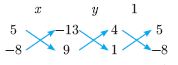
\(\frac { x }{ 45-104 } =\frac { y }{ -13-36 } =\frac { 1 }{ -32-5 } \)
\(\frac { x }{ -59 } =\frac { y }{ -49 } =\frac { 1 }{ -37 } \)
\(x=\frac { 59 }{ 37 } \),\(y=\frac { 49 }{ 37 } \)
Therefore, the point of intersection (x, y) = \(\left( \frac { 59 }{ 37 } ,\frac { 49 }{ 37 } \right) \)
The equation of line parallel to Y axis is x = c.
It passes through (x, y) = \(\left( \frac { 59 }{ 37 } ,\frac { 49 }{ 37 } \right) \). Therefore, c = \(\frac { 59 }{ 37 } \)
The equation of the line x = \(\frac { 59 }{ 37 } \) gives 37x - 59 = 0
16.
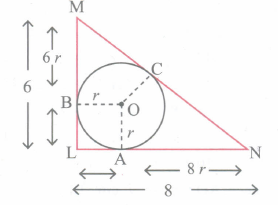
Given \(\triangle\)LMN is a right angled triangle with \(\angle\)L = 90o
By Pythagoras theore
Since PL ∥ OQ,PL= r = OP
we have NR=NP=NL−PL
[ NR and NP are tangents]
= (6 - r)cm
MR = MQ = ML- LQ = (8 - r) cm
[MR and MQ are tangents]
NM = NR+ RM
= (6 - r + 8 - r)cm
= (14 - 2r) cm
Now NM2 = NL2 + LM2 [By pythagoras Theorem]
(14-2r)2 = 82+62
(14-2r)2 = 64+36
17.
\( \sqrt{\frac{1+\sin \theta}{1-\sin \theta}} =\sec \theta+\tan \theta \)
\(\mathbf{L H S} =\sqrt{\frac{1+\sin \theta}{1-\sin \theta}} \)
\(=\sqrt{\frac{1+\sin \theta}{1-\sin \theta} \times \frac{1-\sin \theta}{1-\sin \theta}}\)
[Multiplying the Numerator and denominator by \(\sqrt{1-\sin \theta}\)]
\( =\sqrt{\frac{1^{2}-\sin ^{2} \theta}{(1-\sin \theta)^{2}}} \quad\left[\because(a+b)(a-b)=a^{2}-b^{2}\right] \)
\(=\sqrt{\frac{\cos ^{2} \theta}{(1-\sin \theta)^{2}}} \quad\left[\because 1-\sin ^{2} \theta=\cos ^{2} \theta\right] \)
\(=\frac{\cos \theta}{1-\sin \theta} \)
\(=\frac{\cos \theta}{1-\sin \theta} \times \frac{1+\sin \theta}{1+\sin \theta} \)
[Multiplying Numerator and denominator by \(1+\sin \theta\)]
\( =\frac{\cos \theta(1+\sin \theta)}{1^{2}-\sin ^{2} \theta}=\frac{\cos \theta(1+\sin \theta)}{\cos ^{2} \theta} \)
\({\left[\because(a+b)(a-b)=a^{2}-b^{2}\right]\left[1-\sin ^{2} \theta=\cos ^{2} \theta\right]} \)
\(=\frac{1+\sin \theta}{\cos \theta}=\frac{1}{\cos \theta}+\frac{\sin \theta}{\cos \theta} \)
\(=\sec \theta+\tan \theta=\text { RHS }\)
18.
Given points (3, - 1), (a, 3) and (1, - 3)
Let the points be A (3, - 1), B (a, 3) and C (1,- 3)
Slope of AB = \(\frac{y_{1}-y_{2}}{x_{1}-x_{2}}=\frac{-1-3}{3-a}=\frac{-4}{3-a}
\)
Slope of BC = \(\frac{y_{1}-y_{2}}{x_{1}-x_{2}}=\frac{3+3}{a-1}=\frac{6}{a-1}
\)
Since, the points A, B and C are collinear.
Slope of AB = Slope of BC
\(\frac{-4}{3-a}=\frac{6}{a-1}\)
-2 (a - 1) = 3(3 - a)
-2a + 2 = 9 - 3a
3a - 2a = 9 - 2
a = 7
19.
f(x) = 3 x -2, g(x) = 2x + k
f o g = f(g(x)) = f(2x + k) = 3(2x + k) - 2 = 6x + k - 2
Thus, f o g(x) = 6x + 3k - 2
g o f(x) = g(3x - 2) = 2(3x - 2) + k
Thus, g o f(x) = 6x - 4 + k
Given that f o g = g o f
Therefore, 6x + 3k-2 = 6z - 4 + k
6x - 6x + 3k - k = -4 + 2 ⇒ -1
20.
Let BD = x cm, then DC = (6 – x)cm
AD is bisector of\(\angle\) A
Therefore by Angle Bisector Theorem
\(\frac { AB }{ AC } =\frac { BD }{ DC } \)
\(\frac { 10 }{ 14 } =\frac { x }{ 6-x } \quad \frac { 5 }{ 7 } =\frac { x }{ 6-x } \)
So, 12x = 30 we get, \(x=\frac { 30 }{ 12 } =2.5\)
Therefore, BD = 2.5 cm, DC = 6−x = 6−2.5 = 3.5 cm
21.
Let the distance be 'd'
Speed = 500 km/hr
Time = 't' hours
Distance = Time x Speed
d(t) = 500 t
22.
(i) Set builder form of R = ((x, y) | y = x - 2, x \(\in \) P, y \(\in \) Q}
(ii) Roster form R = {(5 , 3),(6 , 4)(7 , 5)}
(iii) Domain of R = {5, 6, 7} and range of R = {3, 4, 5}
23.
A x B = {(3,2), (3,4), (5,2), (5,4)}
We have A = {set of all first coordinates of elements of A x B}. Therefore, A = {3,5}
B = {set of all second coordinates of elements of A x B}. Therefore, B = {2,4}
Thus A = {3,5} and B = {2,4}.
24.

10th Standard Syllabus & Materials
10th Standard
TN 10th English Prose - 2 - The Night the Ghost Got in Important Questions And Answers Study Material - QB365 Set A
NEW10th Standard
TN 10th English Supplementary - 1 - The Tempest Important Questions And Answers Study Material - QB365 Set A
NEW10th Standard
TN 10th English Poem - 1 - Life Important Questions And Answers Study Material - QB365 Set A
NEW10th Standard
TN 10th English Prose - 1 - His First Flight Important Questions And Answers Study Material - QB365 Set A



Tamilnadu Stateboard 10th Standard Subjects
Tamilnadu Stateboard Standards





