
 100% FREE ACCESS
10th Standard Syllabus & Materials
10th Standard
TN 10th English Prose - 4 - The Attic Important Questions And Answers Study Material - QB365 Set A
NEW10th Standard
TN 10th English Supplementary - 3 - The Story of Mulan Important Questions And Answers Study Material - QB365 Set A
NEW10th Standard
TN 10th English Poem - 3 - I am Every Woman Important Questions And Answers Study Material - QB365 Set A
NEW10th Standard
TN 10th English Prose - 3 - Empowered Women Navigating The World Important Questions And Answers Study Material - QB365 Set A
NEW10th Standard
TN 10th English Supplementary - 2 - Zigzag Important Questions And Answers Study Material - QB365 Set A
NEW10th Standard
TN 10th English Poem - 2 - The Grumble Family Important Questions And Answers Study Material - QB365 Set A

Published on: 13/11/2019
Download Tamil Nadu 10th Standard Maths question papers, model tests, one-mark questions, important questions, and public exam papers in PDF format. Free study materials and answer keys for TN State Board students.
Questions + Answers key
Take MCQ Maths Test1.
2.
A cylinder 10 cone and have there are of a equal base and have the same height. what is the ratio of there volumes?
3:1:2
3:2:1
1:2:3
1:3:2
3.
If S1 denotes the total surface area at a sphere of radius ૪ and S2 denotes the total surface area of a cylinder of base radius ૪ and height 2r, then ___________
S1 = S2
S1 > S2
S1
S1 = 2S2
4.
5.
6.
If the mean and coefficient of variation of a data are 4 and 87.5% then the standard deviation is
3.5
3
4.5
2.5
7.
The angle of elevation of a cloud from a point h metres above a lake is \(\beta \). The angle of depression of its reflection in the lake is 45°. The height of location of the cloud from the lake is
\(\frac { h\left( 1+tan\beta \right) }{ 1-tan\beta } \)
\(\frac { h\left( 1-tan\beta \right) }{ 1+tan\beta } \)
h tan(45°-\(\beta \))
none of these
8.
The value of \(si{ n }^{ 2 }\theta +\frac { 1 }{ 1+ta{ n }^{ 2 }\theta } \) is equal to
\(ta{ n }^{ 2 }\theta \)
1
\(cot^{ 2 }\theta \)
0
9.
If the sequence t1, t2, t3... are in A.P. then the sequence t6, t12, t18,.... is
a Geometric Progression
an Arithmetic Progression
neither an Arithmetic Progression nor a Geometric Progression
a constant sequence
10.
A straight line has equation 8y = 4x + 21. Which of the following is true
The slope is 0.5 and the y intercept is 2.6
The slope is 5 and the y intercept is 1.6
The slope is 0.5 and the y intercept is 1.6
The slope is 5 and the y intercept is 2.6
11.
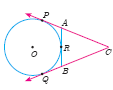
In figure CP and CQ are tangents to a circle with centre at O. ARB is another tangent touching the circle at R. If CP = 11 cm and BC = 7 cm, then the length of BR is
6 cm
5 cm
8 cm
4 cm
12.
A shuttle cock used for playing badminton has the shape of the combination of
a cylinder and a sphere
a hemisphere and a cone
a sphere and a cone
frustum of a cone and a hemisphere
13.
If there are 1024 relations from a set A = {1, 2, 3, 4, 5} to a set B, then the number of elements in B is
3
2
4
8
14.
Which of the following should be added to make x4 + 64 a perfect square
4x2
16x2
8x2
-8x2
15.
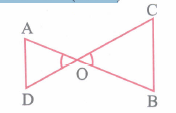
In figure OA· OB = OC·OD
Show that \(\angle A=\angle C\ and\ \angle B=\angle D\)
16.
Find the standard deviation of 30, 80, 60, 70, 20, 40, 50 using the direct method.
17.
Show that any positive odd integer is of the form 4q + 1 or 4q + 3, where q is some integer.
18.
Let A = {1,2, 3, 4} and B = {-1, 2, 3, 4, 5, 6, 7, 8, 9, 10, 11, 12} Let R = {(1, 3), (2, 6), (3, 10), (4, 9)} \(\subseteq \) A x B be a relation. Show that R is a function and find its domain, co-domain and the range of R.
19.
Find the geometric progression whose first term and common ratios are given by
a = 256 , r = 0.5
20.
In each of the following, Find the value of ‘a’ for which the given points are collinear. (a, 2 – 2a), (– a + 1, 2a) and (– 4 – a, 6 – 2a)
21.
If P(A) = 0.37, P(B).= 0.42, P(A∩B) = 0.09 then find P(AUB).
22.
Find the first term of a G.P. in which S6 = 4095 and r = 4
23.
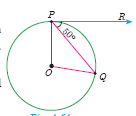
In Figure, O is the centre of a circle. PQ is a chord and the tangent PR at P makes an angle of 50o with PQ. Find \(\angle\)POQ,
24.
Find the equation of a line passing through the point (3, - 4) and having slope \(\frac { -5 }{ 7 } \)
25.
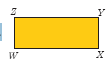
In the rectangle WXYZ, XY+YZ = 17 cm, and XZ + YW = 26 cm .Calculate the length and breadth of the rectangle
26.
The ratio of the volumes of two cones is 2 : 3. Find the ratio of their radii if the height of second cone is double the height of the first.
27.
If f(x) = 3x - 2, g(x) = 2x + k and if f o g = f o f, then find the value of k..
28.
Find the diameter of a sphere whose surface area is 154 m2.
29.
Solve 2x − 3y = 6, x + y = 1
30.
prove that \(\sqrt { \frac { 1+cos\theta }{ 1-cos\theta } } \) = cosec \(\theta \) + cot\(\theta \)
31.
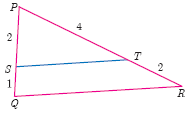
Show that \(\triangle\) PST~\(\triangle\) PQR
32.
The shadow of a tower, when the angle of elevation of the sum is 45o is found to be 10 metres, longer than when it is 60o. find the height of the tower
33.
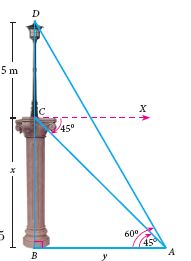
A pole 5 m high is fixed on the top of a tower. The angle of elevation of the top of the pole observed from a point ‘A’ on the ground is 60° and the angle of depression to the point ‘A’ from the top of the tower is 45°. Find the height of the tower.(\(\sqrt3\)=1.732)
34.
In \(AD\bot BC\) prove that AB2 + CD2 = BD2 + AC2.
35.
Find the number of coins, 1.5 cm is diameter and 0.2 cm thick, to be melted to form a right circular cylinder of height 10 cm and diameter 4.5 cm.
36.
A two digit number is such that the product of its digits is 12. When 36 is added to the number the digits interchange their places. Find the number.
37.
Determine the AP whose 3rd term is 5 and the 7th term is 9.
38.
If R = {(a, -2), (-5, b), (8, c), (d, -1)} represents the identity function, find the values of a, b, c and
39.
Let A = {1, 2, 3, 4, 5}, B = N and f: A \(\rightarrow\)B be defined by f(x) = x2. Find the range of f. Identify the type of function.
40.
If the points A(6, 1), B(8, 2), C(9, 4) and D(P, 3) are the vertices of a parallelogram, taken in order. Find the value of P.
41.
If x sin3\(\theta \) + ycos3\(\theta \) = sin\(\theta \) cos\(\theta \) and x sin\(\theta \) = ycos\(\theta \), then prove that x2 + y2 = 1.
42.
Find the standard deviation of the data 2, 3, 5, 7, 8. Multiply each data by 4. Find the standard deviation of the new values.
43.
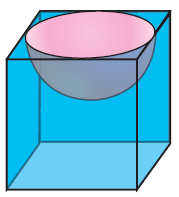
A hemispherical section is cut out from one face of a cubical block such that the diameter l of the hemisphere is equal to side length of the cube. Determine the surface area of the remaining solid.
44.
Forensic scientists can determine the height (in cms) of a person based on the length of their thigh bone. They usually do so using the function h(b) = 2.47b + 54.10 where b is the length of the thigh bone.
(i) Check if the function h is one – one or not
(ii) Also find the height of a person if the length of his thigh bone is 50 cm.
(iii) Find the length of the thigh bone if the height of a person is 147.96 cm.
45.
Discuss the nature of solutions of the following quadratic equations.
x2 + 2x + 5 = 0
1.
(b)
2.
(a)
3:1:2
3.
(a)
S1 = S2
4.
(c)
5.
(a)
6.
(a)
3.5
7.
(a)
\(\frac { h\left( 1+tan\beta \right) }{ 1-tan\beta } \)
8.
(b)
1
9.
(b)
an Arithmetic Progression
10.
(a)
The slope is 0.5 and the y intercept is 2.6
11.
(d)
4 cm
12.
(d)
frustum of a cone and a hemisphere
13.
(b)
2
14.
(b)
16x2
15.
OA· OB = OC . OD (Given)
so, \(\cfrac { OA }{ OC } =\cfrac { OD }{ OB } \)
Also we have 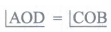
(vertically opposite angles) ...(2)
From (1) and (2)
\(\Delta AOD\sim \Delta COB\)( SAS similarity criterion)
So

(corresponding angles of similar triangles)
16.
| x | x2 |
| 30 | 900 |
| 80 | 6400 |
| 60 | 3600 |
| 70 | 4900 |
| 20 | 400 |
| 40 | 1600 |
| 50 | 2500 |
| Σx = 350 | Σx2 = 20300 |
σ =\(\sqrt { \frac { \Sigma x^{ 2 } }{ n } -\left( \frac { \Sigma x }{ n } \right) ^{ 2 } } \)
=\(\\ \sqrt { \frac { 20300 }{ 7 } -\left( \frac { 350 }{ 7 } \right) ^{ 2 } } \)
=\(\sqrt { 400 } \) = 20
17.
Let us start with taking a, where a is a +ve odd integer.
We apply the division algorithm with 'a' and 'b' = 4.
Since 0 ≤ r < 4, the possible remainders are 0,1,2,3.
That is, a can be 4q, or 4q + 1, or 4q + 2 or 4q + 3, where 1 is the quotient. However, since a is odd, a cannot be 4q or 4q + 2 (since they are both divisible by 2).
Any odd integer is of the form 4q + 1 or 4q + 3
18.
Domain of R = {1,2,3,4}
Co-domain of R = B = {-1, 2, 3,4,5,6, 7, 9, 10, 11,12}
Range of R = {3, 6,10, 9}
19.
The general form of Geometric progression is a, ar, ar2,...
a = 256, ar = 256 x 0.5 = 128 , ar2 = 256 x (0.5)2 = 64
Therefore the required Geometric progression is 256,128, 64,....
20.
Given points are (a, 2 – 2a), (– a + 1, 2a) and (– 4 – a, 6 – 2a)
Since the points are collinear, Area of triangle is zero.
\(\text { i.e., } \frac{1}{2}\left[x_{1}\left(y_{2}-y_{3}\right)+x_{2}\left(y_{3}-y_{1}\right)+x_{3}\left(y_{1}-y_{2}\right)\right]=0\)
a(2a - 6 + 2a) + (- a + 1) (6 - 2a - 2 + 2a) + (- 4 - a) (2 - 2a - 2a) = 0
a (4a - 6) + (- a + 1) (4) + (- 4 - a) (2 - 4a) = 0
4a2 - 6a - 4a + 4 - 8 + 16 a - 2a + 4a2 = 0
8a2 + 4a - 4 = 0
2a2 + a - 1 = 0
(2a - 1)(a + 1) = 0
2a - 1 = 0,a + 1 = 0
a = \(\frac{1}{2},-1\)
21.
P(A) = 0.37, P(B) = 0.42, P(A∩B) = 0.09
P(AUB) = P(A) + P(B) - P(A∩B)
P(AUB) = 0.37 + 0.42 - 0.09 = 0.7
22.
Common ratio = 4 > 1, sum of first 6 terms S6 = 4095
Hence , S6 = \(\frac { a\left( { r }^{ n }-1 \right) }{ r-1 } =4095\)
Since, r = 4,\(\frac { a\left( 4^{ 6 }-1 \right) }{ 4-1 } \) = 4095 gives a x \(\frac { 4095 }{ 3 } =4095\)
First term a = 3.
23.
\(\angle\)OPQ = 90o - 50o = 40o (angle between the radius and tangent is 90o)
OP = OQ (Radii of a circle are equal)
\(\angle\)OPQ = \(\angle\)OQP = 40o (\(\triangle\)OPQ is isosceles)
\(\angle POQ={ 180 }^{ 0 }-\angle OPQ-\angle OQP\)
\(\angle\)POQ = 180o - 40o- 40o = 100o.
24.
Given, (x1, y1) = (3 , − 4) and m = \(\frac { -5 }{ 7 } \)
The equation of the point-slope form of the straight line is y - y1 = m(x - x1)
we write it as y + 4 = − \(\frac { 5 }{ 7 } \) (x - 3)
gives us 5x + 7y + 13 = 0
25.
XY + CZ = 17cm
XZ + YW = 26cm
We know that diagonals if a rectangle bisect each other and the diagonals have equal length.
\(\therefore \text { Each diagonal }=\frac{26}{2}=13 \mathrm{~cm}\)
i.e., XZ = 13 cm and YW = 13 cm
Also given XY + YZ = 17 cm
Squaring on both sides (XY + YZ)2 = 172
\((\mathrm{XY})^{2}+(\mathrm{YZ})^{2}+2 \times(\mathrm{XY}) \times(\mathrm{YZ})=289\)
By Pythagoras theorem (XY)2 + (YZ)2 = XZ2
\(\therefore[\mathrm{XZ}]^{2}+2(\mathrm{XY}) \times(\mathrm{YZ})=289\)
132 + 2 x length x breadth = 289
2 x Area = 289 - 169
\(\text { Area }=\frac{289-169}{2}=\frac{120}{2}\)
The possible length and breadth are
(1,60) (2,30) (3,20) (4, 15), (5, 12) (6, 10).
In this pair the length and breadth should satisfy Pythagoras theorem for diagonal.
5,12 is the possible length and breadth.
26.
Let r1 and h1 be the radius and height of the cone - I and let r2 and h2 be the radius and height of the cone-II.
Given h2 = 2h1 = 2 and \(\frac { Volume\ of\ the\ cone\ I }{ Volume\ of\ the\ cone\ II } =\frac { 2 }{ 3 } \)
\(\frac { \frac { 1 }{ 3 } { \pi r }_{ 1 }^{ 2 }{ h }_{ 1 } }{ \frac { 1 }{ 3 } { \pi r }_{ 2 }^{ 2 }{ h }_{ 2 } } =\frac { 2 }{ 3 } \)
\(\frac { { r }_{ 1 }^{ 2 } }{ { r }_{ 2 }^{ 2 } } \times \frac { { h }_{ 1 } }{ 2{ h }_{ 2 } } =\frac { 2 }{ 3 } \)
\(\frac { { r }_{ 1 }^{ 2 } }{ { r }_{ 2 }^{ 2 } } =\frac { 4 }{ 3 } \text {gives} \frac { { r }_{ 1 } }{ { r }_{ 2 } } =\frac { 2 }{ \sqrt { 3 } } \)
Therefore, ratio of their radii = 2 : \(\sqrt3\)
27.
f(x) = 3 x -2, g(x) = 2x + k
f o g = f(g(x)) = f(2x + k) = 3(2x + k) - 2 = 6x + k - 2
Thus, f o g(x) = 6x + 3k - 2
g o f(x) = g(3x - 2) = 2(3x - 2) + k
Thus, g o f(x) = 6x - 4 + k
Given that f o g = g o f
Therefore, 6x + 3k-2 = 6z - 4 + k
6x - 6x + 3k - k = -4 + 2 ⇒ -1
28.
Let r be the radius of the sphere. Given that, surface area of sphere = 154 m2
4\(\pi\)r2 = 154
\(4\times \frac { 22 }{ 7 } \times { r }^{ 2 }=154\)
gives \({ r }^{ 2 }=154\times \frac { 1 }{ 4 } \times \frac { 7 }{ 22 } \)
hence, \({ r }^{ 2 }=\frac { 49 }{ 4 } \)We get r = \(\frac{7}{2}\)
Therefore, diameter is 7 m
29.
2x − 3y = 6 … (1)
x + y = 1 … (2)
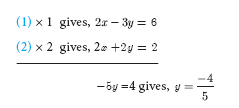
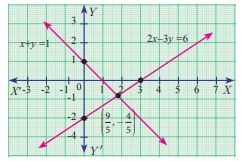
Substituting, y = \(\frac {-4}{5}\) in (2), x - \(\frac {4}{5}\) = 1 we get, x = \(\frac {9}{5}\)
Therefore, x = \(\frac {9}{5}\), y = \(\frac {-4}{5}\).
30.
\(\sqrt { \frac { 1+cos\theta }{ 1-cos\theta } } \)=\(\sqrt { \frac { 1+cos\theta }{ 1-cos\theta } \times \frac { 1+cos\theta }{ 1+cos\theta } } \) [multiply numerator and denominator by the conjugate of 1 - cos\(\theta \)]
=\(\sqrt { \frac { (1+cos\theta { ) }^{ 2 } }{ (1-cos\theta { ) }^{ 2 } } } \) =\(\frac { 1+cos\theta }{ \sqrt { si{ n }^{ 2 }\theta } } \) [since sin2\(\theta \) + cos2\(\theta \) = 1]
=\(\frac { 1+cos\theta }{ sin\theta } =cosec\theta +cot\theta \)
31.
In \(\triangle\)PST and \(\triangle\)PQR,
\(\frac { PS }{ PQ } =\frac { 2 }{ 2+1 } =\frac { 2 }{ 3 } ,\frac { PT }{ PR } =\frac { 4 }{ 4+2 } =\frac { 2 }{ 3 } \)
Thus, \(\frac { PS }{ PQ } =\frac { PT }{ PR } \) and \(\angle\)P is common
Therefore, by SAS similarity,
\(\triangle\) PST~\(\triangle\)PQR
32.
33.
Let BC be the height of the tower and CD be the height of the pole
Let ‘A’ be the point of observation.
Let BC = x and AB = y.
From the diagram,
ㄥBAD = 60° and ㄥXCA = 45° = ㄥBAC
In right triangle ABC, tan 45o = \(\frac{BC}{AB}\)
gives 1 = \(\frac{x}{y}\) so, x = y ...(1)
In right triangle ABD, tan60° = \(\frac{BC}{AB}\) = \(\frac{BC+CD}{AB}\)
gives \(\sqrt3\) = \(\frac{x+5}{y}\) so, \(\sqrt3\)y = x + 5
we get \(\sqrt3\) x = x + 5 [From (1)]
so, \(\frac { 5 }{ \sqrt { 3 } -1 } =\frac { 5 }{ \sqrt { 3 } -1 } \times \frac { \sqrt { 3 } +1 }{ \sqrt { 3 } +1 } =\frac { 5(1.732+1) }{ 2 } \) = 6.83
Hence, height of the tower is 6.83 m.
34.
From \(\Delta ADC\) we have
AC2 = AD2 + CD2 ....(1)
(Pythagoras theorem)
From \(\Delta ADB\) we have
AB2 = AD2 + BD2 ...(2)
(Pythagoras theorem)
Subtracting (1) from (2) we have,
AB2 - AC2 = BD2 - CD2
AB2 + CD2 = BD2 + AC2
35.
No. of coins required \(=\frac{Volume\ of\ the\ cylinder}{Volume\ of\ 1\ coin}\)
\(=\frac { \pi { r }_{ 1 }^{ 2 }{ h }_{ 1 } }{ \pi { r }_{ 2 }^{ 2 }{ h }_{ 2 } } =\frac { \pi \times \frac { 42 }{ 20 } \times \frac { 45 }{ 20 } \times 10 }{ \pi \times \frac { 15 }{ 20 } \times \frac { 15 }{ 20 } \times \frac { 2 }{ 10 } } \)
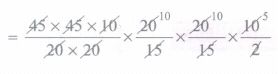
= 450
36.
Let the ten's digit of the number be x. It is given that the product of the digits is 12.
Unit's digit \(\frac{12}{x}\)
Number =10x+\(\frac{12}{x}\)
It 36 is added to the number the digits interchange their places.
\(\therefore 10x+\frac { 12 }{ x } +36=10\times \frac { 12 }{ x } +x\)
\(\Rightarrow 10x+\frac { 12 }{ x } +36=\frac { 120 }{ x } +x\)
\(\Rightarrow 9x-\frac { 108 }{ x } +36=0\)
⇒9x2 - 108 + 36x = 0
⇒X2+ 4x - 12 = 0
⇒ (x + 6)(x - 2) = 0 (∵ (x + 6) ≠ 0 as x >0)
x=-6,2
But a number can never be (-ve). So, x = 2. The
number is 10x2+\(\frac{12}{2}\)=26
37.
We have
a3 = a + (3 - 1)d = a + 2d = 5 (1)
a7 = a + (7 - 1)d = a + 6d = 9 (2)
(1) - (2) ⇒ -4d -4 ⇒ d = 1.
Sub, d = 1 in (1), we get
a + 2(1) = 5
a = 3
Hence the required A.P. is 3, 4, 5, 6, 7.
38.
R = {(a, -2), (-5, b), (8, c), (d, -1)} represents the identity function.
a = -2, b = -5, c = 8, d = -1.
39.
A = {1,2,3,4,5}
B = {1,2,3,4, ... }
f: A \(\rightarrow\)B, f(x) = x2
\(\therefore\) f(1) = 12 = 1
f(2) = 22= 4
f(3) = 32 = 9
f(4) = 42= 16
f(5) = 52= 25
\(\therefore\) Range of f = {1, 4, 9, 16, 25}
Elements in A have been connected with different elements in B. Therefore it is one-one function. But not all the elements in B have preimages in A. Therefore it is not on-to function.
40.
We know that diagonals at a parallelogram bisect each other.
So, the coordinates of the mid-point at AC = coordinates of the mid-point at BD.
i.e., \(\left[ \frac { 6+9 }{ 2 } ,\frac { 1+4 }{ 2 } \right] =\left[ \frac { 8+P }{ 2 } ,\frac { 2+3 }{ 2 } \right] \)
\(\left[ \frac { 15 }{ 2 } ,\frac { 5 }{ 2 } \right] =\left[ \frac { 8+P }{ 2 } ,\frac { 5 }{ 2 } \right] \)
\(\frac { 15 }{ 2 } =\frac { 8+P }{ 2 } \)
P = 7
41.
We have x sin3\(\theta \) + ycos3\(\theta \) = sin\(\theta \) cos\(\theta \)
\(
\Rightarrow \ (x \sin \theta)\left(\sin ^{2} \theta\right)+(y \cos \theta) \cos ^{2} \theta
\)
\(= \sin \theta \cos \theta
\)
\(\Rightarrow \ x \sin \theta\left(\sin ^{2} \theta\right)+(x \sin \theta) \cos ^{2} \theta
\)
\(= \sin \theta \cos \theta \quad[\because x \sin \theta=y \cos \theta] \mathrm{S}
\)
\(\Rightarrow \ x \sin \theta\left(\sin ^{2} \theta+\cos ^{2} \theta\right)=\sin \theta \cos \theta
\)
\(\Rightarrow x \sin \theta=\sin \theta \cos \theta
\)
\( \mathrm{x}=\cos \theta\) ...(1)
\(\text { Now, } x \sin \theta=y \cos \theta
\)
\(
\Rightarrow \cos \theta \sin \theta=y \cos \theta
\)
\(\Rightarrow [\because x=\cos \theta \text { from (1) }]
\)
y = sin\(\theta \) ...(2)
From (1) and (2)
\( x^{2}+y^{2}=\cos ^{2} \theta+\sin ^{2} \theta
\)
= 1
x2 + y2 = 1.
42.
Given, n = 5
| xi | xi2 |
| 2 | 49 |
| 3 | 9 |
| 5 | 25 |
| 7 | 49 |
| 8 | 64 |
| Σxi = 25 | Σxi2 = 151 |
Standard deviation
σ = \(\sqrt { \frac { { \Sigma d }_{ i }^{ 2 } }{ n } -\left( \frac { { \Sigma d }_{ i } }{ n } \right) ^{ 2 } } \)
σ = \(\sqrt { \frac { 151 }{ 5 } -\left( \frac { 25 }{ 5 } \right) ^{ 2 } } =\sqrt { 30.2-25 } =\sqrt { 5.2 } \) ≃ 2.28
When we multiply each data by 4, we get the new values as 8, 12, 20, 28, 32.
| xi | xi2 |
| 8 | 64 |
| 12 | 144 |
| 20 | 400 |
| 28 | 784 |
| 32 | 1024 |
| Σxi = 100 | Σxi2 = 2416 |
Standard deviation
σ = \(\sqrt { \frac { { \Sigma d }_{ i }^{ 2 } }{ n } -\left( \frac { { \Sigma d }_{ i } }{ n } \right) ^{ 2 } } \)
= \(\sqrt { \frac { 2416 }{ 5 } -\left( \frac { 100 }{ 5 } \right) ^{ 2 } } =\sqrt { 483.2-400 } =\sqrt { 83.2 } \)
σ = \(\sqrt { 16\times 5.2 } =4\sqrt { 5.2 } \) ≃ 9.12
43.
Let r be the radius of the hemisphere.
Given that, diameter of the hemisphere = side of the cube = l
Radius of the hemisphere = \(\frac{l}{2}\)
TSA of the remaining solid = Surface area of the cubical part + C.S.A. of the hemispherical part − Area of the base of the hemispherical part
= 6 x (Edge)2 + 2\(\pi\)r2−\(\pi\)r2
= 6 x (Edge)2 + \(\pi\)r2
\(=6{ \times (l) }^{ 2 }+\pi { \left( \frac { l }{ 2 } \right) }^{ 2 }=\frac { 1 }{ 4 } (24+\pi ){ l }^{ 2 }\)
Total surface area of the remaining solid \(=\frac { 1 }{ 4 } (24+\pi ){ l }^{ 2 }\)sq. units
44.
(i) To check if h is one – one, we assume that h(b1) = h(b2)
Then we get 2.47b1 + 54.10 = 2.47b2 + 54.10
2.47b1 = 2.47b2
⇒ b1 = b2
Thus, h(b1) = h(b2) ⇒ b1 = b2, So, the function h is one – one.
(ii) If the length of the thigh bone b = 50, then the height is
h(50) = (2.47 x 50) + 54.10 =177.6 cms
(iii) If the height of a person is 147.96 cms, then h(b) = 147.96 and so the length of the thigh bone is given by
2.47b + 54.10 = 147.96.
2. 47 = 147. 96 - 54. 10 = 93. 86
b = \(\frac { 93.86 }{ 2.47 } \)
Therefore, the length of the thigh bone is 38 cm.
45.
x2 + 2x + 5 = 0
Let y = x2 + 2x + 5
Step 1 Prepare a table of values for the equation y = x2 + 2x + 5
| x | -3 | -2 | -1 | 0 | 1 | 2 | 3 |
| y | 8 | 5 | 4 | 5 | 8 | 13 | 20 |
Step 2: Plot the above ordered pairs(x, y) on the graph using suitable scale.
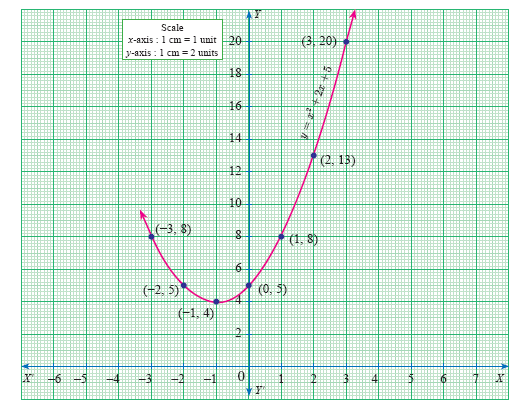
Step 3: Join the points by a free-hand smooth curve this smooth curve is the graph of y = x2 + 2x + 5
Step 4: The solutions of the given quadratic equation are the x coordinates of the intersecting points of the parabola the X axis.
Here the parabola doesn’t intersect or touch the X axis.
So, we conclude that there is no real root for the given quadratic equation.

10th Standard Syllabus & Materials
10th Standard
TN 10th English Prose - 2 - The Night the Ghost Got in Important Questions And Answers Study Material - QB365 Set A
NEW10th Standard
TN 10th English Supplementary - 1 - The Tempest Important Questions And Answers Study Material - QB365 Set A
NEW10th Standard
TN 10th English Poem - 1 - Life Important Questions And Answers Study Material - QB365 Set A
NEW10th Standard
TN 10th English Prose - 1 - His First Flight Important Questions And Answers Study Material - QB365 Set A



Tamilnadu Stateboard 10th Standard Subjects
Tamilnadu Stateboard Standards





