
 100% FREE ACCESS
10th Standard Syllabus & Materials
10th Standard
TN 10th English Prose - 4 - The Attic Important Questions And Answers Study Material - QB365 Set A
NEW10th Standard
TN 10th English Supplementary - 3 - The Story of Mulan Important Questions And Answers Study Material - QB365 Set A
NEW10th Standard
TN 10th English Poem - 3 - I am Every Woman Important Questions And Answers Study Material - QB365 Set A
NEW10th Standard
TN 10th English Prose - 3 - Empowered Women Navigating The World Important Questions And Answers Study Material - QB365 Set A
NEW10th Standard
TN 10th English Supplementary - 2 - Zigzag Important Questions And Answers Study Material - QB365 Set A
NEW10th Standard
TN 10th English Poem - 2 - The Grumble Family Important Questions And Answers Study Material - QB365 Set A

Published on: 21/09/2019
Mensuration
Download Tamil Nadu 10th Standard Maths question papers, model tests, one-mark questions, important questions, and public exam papers in PDF format. Free study materials and answer keys for TN State Board students.
Questions + Answers key
Take MCQ Maths Test1.
Find the depth of a cylindrical tank of radius 28 m, if its capacity is equal to that of a rectangular tank of size 28 m x 16 m x 11 m.
2.
If the radii of the circular ends of a conical bucket which is 45 cm high are 28 cm and 7 cm, find the capacity of the bucket. (Use π = \(\frac{22}{7}\))
3.
If the base area of a hemispherical solid is 1386 sq. metres, then find its total surface area?
4.
The radius of a spherical balloon increases from 12 cm to 16 cm as air being pumped into it. Find the ratio of the surface area of the balloons in the two cases.
5.
If the total surface area of a cone of radius 7cm is 704 cm2, then find its slant height.
6.
A garden roller whose length is 3 m long and whose diameter is 2.8 m is rolled to level a garden. How much area will it cover in 8 revolutions?
7.
The curved surface area of a right circular cylinder of height 14 cm is 88 cm2 . Find the diameter of the cylinder.
8.
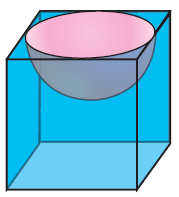
A hemispherical section is cut out from one face of a cubical block such that the diameter l of the hemisphere is equal to side length of the cube. Determine the surface area of the remaining solid.
9.
A funnel consists of a frustum of a cone attached to a cylindrical portion 12 cm long attached at the bottom. If the total height be 20 cm, diameter of the cylindrical portion be 12 cm and the diameter of the top of the funnel be 24 cm. Find the outer surface area of the funnel.
10.
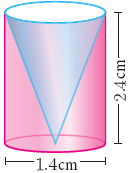
From a solid cylinder whose height is 2.4 cm and diameter 1.4 cm, a conical cavity of the same height and base is hollowed out. Find the total surface area of the remaining solid.
1.
Volume of the cylindrical tank = Volume of the rectangle tank
πr2h = 28 x 16 x 11 m3

\(h=\frac { 16\times 11 }{ 88 } =2m\)
2.
Clearly bucket forms frustum of a cone such that the radii of its circular ends are r1 = 28 cm, r2 = 7 cm, h = 45 cm
Capacity of the bucket = volume of the frustum
\(\Rightarrow \frac { 1 }{ 3 } \times \pi h[{ r }_{ 1 }^{ 2 }+{ r }_{ 2 }^{ 2 }+{ r }_{ 1 }{ r }_{ 2 }]\)
\(\Rightarrow \frac { 1 }{ 3 } \times \frac { 22 }{ 7 } \times 45[{ 28 }^{ 2 }+{ 7 }^{ 2 }+28\times 7)]\)
= 22 x 15 x (28 x 4 + 7 + 28)
\(\Rightarrow 330\times 147{ cm }^{ 2 }\Rightarrow 48510{ cm }^{ 2 }\)
3.
Let r be the radius of the hemisphere.
Given that, base area = \(\pi\)r2 = 1386 sq. m
T.S.A. = 3 \(\pi\)r2 sq.m
= 3 x 1386 = 4158
Therefore, T.S.A. of the hemispherical solid is 4158 m2.
4.
Let r1 and r2 be the radii of the balloons.
Given that, \(\frac { { r }_{ 1 } }{ { r }_{ 2 } } =\frac { 12 }{ 16 } =\frac { 3 }{ 4 } \)
Now, ratio of C.S.A. of balloons \(=\frac { 4\pi { r }_{ 1 }^{ 2 } }{ 4\pi { r }_{ 2 }^{ 2 } } =\frac { { r }_{ 1 }^{ 2 } }{ { r }_{ 2 }^{ 2 } } ={ \left( \frac { { r }_{ 1 } }{ { r }_{ 2 } } \right) }^{ 2 }={ \left( \frac { 3 }{ 4 } \right) }^{ 2 }=\frac { 9 }{ 16 } \)
Therefore, ratio of C.S.A. of balloons is 9:16.
5.
Given that, radius r = 7 cm
Now, total surface area of the cone = \(\pi\)r(l + r)sq. units
T.S.A = 704 cm2
704 = \(\frac{22}{7}\times7(l+7)\)
32 = l + 7 implies l = 25 cm
Therefore, slant height of the cone is 25 cm.
6.
Given that, diameter d = 2.8 m and height = 3 m
radius r = 1.4 m
Area covered in one revolution = curved surface area of the cylinder
= 2\(\pi\)rh sq. units
\(2\times \frac { 22 }{ 7 } \times 1.4\times 3=26.4\)
Area covered in 1 revolution = 26.4 m2
Area covered in 8 revolutions = 8 x 26.4 = 211.2
Therefore, area covered is 211.2 m2
7.
Given that, C.S.A. of the cylinder = 88 sq. cm
2\(\pi\)rh = 88
\(2\times \frac { 22 }{ 7 } \times 14=88\) (given h = 14cm)
2r = \(\frac { 88\times 7 }{ 22\times 14 } =2\)
Therefore, diameter = 2 cm
8.
Let r be the radius of the hemisphere.
Given that, diameter of the hemisphere = side of the cube = l
Radius of the hemisphere = \(\frac{l}{2}\)
TSA of the remaining solid = Surface area of the cubical part + C.S.A. of the hemispherical part − Area of the base of the hemispherical part
= 6 x (Edge)2 + 2\(\pi\)r2−\(\pi\)r2
= 6 x (Edge)2 + \(\pi\)r2
\(=6{ \times (l) }^{ 2 }+\pi { \left( \frac { l }{ 2 } \right) }^{ 2 }=\frac { 1 }{ 4 } (24+\pi ){ l }^{ 2 }\)
Total surface area of the remaining solid \(=\frac { 1 }{ 4 } (24+\pi ){ l }^{ 2 }\)sq. units
9.
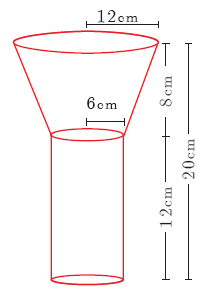
Let R, r be the top and bottom radii of the frustum.
Let h1, h2 be the heights of the frustum and cylinder respectively.
Given that, R = 12 cm, r = 6 cm, h2 = 12 cm
Now, h1 = 20 – 12 = 8 cm
Here, Slant height of the frustum l = \(\sqrt { \left( R-r \right) ^{ 2 }+{ h }_{ 1 }^{ 2 } } units\)
\(=\sqrt { 36+64 } \)
l = 10 cm
Outer surface area = \(2\pi r{ h }_{ 2 }+\pi (R+r)\quad l\quad sq.units\)
\(=\pi [2r{ h }_{ 2 }+(R+r)l]\)
\(=\pi [(2\times 6\times 12)+(18\times 10)]\)
\(=\pi [144+180]\)
\(=\frac { 22 }{ 7 } \times 324=1018.28\)
Therefore, outer surface area of the funnel is 1018.28 cm2.
10.
Let h and r be the height and radius of the cone and cylinder.
Let l be the slant height of the cone.
Given that, h = 2.4 cm and d = 1.4 cm ; r = 0.7 cm
Here, total surface area of the remaining solid} C.S.A. of the cylinder + C.S.A. of the cone + area of the bottom
= 2\(\pi\)rh + \(\pi\)rl + \(\pi\)r2 sq.units
Now, \(\\ \\ l=\sqrt { { r }^{ 2 }+{ h }^{ 2 } } =\sqrt { 0.49+5.76 } =\sqrt { 6.25 } =2.5cm\)
Area of the remaining solid = 2\(\pi\)rh + \(\pi\)rl + \(\pi\)r2 sq.units
= \(\pi\)r(2h + l + r)
\(\frac { 22 }{ 7 } \times 0.7\times [(2\times 2.4)+2.5+0.7]\)
Therefore, total surface area of the remaining solid is 17.6 m2

10th Standard Syllabus & Materials
10th Standard
TN 10th English Prose - 2 - The Night the Ghost Got in Important Questions And Answers Study Material - QB365 Set A
NEW10th Standard
TN 10th English Supplementary - 1 - The Tempest Important Questions And Answers Study Material - QB365 Set A
NEW10th Standard
TN 10th English Poem - 1 - Life Important Questions And Answers Study Material - QB365 Set A
NEW10th Standard
TN 10th English Prose - 1 - His First Flight Important Questions And Answers Study Material - QB365 Set A



Tamilnadu Stateboard 10th Standard Subjects
Tamilnadu Stateboard Standards





