
 100% FREE ACCESS
10th Standard Syllabus & Materials
10th Standard
TN 10th English Prose - 4 - The Attic Important Questions And Answers Study Material - QB365 Set A
NEW10th Standard
TN 10th English Supplementary - 3 - The Story of Mulan Important Questions And Answers Study Material - QB365 Set A
NEW10th Standard
TN 10th English Poem - 3 - I am Every Woman Important Questions And Answers Study Material - QB365 Set A
NEW10th Standard
TN 10th English Prose - 3 - Empowered Women Navigating The World Important Questions And Answers Study Material - QB365 Set A
NEW10th Standard
TN 10th English Supplementary - 2 - Zigzag Important Questions And Answers Study Material - QB365 Set A
NEW10th Standard
TN 10th English Poem - 2 - The Grumble Family Important Questions And Answers Study Material - QB365 Set A

Published on: 17/01/2020
Download Tamil Nadu 10th Standard Maths question papers, model tests, one-mark questions, important questions, and public exam papers in PDF format. Free study materials and answer keys for TN State Board students.
Questions + Answers key
Take MCQ Maths Test1.
2.
If S1 denotes the total surface area at a sphere of radius ૪ and S2 denotes the total surface area of a cylinder of base radius ૪ and height 2r, then ___________
S1 = S2
S1 > S2
S1
S1 = 2S2
3.
If A is an assets angle of Δ ABC, right angle at 3, then the value of sin A T cos A is ___________
=1
>1
<1
=2
4.
The sum of all deviations of the data from its mean is
Always positive
always negative
zero
non-zero integer
5.
The angle of elevation of a cloud from a point h metres above a lake is \(\beta \). The angle of depression of its reflection in the lake is 45°. The height of location of the cloud from the lake is
\(\frac { h\left( 1+tan\beta \right) }{ 1-tan\beta } \)
\(\frac { h\left( 1-tan\beta \right) }{ 1+tan\beta } \)
h tan(45°-\(\beta \))
none of these
6.
A tower is 60 m height. Its shadow is x metres shorter when the sun’s altitude is 45° than when it has been 30°, then x is equal to
41.92 m
43.92 m
43 m
45.6 m
7.
An A.P. consists of 31 terms. If its 16th term is m, then the sum of all the terms of this A.P. is
16 m
62 m
31 m
\(\frac { 31 }{ 2 } \) m
8.
The area of triangle formed by the points (−5, 0), (0, −5) and (5, 0) is
0 sq. units
25 sq. units
5 sq. units
none of these
9.
How many tangents can be drawn to the circle from an exterior point?
one
two
infinite
zero
10.
If in triangles ABC and EDF,\(\cfrac { AB }{ DE } =\cfrac { BC }{ FD } \) then they will be similar, when
\(\angle B=\angle E\)
\(\angle A=\angle D\)
\(\angle B=\angle D\)
\(\angle A=\angle F\)
11.
12.
Let n(A) = m and n(B) = n then the total number of non-empty relations that can be defined from A to B is
mn
nm
2mn-1
2mn
13.
A = {a, b, p}, B = {2, 3}, C = {p, q, r, s} then n[(A U C) x B] is
8
20
12
16
14.
For the given matrix A = \(\left( \begin{matrix} 1 \\ 2 \\ 9 \end{matrix}\begin{matrix} 3 \\ 4 \\ 11 \end{matrix}\begin{matrix} 5 \\ 6 \\ 13 \end{matrix}\begin{matrix} 7 \\ 8 \\ 15 \end{matrix} \right) \) the order of the matrix AT is
2 x 3
3 x 2
3 x 4
4 x 3
15.
If tanθ+sinθ=P; tanθ-sinθ=q P.T P2-q2=4\(\sqrt{pq}\)
16.
Prove that in a right triangle, the square of 8. the hypotenuse is equal to the sum of the squares of the others two sides.
17.
A spherical ball of iron has been melted and made into small balls. If the radius of each smaller ball is one-fourth of the radius of the original one, how many such balls can be made?
18.
What is the ratio of the volume of a cylinder, a cone, and a sphere. If each has the same diameter and same height?
19.
C.V. of a data is 69%, S.D. is 15.6, then find its mean.
20.
Find two consecutive natural numbers whose product is 20.
21.
If the sum of the first 14 terms of an AP is 1050 and its first term is 10, find the 20th term.
22.
A function f: (1,6) \(\rightarrow\)R is defined as follows:
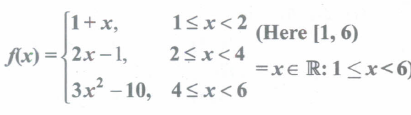
Find the value of f(3),
23.
A function f: [-7,6) \(\rightarrow\) R is defined as follows.
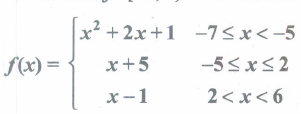
find 2f(-4) + 3f(2)
24.
Find the coordinates at the points of trisection (i.e. points dividing in three equal parts) of the line segment joining the points A(2, -2) and B(-7, 4).
25.
prove the following identities.
\(\frac { cot\theta -cos\theta }{ cot\theta +cos\theta } =\frac { cosec\theta -1 }{ cosec+1 } \)
26.
Find the equation of a straight line Passing through (-8, 4) and making equal intercepts on the coordinate axes
27.
The graph relates temperatures y (in Fahrenheit degree) to temperatures x (in Celsius degree) Write an equation of the line
28.
In a box there are 20 non-defective and some defective bulbs. If the probability that a bulb selected at random from the box found to be defective is \(\frac{3}{8}\) then, find the number of defective bulbs.
29.
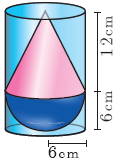
A solid consisting of a right circular cone of height 12 cm and radius 6 cm standing on a hemisphere of radius 6 cm is placed upright in a right circular cylinder full of water such that it touches the bottom. Find the volume of the water displaced out of the cylinder, if the radius of the cylinder is 6 cm and height is 18 cm.
30.
The radius and height of a cylinder are in the ratio 5 : 7 and its curved surface area is 5500 sq.cm. Find its radius and height.
31.
Determine the general term of an A.P. whose 7th term is -1 and 16th term is 17.
32.
Solve \(\frac { x }{ 2 } -1=\frac { y }{ 6 } +1=\frac { z }{ 7 } +2\); \(\frac { y }{ 3 } +\frac { z }{ 2 } =13\)
33.
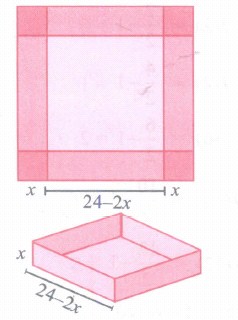
An open box is to be made from a square piece of material, 24 cm on a side, by cutting equal squares from the corners and turning up the sides as shown Fig. Express the volume V of the box as a function of x.
34.
Let A = {3,4,7,8} and B = {1,7,10}. Which of the following sets are relations from A to B?
R3 = {(3,7), (4,10), (7,7), (7,8), (8,11), (8,7), (8,10)}
35.
If the radii of the circular ends of a conical bucket which is 45 cm high are 28 cm and 7 cm, find the capacity of the bucket. (Use π = \(\frac{22}{7}\))
36.
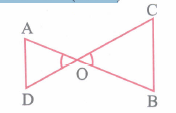
In figure OA· OB = OC·OD
Show that \(\angle A=\angle C\ and\ \angle B=\angle D\)
37.
The marks scored by 5 students in a test for 50 marks are 20, 25, 30, 35, 40. Find the S.D for the marks. If the marks are converted for 100 marks, find the S.D. for newly obtained marks.
38.
Using quadratic formula solve the following equations.9x2-9(a+b)x+(2a2+5ab+2b2)=0
39.
Prove that \(\sqrt { 3 } \) is irrational
40.
If A (-5, 7), B (-4, -5), C (-1, -6) and D (4, 5) are the vertices of a quadrilateral, find the area of the quadrilateral ABCD.
41.
A and B are two events such that, P(A) = 0.42, P(B) = 0.48, P(A ∩ B) = 0.16. Find (i) P(not A) (ii) P(not B) (iii) P(A or B)
42.
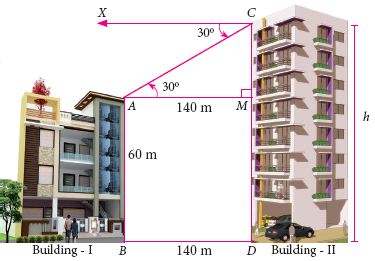
The horizontal distance between two buildings is 140 m. The angle of depression of the top of the first building when seen from the top of the second building is 30° . If the height of the first building is 60 m, find the height of the second building.(\(\sqrt { 3 } \) = 1.732)
43.
Find the first term of the G.P. whose common ratio 5 and whose sum to first 6 terms is 46872
44.
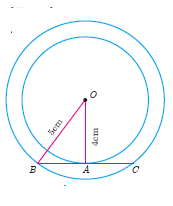
If radii of two concentric circles are 4 cm and 5 cm then find the length of the chord of one circle which is a tangent to the other circle
45.
Show that the given vertices form a right angled triangle and check whether its satisfies Pythagoras theorem A(1, - 4) , B(2, - 3) and C(4, - 7)
46.
Find the LCM of the given expressions.
4x2y, 8x3y2
1.
(c)
2.
(a)
S1 = S2
3.
(a)
=1
4.
(c)
zero
5.
(a)
\(\frac { h\left( 1+tan\beta \right) }{ 1-tan\beta } \)
6.
(b)
43.92 m
7.
(i) To check if h is one – one, we assume that h(b1) = h(b2)
Then we get 2.47 b1 + 54.10 = 2.47 b2 + 54.10
2.47b1 = 2.47b2 ⇒ b1 = b2
Thus, h(b1) = h(b2) ⇒ b1 = b2, So, the function h is one – one.
(ii) If the length of the thigh bone b = 50, then the height is
h(50) = (2.47 x 50) + 54.10 = 177.6 cms
(iii) If the height of a person is 147.96 cms, then h(b) = 147.96 and so the length of the thigh bone is given by 2.47b + 54.10 = 147.96.
b = \(\frac { 93.86 }{ 2.47 } \)
Therefore, the length of the thigh bone is 38 cms.
8.
(b)
25 sq. units
9.
(b)
two
10.
(c)
\(\angle B=\angle D\)
11.
(a)
12.
(c)
2mn-1
13.
(c)
12
14.
(d)
4 x 3
15.
16.
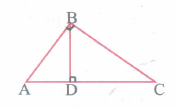
We are given a right triangle ABC right angled at B.
We need to prove that AC2 = AB2 + BC2
Let us draw \(BD\bot AC\)
Now,\(\Delta ADB\sim \Delta ABC\)
\(\cfrac { AD }{ DB } =\cfrac { BC }{ AC } \)
(sides are proportional)
Also,
\(\Delta BDC\sim \Delta ABC\)
\(\cfrac { CD }{ BC } =\cfrac { BC }{ AC } \)
CD·AC = BC2 ..(2)
Adding (1) and (2)
AD .AC + CD . AC = AB2+ BC2
AC(AD + CD) = AB2 + BC2
AC.AC = AB2 + BC2
AC = AB2 + BC2
17.
No. of balls required \(=\frac { \frac { 4 }{ 3 } \pi { r }^{ 3 } }{ \frac { 4 }{ 3 } \pi \times { \left( \frac { r }{ 4 } \right) }^{ 3 } } \)
\(={ r }^{ 3 }\times \frac { 4 }{ r } \times \frac { 4 }{ r } \times \frac { 4 }{ r } =64\)
18.
Volume of a cylinder \(=\pi { r }^{ 2 }h\)
Volume of a cone \(=\frac { 1 }{ 3 } \pi { r }^{ 2 }h\)
Volume of a sphere \(=\frac { 4 }{ 3 } \pi { r }^{ 3 }\)
Their ratio V1 : V2 : V3
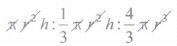
\(h:\frac { h }{ 3 } :\frac { 4r }{ 3 } \)
3h: h: 4r
3h : h : 2(2r) (where 2r = h)
∴ V1 : V2 : V3 = 3: 1 : 2
19.
CV =\(\frac { \sigma }{ \bar { x } } \) x 100 ⇒ \(\bar { x } =\frac { \sigma }{ CV } \) x 100
\(\bar { x } =\frac { 15.6 }{ 6.9 } \) x 100 = 22.6
20.
Let a natural number be x.
The next number = x + 1
x (x + 1) = 20
X2+x-20 = 0
(x + 5)(x - 4) = 0
x=-5,4
∴ x=4
(∵ x≠-5, x is a natural number
The next number = 4 + 1= 5
Two consecutive numbers are 4,5.
21.
Here S14 = 1050
n = 14
a = 10
Sn = \(\frac{n}{2}\) 2(2a + (n -1)d)
1050 = \(\frac{14}{2}\)(20 + 13d)
= 140 + 91d
910 = 91d
d = 10
a20 = 10 + (20 - 1) x 10
= 20
∴ 20th term = 200.
22.
f(3) =. 2x - 1
= 2(3) - 1 = 6 - 1 = 5
23.
2f(-4) + 3f(2)
f(-4) = x + 5 = -4 + 5 = 1
2f(-4) = 2 x 1 = 2
f(2) = x + 5 = 2 + 5 = 7
3f(2) = 3(7) = 21
∴ 2f(-4) + 3f(2) = 2 + 21 = 23
24.
Let P and Q be the points of trisection at AB.
i.e., AP = PQ = QB
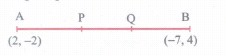
Therefore, P divides AB internally in the ratio 1:2. Therefore, the coordinates at P, by applying the section formula, are
\(\left[ \frac { 1(-7)+2(2) }{ 1+2 } ,\frac { 1(7)+2(-2) }{ 1+2 } \right] \) i.e., (-1,10)
Now, Q also divides AB internally in the ratio 2:1, so, the coordinates at Q are
\(\left[ \frac { 2(-7)+1(2) }{ 2+1 } ,\frac { 2(4)+(-2) }{ 2+1 } \right] \) i.e., (-4,2)
Therefore, the coordinates at the points at trisection of the line segment joining A and B are (-1, 0) and (-4, 2).
25.
\(\frac{\cot \theta-\cos \theta}{\cot \theta+\cos \theta}=\frac{\operatorname{cosec} \theta-1}{\operatorname{cosec} \theta+1}\)
\(
\text { LHS } =\frac{\cot \theta-\cos \theta}{\cot \theta+\cos \theta}
\)
\(=\frac{\frac{\cos \theta}{\sin \theta}-\cos \theta}{\frac{\cos \theta}{\sin \theta}+\cos \theta}
\)
\(
\frac{\frac{\cos \theta-\sin \theta \cos \theta}{\sin \theta}}{\frac{\cos \theta+\sin \theta \cos \theta}{\sin \theta}}
\)
\(=\frac{(\cos \theta-\sin \theta \cos \theta)}{\sin \theta} \times \frac{\sin \theta}{(\cos \theta+\sin \theta \cos \theta)}
\)
\(=\frac{\cos \theta(1-\sin \theta)}{\cos \theta(1+\sin \theta)}
\)
\(
\mathrm{LHS} =\frac{1-\sin \theta}{1+\sin \theta}
\) ....(1)
\(\mathrm{RHS} =\frac{\operatorname{cosec} \theta-1}{\operatorname{cosec} \theta+1}\)
\(=\frac{\frac{1}{\sin \theta}-1}{\frac{1}{\sin \theta}+1}=\frac{\frac{1-\sin \theta}{\sin \theta}}{\frac{1+\sin \theta}{\sin \theta}}=\frac{1-\sin \theta}{\sin \theta} \times \frac{\sin \theta}{1+\sin \theta}\)
\(\text { RHS }=\frac{1-\sin \theta}{1+\sin \theta}\)
From (1) and (2)
LHS = RHS
26.
Given that intercepts are equal.
a = b
Equation of the line in intercepts form is
\(\frac{x}{a}+\frac{y}{b}=1
\)
\(\frac{x}{a}+\frac{y}{a}=1
\)
x + y = a
This passes through (- 8, 4)
-8 + 4 = a
a = -4
b = -4
Equation of the straight line is
\(\frac{x}{a}+\frac{y}{b}=1
\)
\(\frac{x}{-4}+\frac{y}{-4}=1
\)
x + y + 4 = 0.
27.
Use the slope and y intercept to write an equation
The equation is y = \(\frac { 9 }{ 5 } x\) + 32
28.
Number of non defective bulbs = 20.
Let x be the number of defective bulbs
Then total number of bulbs n(s) = 20 + x
Let 'A' be the event of getting defective bulbs
\(\mathrm{P}(\mathrm{A})=\frac{x}{20+x}=\frac{3}{8}\)
8x = 3 (20 + x)
8x = 60 + 3x
8x - 3x = 60
5x = 60
\(x=\frac{60}{5}\)
x = 12
Number of defective bulbs = 12
29.
Radius of hemisphere = 6 cm
Volume of hemisphere \(=\frac{2}{3} \pi r^{3} \text { cu. units }\)
\(=\frac{2}{3} \pi(6)^{3}
\)
\(=\frac{2}{3} \pi(216)
\)
\(=144 \pi \mathrm{cm}^{3}
\)
base of cone = 6 cm
Height of the cone = 12 cm
Volume of the cone \(=\frac{1}{3} \pi r^{2} h \text { cu. units }
\)
\(=\frac{1}{3} \pi(6)^{2}(12)
\)
= 144 cm3
volume of the solid = Volume of cone + Volume of hemisphere
\(=144 \pi+144 \pi=288 \pi\)
Volume of water displaced
= Volume of the solid placed in the cylinder
\(=288 \pi=288 \times \frac{22}{7}\)
= 905.14 cm3
30.
Given that radius and height of a cylinder are in the ratio 5 : 7
\(\text { i.e., } \frac{r}{h}=\frac{5}{7} \Rightarrow \mathrm{h}=\frac{7 r}{5}\)
Curved surface area = 5500 sq. cm
\(2 \pi r h =5500 \)
\(2 \times \frac{22}{7} \times r \times \frac{7 r}{5} =5500 \)
\(r^{2} =\frac{5500 \times 5}{2 \times 22} \)
\(r^{2} =625 \Rightarrow r=25 \)
\(=\frac{7(25)}{5}=35 \)
radius = 25 cm, height = 35 cm
31.
Let the A.P. be t1, t2 , t3, t4,....
It is given that t7 = -1 and t16 = 17
a + (7 -1)d = -1 and a + (16 - 1)d = 17
a + 6d = -1 .....(1)
a + 15d = 17 ......(2)
Subtracting equation (1) from equation (2), we get 9d = 18 gives d = 2
putting d = 2 in equation (1), we get a + 12 = -1 so a = -13
Hence, General term tn = a + (n - 1)d
= -13 + (n -1) x 2 = 2n - 15
32.
Considering, \(\frac { x }{ 2 } -1=\frac { y }{ 6 } +1\)
\(\frac { x }{ 2 } -\frac { y }{ 6 } \) = 1 + 1 \(\frac { 6x-2y }{ 12 } \) = 2 we get, 3x - y = 12.... (1)
Considering \(\frac { x }{ 2 } -1=\frac { z }{ 7 } +2\)
\(\frac { x }{ 2 } -\frac { z }{ 7 } \) = 1 + 2 gives, \(\frac { 7x-2z }{ 14 } \) = 3 we get, 7x - 2z = 42... (2)
Also, from \(\frac { y }{ 3 } +\frac { z }{ 2 } \) = 13 \(\frac { 2y+3z }{ 6 } \) = 13 we get, 2y + 3z = 78 .(3)
Eliminating z from (2) and (3)
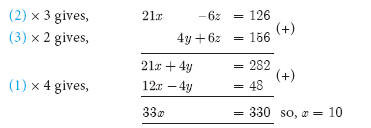
Substituting x = 10 in (1), 30 - y = 12 we get, y = 18
Substituting x = 10 in (2), 70 - 2x = 42 then, z = 14
Therefore, x = 10, y = 18, z = 14.
33.
From the diagram,
The solid is a cuboid volume of cuboid = length x breadth x height
where l = 24 - 2x, b - 24 - 2x,. h = x
Volume V (x) = (24 - 2x) (24 - 2x) x
V(x) = x(24 - 2x)2, x > 0
= 4x3 - 96x2 + 576x, x > 0
So, the domain is 0 < x < 12
34.
A x B = {(3,1), (3,7), (3,10), (4,1), (4,7), (4,10), (7,1), (7,7), (7,10), (8,1), (8,7), (8,10)}
Here, (7,8) \(\in \) R3, but (7,8) \(\notin \) A x B. So, R3 is not a relation from A to B.
35.
Clearly bucket forms frustum of a cone such that the radii of its circular ends are r1 = 28 cm, r2 = 7 cm, h = 45 cm
Capacity of the bucket = volume of the frustum
\(\Rightarrow \frac { 1 }{ 3 } \times \pi h[{ r }_{ 1 }^{ 2 }+{ r }_{ 2 }^{ 2 }+{ r }_{ 1 }{ r }_{ 2 }]\)
\(\Rightarrow \frac { 1 }{ 3 } \times \frac { 22 }{ 7 } \times 45[{ 28 }^{ 2 }+{ 7 }^{ 2 }+28\times 7)]\)
= 22 x 15 x (28 x 4 + 7 + 28)
\(\Rightarrow 330\times 147{ cm }^{ 2 }\Rightarrow 48510{ cm }^{ 2 }\)
36.
OA· OB = OC . OD (Given)
so, \(\cfrac { OA }{ OC } =\cfrac { OD }{ OB } \)
Also we have 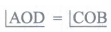
(vertically opposite angles) ...(2)
From (1) and (2)
\(\Delta AOD\sim \Delta COB\)( SAS similarity criterion)
So

(corresponding angles of similar triangles)
37.
Let assumed mean A = 30
C = 5
| x | d' = \(\frac { x-30 }{ 5 } \) | d'2 |
| 20 | -2 | 4 |
| 25 | -1 | 1 |
| 30 | 0 | 0 |
| 35 | 1 | 1 |
| 40 | 2 | 4 |
| Σd' = 0 | Σd'2 = 10 |
σ =\(\sqrt { \left( \frac { \Sigma d'^{ 2 } }{ n } \right) -\left( \frac { \Sigma d' }{ n } \right) ^{ 2 } } \) x c
=\(\sqrt { \frac { 10 }{ 5 } -0 } \) x 5
=\(\sqrt { 2 } \) x 5
= 5\(\sqrt { 2 } \)
To convert the values for 100, all the values will be multiplied by 2. Therefore the new values are 40, 50, 60, 70, 80.
Let A = 60, C = 10
| x | d' = \(\frac { x-60 }{ 10 } \) | d'2 |
| 40 | -2 | 4 |
| 50 | -1 | 1 |
| 60 | 0 | 0 |
| 70 | 1 | 1 |
| 80 | 2 | 4 |
σ =\(\sqrt { \left( \frac { \Sigma d'^{ 2 } }{ n } \right) -\left( \frac { \Sigma d' }{ n } \right) ^{ 2 } } \) x c
=\(\sqrt { \frac { 10 }{ 5 } -0 } \) x 10
=\(\sqrt { 2 } \) x 10
= 10\(\sqrt { 2 } \)
S.D. also be multiplied by 2. It is also true for the division also.
38.
9x2-9(a+b)x+(2a2+5ab+2b2)=0
Comparing this with ax2 + bx + c = O.
a =9
b = -9(a + b)
c = (2a2 + 5ab + 2b2)
∴ ∆=B2-4AC
⇒ 81(a+b)2-36(2a2+5ab+2b2)
⇒ 9a2 + 9b2 - 18ab
⇒ 9(a - b)2> 0
∴ the roots are real and given by
\(\beta =\frac { -B-\sqrt { D } }{ 2A } =\frac { 9(a+b)+3(a-b) }{ 18 } \)
\(=\frac { 12a+6b }{ 18 } =\frac { 2a+b }{ 3 } \)
\(\beta =\frac { -B-\sqrt { D } }{ 2A } =\frac { 9(a+b)+3(a-b) }{ 18 } \)
\(=\frac { 6a+12b }{ 18 } =\frac { a+2b }{ 3 } \)
39.
Let us assume the opposite, (1) \(\sqrt { 3 } \) is irrational.
Hence \(\sqrt { 3 } =\frac { p }{ q } \)
Where p and q (q ≠ 0) are co-prime (no common factor other than 1)
Hence, \(\sqrt { 3 } =\frac { p }{ q } \)
\(\sqrt { 3 } \)q = p
Squaring both side
\({ (\sqrt { 3 }q ) }^{ 2 }={ p }^{ 2 }\)
3q2 = p2
\({ q }^{ 2 }=\frac { p }{ 3 } \)
Hence, 3 divides p2 So 3 divides p also .....(1)
Hence we can say
\(\frac{p}{3}\) = c where c is some integer
s, p =p2
Putting p = 3c
3q2 = (3c)2
3q2 = 9c2
q2 = \(\frac13\) x 9c2
q2 = 3c2
\(\frac{9^2}{3}\) = c2
Hence 3 divides q2
So, 3 divides q also ...(2)
By (1) and (2) 3 divides both p and q
By contradiction \(\sqrt { 3 } \) is irrational.
40.
By joining B to D, you will get too triangles ABD and BCD.
Now, the area of ΔABD
=\(\frac { 1 }{ 2 } \)[ -5(-5 - 5) + (-4)(5 -7) + 4(7 + 5)]
=\(\frac { 1 }{ 2 } \)(50 + 8 + 48)
=\(\frac { 106 }{ 2 } \) = 53 square units.
Also, the area of ΔBCD
=\(\frac { 1 }{ 2 } \) = [-4(-6 - 5) - 1(5 + 5) + 4(-5 + 6)]
=\(\frac { 1 }{ 2 } \)(44 - 10 + 4)
= 19 square units.
So, the area of quadrilateral ABCD
= 53 + 19 = 72 square units.
41.
(i) Given P(A) = 0.42
P(not A) = 1 - P(A)
\(\mathrm{P}(\bar{A})=1-0.42=0.58\)
(ii) Given P(B) = 0.48
P(not B) = 1 - P(B)
\(\mathrm{P}(\bar{B})=1-0.48=0.52\)
(iii) P(A or B) = \(P(A \cup B)\)
\(=\mathrm{P}(\mathrm{A})+\mathrm{P}(\mathrm{B})-\mathrm{P}(A \cap B)\)
= 0.42 + 0.48 - 015
= 0.90 - 0.16
P(A or B) = 0.74
42.
The height of the first building AB = 60 m. Now, AB = MD = 60 m
Let the height of the second building CD = h. Distance BD = 140 m
Now, AM = BD = 140 m
From the diagram,
\(\angle \)XCA = 30° =\(\angle \)CAM
In right triangle AMC, tan30° = \(\frac { CM }{ Am } \)
\(\frac { 1 }{ \sqrt { 3 } } =\frac { CM }{ 140 } \)
CM=\(\frac { 140 }{ \sqrt { 3 } } =\frac { 140\sqrt { 3 } }{ 3 } \)
\(=\frac { 140\times 1.732 }{ 3 } \)
CM = 80.78
Now, h = CD = CM + MD = 80.78 + 60 = 140.78
Therefore the height of the second building is 140.78 m
43.
Given r = 5 and S6 = 46872
Sum upto n terms of a G.P \(\mathrm{S}_{\mathrm{n}}=\frac{a\left(r^{n}-1\right)}{r-1}\)
\(46872 =\frac{a\left(5^{6}-1\right)}{5-1}
\)
\(46872 =a \frac{(15625-1)}{4}=a \times \frac{15624}{4}
\)
46872 = a x 3906
\(\frac{46872}{3906}=a\)
a = 12
First term of the G.P., a = 12
44.
OA = 4 cm, OB = 5 cm; also OA\(\bot \)BC.
OB2 = OA2 + AB2
52 = 42 + AB2 gives AB2 = 9
Therefore AB = 3 cm
BC = 2AB hence BC = 2 x 3 = 6 cm
45.
Given vertices A(1, - 4) , B(2, - 3) and C(4, - 7)
Slope of the line = \(\frac{y_{1}-y_{2}}{x_{1}-x_{2}}\)
Slope of AB = \(\frac{-4+3}{1-2}=\frac{-1}{-1}=1
\)
Slope of BC = \(\frac{-3+7}{2-4}=\frac{4}{-2}=-2
\)
Slope of AC = \(\frac{-4+7}{1-4}=\frac{3}{-3}=-1
\)
(Slope of AB) x (Slope of AC) = - 1
AB is perpendicular to AC.
Hence, the given vertices form a right angled triangle
Distance between the points (x1, y1) and (x2, y2) is \(\sqrt{\left.\left(x_{1}-x_{2}\right)^{2}+y_{1}-y_{2}\right)^{2}}\) units
\(A B =\sqrt{(1-2)^{2}+(-4+3)^{2}}=\sqrt{1+1}=\sqrt{2}
\)
\(A B^{2} =(\sqrt{2})^{2}=2
\)
\(B C =\sqrt{(2-4)^{2}+(-3+7)^{2}}=\sqrt{4+16}=\sqrt{20}
\)
BC2 = 20
\(A C=\sqrt{(1-4)^{2}+(-4+7)^{2}}=\sqrt{9+9}=\sqrt{18}\)
AC2 = 18
Now, AB2 + AC2 = BC2
Hence, the Pythagoras theorem is satisfied.
46.
4x2y, 8x3y2
LCM of (4, 8) = 8
LCM of (x2y, x3y2) = x3y2
LCM of (4x2y, 8x3y2) = 8x3y2

10th Standard Syllabus & Materials
10th Standard
TN 10th English Prose - 2 - The Night the Ghost Got in Important Questions And Answers Study Material - QB365 Set A
NEW10th Standard
TN 10th English Supplementary - 1 - The Tempest Important Questions And Answers Study Material - QB365 Set A
NEW10th Standard
TN 10th English Poem - 1 - Life Important Questions And Answers Study Material - QB365 Set A
NEW10th Standard
TN 10th English Prose - 1 - His First Flight Important Questions And Answers Study Material - QB365 Set A



Tamilnadu Stateboard 10th Standard Subjects
Tamilnadu Stateboard Standards





