
 100% FREE ACCESS
10th Standard Syllabus & Materials
10th Standard
TN 10th English Prose - 4 - The Attic Important Questions And Answers Study Material - QB365 Set A
NEW10th Standard
TN 10th English Supplementary - 3 - The Story of Mulan Important Questions And Answers Study Material - QB365 Set A
NEW10th Standard
TN 10th English Poem - 3 - I am Every Woman Important Questions And Answers Study Material - QB365 Set A
NEW10th Standard
TN 10th English Prose - 3 - Empowered Women Navigating The World Important Questions And Answers Study Material - QB365 Set A
NEW10th Standard
TN 10th English Supplementary - 2 - Zigzag Important Questions And Answers Study Material - QB365 Set A
NEW10th Standard
TN 10th English Poem - 2 - The Grumble Family Important Questions And Answers Study Material - QB365 Set A

Published on: 14/09/2019
Download Tamil Nadu 10th Standard Maths question papers, model tests, one-mark questions, important questions, and public exam papers in PDF format. Free study materials and answer keys for TN State Board students.
Questions + Answers key
Take MCQ Maths Test1.
The marks scored by 5 students in a test for 50 marks are 20, 25, 30, 35, 40. Find the S.D for the marks. If the marks are converted for 100 marks, find the S.D. for newly obtained marks.
2.
Let A = {1,2, 3, 4} and B = {-1, 2, 3, 4, 5, 6, 7, 8, 9, 10, 11, 12} Let R = {(1, 3), (2, 6), (3, 10), (4, 9)} \(\subseteq \) A x B be a relation. Show that R is a function and find its domain, co-domain and the range of R.
3.
The range of a set of data is 13.67 and the largest value is 70.08. Find the smallest value.
4.
Find the equation of a straight line passing through (5, - 3) and (7, - 4).
5.
Using the functions f and g given below, find f o g and g o f. Check whether f o g = g o f.
f(x) = x - 6, g(x) = x2
6.
Solve 8x \(\equiv \) 1 (mod 11)
7.
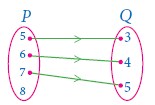
The arrow diagram shows a relationship between the sets P and Q. Write the relation in
(i) Set builder form
(ii) Roster form
(iii) What is the domain and range of R.
8.
If A x B = {(3,2), (3, 4), (5,2), (5, 4)} then find A and B.
9.
If ATB=90o then prove that
\(\sqrt { \frac { tanA\quad tanB+tanA\quad cotB }{ sinA\quad secB } } -\frac { { Sin }^{ 2 }A }{ { Cos }^{ 2 }A } =tanA\)
10.
Find the co-efficient of variation for the following data: 16, 13, 17,21, 18.
11.
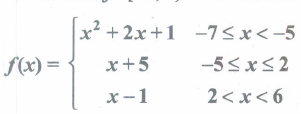
A function f: [-7,6) \(\rightarrow\) R is defined as follows.
f(-7) - f(-3)
12.
Which of the following list of numbers form an AP? If they form an AP, write the next two terms:
4,10,16, 22, ...
13.
Find the area of a triangle vertices are(1, -1), (-4, 6) and (-3, -5).
14.
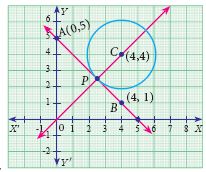
The line joining the points A(0,5) and B(4,1) is a tangent to a circle whose centre C is at the point (4, 4) find The coordinates of the point of contact of tangent line AB with the circle
15.
If A = \(\left[ \begin{matrix} 1 & 2 & 1 \\ 2 & -1 & 1 \end{matrix} \right] \) and B = \(\left[ \begin{matrix} 2 & -1 \\ -1 & 4 \\ 0 & 2 \end{matrix} \right] \) show that (AB)T = BTAT
16.
Find the mean and variance of the first n natural numbers.
17.
The 13th term of an A.P is 3 and the sum of the first 13 terms is 234.Find the common difference and the sum of first 21 terms.
18.
Find x if gff(x) = fgg(x), given f(x) = 3x + 1 and g(x) = x + 3.
19.
Construct a triangle \(\triangle\)PQR such that QR = 5 cm, \(\angle\)P = 30o and the altitude from P to QR is of length 4.2 cm.
20.
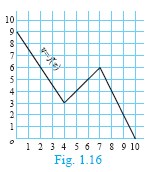
A graph representing the function f (x) is given in Fig it is clear that f (9) = 2.
(i) Find the following values of the function
(a) f(0)
(b) f(7)
(c) f(2)
(d) f(10)
(ii) For what value of x is f (x) = 1?
(iii) Describe the following (i) Domain (ii) Range.
(iv) What is the image of 6 under f ?
21.
22.
IF the probability of the non-happening of a event is q, then the probability of happening of that event is
1-q
q
q/2
∝q
23.
24.
If ∆ABC is right angled at C, then the value of cos (A + B) is ___________
0
1
\(\frac{1}{2}\)
\(\frac{\sqrt{3}}{2}\)
25.
If sin A = \(\frac{1}{2}\), then the value of cot A is ___________
\(\sqrt{3}\)
\(\frac{1}{\sqrt{3}}\)
\(\frac{\sqrt{3}}{2}\)
1
26.
If a letter is chosen at random from the English alphabets {a, b,...,z}, then the probability that the letter chosen precedes x
\(\frac{12}{13}\)
\(\frac{1}{13}\)
\(\frac{23}{26}\)
\(\frac{3}{26}\)
27.
The sum of all deviations of the data from its mean is
Always positive
always negative
zero
non-zero integer
28.
(1 + tan \(\theta \) + sec\(\theta \)) (1 + cot\(\theta \) - cosec\(\theta \)) is equal to
0
1
2
-1
29.
The least number that is divisible by all the numbers from 1 to 10 (both inclusive) is
2025
5220
5025
2520
30.
A straight line has equation 8y = 4x + 21. Which of the following is true
The slope is 0.5 and the y intercept is 2.6
The slope is 5 and the y intercept is 1.6
The slope is 0.5 and the y intercept is 1.6
The slope is 5 and the y intercept is 2.6
31.
32.
If in \(\triangle\)ABC, DE || BC, AB = 3.6 cm, AC = 2.4 cm and AD = 2.1 cm then the length of AE is
1.4 cm
1.8 cm
1.2 cm
1.05 cm
33.
If \(\triangle\)ABC is an isosceles triangle with \(\angle\)C = 90o and AC = 5 cm, then AB is
2.5 cm
5 cm
10 cm
\(5\sqrt { 2 } \)cm
34.
If n(A x B) = 6 and A = {1,3} then n(B) is
1
2
3
6
35.
Draw the graph of y = x2 - 4x + 3 and use it to solve x2 - 6x + 9 = 0
1.
Let assumed mean A = 30
C = 5
| x | d' = \(\frac { x-30 }{ 5 } \) | d'2 |
| 20 | -2 | 4 |
| 25 | -1 | 1 |
| 30 | 0 | 0 |
| 35 | 1 | 1 |
| 40 | 2 | 4 |
| Σd' = 0 | Σd'2 = 10 |
σ =\(\sqrt { \left( \frac { \Sigma d'^{ 2 } }{ n } \right) -\left( \frac { \Sigma d' }{ n } \right) ^{ 2 } } \) x c
=\(\sqrt { \frac { 10 }{ 5 } -0 } \) x 5
=\(\sqrt { 2 } \) x 5
= 5\(\sqrt { 2 } \)
To convert the values for 100, all the values will be multiplied by 2. Therefore the new values are 40, 50, 60, 70, 80.
Let A = 60, C = 10
| x | d' = \(\frac { x-60 }{ 10 } \) | d'2 |
| 40 | -2 | 4 |
| 50 | -1 | 1 |
| 60 | 0 | 0 |
| 70 | 1 | 1 |
| 80 | 2 | 4 |
σ =\(\sqrt { \left( \frac { \Sigma d'^{ 2 } }{ n } \right) -\left( \frac { \Sigma d' }{ n } \right) ^{ 2 } } \) x c
=\(\sqrt { \frac { 10 }{ 5 } -0 } \) x 10
=\(\sqrt { 2 } \) x 10
= 10\(\sqrt { 2 } \)
S.D. also be multiplied by 2. It is also true for the division also.
2.
Domain of R = {1,2,3,4}
Co-domain of R = B = {-1, 2, 3,4,5,6, 7, 9, 10, 11,12}
Range of R = {3, 6,10, 9}
3.
Range R = 13.67
Largest value L = 70.08
Range R = L - S
13.67 = 70.08-S
S = 70.08 - 13.67 = 56.41
Therefore, the smallest value is 56.41
4.
The equation of a straight line passing through the two points (x1, y1) and (x2, y2) is \(\frac { y-{ y }_{ 1 } }{ { y }_{ 2 }-{ y }_{ 1 } } =\frac { x-{ x }_{ 1 } }{ { x }_{ 2 }-{ x }_{ 1 } } \)
Substituting the points we get, \(\frac { y+3 }{ -4+3 } =\frac { x-5 }{ 7-5 } \)
gives 2y + 6 = − x + 5
Therefore, x + 2y + 1 = 0
5.
f(x) = x - 6, g(x) = x2
fog(x) = f(g(x)) = f(x2) = x2 - 6 ...(1)
gof(x) = g(f(x)) = g(f(x)) = g(x - 6) = (x - 6)2
= x2 - 12x + 36
fog(x) ≠ gof
6.
8x \(\equiv \) 1 (mod 11) can be written as 8x - 1 = 11k, for some integer k.
\(x=\frac { 11k+1 }{ 8 } \)
When we put k = 5, 13, 21,29 ,....then 11 k + 1 is divisible by 8
\(x=\frac { 11\times 5+1 }{ 8 } =7\)
\(x=\frac { 11\times 13+1 }{ 8 } =18\)
Therefore, the solutions are 7,18,29,40,....
7.
(i) Set builder form of R = ((x, y) | y = x - 2, x \(\in \) P, y \(\in \) Q}
(ii) Roster form R = {(5 , 3),(6 , 4)(7 , 5)}
(iii) Domain of R = {5, 6, 7} and range of R = {3, 4, 5}
8.
A x B = {(3,2), (3,4), (5,2), (5,4)}
We have A = {set of all first coordinates of elements of A x B}. Therefore, A = {3,5}
B = {set of all second coordinates of elements of A x B}. Therefore, B = {2,4}
Thus A = {3,5} and B = {2,4}.
9.
10.
Mean \(\bar { x } \) = \(\frac { 16+13+17+21+18 }{ 5 } =\frac { 85 }{ 5 } \) = 17
| x | d = x - 17 | d2 |
| 16 | -1 | 1 |
| 13 | -4 | 16 |
| 17 | 0 | 0 |
| 21 | 4 | 16 |
| 18 | 1 | 1 |
| Σd = 0 | Σd2 = 34 |
σ =\(\sqrt { \frac { \Sigma d^{ 2 } }{ n } } =\sqrt { \frac { 34 }{ 5 } } =\sqrt { 638 } \)
σ = 2.61
Co-efficient of variation
CV = \(\frac { \sigma }{ \bar { x } } \) x 100 = \(\frac { 2.61 }{ 17 } \) x 100
= 15.35%
11.
f(-7) = x2 + 2x + 1
= (-7)2 + 2(-7) + 1
= 49 - 14 + 1 = 36
f(3) = x + 5 = -3 + 5 = 2
f(-7) - f(-3) = 36 + 2 = 38
12.
4, 10, 16,22, ...
We have a2 - a2 = 10 - 4 = 6
a3 - a2 = 16 -10 = 6
ஃ It is an A.P. with common difference 6
ஃ The next two terms are, 
13.
The area of the triangle formed by the vertices A(1, -1), B(-4, 6) and C(-3, -5), by using the formula above, is given by
= \(\frac { 1 }{ 2 } \)[1(6 + 5) +(-4) (-5 + 1) + (-3)(-1 - 6)]
= \(\frac { 1 }{ 2 } \)[11 + 16 + 21] = 24 square units.
14.
The coordinate of the point of contact P of the tangent line AB with the circle is point of intersection of line.
x + y − 5 = 0 and x − y = 0
solving, we get x = \(\frac { 5 }{ 2 } \) and y = \(\frac { 5 }{ 2 } \)
Therefore, the coordinate of the P\(\left( \frac { 5 }{ 2 } ,\frac { 5 }{ 2 } \right) \)
15.
LHS = (AB)T
AB = \({ \left[ \begin{matrix} 1 & 2 & 1 \\ 2 & -1 & 1 \end{matrix} \right] }_{ 2\times 3 }\times { \left[ \begin{matrix} 2 & -1 \\ -1 & 4 \\ 0 & 2 \end{matrix} \right] }_{ 3\times 2 }\)
= \(\left[ \begin{matrix} 2-2+0 & -1+8+2 \\ 4+1+0 & -2-4+2 \end{matrix} \right] =\left[ \begin{matrix} 0 & 9 \\ 5 & -4 \end{matrix} \right] \)
(AB)T = \({ \left[ \begin{matrix} 0 & 9 \\ 5 & -4 \end{matrix} \right] }^{ T }=\left[ \begin{matrix} 0 & 5 \\ 9 & -4 \end{matrix} \right] \) ....(1)
RHS = (BTAT)
BT = \(\left[ \begin{matrix} 2 & -1 & 0 \\ -1 & 4 & 2 \end{matrix} \right] \), AT = \(\left[ \begin{matrix} 1 & 2 \\ 2 & -1 \\ 1 & 1 \end{matrix} \right] \)
BTAT = \({ \left[ \begin{matrix} 2 & -1 & 0 \\ -1 & 4 & 2 \end{matrix} \right] }_{ 2\times 3 }\times { \left[ \begin{matrix} 1 & 2 \\ 2 & -1 \\ 1 & 1 \end{matrix} \right] }_{ 3\times 2 }\)
= \(\left[ \begin{matrix} 2-2+0 & 4+1+0 \\ -1+8+2 & -2-4+2 \end{matrix} \right] \)
BTAT = \(\left[ \begin{matrix} 0 & 5 \\ 9 & -4 \end{matrix} \right] \)...(2)}
From (1) and (2), (AB)T = BTAT.
Hence proved.
16.
Mean \(\bar { x } \) = \(\frac { Sum\ of\ all\ observations }{ Number\ of\ observation } \)
= \(\frac { \Sigma x_{ i } }{ n } =\frac { 1+2+3+...+n }{ n } =\frac { n(n+1) }{ 2\times n } \)
Mean \(\bar { x } \) = \(\frac { n+1 }{ 2 } \)
Variance σ2 = \(\frac { \Sigma x_{ i }^{ 2 } }{ n } -\left( \frac { \Sigma x_{ i } }{ n } \right) ^{ 2 }\left[ \begin{matrix} \Sigma x_{ i }^{ 2 }={ 1 }^{ 2 }+{ 2 }^{ 2 }+{ 3 }^{ 2 }+...+{ n }^{ 2 } \\ (\Sigma x_{ i })^{ 2 }=(1+2+3+...+n)2 \end{matrix} \right] \)
= \(\frac { n(n+1)(2n+1) }{ 6\times n } -\left[ \frac { n(n+1) }{ 2\times n } \right] ^{ 2 }\)
= \(\frac { 2n^{ 2 }+3n+1 }{ 6 } -\frac { { n }^{ 2 }+2n+1 }{ 4 } \)
Variance σ2 = \(\frac { 4n^{ 2 }+6n+2-3n^{ 2 }-6n-3 }{ 12 } =\frac { { n }^{ 2 }-1 }{ 12 } \).
17.
Given the 13th term = 3 so, t13 = a + 12d = 3..... (1)
Sum of first 13 terms = 234 gives \(\frac { 13 }{ 2 } \) [2a + 12d] = 234
2a + 12 = 36...(2)
Solving (1) and (2) we get , a = 33, d = \(\frac { -5 }{ 2 } \)
Therefore, common difference is \(\frac { -5 }{ 2 } \).
Sum of first 21 terms S21 = \(\frac { 21 }{ 2 } \left[ 2\times 33+\left( 21-1 \right) \times \left( -\frac { 5 }{ 2 } \right) \right] =\frac { 21 }{ 2 }\)[66 - 50] = 168.
18.
gff(x) = g[f{f(x)}] (This means "g of f of f of x")
= g[f(3x + 1)] = g[3(x + 1) + 1] = g(9x + 4)
g(9x + 4) = [(9x + 4) + 3] = 9x + 7
fgg(x) = f[g{g(x)}] (This means " f of g of g of x")
= f[g(x + 3)] = f[(x + 3) + 3] = f(x + 6)
f(x + 6) = [3(x + 6) + 1] = 3x + 19
These two quantities being equal, we get 9x + 7 = 3x + 19. Solving this equation we obtain x = 2.
19.
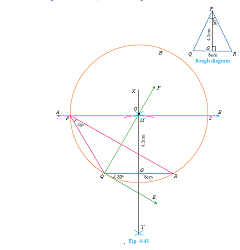
Construction
Step 1 : Draw a line segment QR = 5 cm.
Step 2 : At Q draw QE such that \(\angle\)RQE = 30o.
Step 3 : At Q draw QF such that \(\angle EQF\) = 90o
Step 4 : Draw the perpendicular bisector XY to QR which intersects QF at O and QR at G.
Step 5 : With O as centre and OQ as radius draw a circle.
Step 6: From G mark an arc in the line XY at M, such that GM = 42. cm.
Step 7 : Draw AB through M which is parallel to QR.
Step 8 : AB meets the circle at P and S.
Step 9 : Join QP and RP. Then\(\triangle\)PQR is the required triangle
20.
(i) From the given graph
(a) f(0) = 9
(b) f(7) = 6
(c) = f(2)
(d) = f(10) = 0
(ii) From the graph, it is known that
when x = 9.5, f(x) = 1
(iii) (a) Domain = {x|0 ≤ x ≤ 10, x \(\in \) R}
(b) Range = {x|0 ≤ x ≤ 9, x \(\in \) R}
(iv) The image of '6' under f is '5'.
21.
(b)
22.
(a)
1-q
23.
(d)
24.
(a)
0
25.
(a)
\(\sqrt{3}\)
26.
(c)
\(\frac{23}{26}\)
27.
(c)
zero
28.
(c)
2
29.
(d)
2520
30.
(a)
The slope is 0.5 and the y intercept is 2.6
31.
(b)
32.
(a)
1.4 cm
33.
(d)
\(5\sqrt { 2 } \)cm
34.
(c)
3
35.
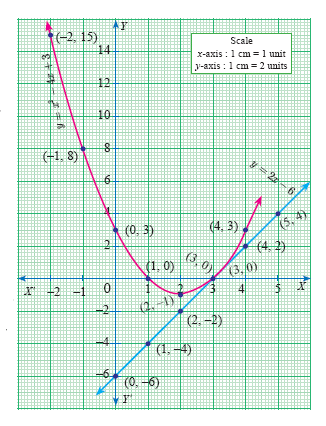
Step 1 : Draw the graph of y = x2 - 4x + 3 by preparing the table of values as below
| x | -2 | -1 | 0 | 1 | 2 | 3 | 4 |
| y | 15 | 8 | 3 | 0 | -1 | 0 | 3 |
Step 2 : To solve x2 - 6x + 9 = 0, subtract x2 - 6x + 9 = 0 from y = x2 - 4x + 3
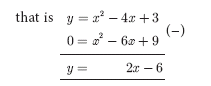
The equation y = 2x - 6 represent a straight line. Draw the graph of y = 2x - 6 forming the table of values as below.
| x | 0 | 1 | 2 | 3 | 4 | 5 |
| y | -6 | -4 | -2 | 0 | 2 | 4 |
The line y = 2x - 6 intersect y = x2 - 4x + 3 only at one point.
Step 3 : Mark the point of intersection of the curve y = x2 - 4x + 3 and y = 2x - 6 that is (3,0).
Therefore, the x coordinate 3 is the only solution for the equation x2 - 6x + 9 = 0

10th Standard Syllabus & Materials
10th Standard
TN 10th English Prose - 2 - The Night the Ghost Got in Important Questions And Answers Study Material - QB365 Set A
NEW10th Standard
TN 10th English Supplementary - 1 - The Tempest Important Questions And Answers Study Material - QB365 Set A
NEW10th Standard
TN 10th English Poem - 1 - Life Important Questions And Answers Study Material - QB365 Set A
NEW10th Standard
TN 10th English Prose - 1 - His First Flight Important Questions And Answers Study Material - QB365 Set A



Tamilnadu Stateboard 10th Standard Subjects
Tamilnadu Stateboard Standards





