
 100% FREE ACCESS
10th Standard Syllabus & Materials
10th Standard
TN 10th English Prose - 4 - The Attic Important Questions And Answers Study Material - QB365 Set A
NEW10th Standard
TN 10th English Supplementary - 3 - The Story of Mulan Important Questions And Answers Study Material - QB365 Set A
NEW10th Standard
TN 10th English Poem - 3 - I am Every Woman Important Questions And Answers Study Material - QB365 Set A
NEW10th Standard
TN 10th English Prose - 3 - Empowered Women Navigating The World Important Questions And Answers Study Material - QB365 Set A
NEW10th Standard
TN 10th English Supplementary - 2 - Zigzag Important Questions And Answers Study Material - QB365 Set A
NEW10th Standard
TN 10th English Poem - 2 - The Grumble Family Important Questions And Answers Study Material - QB365 Set A

Published on: 19/10/2025
Download Tamil Nadu 10th Standard Science question papers, model tests, one-mark questions, important questions, and public exam papers in PDF format. Free study materials and answer keys for TN State Board students.
Questions + Answers key
Take MCQ Science Test
1.
A single displacement reaction is represented by X(s) + 2HCl(aq) → XCl2(aq) + H2(g). Which of the following(s) could be X. (i) Zn (ii) Ag (iii) Cu (iv) Mg. Choose the best pair.
i and ii
ii and iii
iii and iv
i and iv
2.
A reaction between carbon and oxygen is represented by C(s) + O2(g) → CO2(g) + Heat. In which of the type(s), the above reaction can be classified?
(i) Combination Reaction
(ii) Combustion Reaction
(iii) Decomposition Reaction
(iv) Irreversible Reaction
i and ii
i and iv
i, ii and iii
i, ii and iv
3.
The basis of modern periodic law is__________.
atomic number
atomic mass
isotopic mass
number of neutrons
4.
Velocity of sound in a gaseous medium is 330 ms-1. If the pressure is increased by 4 times without causing a change in the temperature, the velocity of sound in the gas is
330 ms-1
660 ms-1
156 ms-1
990 ms-1
5.
Which of the following is a triatomic molecule?
Glucose
Helium
Carbon dioxide
Hydrogen
6.
SI unit of resistance is
mho
joule
ohm
ohm meter
7.
If a substance is heated or cooled, the change in mass of that substance is
positive
negative
zero
none of the above
8.
In a myopic eye, the image of the object is formed
behind the retina
on the retina
in front of the retina
on the blind spot
9.
Plotting a graph for momentum on the Y-axis and time on X-axis. slope of momentum- time graph gives
Impulsive force
Acceleration
Force
Rate of force
10.
Define combination reaction. Give one example for an exothermic combination reaction.
11.
Classify the following substances into deliquescent, hygroscopic. Conc. Sulphuric acid, Copper sulphate pentahydrate, Silica gel, Calcium chloride, and Gypsum salt.
12.
What is aqueous and non-aqueous solution? Give an example.
13.
Why is tungsten metal used in bulbs, but not in fuse wires?
14.
Give any two examples for heterodiatomic molecules.
15.
Differentiate mass and weight.
16.
Explain the types of alloys.
17.
The resistance of a wire of length 10 m is 2 ohm. If the area of cross section of the wire is 2 × 10⁻⁷ m2, determine its
(i) resistivity
(ii) conductance
(iii) conductivity
18.
16 grams of NaOH is dissolved in 100 grams of water at 25°C to form a saturated solution. Find the mass percentage of solute and solvent.
(i) Mass of the solute (NaOH) = 16 g
(ii) Mass of the solvent H2O = 100 g
19.
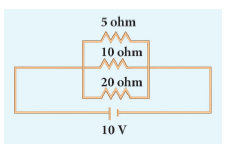
In the circuit diagram given below, three resistors R1, R2 and R3 of 5 Ω, 10 Ω and 20 Ω respectively are connected as shown. Calculate:
A) Current through each resistor
B) Total current in the circuit
C) Total resistance in the circuit
20.
A container whose capacity is 70 ml is filled with a liquid up to 50 ml. Then, the liquid in the container is heated. Initially, the level of the liquid falls from 50 ml to 48.5 ml. Then we heat more, the level of the liquid rises to 51.2 ml. Find the apparent and real expansion.
21.
A ball of mass 1 kg moving with a speed of 10 ms-1 rebounds after a perfect elastic collision with the floor. Calculate the change in linear momentum of the ball.
22.
In what way hygroscopic substances differ from deliquescent substances.
23.
Explain the factors influencing the rate of a reaction
24.
a) What do you understand by the term ‘ultrasonic vibration’?
b) State three uses of ultrasonic vibrations.
c) Name three animals which can hear ultrasonic vibrations.
25.
26.
Describe rocket propulsion.
1.
(d)
i and iv
2.
(d)
i, ii and iv
3.
(a)
atomic number
4.
(a)
330 ms-1
5.
(c)
Carbon dioxide
6.
(c)
ohm
7.
(c)
zero
8.
(c)
in front of the retina
9.
(c)
Force
10.
(i) A combination reaction is a reaction in which two or more reactants combine to form a compound.
(ii) It is also called as synthesis reaction (or) composition reaction (a single product).
(iii) S(s) + O2(g) → SO2(g)
(iv) Sulphur reacts with oxygen it produce sulphur dioxide.
(v) Most of combination reactions are exothermic in nature, because they involve the formation of new bonds, which releases a huge amount of energy in the form of heat.
11.
|
Deliquescent |
Hygroscopic |
|---|---|
| Copper sulphate pentahydrate, Calcium chloride, Gypsum Salt. | Conc. Sulphuric acid, Silica gel. |
12.
(i) Aqueous solution:
a) The solution in which water acts as a solvent is called aqueous solution.
b) Example: common salt in water, Copper Sulphate in water.
(ii) Non - Aqueous solution:
a) The solution in which any liquid, other than water, acts as a solvent is called non-aqueous solution.
b) Example: Sulphur dissolved in carbon disulphide, Iodine dissolved in carbon tetrachloride
13.
(i) Melting point of tungsten is very.
(ii) Hence it is used in a filament bulb.
(iii) But a fuse wire should be made up of material which has low melting point.
14.
Hydrogen chloride (HCl), Hydrogen iodide (HI) are two examples for heterodiatomic molecules.
15.
| S. No | Mass | Weight |
|---|---|---|
| (i) | Fundamental quantity. | Derived quantity. |
| (ii) | It is the amount of matter containing in a body. | It is the gravitational pull acting on the body. |
| (iii) | Its unit is kilogram (kg). | Its unit is newton (N). |
| (iv) | Remains the same. | Varies from one place to another place. |
| (v) | It is a scalar quantity. | It is a vector quantity. |
16.
17.
Given: Length, L = 10 m
Resistance, R = 2 ohm
Area, A = 2 × 10⁻⁷ m2
Resistivity, ρ = \(\frac{RA}{L}\)= \(\frac{2 \times 2 \times 10^{-7}}{10}\)
= 4 × 10⁻⁸ Ω m
Conductance, G = \(\frac{1}{R}=\frac{1}{2}\) = 0.5 mho
Conductivity, σ = \(\frac{1}{ρ}\)= \(\frac{1}{4 \times 10^{-8}}\)
= 0.25 × 10⁸ mho m–1
18.
(i) Mass percentage of the solute
Mass percentage of solute = \(\begin{aligned} & \frac{\text { Mass of the solute }}{\text { Mass of the solute +Mass of the solvent}} \times 100 \\ \end{aligned}\)
= \(\frac{16 × 100}{16 + 100}\)
\(=\frac{1600}{116}\)
Mass percentage of the solute = 13.79 %
(ii) Mass percentage of solvent = 100 - (Mass percentage of the solute)
= 100 – 13.79
= 86.21%
19.
A) Since the resistors are connected in parallel, the potential difference across each resistor is same (i.e. V=10V)
Therefore, the current through R1 is,
\({ I }_{ 1 }=\frac { V }{ { R }_{ 1 } } =\frac { 10 }{ 5 } =2A\)
Current through \({ R }_{ 2 }={ I }_{ 2 }=\frac { V }{ { R }_{ 2 } } =\frac { 10 }{ 10 } =1A\)
Current through \({ R }_{ 3 }={ I }_{ 3 }=\frac { V }{ { R }_{ 3 } } =\frac { 10 }{ 20 } =0.5A\)
B) Total current in the circuit, I = I1 + I2 + I3
= 2 + 1 + 0.5 = 3.5 A
C) Total resistance in the circuit \(\frac { 1 }{ { R }_{ P } } =\frac { 1 }{ { R }_{ 1 } } +\frac { 1 }{ { R }_{ 2 } } +\frac { 1 }{ { R }_{ 3 } } \)
\(=\frac { 1 }{ 5 } +\frac { 1 }{ 10 } +\frac { 1 }{ 20 } \)
\(=\frac { 4+2+1 }{ 20 } \)
\(\frac { 1 }{ { R }_{ P } } =\frac { 7 }{ 20 } \)
Hence, \({ R }_{ P }=\frac { 20 }{ 7 } =2.857\Omega \)
20.
Data:
Level of the liquid L1 = 50 ml
Level of the liquid L2 = 48.5 ml
Level of the liquid L3 = 51.2 ml
Apparent expansion = L3 − L1
= 51.2 ml – 50 ml = 1.2ml
Real expansion = L3 − L2
= 51.2 ml – 48.5ml = 2.7ml
So, Real expansion > apparent expansion
21.
Given \(\mathrm{m}=1 \mathrm{~kg}, \quad \mathrm{v}=10 \mathrm{~m} \mathrm{~s}^{-1}\)
When a ball bounces back with the same speed, the momentum changes from mv to -mv. So, the change in momentum is -2 mv.
Δp = mv - mu
= -mv - mv
\(=-2 \mathrm{mv}=-2 \times 1 \times 10 \) \([Here \ mu = mv \\ mv = -mv]\)
\(\therefore \Delta P=-20 \mathrm{~kg} \mathrm{~m} \mathrm{~s}^{-1}\)
22.
|
Deliquescence substances |
Hygroscopic substances |
|---|---|
| When exposed to the atmosphere at ordinary temperature, they absorb moisture and do not dissolve. |
When exposed to the atmospheric air at ordinary temperature, they absorb moisture and dissolve. |
| Hygroscopic substances do not change its physical state on exposure to air. | Deliquescent substances change its physical state on exposure to air. |
| Hygroscopic substances may be amorphous solids or liquids. |
Deliquescent substances are crystalline solids. |
| Hygroscopic substances are used as drying agents. | Deliquescent Substances are not used as drying agent. |
| Example : H2SO4.P2O5 | Example : NaOH, KOH |
23.
Important factors that affect rate of a reaction are:
(i) Nature of the reactants
(ii) Concentration of the reactants
(iii) Temperature
(iv) Catalyst
(v) Pressure
(vi) Surface area of the reactants
(i) Nature of the reactants:
a) The reaction of sodium with hydrochloric acid is faster than that with acetic acid.
b) Because Hydrochloric acid is a stronger acid than acetic acid and thus more reactive.
c) \(2 \mathrm{Na}_{(\mathrm{s})}+2 \mathrm{CH}_{3} \mathrm{COOH}_{\text {(aq) }} \rightarrow 2 \mathrm{CH}_{3} \mathrm{COONa}_{\text {(aq) }}+\mathrm{H}_{2(\mathrm{~g})} \rightarrow (slow)\)
d) 2 Na(S)+ 2HCI(aq) ⟶ 2NaCI(aq)+ H2(g) ⟶ fast
(ii) Concentration of the reactants:
a) The amount of the substance present in a certain volume of the solution is called 'concentration'.
b) More the concentration, more particles per volume exist in it and faster the reaction.
c) Granulated zinc reacts faster with 2 M hydrochloric acid than 1 M hydrochloric acid.
(iii) Temperature:
a) Most of the reactions go faster at higher temperature.
b) Because adding heat to the reactants provides energy to break more bonds and thus speed up the reaction.
c) E.g: Calcium carbonate reacts slowly with hydrochloric acid at room temperature and faster when temperature increases.
(iv) Pressure:
a) Increasing the pressure of reactant gases increases the reaction rate.
b) Because, increasing pressure the reacting particles come closer and collide frequently.
(v) Catalyst:
a) A catalyst is a substance which increases the reaction rate without being consumed in the reaction.
b) E.g: On heating potassium chlorate, it decomposes into potassium chloride and oxygen gas, but at a slower rate.
c) If manganese dioxide is added, it increases the reaction rate.
(vi) Surface area of the reactants:
a) When solid reactants are involved in a reaction, their powdered form reacts more readily.
b) Because, powdering of the reactants increases the surface area and more energy is available on collision of the reactant particles.
c) Thus, the reaction rate is increased.
d) E.g: Powdered calcium carbonate reacts more readily with hydrochloric acid than marble chips.
24.
a) Ultrasonic Vibrations:
(i) The Vibrations produced by sound waves with a frequency greater than 20 KHz are called ultrasonic vibrations.
(ii) Human ear cannot detect these waves.
b) Uses of Ultrasonic vibration:
(i) Ultrasonic devices are used to detect objects and measure distances.
(ii) Ultrasound imaging or sonography is often used in medicine.
(iii) In the non destructive testing of products and structures. Ultra sound is used to detect invisible flaws.
c) Certain creatures like mosquitoes, dogs, bats and dolphins can detect these waves.
25.
26.
(i) Propulsion of rockets is based on law of conservation of linear momentum as well as Newton's III law of motion.
(ii) Rockets are filled with a fuel (either liquid or solid) in the propellant tank.
(iii) When the rocket is fired, this fuel is burnt and a hot gas is ejected with high speed from the back nozzle producing a huge momentum.
(iv) To balance this momentum, an equal and opposite reaction force is produced combustion chamber which makes the rocket project forward.
(v) While in motion, the mass of the rocket gradually decreases, until the fuel is completely burnt out.
(vi) Since there is no net external force acting on it, the linear momentum of the system is conserved.
(vii) The mass of the rocket decreases with altitude, which results in the gradual increase in velocity of the rocket.
(viii) At one stage, it reaches a velocity, which is sufficient to just escape from the gravitational pull of the Earth. This velocity is called escape velocity.

10th Standard Syllabus & Materials
10th Standard
TN 10th English Prose - 2 - The Night the Ghost Got in Important Questions And Answers Study Material - QB365 Set A
NEW10th Standard
TN 10th English Supplementary - 1 - The Tempest Important Questions And Answers Study Material - QB365 Set A
NEW10th Standard
TN 10th English Poem - 1 - Life Important Questions And Answers Study Material - QB365 Set A
NEW10th Standard
TN 10th English Prose - 1 - His First Flight Important Questions And Answers Study Material - QB365 Set A



Tamilnadu Stateboard 10th Standard Subjects
Tamilnadu Stateboard Standards




