
 100% FREE ACCESS
10th Standard Syllabus & Materials
10th Standard
TN 10th English Prose - 4 - The Attic Important Questions And Answers Study Material - QB365 Set A
NEW10th Standard
TN 10th English Supplementary - 3 - The Story of Mulan Important Questions And Answers Study Material - QB365 Set A
NEW10th Standard
TN 10th English Poem - 3 - I am Every Woman Important Questions And Answers Study Material - QB365 Set A
NEW10th Standard
TN 10th English Prose - 3 - Empowered Women Navigating The World Important Questions And Answers Study Material - QB365 Set A
NEW10th Standard
TN 10th English Supplementary - 2 - Zigzag Important Questions And Answers Study Material - QB365 Set A
NEW10th Standard
TN 10th English Poem - 2 - The Grumble Family Important Questions And Answers Study Material - QB365 Set A

Published on: 19/10/2025
Download Tamil Nadu 10th Standard Science question papers, model tests, one-mark questions, important questions, and public exam papers in PDF format. Free study materials and answer keys for TN State Board students.
Questions + Answers key
Take MCQ Science Test
1.
 IUPAC name of this compound
2 Ethyl pentane
2 Ethyl butane
3-methyl hexane
2-methyl hexane
2.
Complete the reaction: 88Ra226 ➝ 86Rn222+ ?
-1e0
1eo
2He4
0n1
3.
A cheap, conventional, commercial and inexhaustible source of energy is
hydropower
solar energy
wind energy
thermal energy
4.
Green house effect refers to
cooling of earth
trapping of UV rays
cultivation of plants
warming of earth
5.
A renewable source of energy is
petroleum
coal
nuclear fuel
trees
6.
7.
8.
Proton - Proton chain reaction is an example of__________
Nuclear fission
\(\alpha\) - decay
Nuclear fusion
\(\beta\) - decay
9.
_____________ aprons are used to protect us from gamma radiations
Lead oxide
Iron
Lead
Aluminium
10.
Which of the following pairs can be the successive members of a homologous series?
C3H8 and C4H10
C2H2 and C2H4
CH4 and C3H6
C2H5OH and C4H8OH
11.
The secondary suffix used in IUPAC nomenclature of an aldehyde is ____
- ol
– oic acid
– al
- one
12.
The molecular formula of an open chain organic compound is C3H6. The class of the compound is
alkane
alkene
alkyne
alcohol
13.
How are e-wastes generated?
14.
Solar energy is a renewable energy. How?
15.
Why fossil fuels are to be conserved?
16.
What is Scratch?
17.
What is the average energy released from a single fission process?
18.
If A is a radioactive element which emits an \(\alpha\) - particle and produces 104Rf 259. Write the atomic number and mass number of the element A.
19.
Who discovered natural radioactivity?
20.
Differentiate soaps and detergents.
21.
How do detergents cause water pollution? Suggest remedial measures to prevent this pollution?
22.
How is ethanoic acid prepared from ethanol? Give the chemical equation.
23.
Enumerate the importance of forest.
24.
What are the sources of solid wastes? How are solid wastes managed?
25.
What is a nuclear reactor? Explain its essential parts with their functions.
26.
Compare the properties of alpha, beta and gamma radiations.
27.
28.
How is ethanol manufactured from sugarcane?
29.
CH3-CH2-CH2-CH=CH2
30.

31.

32.
List any three activities based on 4R approach to conserve natural resources.
33.
What are the consequences of deforestation?
34.
What are the advantages of using biogas?
35.
What is the importance of rainwater harvesting?
36.
State Soddy and Fajans displacement law.
37.
Define critical mass.
38.
Write any three features of natural and artificial radioactivity.
1.
(c)
3-methyl hexane
2.
(c)
2He4
3.
(a)
hydropower
4.
(d)
warming of earth
5.
(d)
trees
6.
(a)
7.
(d)
8.
(c)
Nuclear fusion
9.
(c)
Lead
10.
(a)
C3H8 and C4H10
11.
(c)
– al
12.
(b)
alkene
13.
Electronic wastes are generated from the spoiled, outdated, non - repairable electrical and electronic devices such as computers, calculator, toys etc.
14.
The sun gets its energy through nuclear fusion. In this reaction hydrogen atoms fused to form helium atom. As a result huge energy is radiated on the surface of the sun. This reaction is repeated again and again resulting in the energy output continuously.
\(4 \mathrm{H}^{1} \rightarrow{ }_{2} \mathrm{He}^{4}+2+{ }_{1} e^{0}+\text { energy }\)
15.
i) Non-renewable energy.
ii) Formation of these fuels is a very slow process and takes very long period of time for renewal.
16.
Scratch is a software used to create animations, cartoons and games easily. Scratch, on the other hand, is a visual programming language. It is developed in the Massachusetts Institute of Technology (MIT). Media Lab to make programming easier and more fun to learn.
17.
The average energy released from a single fission process is 200 MeV = 3.2 x 10⁻¹¹J
18.
Atomic number -106 ; Mass number - 263 (In alpha decay atomic number decrease by two and mass number decrease by four)
19.
Henri Becquerel
20.
| S. No | Soap | Detergent |
|---|---|---|
| i) | Soap is a sodium salt of long chain fatty acids. | Detergent is sodium salt of sulphonic acids. |
| ii) | The ionic part of a soap is -COO-Na+. | The ionic part in a detergent is -SO3-Na+. |
| iii) | It is prepared from animal fats or vegetable oils. | It is prepared from hydrocarbons obtained from crude oil. |
| iv) | Soaps are biodegradable. | Most of the detergents are non biodegradable. |
21.
(i) Some detergents having a branched hydrocarbon chain are not fully biodegradable by microorganisms present in water.
(ii) So they settle as insoluble chemical in water bodies.
(iii) To avoid this type of water pollution, we should. use detergents which have straight hydrocarbon chains.
(iv) Because these are easily degraded by bacteria.
22.
Ethanoic acid is prepared by the oxidation of ethanol in the presence of alkaline potassium permanganate or acidified potassium dichromate.

23.
a) Forests are an important component of our environment.
b) Forest is dominated by
i) microorganisms
ii) flowering plants
iii) shrubs
iv) climbers
v) dense trees
vi) provide a vast habitat for wild animals.
a) Forests also contribute to the economic development of our country.
b) Forests are vital for human life.
c) It is a source for a wide range of renewable natural resource.
d) They provide wood, food, fodder, fibre and medicine.
e) Forest are major factor of environment concern like.
i) carbon sink
ii) regular climatic conditions
iii) increase rainfall
iv) reduce global warming
v) prevent natural hazards like food and landslides
vi) protect wildlife
vii) act as catchments for water conservation.
f) They also play a vital role in maintaining the ecological balance.
24.
Sources of solid waste:
a) Municipal wastes
b) Hospital wastes
c) Industrial wastes
d) e - wastes
Solid waste management:
Solid-waste management involves the collection, treatment and proper disposing of solid material that is discarded from the household and industrial activities.
Methods of solid wastes disposal:
i) Segregation:
It is the separation of different type of waste materials like biodegradable and non biodegradable wastes.
ii) Sanitary landfill:
a) Solid wastes are dumped into Iow lying areas.
b) The layers are compacted by trucks to allow settlement.
c) The waste materials get stabilized in about 2 - 12 months.
d) The organic matter undergoes decomposition.
iii) Incineration:
It is the burning of non-biodegradable solid wastes (medical wastes) in properly constructed furnace at high temperature.
iv) Composting:
Biodegradable matter of solid wastes is digested by microbial action or earthworms and converted into humus.
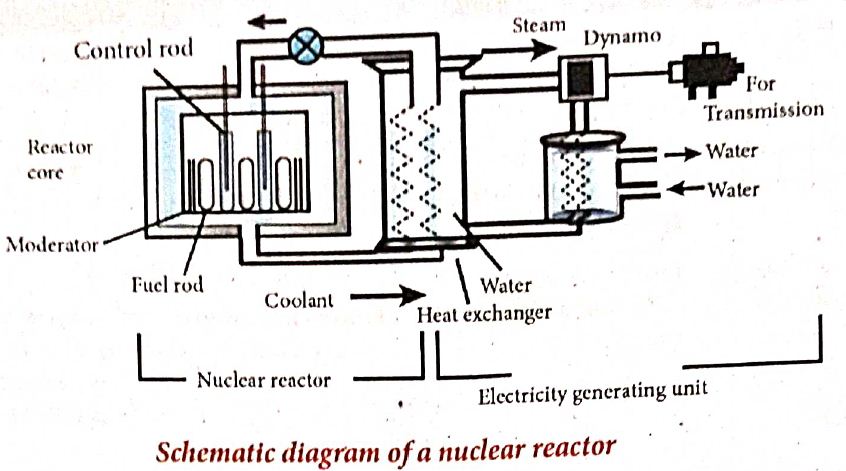
25.
A Nuclear reactor is a device in which the nuclear fission reaction takes place in a self-sustained and controlled manner to produce electricity.
(i) Fuel:
a) A fissile material is used as fuel.
b) The commonly used fuel material is uranium
(ii) Moderator:
a) A moderator is used to slow down the high-energy neutrons to get slow neutrons.
b) Graphite and heavy water are the commonly used moderators.
(iii) Control rod:
a) Control rods are used to control the number of neutrons in order to have a sustained chain reaction.
b) Mostly boron or cadmium rods are used as control rods.
(iv) Coolant:
a)A coolant is used to remove the heat produced in the reactor core to produce steam.
b) This steam is used to run a turbine to produce electricity.
c) Water, air and helium are some of the coolants.
(v) Protection wall:
A thick concrete lead wall is built around the nuclear reactor in order to prevent the harmful radiations from escaping into the environment.
26.
|
Properties |
\(\alpha \) - rays |
\(\beta \) - rays |
\(\gamma \) - rays |
|---|---|---|---|
| What are they? | Helium nucleus (2He4) consisting of two protons and two neutrons | They are electrons. (-1e0), basic elementary particles of all atoms. |
They are electromagnetic waves consisting of photons. |
| Charge | Positively charged particles. Charge of each alpha particle = +2e | Negatively charged particles. Charge of each beta particle=-e | Neutral particles Charge of each gamma particle = zero |
| Ionizing power | 100 times greater than \(\beta \) rays and 10,000 times greater than \(\gamma \)rays | Comparatively low | Very less ionization power |
| Penetrating power | Low penetrating power (even stopped by a thick paper) |
Penetrating power is greater than that of α rays. They can penetrate through the thin metal foil. | They have a very high penetrating power greater than that of \(\beta \) rays. They can penetrate through thick metal blocks. |
| Effect of electric and magnetic field | Deflected by both the fields. (in accordance with Fleming's left-hand rule) | Deflected by both the fields but the direction of deflection is opposite to alpha rays. (in accordance with Fleming's left-hand rule) | They are not deflected by both the fields |
| Speed | Their speed ranges from 1/10 to 1/20 times the speed of light. | Their speed can go up to 9/10 times the speed of light. | They travel at the speed of light. |
27.
28.
(i) Molasses is a dark coloured syrupy liquid left after the crystallization of sugar from the concentrated sugarcane juice.
(ii) It contains 30 % of sucrose, which cannot be separated by crystallization
(i) Dilution of molasses: Molasses is first diluted with water to bring down the U concentration of sugar to about 8 to 10%.
(ii) Addition of Nitrogen source:
a) Molasses usually contains enough nitrogenous matter to act as food for yeast during the fermentation process.
b) If the nitrogen content of the molasses is poor, ammonium sulphate or ammonium phosphate is added.
(iii) Addition of Yeast:
a) This solution kept in large fermentation tank and yeast is added to and it kept at about 303 K for a few days.
b) During this period, the enzymes invertase and, zymase present in yeast, converts sucrose into ethanol.
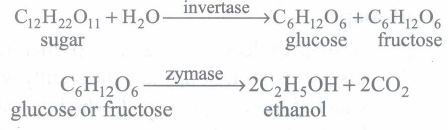
c) The fermented liquid is technically called wash.
(iv) Distillation of wash:
a) This wash containing 15 to 18 % alcohol, is now subjected to fractional distillation.
b) The main fraction drawn in an aqueous solution of ethanol which contains 95.5 % of ethanol and 4.5 % of water.
c) This is called rectified spirit.
d) This mixture is then refluxed over quicklime for about 5 to 6 hour and then allowed to stand for 12 hours.
e) On distillation of mixture, pure alcohol (100%) is obtained.
f) This is called absolute alcohol.
29.
Step 1: It is a ‘five- carbon atoms chain’ and hence the root word is ‘Pent’. (Rule 1)
Step 2: There is a carbon to carbon double bond. The suffix is ‘ene’.
Step 3: The carbon chain is numbered from the end such that double bond has the lowest locant number as shown below: (Rule 3):

Step 4: The locant number of the double bond is 1 and thus the suffix is ‘-1-ene’.
So, the name of the compound is Pent + (-1-ene) = Pent-1-ene
30.
Step 1: The longest chain contains seven carbon atoms and hence the root word is ‘Hept’.
Step 2: There is a substituent. So, the carbon chain is numbered from the end, which is closest to substituent. (Rule 2)

Step 3: All are single bonds between the carbon atoms and thus the suffix is ‘ane’.
Step 4: The substituent is a methyl group and it is located at third carbon. So, its locant number is 3. Thus the prefix is ‘3-Methyl’. (Rule 6)
Hence the name of the compound is 3-Methyl + hept + ane = 3 – Methylheptane
31.
Step 1: The longest chain contains five carbon atoms and hence the root word is ‘Pent’.
Step 2: There is a substituent. So, the carbon chain is numbered from the left end, which is closest to the substituent. (Rule 2)

Step 3: All are single bonds between the carbon atoms and thus the suffix is ‘ane’.
Step 4: The substituent is a methyl group and it is located at second carbon atom. So, its locant number is 2. Thus the prefix is ‘2-Methyl’. (Rule 6).
The name of the compound is 2-Methyl + pent +ane = 2-Methylpentane
32.
The 4R approach such as Reduce, Reuse Recovery and Recycle may be followed for effective waste management.
Reduce:
Avoid the use of material which increases the solid waste.
Reuse:
Repeating use of items such as bottles, old clothes, books and anything else that is used again for a similar purpose to that originally intended.
Recovery:
We can be able to use our waste to recover energy or produce biofuel.
Recycle:
Using recycled material of glass, paper, meta etc..
33.
Deforestation gives rise to ecological problems like floods, drought, soil erosion, loss of wild life, extinction of species, imbalance of biogeochemical cycles, alternation of climatic conditions and desertification.
34.
(i) It burns without smoke and therefore causes less pollution.
(ii) An excellent way to get rid of organic wastes like bio-waste and sewage material.
(iii) Left over slurry is good manure rich in nitrogen and phosphorus.
(iv) It is safe and convenient to use.
(v) It can reduce the amount of green house gases emitted.
35.
(i) Overcome the rapid depletion of ground water levels.
(ii) To meet the increase demand of water.
(iii) Reduce flood and soil erosion.
(iv) Used for drinking purpose.
36.
Soddy and Fagan's displacement laws:
(i) When a parent element emits an alpha particle the new element is formed with a decrease in atomic number by two and mass number by four.
(ii) When a parent nucleus emits a beta particle the daughter nucleus is formed with an increase in atomic number by one and has same mass number of the parent nucleus.
(iii) In gamma decay, the energy level of nucleus only changes. No new elements are formed.
37.
(i) The minimum mass of fissile material necessary to sustain chain reaction is called "critical mass".
(ii) It depends on the nature, density and the size of fissile material.
38.
Natural radioactivity:
(i) Emission of radiation due to self-disintegration of a nucleus
(ii) Exhibited by elements with atomic number more than 82
(iii) This cannot be controlled
Artificial radioactivity:
(i) Emission of radiation due to disintegration of a nucleus through induced process.
(ii) Exhibited by elements with atomic number less than 82.
(iii) This can be controlled.

10th Standard Syllabus & Materials
10th Standard
TN 10th English Prose - 2 - The Night the Ghost Got in Important Questions And Answers Study Material - QB365 Set A
NEW10th Standard
TN 10th English Supplementary - 1 - The Tempest Important Questions And Answers Study Material - QB365 Set A
NEW10th Standard
TN 10th English Poem - 1 - Life Important Questions And Answers Study Material - QB365 Set A
NEW10th Standard
TN 10th English Prose - 1 - His First Flight Important Questions And Answers Study Material - QB365 Set A



Tamilnadu Stateboard 10th Standard Subjects
Tamilnadu Stateboard Standards




