
 100% FREE ACCESS
10th Standard Syllabus & Materials
10th Standard
TN 10th English Prose - 4 - The Attic Important Questions And Answers Study Material - QB365 Set A
NEW10th Standard
TN 10th English Supplementary - 3 - The Story of Mulan Important Questions And Answers Study Material - QB365 Set A
NEW10th Standard
TN 10th English Poem - 3 - I am Every Woman Important Questions And Answers Study Material - QB365 Set A
NEW10th Standard
TN 10th English Prose - 3 - Empowered Women Navigating The World Important Questions And Answers Study Material - QB365 Set A
NEW10th Standard
TN 10th English Supplementary - 2 - Zigzag Important Questions And Answers Study Material - QB365 Set A
NEW10th Standard
TN 10th English Poem - 2 - The Grumble Family Important Questions And Answers Study Material - QB365 Set A

Published on: 19/10/2025
Download Tamil Nadu 10th Standard Science question papers, model tests, one-mark questions, important questions, and public exam papers in PDF format. Free study materials and answer keys for TN State Board students.
Questions + Answers key
Take MCQ Science Test
1.
What do you understand by the term ‘ultrasonic vibration’?
2.
Use the analogy to fill the blank:
i) Bats : Ultrasonic,
Earthquake : _________.
ii) Whispering Gallery : Application of echo,
Tracking a satellite : _________.
3.
What happens when aluminium is heated to 800°C?
4.
Define electronegativity.
5.
Define atomic radius.
6.
Differentiate xylem and phloem.
7.
Define Osmosis.
8.
Name the parts of the hind brain.
9.
What is the shape of RBC in human blood?
10.
What will be the frequency sound having 0.20 m as its wavelength, when it travels with a speed of 331 m s–1?
11.
a) Define Doppler effect.
b) Write the expression for apparent frequency when
i) Both source and listener move towards each other
ii) Both source and the listener move away from each other
iii) Both source and the listener move one behind the other.
12.
Tabulate the different parts of the brain and their functions.
13.
Explain Bessemerisation
14.
Differentiate between Voluntary and involuntary actions.
15.
Differentiate between systemic circulation and pulmonary circulation.
16.
What causes the opening and closing of guard cells of stomata during transpiration?
17.
What is rust? Give the equation for formation of rust.
18.
A is a reddish brown metal, which combines with O2 at < 1370 K gives B, a black coloured compound. At a temperature > 1370 K, A gives C which is red in colour. Find A, B and C with reaction.
19.
Two observers are stationed in two boats 4.5 km apart. A sound signal sent by one, under water, reaches the other after 3 seconds. What is the speed of sound in the water?
20.
Explain why, the ceilings of concert halls are curved.
21.
Absorption of water by seeds and dry grapes is an example for ________________.
Imbibition
Plasmolysis
Ascent of sap
Exosmosis
22.
The bulk movement of substances through the vascular tissue is called ___________________.
Translocation
Imbibition
Diffusion
Osmosis
23.
Sound waves are _______ waves.
Longitudinal waves
transverse waves
either a or b
none
24.
25.
There are ________ pairs of cranial nerves and _______ pairs of spinal nerves.
12, 31
31, 12
12, 13
12, 21
26.
Bipolar neurons are found in
retina of eye
cerebral cortex
embryo
respiratory epithelium
27.
‘Heart of Heart’ is called
SA node
AV node
Purkinje fibres
Bundle of His
28.
Active transport involves
Movement of molecules from lower to higher concentrations
Expenditure of energy
It is an uphill task
All of the above
29.
_____ is a relative periodic property.
atomic radii
ionic radii
electron affinity
electronegativity
30.
_____ group contains the member of halogen family.
17th
15th
18th
16th
31.
The frequency, which is audible to the human ear is
50 kHz
20 kHz
15000 kHz
10000 kHz
32.
When a sound wave travels through air, the air particles
vibrate along the direction of the wave motion
vibrate but not in any fixed direction
vibrate perpendicular to the direction of the wave motion
do not vibrate
33.
With a neat labelled diagram explain the structure of a neuron.
34.
What is Transpiration? Give the importance of transpiration.
35.
Explain smelting process.
36.
The electronic configuration of metal A is 2,8,18,1.
The metal A when exposed to air and moisture forms B a green layered compound. A with con. H2SO4 forms C and D along with water. D is a gaseous compound. Find A,B,C and D.
37.
What is an echo?
a) State two conditions necessary for hearing an echo.
b) What are the medical applications of echo?
c) How can you calculate the speed of sound using echo?
38.
a) What do you understand by the term ‘ultrasonic vibration’?
b) State three uses of ultrasonic vibrations.
c) Name three animals which can hear ultrasonic vibrations.
1.
Ultrasonic Vibrations:
(i) The Vibrations produced by sound waves with a frequency greater than 20 KHz are called ultrasonic vibrations.
(ii) Human ear cannot detect these waves.
2.
i) Infrasonic.
ii) Application of Doppler effect.
3.
On heating at 800oC, aluminium burns very brightly forming it's oxide and nitride.
4AI + 3O2 ➝ 2Al2O3 (Aluminium oxide)
2AI + N2 ➝ 2AIN (Aluminium nitride)
4.
Electronegativity of an element is the measure of the tendency of its atom to attract the shared pair of electrons towards itself in a covalent bond.
5.
Atomic radius is of an atom defined as the distance between the centre of its nucleus and the outermost shell containing the valence electron.
6.
| S.No |
Xylem |
Phloem |
|---|---|---|
| (i) | It is the tissue that transports water and mineral salts absorbed by the roots to all parts of the plant. | It is the tissue that transports the food synthesized by the leaves to the area of requirement as storage parts. |
| (ii) | The movement of water through xylem is an upward direction. | The movement of food through phloem is bidirectional. |
7.
Osmosis is the movement of solvent or water molecules from the region of higher concentration to the region of lower concentration through a semi-permeable membrane.
8.
Hind brain is formed of three parts (1) cerebellum, (2) pons and (3) medulla oblongata.
9.
RBCs are biconcave and disc - shaped.
10.
Given: V = 331 ms-1, λ = 0.20 m, n =?
V = n x λ
331 = n(0.20)
n = \(\frac{331}{0.20}\) = 1655 Hz
11.
a) Definition:
Whenever there is a relative motion between a source and a listener, the frequency of the sound heard by the listener is different from the original frequency of sound emitted by the source. This is known as "Doppler effect'.
b)
| Case No | Position of source and listener |
Note | Expression for apparent frequency |
| (i) | i. Both source and listener move. ii. They move towards each other. |
i. Distance between source and listener decreases. ii. Apparent frequency is more than actual frequency. |
\(\mathrm{n}^{\prime}=\left(\frac{\mathrm{v}^{2}+\mathrm{v}_{L}}{\mathrm{v}-\mathrm{v}_{s}}\right) \mathrm{n}\) |
| (ii) | i. Both source and listener move. ii. They move away from each other. |
i. Distance between source and listener increases. ii. Apparent frequency is less than the actual frequency vS and vL become opposite to that in case-1. |
\(n^{\prime}=\left(\frac{v-v_{L}}{v+v_{s}}\right) n\) |
| (iii) | i. Both source and listener move. ii. They move one behind the other. iii. Source follows the listener. |
Apparent frequency depends on the velocities of the source and the listener vS becomes opposite to that in case-2. | \(\mathrm{n}^{\prime}=\left(\frac{\mathrm{v}-\mathrm{v}_{L}}{\mathrm{v}-\mathrm{v}_{s}}\right) \mathrm{n}\) |
12.
| Structure | Functions |
| Cerebral cortex | Sensory perception, control of voluntary functions, language, thinking, memory, decision making, creativity. |
| Thalamus | Acts as relay station. |
| Hypothalamus | Temperature control, thirst, hunger, urination, important link between nervous system and endocrine glands. |
| Cerebellum | Maintenance of posture and balance, coordinate voluntary muscle activity. |
| Pons and medulla | Role in sleep-awake cycle, cardiovascular, respiratory and digestive control centers. |
13.
Bessemerisation The molten matte is transferred to Bessemer converter in order to obtain blister copper. Ferrous sulphide from matte is oxidized to ferrous oxide, which is removed as slag using silica.
2FeS+3O2 ⟶ 2FeO+2SO2 ↑
.JPG)
2 Cu2S + 3O2 ⟶ 2 Cu2O + 2 SO2
.JPG)
14.
| S.No | Voluntary actions | Involuntary actions |
|---|---|---|
| i) | An action which is under conscious control. |
An action which is not under conscious control. |
| ii) | Voluntary action is controlled by the brain. | Involuntary action is controlled by the spinal cord. |
| iii) | All voluntary actions result in a muscular action. | Involuntary actions result in a muscular action (or) secretion from some gland. |
15.
| Systemic circulation | Pulmonary circulation |
| Systemic circulation moves blood between the heart and the rest of the body. | Pulmonary circulation moves blood between the heart and the lungs. |
| It sends oxygenated blood out to cells and returns deoxygenated blood to the heart. | It transports deoxygenated blood to the lungs to absorb oxygen and release carbon dioxide. The oxygenated blood then flows back to the heart. |
16.
(i) The opening and closing of stomata is due to the change in turgidity of the guard cells.
(ii) When water enters into the guard cells, they become turgid and the stomata opens.
(iii) When the guard cells lose water, it becomes flaccid and the stomata closes.

17.
(i) Rust is the formation of scaling reddish brown hydrated ferric oxide on the surface of iron containing materials.
(ii) This compound is known as rust and the phenomenon of formation of rust in known as rusting.
(iii) \( 4 \mathrm{Fe}+3 \mathrm{O}_{2}+\mathrm{xH}_{2} \mathrm{O} \rightarrow 2 \mathrm{Fe}_{2} \mathrm{O}_{3} \cdot \mathrm{xH}_{2} \mathrm{O}\\ \quad \quad \quad \quad \quad\quad\text { (Rust hydrated ferric oxide) } \)
18.
(i) A - reddish brown metal - Copper
(ii) When copper is heated at < 1370 K in the presence of oxygen, copper forms black colour Copper (II) oxide (CuO).
(iii) \(2 \mathrm{Cu}+\mathrm{O}_{2} \stackrel{\text { below } 1370 \mathrm{~K}}{\longrightarrow} \underset{\text { (copper (Il)oxide-black) }}{2 \mathrm{CuO}}\)
(iv) When copper is heated at >1370 K in the presence of oxygen, copper forms red colour Cop-per (I) oxide \((\mathrm{Cu}_{2} \mathrm{O} )\)
(v) \(4 \mathrm{Cu}+\mathrm{O}_{2} \stackrel{\text { above } 1370 \mathrm{~K}}{\longrightarrow} \underset{\text { (copper-I-oxide-red) }}{2 \mathrm{Cu_2O}}\)
(vi) A - copper (Cu)
(vii) B - copper (II) oxide (CuO) - Black coloured
(viii) \(\mathbf{C} - copper-I-oxide \left(\mathrm{Cu}_{2} \mathbf{O}\right)-\operatorname{Red}\) coloured
19.
d = 4.54 km = 4500 m
t = 3 s
v = ?
\(v=\cfrac { d }{ t } =\cfrac { 4500 }{ 3 } \)
v = 1500 m/s
20.
(i) When sound is reflected from a concave surface, the reflected waves are converged at a point.
(ii) So, the ceilings of the concrete wall is curved.
21.
(a)
Imbibition
22.
(a)
Translocation
23.
(a)
Longitudinal waves
24.
(a)
25.
(a)
12, 31
26.
(a)
retina of eye
27.
(a)
SA node
28.
(d)
All of the above
29.
(d)
electronegativity
30.
(a)
17th
31.
(b)
20 kHz
32.
(a)
vibrate along the direction of the wave motion
33.
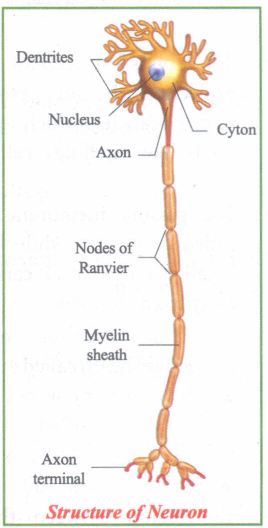
A neuron typically consists of three basic parts:
Cyton, Dendrites and Axon.
(i) Cyton:
(a) Cyton is also called cell body or perikaryon.
(b) It has a central nucleus with abundant cytoplasm called neuroplasm.
(c) The cytoplasm has large granular body called Nissl's granules and the other cell organelles like mitochondria, ribosomes, lysosomes, and endoplasmic recticulum.
(d) Neurons do not have the ability to divide, as there is no centriole
(e) Several neurofibrils are present. in the cytoplasm that help in transmission of nerve impulses to and from the cell body.
(ii) Dendrites:
(a) These are the numerous branched cytoplasmic processes that project from the surface of the cell body.
(b) They conduct nerve impulses towards the cyton.
(c) The branched projections increase the surface area for receiving the signals from other nerve cells.
(iii) Axon:
(a) The axon is a single, elongated, slender projection.
(b) The end of axon terminates as fine branches which terminate into knob like swellings called synaptic knob.
(c) The plasma membrane of axon is called axolemma, while the cytoplasm is called axoplasm.
(d) It carries impulses away from the cyton.
(e) The axons may be covered by a protective sheath called myelin sheath which is further covered by a layer of Schwann cells called neurilemma.
(f) Myelin sheath breaks at intervals by depressions called Nodes of Ranvier.
(g) The region between the nodes is called as internode.
(h) Myelin sheath acts as insulator and ensures rapid transmission of nerve impulses.
(iv) Synapse:
(a) A junction between synaptic knob of axon of one neuron and dendron of next neuron is called synaptic junction.
34.
Definition: Transpiration is the evaporation of water from the aerial parts of the plant especially through stomata in the leaves.
Importance of Transpiration:
(i) Creates transpirational pull for transport of water.
(ii) Supplies water for photosynthesis.
(iii) Transports minerals from soil to all parts of the plant.
(iv) Cools the surface of the leaves by evaporation.
(v) Keeps the cells turgid; hence, maintains their shape.
35.
Smelting (in a Blast Furnace):
(i) The charge consisting of roasted ore, coke and limestone in the ratio 8:4:1 is smelted in a blast furnace by introducing it through the hopper arrangement at the top.
(ii) There are three important regions in the furnace.
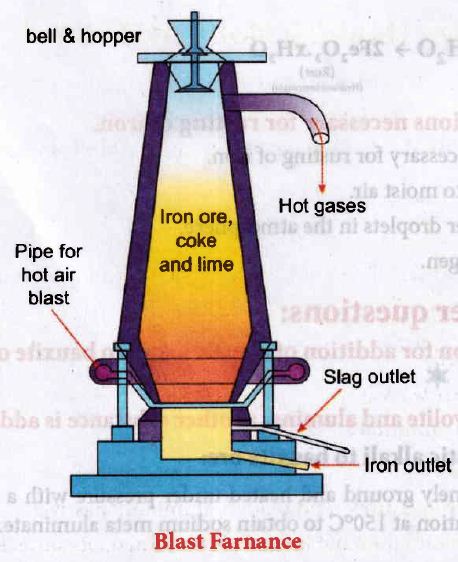
a) The Lower Region (Combustion Zone):
(i) The temperature is at \(1500^{\circ} \mathrm{C}\).
(ii) In this region, coke burns with oxygen to form CO2 when the charge comes in contact with a hot blast of air.
(iii) It is an exothermic reaction since heat is liberated.
\(\mathbf{C}+\mathbf{O}_{2} \underset{\Delta}{\stackrel{1500^{\circ} \mathrm{C}}{\longrightarrow}} \mathrm{CO}_{2}+ Heat\)
b) The Middle Region (Fusion Zone):
(i) The temperature prevails at \(1000^{\circ} \mathrm{C}\).
(ii) In this region, CO2 is reduced to CO.
\(\mathrm{CO}_{2}+\mathrm{C} \underset{\Delta}{\stackrel{1000^{\circ} \mathrm{C}}{\longrightarrow}} 2 \mathrm{CO}-\text { Heat }\)
(iii) Limestone decomposes to calcium oxide and CO2.
\(\mathrm{CaCO}_{3} \underset{\Delta}{\stackrel{1000^{\circ} \mathrm{C}}{\longrightarrow}} \mathrm{CaO}+CO_2-\text { Heat }\)
(iv) These two reactions are endothermic due to absorption of heat.
(v) Calcium oxide combines with silica to form calcium silicate slag.
\(\mathrm{CaO}+\mathrm{SiO}_{2} \longrightarrow \mathrm{CaSiO}_{3}\)
c) The Upper Region (Reduction Zone):
(i) The temperature prevails at \(\mathbf{4 0 0 ^ { \circ } \mathrm { C } \text { . }}\)
(ii) In this region carbon monoxide reduces ferric oxide to form a fairly pure spongy iron.
\(\mathrm{Fe}_{2} \mathrm{O}_{3}+3 \mathrm{CO} \stackrel{400^{\circ} \mathrm{C}}{\longrightarrow} 2 \mathrm{Fe}+3 \mathrm{CO}_{2}\uparrow\)
(iii) The molten iron is collected at the bottom of the furnace after removing the slag.
(iv) The iron thus formed is called pig iron.
(v) It is remelted and cast into different molds.
(vi) This iron is called cast iron.
36.
(i) Copper gets covered with a green layer of basic copper carbonate in the presence of CO2 and moisture.
(ii) \(2 \mathrm{Cu}+\mathrm{O}_{2}+\mathrm{CO}_{2}+\mathrm{H}_{2} \mathrm{O} \rightarrow \mathrm{CuCO}_{3} \cdot \mathrm{Cu}(\mathrm{OH})_{2}\)
(iii) Copper reacts with con. \(\mathrm{H}_{2} \mathrm{SO}_{4}\) to from copper sulphate and SO2.
(iv) \(\mathrm{Cu}+2 \mathrm{H}_{2} \mathrm{SO}_{4} \rightarrow \mathrm{CuSO}_{4}+\mathrm{SO}_{2} \uparrow+2 \mathrm{H}_{2} \mathrm{O}\)
(v) So, A is-Copper (Cu)
\(\mathrm{B}\ is \ -\mathrm{CuCO}_{3} \cdot \mathrm{Cu}(\mathrm{OH})_{2}\) Basic copper carbonate.
\(\mathrm{C}\ is \ -\mathrm{CuSO}_{4}\) (copper sulphate)
\(\mathrm{D}\ is \ -\mathrm{SO}_{2}\) (Sulphur oxide)
37.
Echo:
(i) An echo is the sound reproduced due to the reflection of the original sound from various rigid surfaces such as walls, ceilings, surfaces of mountains, etc.
a) Conditions necessary for hearing echo:
(i) The persistence of hearing for human ears is 0.1 second.
(ii) This means that you can hear two sound waves clearly, if the time interval between the two sounds is at least 0.1 s.
(iii) Thus, the minimum time gap between the original sound and an echo must be 0.1 s.
(iv) The above criterion can be satisfied only when the distance between the source of sound and the reflecting surface would satisfy the following equation:
\(\text { Velocity } =\frac{\text { distance travelled by sound }}{\text { time taken }} \)
\(v =\frac{2 d}{t} \)
\(d =\frac{v t}{2}\)
since, t = 0.1 second, then \(\mathrm{d}=\frac{331}{0.20}=\frac{\mathrm{v}}{20}\)
(v) Thus the minimum distance required to hear an echo is 1 / 20th part of the magnitude of the velocity of sound in air.
(vi) If you consider the velocity of sound as 344 ms-1, the minimum distance required to hear an echo is 17.2 m.
b) Applications of echo:
(i) The principle of echo is used in obstetric ultrasonography, which is used to create real-time visual images of the developing embryo or fetus in the mother's uterus.
(ii) This is a safe testing tool, as it does not use any harmful radiations.
c) Calculation of speed of sound:
(i) The sound pulse emitted by the source travels a total distance of 2d while travelling from the source to the wall and then back to the receiver.
(ii) The time taken for this has been observed to be 't'. Hence, the speed of sound wave is given by
\(\text { Speed of Sound }=\frac{\text { distance travelled }}{\text { time taken }}=\frac{2 \mathrm{d}}{\mathrm{t}}\)
38.
a) Ultrasonic Vibrations:
(i) The Vibrations produced by sound waves with a frequency greater than 20 KHz are called ultrasonic vibrations.
(ii) Human ear cannot detect these waves.
b) Uses of Ultrasonic vibration:
(i) Ultrasonic devices are used to detect objects and measure distances.
(ii) Ultrasound imaging or sonography is often used in medicine.
(iii) In the non destructive testing of products and structures. Ultra sound is used to detect invisible flaws.
c) Certain creatures like mosquitoes, dogs, bats and dolphins can detect these waves.

10th Standard Syllabus & Materials
10th Standard
TN 10th English Prose - 2 - The Night the Ghost Got in Important Questions And Answers Study Material - QB365 Set A
NEW10th Standard
TN 10th English Supplementary - 1 - The Tempest Important Questions And Answers Study Material - QB365 Set A
NEW10th Standard
TN 10th English Poem - 1 - Life Important Questions And Answers Study Material - QB365 Set A
NEW10th Standard
TN 10th English Prose - 1 - His First Flight Important Questions And Answers Study Material - QB365 Set A



Tamilnadu Stateboard 10th Standard Subjects
Tamilnadu Stateboard Standards




