
 100% FREE ACCESS
10th Standard Syllabus & Materials
10th Standard
TN 10th English Prose - 4 - The Attic Important Questions And Answers Study Material - QB365 Set A
NEW10th Standard
TN 10th English Supplementary - 3 - The Story of Mulan Important Questions And Answers Study Material - QB365 Set A
NEW10th Standard
TN 10th English Poem - 3 - I am Every Woman Important Questions And Answers Study Material - QB365 Set A
NEW10th Standard
TN 10th English Prose - 3 - Empowered Women Navigating The World Important Questions And Answers Study Material - QB365 Set A
NEW10th Standard
TN 10th English Supplementary - 2 - Zigzag Important Questions And Answers Study Material - QB365 Set A
NEW10th Standard
TN 10th English Poem - 2 - The Grumble Family Important Questions And Answers Study Material - QB365 Set A

Published on: 19/10/2025
Download Tamil Nadu 10th Standard Science question papers, model tests, one-mark questions, important questions, and public exam papers in PDF format. Free study materials and answer keys for TN State Board students.
Questions + Answers key
Take MCQ Science Test
1.
Differentiate external and cellular respiration.
2.
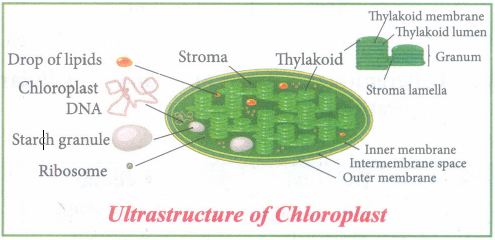
Draw the ultrastructure of a chloroplast and label the parts.
3.
Differentiate Dicot leaf and Monocot leaf.
4.
Name the internal factors affecting photosynthesis.
5.
What are grana?
6.
What are bulliform cells?
7.
Fermentation is a process applicable of Bakery and Breweries. What is the scientific explanation for this?
8.
Describe the structure of mitochondria. Why is it called the "Power house of the cell"?
9.
Explain the role of sunlight in photosynthesis.
10.
11.
12.
13.
14.
15.
Explain the internal structure of monocot root (Maize) with labeled diagram.
16.
Tabulate the components and functions of three types of tissue system.
17.
Explain the three types of tissue systems of plants.
1.
| S. No. |
External respiration | Cellular respiration |
|---|---|---|
| i | It is a physical process. | It is a chemical process. |
| ii | Exchange of gases take place. | Food is oxidised to produce energy. |
2.
3.
| S.No: |
Dicot Leaf |
Monocot Leaf |
|---|---|---|
| i | Dorsiventral leaf. | Isobilateral leaf. |
| ii | Mesophyll is differentiated into palisade and spongy parenchyma. | Mesophyll is not differentiated into palisade and spongy parenchyma. |
4.
(i) Pigments.
(ii) Leaf age.
(iii) Accumulation of carbohydrates.
(iv) Hormones.
5.
(i) In the strong of a chloroplast some of the thylakoids are arranged in the form of discs stacked one above the other.
(ii) These stacks are termed as grana. They are interconnected to each other by membranous lamellae called Fret channels.
6.
In monocot leaf some cells of upper epidermis are large and thin walled. They are known as bulliform cells.
7.
(i) Anaerobic respiration is referred to as fermentation. Microbes like yeast are used in these processes.
(ii) They respire anaerobically by which the substrate (sugar) is converted to alcohol and carbon dioxide.
(iii) Carbon dioxide is used by bakeries. Alcohol is used by breweries.
8.
Mitochondria:
(i) Mitochondria are organelles within eukaryotic cells that produce Adenosine Triphosphate (ATP) which form the energy currency of the cell. The mitochondria is referred to as the "Power house of the cell".
Structure of mitochondira:
(i) Mitochondrial membranes: It consists two membranes called inner and outer membrane. Each membrane is 60-70 Â thick.
(ii) Outer mitochondrial membrane is smooth and freely permeable to most small molecules. It contains enzymes, proteins and lipids
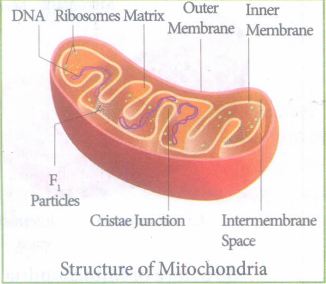
(iii) It has porin molecules (proteins) which form channels for passage of molecules through it.
(iv) Inner mitochondrial membrane is semi permeable membrane and regulates the passage of materials into and out of the mitochondria. It is rich in enzymes and carrier proteins.
Cristae:
(i) The inner mitochondrial membrane gives rise to finger like projections called cristae.
(ii) These cristae increase the inner surface area (fold in inner membrane) of the mitochondria to hold variety of enzymes
Oxysomes:
(i) The inner mitochondrial membrane bear minute regularly spaced tennis racket shaped particles known as oxysomes (F1 particle).
(ii) They involve in ATP synthesis.
9.
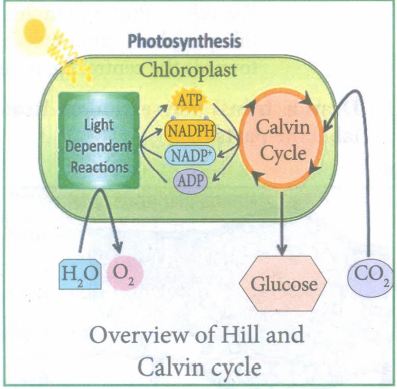
The entire process of photosynthesis takes place inside the chloroplast. The structure of chloroplast is such that the light dependent (Light reaction) and light independent (Dark reaction) take place at different sites in the organelle.
a) Light dependent photosynthesis:
(Hill reaction \ Light reaction)
(i) Discovered by Robin Hill (1939). This reaction takes place in the presence of light energy in thylakoid membranes (grana) of the chloroplasts.
(ii) Photosynthetic pigments absorb the light energy and convert it into chemical energy ATP and NADPH2. These products of light reaction move out from the thylakoid to the stroma of the chloroplast.
b) Light independent reactions:
(Biosynthetic phase):
(i) The second steps (dark reaction or biosynthetic pathway) is carried out in the stroma.
(ii) During this reaction CO2 is reduced into carbohydrates with the help of light generated ATP and NADPH2.
(iii) This is also called as Calvin cycle and is carried out in the absence of light.
(iv) In Calvin cycle the inputs are CO2 from the atmosphere and the ATP and NADPH2 produced from light reaction
10.
(d)
11.
(b)
12.
(d)
13.
(a)
14.
(d)
15.
Internal Structure of Monocot Root (Maize)
A thin transverse section of monocot root, shows the following characteristic features.
i) Epiblema or Rhizodermis: It is the outermost layer of the root, and is made up of single layer of thin walled, parenchymatous cell. Stomata and cuticle are absent. The root hair helps in absorption of water and minerals from the soil. This layer also protects the inner tissues.
ii) Cortex: It is multilayered large zone, composed of parenchymatous cells with intercellular spaces. It stores water and food material.
iii) Endodermis: It is the innermost layer of cortex with characteristic casparian strips and passage cells. Casparian strips are band like thickening made of suberin.
iv) Stele: All the tissues inner to endodermis constitute stele. It includes pericycle, vascular tissues and pith.
a) Pericycle: It is a single layer of thin walled cells. The lateral roots originate from this layer.
b) Vascular tissues: It consists of many patches of xylem and phloem arranged radially. The xylem is exarch and polyarch. The conjunctive tissue is made up of sclerenchyma.
c) Pith: It is present at the center. It is made up of parenchyma cells with intercellular space. Its contains abundant amount of starch grains. It stores food.
16.
| Tissue System | Components | Functions |
| a) Dermal Tissue System | i) Epidermis and ii) Periderm (In older stems and roots) |
i) Protection ii) Prevention of water loss |
| b) Ground Tissue System | i) Parenchyma tissue ii) Collenchyma tissue iii) Sclerenchyma tissue |
.i) Photosynthesis ii) Food Storage iii) Regeneration iv) Support v) Protection |
| c) Vascular Tissue System | Vascular tissues i) Xylem tissue ii) Phloem tissue |
i) Transport of water and minerals ii) Transport of food. |
17.
Sachs (1875) classified tissue system in plants into three types
a) Dermal or Epidermal tissue system
b) Ground tissue system and
c) Vascular tissue system
a) Dermal or Epidermal Tissue System:
It consists of epidermis, stomata and epidermal outgrowths. Epidermis is the outer most layer. It has many minute pores called stomata. Cuticle is present on the outer wall of epidermis to check evaporation of water. Trichomes and root hairs are the epidermal outgrowths.
Functions:
i) Epidermis protects the inner tissues.
ii) Stomata helps in transpiration.
iii) Root hairs help in absorption of water and minerals
b) Ground Tissue System on Fundamental tissue system:
It includes all the tissues of the plant body except epidermal and vascular tissues like
(i) Cortex
(ii) Endodermis
(iii) Pericycle
(iv) Pith
c) Vascular Tissue System on conducting tissue system:
It consists of xylem and phloem tissues. They are present in the form of bundles called vascular bundles. Xylem conducts water and minerals to different parts of the plant. Phloem conducts food materials to different parts of the plant.
There are three different types of vascular bundles namely
(i) Radial
(ii) Conjoint
(iii) Concentric.
i) Radial Bundles:
Xylem and phloem are present in different radii alternating with each other. e.g. roots.
ii) Conjoint bundles:
Xylem and phloem lie on the same radius. There are two types of conjoint bundles.
a) Collateral: Xylem lies towards the centre and phloem lies towards the periphery. When cambium is present in collateral bundles, it is called open. e.g. dicot stem and collateral bundle without cambium is called closed. e.g. monocot stem.
b) Bicollateral: In this type of bundle, the phloem is present on both outer and inner side of xylem. e.g. Cucurbita
iii) Concentric Bundles:
Vascular bundle in which xylem completely surrounds the phloem or vice versa is called concentric vascular bundle. It is of two types:
a) Amphivasal: Xylem surrounds phloem. e.g. Dracaena.
b) Amphicribral: Phloem surrounds xylem. e.g. Ferns.

10th Standard Syllabus & Materials
10th Standard
TN 10th English Prose - 2 - The Night the Ghost Got in Important Questions And Answers Study Material - QB365 Set A
NEW10th Standard
TN 10th English Supplementary - 1 - The Tempest Important Questions And Answers Study Material - QB365 Set A
NEW10th Standard
TN 10th English Poem - 1 - Life Important Questions And Answers Study Material - QB365 Set A
NEW10th Standard
TN 10th English Prose - 1 - His First Flight Important Questions And Answers Study Material - QB365 Set A



Tamilnadu Stateboard 10th Standard Subjects
Tamilnadu Stateboard Standards




