
 100% FREE ACCESS
10th Standard Syllabus & Materials
10th Standard
TN 10th English Prose - 4 - The Attic Important Questions And Answers Study Material - QB365 Set A
NEW10th Standard
TN 10th English Supplementary - 3 - The Story of Mulan Important Questions And Answers Study Material - QB365 Set A
NEW10th Standard
TN 10th English Poem - 3 - I am Every Woman Important Questions And Answers Study Material - QB365 Set A
NEW10th Standard
TN 10th English Prose - 3 - Empowered Women Navigating The World Important Questions And Answers Study Material - QB365 Set A
NEW10th Standard
TN 10th English Supplementary - 2 - Zigzag Important Questions And Answers Study Material - QB365 Set A
NEW10th Standard
TN 10th English Poem - 2 - The Grumble Family Important Questions And Answers Study Material - QB365 Set A

Published on: 19/10/2025
Download Tamil Nadu 10th Standard Science question papers, model tests, one-mark questions, important questions, and public exam papers in PDF format. Free study materials and answer keys for TN State Board students.
Questions + Answers key
Take MCQ Science Test
1.
2.
3.
Light independent reaction is also called as ___________
Calvin cycle
Krebs cycle
Glycolysis
Hill reaction
4.
The study of internal structure of plants __________
Plant Physiology
Plant Anatomy
Taxonomy
Cytology
5.
Penetration power is the greatest in_______ rays
alpha
beta
gamma
helium
6.
7.
The body of leech has
23 segments
33 segments
38 segments
30 segments
8.
The segments of leech are known as
Metameres (somites)
Proglottids
Strobila
All the above
9.
Kreb’s cycle takes place in
chloroplast
mitochondrial matrix
stomata
inner mitochondrial membrane
10.
In the nuclear reaction 6X12 \(\overset { \alpha \ decay }{ \longrightarrow } \) zYA, the value of A & Z.
8, 6
8, 4
4, 8
cannot be determined with the given data
11.
In which of the following, no change in mass number of the daughter nuclei takes place
i) \(\alpha\) decay
ii) \(\beta\) decay
iii) \(\gamma \) decay
iv) neutron decay
(i) is correct
(ii) and (iii) are correct
(i) & ( iv) are correct
(ii) & (iv) are correct
12.
The gram molecular mass of oxygen molecule is
16 g
18 g
32 g
17 g
13.
Which is the powerhouse of cells? Why?
14.
Compare between Natural and Artificial Radioactivity.
15.
What is Nuclear Fusion?
16.
Name the elements which undergoes spontaneous radioactivity.
17.
State Avogadro's Hypothesis.
18.
How many pairs of testes are present in leech?
19.
Give the common name of the Hirudinaria granulosa
20.
What is the common step in aerobic and anaerobic pathway?
21.
If A is a radioactive element which emits an \(\alpha\) - particle and produces 104Rf 259. Write the atomic number and mass number of the element A.
22.
Define: Atomicity
23.
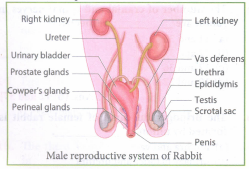
Explain the male reproductive system of rabbit with a labelled diagram.
24.
Differentiate the following
a) Monocot root and Dicot root
b) Aerobic and Anaerobic respiration
25.
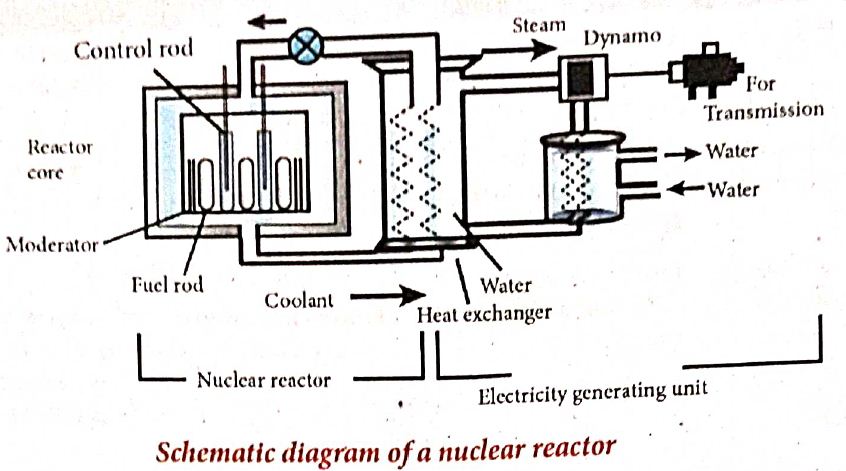
What is a nuclear reactor? Explain its essential parts with their functions.
26.
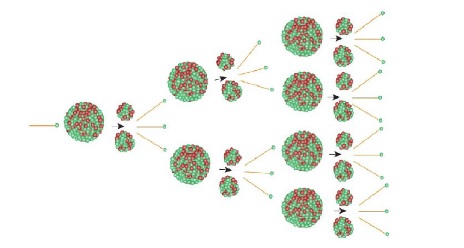
Explain the process of controlled and uncontrolled chain reactions.
27.
Give the salient features of “Modern atomic theory”.
28.
Calculate the number of moles in
(i) 27g of Al
(ii) 1.51 × 10²³ molecules of NH4Cl
29.
Write Applications of Avogadro's law.
30.
List out the parasitic adaptations in leech.
31.
Why are the rings of cartilages found in trachea of rabbit?
32.
Identify A, B, C, and D from the following nuclear reactions.
(i) 13AI27 + A \(\longrightarrow \) 15P30 + B
(ii) 12Mg24 + B \(\longrightarrow \) 11Na24 + C
(iii) 92U238 + B \(\longrightarrow \) 93Np239 + D
33.
Write the reaction for photosynthesis?
34.
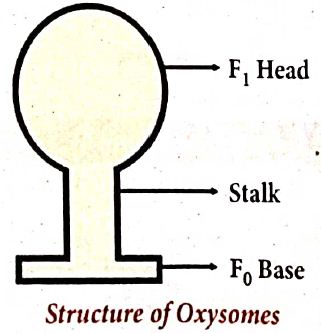
Draw and label the structure of oxysomes.
35.
Mr. Ramu is working as an X - ray technician in a hospital. But, he does not wear the lead aprons. What suggestion will you give to Mr. Ramu?
36.
State Soddy and Fajans displacement law.
37.
Calculate the percentage of sulphur in H2SO4.
38.
Calculate the % of oxygen in Al2(SO4)3. (Atomic mass: Al-27, O-16, S -32).
1.
(c)
2.
(b)
3.
(a)
Calvin cycle
4.
(b)
Plant Anatomy
5.
(c)
gamma
6.
(c)
7.
(b)
33 segments
8.
(a)
Metameres (somites)
9.
(b)
mitochondrial matrix
10.
(b)
8, 4
11.
(b)
(ii) and (iii) are correct
12.
(c)
32 g
13.
i) Mitochondria is the power house of cells.
ii) Because produces a large number of ATP molecules.
14.
| S. No. |
Natural radioactivity |
Artificial radioactivity |
| i | Emission of radiation due to self-disintegration of a nucleus. | Emission of radiation due to disintegration of a nucleus through the induced process. |
| ii | Alpha, beta and gamma radiations are emitted. | Mostly elementary particles such as neutron, positron, etc., are emitted. |
| iii | It is a spontaneous process. | It is an induced process. |
| iv | Exhibited by elements with atomic number more than 83. | Exhibited by elements with atomic number less than 83. |
| v | This cannot be controlled. | This can be controlled. |
15.
The process in which two lighter nuclei combine to form a heavier nucleus is termed as "nuclear fusion".
Eg: 1H2 + 1H2- 2He4 + Q (Energy)
Here, 1H2 represents an isotope of hydrogen known as "deuterium". The average energy released in each fusion reaction is about 3.84 x 10⁻¹²J.
16.
The elements whose atomic number is more than 83 undergo spontaneous radioactivity.
Ex : Uranium, Radium, etc.
Technetium (Tc) with atomic number 43 and Promethium (Pm) with atomic number 61 are the only tow radio active substances.
17.
Avogadro's law states that "equal volumes of all gases under similar conditions of temperature and pressure contain the equal number of molecules"
18.
There are eleven pairs of testes in leech.
19.
The Indian cattle leech.
20.
Glycolysis is the common step in both aerobic and anaerobic pathway.
21.
Atomic number -106 ; Mass number - 263 (In alpha decay atomic number decrease by two and mass number decrease by four)
22.
The total number of atoms present in the molecule is called its atomicity.
\(\text { Atomicity }=\frac{\text { Molecular mass }}{\text { Atomic mass }}\)
23.
Male Reproductive system
(i) Male reproductive system of rabbit consists of a pair of testes which are ovoid in shape.
(ii) Testes are enclosed by scrotal sacs in the abdominal cavity
(iii) Each testis consists of numerous fine tubules called seminiferous tubules
(iv) This network of tubules lead into a coiled tubule called epididymis, which lead into the sperm duct called vas deferens.
(v) Below the urinary bladder is the urethra. Vas deferens joins the urethra.
(vi) Urethra runs backward and passes into the penis.
(vii) There are three accessory glands namely prostate gland, cowper's gland and perineal gland. Their secretions are involved in reproduction.
24.
a) Monocot root and dicot root
|
S.No |
Tissues |
Monocot Root |
Dicot Root |
|---|---|---|---|
| i | Number of Xylem | Polyarch | Tetrarch |
| ii | Cambium | Absent | Present (During secondary growth only) |
| iii | Secondary Growth | Absent | Present |
| iv | Pith | Present | Absent |
b) Aerobic respiration and anaerobic Respiration:
| Basis for Comparison |
Aerobic Respiration |
Anaerobic Respiration |
|---|---|---|
| It occurs in | The cytoplasm and mitochondria. | Cytoplasm only. |
| Final product | Carbon dioxide, water and energy |
Carbon dioxide, Lactic acid (animal cells), ethanol (plant cell) and energy |
| It requires | Oxygen and glucose to produce energy |
It does not require oxygen but uses glucose to Produce energy |
| Number of ATP released | 38 ATP. | 2 ATP. |
25.
A Nuclear reactor is a device in which the nuclear fission reaction takes place in a self-sustained and controlled manner to produce electricity.
(i) Fuel:
a) A fissile material is used as fuel.
b) The commonly used fuel material is uranium
(ii) Moderator:
a) A moderator is used to slow down the high-energy neutrons to get slow neutrons.
b) Graphite and heavy water are the commonly used moderators.
(iii) Control rod:
a) Control rods are used to control the number of neutrons in order to have a sustained chain reaction.
b) Mostly boron or cadmium rods are used as control rods.
(iv) Coolant:
a)A coolant is used to remove the heat produced in the reactor core to produce steam.
b) This steam is used to run a turbine to produce electricity.
c) Water, air and helium are some of the coolants.
(v) Protection wall:
A thick concrete lead wall is built around the nuclear reactor in order to prevent the harmful radiations from escaping into the environment.
26.
(a) Controlled chain reaction:
(i) In the controlled chain reaction the number of neutrons released is maintained to be one.
(ii) This is achieved by absorbing the extra neutrons with a neutron absorber leaving only one neutron to produce further fission.
(iii) Thus, the reaction is sustained in a controlled manner.
(iv) The energy released due to controlled chain reaction can be utilized for constructive purpose.
(v) Controlled chain reaction is used in a nuclear reactor to produce energy in a sustained and controlled manner.
(b) Uncontrolled chain reaction:
(i) In the uncontrolled chain reaction the number of neutrons multiplies indefinitely and cause fission in a large amount of fissile material.
(ii) This results in the release of huge amount of energy within a fraction of second.
(iii) This kind of chain reaction is used in atom bomb to produce explosion.
27.
(i) An atom is no longer indivisible.
(ii) Atoms of the same element may have different atomic masses (isotopes 17Cl35, 17Cl37)
(iii) Atoms of different elements may have the same atomic masses (isobars 18Ar40, 17Ca40)
(iv) Atoms of one element can be transmuted into atoms of other elements. So atom is no longer indestructible. It is called artificial transmutation.
(v) Atoms may not always combine in a simple whole number ratio [Eg: Glucose C6H12O6, sucrose C12H22O11)
(vi) Atom is the smallest particle that takes part in a chemical reaction.
(vii) The mass of an atom can be converted into energy (E = mc2).
28.
(i) 27 g of AI
Number of moles = \(\frac{Given\ Mass}{Atomic \ Mass}=\frac{27}{27}=1\)
Number of moles of 27 g of Al is 1 mole
(ii) 1.51 x 10²³ molecules of NH4Cl
Number of moles = \(\frac{Number \ of \ molecules}{6.023 \times 10^\text{23}}\)
= \(\frac{1.51 \times10^{23}}{6.023 \times10^{23}}\)
\(\frac{1.51}{6.023}\)
Number of moles of 1.51 x 10²³ molecules of NH4Cl = 0.25 mole
29.
30.
Leech is a parasite and sucks the blood of vertebrates and show adaptations.
(i) Suckers are present in the anterior and posterior ends of the body, by which the animal attaches itself to the body of the host.
(ii) The three jaws inside the mouth causes a triradiate or Y shaped wound in the skin of the host.
(iii) Saliva contains a protein called hirudin which prevents the blood clotting. Thus continuous supply of blood is maintained.
(iv) Blood is stored in the crop. It gives nourishment to the leech for several months. Hence, there is no digestive juices and enzyme.
31.
Rings of cartilages are found in the tracheal walls of rabbit to help in the free passage of air.
32.
(i) 13AI27 + 2He4 \(\longrightarrow \) 15P30 + 0n1
(ii) 12Mg24 + 0n1 \(\longrightarrow \) 11Na24 + 1H1
(iii) 92U238 + 0n1 \(\longrightarrow \) 93Np239 + -1e0
A is alpha particle, B is neutron, C is proton, and D is electron.
33.

Carbon dioxide + Water ➝ Glucose + Water + Oxygen
34.
35.
(i) Radiation emitted by the X-ray machine can easily passes through our body and can cause genetic diseases.
(ii) These have been passed by genetic diseases from generation to generation.
(iii) When the emitted radiation is so high, it leads to death. So Mr. Ramu must wear the lead aprons.
36.
Soddy and Fagan's displacement laws:
(i) When a parent element emits an alpha particle the new element is formed with a decrease in atomic number by two and mass number by four.
(ii) When a parent nucleus emits a beta particle the daughter nucleus is formed with an increase in atomic number by one and has same mass number of the parent nucleus.
(iii) In gamma decay, the energy level of nucleus only changes. No new elements are formed.
37.
molecular mass of H2SO4
= (1 × 2) + (32 × 1) + (16 × 4)
= 2 + 32 + 64
= 98 g
% of S in H2SO4 = \(\frac { Mass\ of\ sulphur }{ Moleculer\ mass\ of\ H_2\ SO_4 } \times 100\)
% of S in H2SO4 = \(\cfrac { 32 }{ 98 } \times 100\)
= 32.65%
38.
\(\text { Molar mass of } \mathrm{Al}_{2}\left(\mathrm{SO}_{4}\right)_{3}=\mathrm{Al} \times 2+3[\mathrm{~S} \times 1+\mathrm{O} \times 4]\)
\(27 \times 2+3[32 \times 1+16 \times 4]\)
= 54 + 3[32 + 64]
= 54 + 3 [96]
Molar Mass = 54 + 288 = 342
\(\text { Mass } \% \text { of an element }=\frac{\text { mass of that element in the compound }}{\text { molar mass of the compound }} \times100\)
\(\text { Mass } \% \text { oxygen in } \mathrm{Al}_{2}\left(\mathrm{SO}_{4}\right)_{3}=\frac{192}{342} \times 100 \)
\(=0.5614 \times 100=56.14 \% \)
\(\text { Mass } \% \text { of oxygen in } \mathrm{Al}_{2}\left(\mathrm{SO}_{4}\right)_{3} \text { is } 56.14 \%\)

10th Standard Syllabus & Materials
10th Standard
TN 10th English Prose - 2 - The Night the Ghost Got in Important Questions And Answers Study Material - QB365 Set A
NEW10th Standard
TN 10th English Supplementary - 1 - The Tempest Important Questions And Answers Study Material - QB365 Set A
NEW10th Standard
TN 10th English Poem - 1 - Life Important Questions And Answers Study Material - QB365 Set A
NEW10th Standard
TN 10th English Prose - 1 - His First Flight Important Questions And Answers Study Material - QB365 Set A



Tamilnadu Stateboard 10th Standard Subjects
Tamilnadu Stateboard Standards




