
 100% FREE ACCESS
10th Standard Syllabus & Materials
10th Standard
TN 10th English Prose - 4 - The Attic Important Questions And Answers Study Material - QB365 Set A
NEW10th Standard
TN 10th English Supplementary - 3 - The Story of Mulan Important Questions And Answers Study Material - QB365 Set A
NEW10th Standard
TN 10th English Poem - 3 - I am Every Woman Important Questions And Answers Study Material - QB365 Set A
NEW10th Standard
TN 10th English Prose - 3 - Empowered Women Navigating The World Important Questions And Answers Study Material - QB365 Set A
NEW10th Standard
TN 10th English Supplementary - 2 - Zigzag Important Questions And Answers Study Material - QB365 Set A
NEW10th Standard
TN 10th English Poem - 2 - The Grumble Family Important Questions And Answers Study Material - QB365 Set A

Published on: 19/10/2025
Download Tamil Nadu 10th Standard Science question papers, model tests, one-mark questions, important questions, and public exam papers in PDF format. Free study materials and answer keys for TN State Board students.
Questions + Answers key
Take MCQ Science Test
1.
The condition in which an extra copy of a chromosome (2n + 1) is present in the cell nuclei is known as ______________
Monosomy
Trisomy
Nullisomy
None of the above
2.
Name the first naturally occurring cytokines.
Neoxanthin
Xanthoxin
Zeatin
Isopentenyl adenine
3.
Okasaki fragments are joined together by ___________________.
Helicase
DNA polymerase
RNA primer
DNA ligase
4.
Avena coleoptile test was conducted by
Darwin
N. Smit
Paal
F.W. Went
5.
Estrogen is secreted by
Anterior pituitary
Primary follicle
Graffian follicle
Graffian follicle
6.
Anemophilous flowers have __________
Sessile stigma
Small smooth stigma
Colored flower
Large feathery stigma
7.
Which of the following is hygroscopic in nature?
ferric chloride
copper sulphate pentahydrate
silica gel
none of the above
8.
When pressure is increased at constant temperature the solubility of gases in liquid _________
No change
increases
decreases
no reaction
9.
Which of the following is the universal solvent?
Acetone
Benzene
Water
Alcohol
10.
In the Given diagram, the possible direction of heat energy transformation is
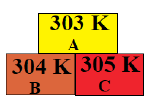
A\(\leftarrow\)B, A\(\leftarrow\)C, B\(\leftarrow\)C
A\(\rightarrow\)B, A\(\rightarrow\)C, B\(\rightarrow\)C
A\(\rightarrow\)B, A\(\leftarrow\)C, B\(\rightarrow\)C
A\(\leftarrow\)B, A\(\rightarrow\)C, B\(\leftarrow\)C
11.
If a substance is heated or cooled, the linear expansion occurs along the axis of
X or –X
Y or –Y
both (a) and (b)
(a) or (b)
12.
13.
An iron ball at 40o C is transferred to a mug containing water at a temperature of 40o C, in which direction will the heat flow?
14.
Give the importance of Pollination?
15.
7.5 litre of ethanol is present in 15 litre of aqueous solution of ethanol. Calculate volume percent of ethanol solution.
16.
Define solubility.
17.
List any three traits of pea plant selected by Mendel for his experiments and mention their dominant & recessive form
18.
Which hormone promotes the production of male flowers in Cucurbits?
19.
Name two organisms which reproduces through budding
20.
The aquatic animals live more in cold region Why?
21.
Distinguish between ideal gas and real gas.
22.
Why a spanner with a long handle is preferred to tighten screws in heavy vehicles?
23.
How is the structure of DNA organised? What is the biological significance of DNA?
24.
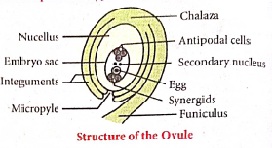
With a neat labelled diagram describe the parts of a typical angiospermic ovule.
25.
In what way hygroscopic substances differ from deliquescent substances.
26.
Write notes on various factors affecting solubility.
27.
28.
Deduce the equation of a force using Newton’s second law of motion.
29.
Write notes on
i) saturated solution
ii) unsaturated solution
iii) Super saturated solution
30.
Write any three applications of torque.
31.
Explain the physiological effects of Auxins.
32.
Derive the Relation between g and G?
33.
34.
Why did Mendel select pea plant for his experiments?
35.
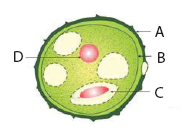
Identify the parts A, B, C and D
36.
A solution is made from 35 ml of Methanol and 65 ml of water. Calculate the volume percentage.
37.
16 grams of NaOH is dissolved in 100 grams of water at 25°C to form a saturated solution. Find the mass percentage of solute and solvent.
(i) Mass of the solute (NaOH) = 16 g
(ii) Mass of the solvent H2O = 100 g
38.
Find the final temperature of a copper rod. Whose area of cross section changes from 10 m2 to 11 m2 due to heating. The copper rod is initially kept at 90 K. (Coefficient of superficial expansion is 0.0021 /K)
1.
(b)
Trisomy
2.
(c)
Zeatin
3.
(d)
DNA ligase
4.
(d)
F.W. Went
5.
(c)
Graffian follicle
6.
(d)
Large feathery stigma
7.
(c)
silica gel
8.
(b)
increases
9.
(c)
Water
10.
(a)
A\(\leftarrow\)B, A\(\leftarrow\)C, B\(\leftarrow\)C
11.
(d)
(a) or (b)
12.
(d)
13.
Heat will not flow. Because, the iron ball and water are at same temperature.
14.
i) It results in fertilization which leads to the formation of fruits and seed.
ii) New varieties of plants are formed through new combination of genes in case of cross pollination.
15.
Volume percentage = \(\frac{Volume \ of \ the \ solute}{Volume \ of \ the \ solution}\)
= \(\frac{7.5}{15}\) x 100 = 50%
16.
Solubility is defined as the number of grams of a solute that is dissolved in 100 g of a solvent to form a saturated solution at a given temperature and pressure.
17.
| Characteristic studied | Dominant character | Recessive character |
|---|---|---|
| Seed shape | Round | Wrinkled |
| Seed colour | Yellow | Green |
| Seed-coat colour | Coloured | White |
18.
Gibberellin promote the production of male flowers in Cucurbits.
19.
Hydra and yeast are the organisms which are reproduces through budding
20.
(i) Aquatic animals live more in cold regions.
(ii) More amount of dissolved oxygen is present in the water of cold regions.
(iii) This shows that the solubility of oxygen in water is more at low pressure.
21.
| S. No |
Ideal gas |
Real gas |
|---|---|---|
| (i) | If the atoms or molecules of a gas do not interact with each other, then the gas is said to be an ideal gas or a perfect gas. | If the molecules or atoms of a gas interact with each other with a definite amount of intermolecular or interatomic force of attraction, then the gases are said to be a real gases. |
22.
(i) A spanner has a long handle to produce a larger moment of force by a small force applied normally at the end of its handle.
(ii) Moment of force = \(\overrightarrow{\mathbf{F}} \times \overrightarrow{\mathrm{d}}\)
23.
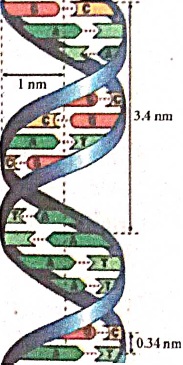
DNA is a large molecule consisting of millions of nucleotides. Hence, it is also called a polynucleotide. Each nucleotide consists of three components.
(i) A sugar molecules - Deoxyribose sugar.
(ii) A nitrogenous base.
There are two types of nitrogenous bases in DNA.
They are
(a) Purines (Adenine and Guanine)
(b) Pyrimidines (Cytosine and Thymine)
(iii) A phosphate group
Nucleoside and Nucleotide:
Nucleoside = Nitrogen base + Sugar
Nucleotide = Nucleoside + Phosphate
The nucleotides are formed according to the purines and pyrimidines present in them.
Watson and Crick model of DNA:
(i) DNA molecule consists of two polynucleotide chains.
(ii) These chains form a double helix structure with two strands which run anti-parallel to one another.
(iii) Nitrogenous bases in the centre are linked to sugar-phosphate units which form the backbone of the DNA.
(iv) Pairing between the nitrogenous bases is very specific and is always between purine and pyrimidine linked by hydrogen bonds.
a) Adenine (A) links Thymine (T) with two hydrogen bonds (A = T)
b) Cytosine (C) links Guanine (G) with three hydrogen bonds( C ≡ G) This is called complementary base pairing.
(v) Hydrogen bonds between the nitrogenous bases make the DNA molecule stable.
(vi) Each turn of the double helix is 34 Ao (3.4 nm). There are ten base pairs in a complete turn.
(vii) The nucleotides in a helix are joined together by phosphodiester bonds.
Significance of DNA:
(i) DNA is responsible for the transmission of hereditary information from one generation to next generation.
(ii) It contains information required for the formation of proteins.
(iii) It controls the developmental process and life activities of an organism.
24.
(i) The main part of the ovule is the nucellus which is enclosed by two integuments leaving an opening called as micropyle.
(ii) The ovule is attached to the ovary wall by a stalk known as funiculus.
(iii) Chalaza is the basal part.
(iv) The embryo sac contains seven cells and eight nuclei located within the nucellus.
(v) Three cells at the micropylar end form the egg apparatus and the three cells at the chalaza end are the antipodal cells.
(vi) The remaining two nuclei are called polar nuclei found in the centre.
(vii) In the egg apparatus one is the egg cell (female gamete) and the remaining two cells are the synergids.
25.
|
Deliquescence substances |
Hygroscopic substances |
|---|---|
| When exposed to the atmosphere at ordinary temperature, they absorb moisture and do not dissolve. |
When exposed to the atmospheric air at ordinary temperature, they absorb moisture and dissolve. |
| Hygroscopic substances do not change its physical state on exposure to air. | Deliquescent substances change its physical state on exposure to air. |
| Hygroscopic substances may be amorphous solids or liquids. |
Deliquescent substances are crystalline solids. |
| Hygroscopic substances are used as drying agents. | Deliquescent Substances are not used as drying agent. |
| Example : H2SO4.P2O5 | Example : NaOH, KOH |
26.
There are three main factors which govern the solubility of a solute. They are:
a) Nature of the solute and solvent
b) Temperature
c) Pressure
a) Nature of the solute and solvent:
(i) The nature of the solute and solvent plays an important role in solubility.
(ii) Although water dissolves an enormous variety of substances, both ionic and covalent, it does not dissolve everything.
(iii) The phrase that scientists often use when predicting solubility is "like dissolves like".
(iv) The expression means that dissolving occurs when similarities exist between the solvent and the solute.
(v) For example: Common salt is a polar compound 4 and dissolves readily in polar solvent like water.
(vi) Non-polar compounds are soluble in non-polar solvents. For example: Fat dissolved in ether.
(vii) But non-polar compounds, do not dissolve in polar solvents; polar compounds do not dissolve in non-polar solvents.
b) Effect of Temperature:
Solubility of Solids in Liquid:
(i) Generally, solubility of a solid solute in a liquid solvent increases with increase in temperature.
(ii) For example, a greater amount of sugar will dissolve in warm water than in cold water.
(iii) In endothermic process, solubility increases with increase in temperature.
(iv) In exothermic process, solubility decreases with increase in temperature.
Solubility of Gases in liquid:
(i) Solubility of gases in liquid decrease with increase in temperature.
(ii) Generally, water contains dissolved oxygen.
(iii) When water is boiled, the solubility of oxygen in water decreases, so oxygen escapes in the form of bubbles.
(iv) Aquatic animals live more in cold regions because, more amount of dissolved oxygen is present in the water of cold regions.
(v) This shows that the solubility of oxygen in water is more at low temperatures.
c) Effect of Pressure:
(i) Effect of pressure is observed only in the case of solubility of a gas in a liquid.
(ii) When the pressure is increased, the solubility of a gas in liquid increases.
(iii) The common examples for solubility of gases in liquids are carbonated beverages, i.e. soft drinks, household cleaners containing aqueous solution of ammonia, formalin aqueous solution of formaldehyde, etc.
27.
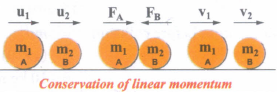
28.
(i) According to Newton's second law, "the force acting on a body is directly proportional to the rate of change of linear momentum of the body and the change in momentum takes place in the direction of the force".
(ii) This law helps us to measure the amount of force. So it is called as law of force'
(iii) Let, "m" be the mass of a moving body, moving along a straight line with an initial speed 'u'.
(iv) After a time interval of 't', the velocity of the body changes to 'v' due to the impact of an unbalanced external force F.
Initial momentum of the body, \( P_{i}=m u \)
Final momentum of the body, \( P_{f}=m v \)
Change in momentum, \( \Delta \mathrm{p}=\mathrm{P}_{\mathrm{f}}-\mathrm{P}_{\mathrm{i}} \)
\(=m v-m u \)
By Newton's second law of motion,
\(\text {Force, } \ F \propto\) rate of change of momentum
\(\mathrm{F} \propto \) change in momentum / time
\(\mathrm{F} \propto \frac{\mathrm{mv}-\mathrm{mu}}{\mathrm{t}}\)
\(\mathrm{F}=\frac{\mathrm{km}(\mathrm{v}-\mathrm{u})}{\mathrm{t}}\)
Here, k is the proportionality constant.
k = 1 in all system of units. Hence,
\(F=\cfrac { m(v-u) }{ t } \)
Since acceleration = change in velocity / time, a = (v-u) / t. Hence, we have
F = m x a
Force = mass x acceleration
29.
(i) Saturated solution:
1. A solution in which no more solute can be dissolved in a definite amount of the solvent at a given temperature is called saturated solution.
2. E.g. 36 g of sodium chloride in 100g of water at 25° C forms saturated solution.
3. Further addition of sodium chloride, leaves it undissolved.
(ii) Unsaturated solution:
Unsaturated solution is one that contains less solute than that of the saturated solution at a given temperature.
E.g. 109 or 20 g or 30 g of Sodium chloride in 100 g of water at 25° C forms an unsaturated solution.
30.
Gears:
A gear is a circular wheel with teeth around its rim. It helps to change the speed of rotation of a wheel by changing the torque and helps to transmit power.
Seesaw:
(i) Most of you have played on the seesaw. Since there is a difference in the weight of the persons sitting on it, the heavier person lifts the lighter person.
(ii) When the heavier Person comes closer to the pivot point (fulcrum) the distance of the line of action of the force decreases.
(iii) It causes less amount of torque to act on it. This enables the lighter person to lift the heavier Person.
Steering Wheel:
A small steering wheel enables you to turn a car easily by transferring a torque to the wheels with less effort.
31.
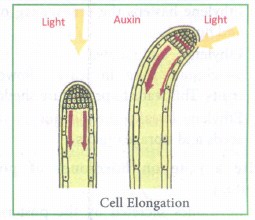
Auxins bring about a variety of physiological effects in different parts of the plant body. Some of them are discussed below:
(i) Auxins promote the elongation of stems and coleoptiles which makes them to grow.
(ii) Auxins induce root formation at low concentration and inhibit it at higher concentration.
(iii) The auxins produced by the apical buds suppress growth of lateral buds. This is called Apical Dominance.
(iv) Seedless fruits without fertilization are induced by the external application of auxins. (Parthenocarpy). Examples: Watermelon, Grapes, Lime etc.
(v) Auxins prevent the formation of abscission layer.
32.
(i) Let M be the mass of the Earth and m be the mass of the object.
(ii) The entire mass of the earth is assumed to be concentrated at its centre. The radius of the earth is R (= 6378 km = 6400 km approximately).
(iii) By Newton's law of gravitation, the force acting on the object is given by
F = G M m / R2 ............. (A)
(iv) According to Newton's second law, the force acting on the object is given by the product of its mass and acceleration. Here acceleration of the is under action of gravity hence a =g.
F=ma =mg
F = weight = mg
Comparing equations (A) and (B), we get
g= GM/ R2
Acceleration due to gravity
g=\(\frac { GM }{ { R }^{ 2 } } \).
33.
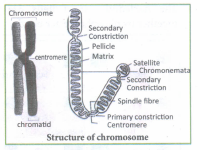
34.
(i) Pea plant is naturally self-pollinating and so is very easy to raise pure breeding individuals.
(ii) It has a short life span as it is an annual and so it was possible to follow several generations.
(iii) It is easy to cross-pollinate.
(iv) It has deeply defined contrasting characters.
(v) The flowers are bisexual.
35.
A - Exine
B - Intine
C - Generative cell
D - Vegetative nucleus
36.
Volume of the ethanol = 35 ml
Volume of the water = 65 ml
Volume percentage = \(\frac{\text { Volume of the solute }}{\text { Volume of the solution }} \times 100\)
Volume percentage =\(\frac{\text { Volume of the solute }}{\text { Volume of the solute + Volume of the solvent }} \times 100\)
Volume percentage = \(\frac{35}{35+65}\times\)100
Volume percentage = \(\frac{35}{100 }\) x 100
= 35%
37.
(i) Mass percentage of the solute
Mass percentage of solute = \(\begin{aligned} & \frac{\text { Mass of the solute }}{\text { Mass of the solute +Mass of the solvent}} \times 100 \\ \end{aligned}\)
= \(\frac{16 × 100}{16 + 100}\)
\(=\frac{1600}{116}\)
Mass percentage of the solute = 13.79 %
(ii) Mass percentage of solvent = 100 - (Mass percentage of the solute)
= 100 – 13.79
= 86.21%
38.
Area of copper rod, Ao = 10 m2
Changes of Area of cross section,
Initial temperature \(\Delta \mathrm{A} =11 -10 =1 \mathrm{~m}^{2} \)
\(\mathrm{~T}_{1} =90 \mathrm{~K} \)
\(a_{\mathrm{A}} =0.0021 / \mathrm{K} \)
\(\mathrm{T}_{2} =? \)
\(\frac{\Delta A}{A_{0}} =a_{\mathrm{A}} \Delta \mathrm{T} \)
\(\frac{1 }{10 } =0.0021\left[\mathrm{~T}_{2}-90\right] \)
\(0.1 =0.0021\left[\mathrm{~T}_{2}-90\right]=\frac{0.1}{0.0021}+90=\mathrm{T}_{2} \)
\(\mathrm{~T}_{2} =137.61 \mathrm{~K}\)
So the final temperature of a copper rod is 137.61 K

10th Standard Syllabus & Materials
10th Standard
TN 10th English Prose - 2 - The Night the Ghost Got in Important Questions And Answers Study Material - QB365 Set A
NEW10th Standard
TN 10th English Supplementary - 1 - The Tempest Important Questions And Answers Study Material - QB365 Set A
NEW10th Standard
TN 10th English Poem - 1 - Life Important Questions And Answers Study Material - QB365 Set A
NEW10th Standard
TN 10th English Prose - 1 - His First Flight Important Questions And Answers Study Material - QB365 Set A



Tamilnadu Stateboard 10th Standard Subjects
Tamilnadu Stateboard Standards




