
 100% FREE ACCESS
10th Standard Syllabus & Materials
10th Standard
TN 10th English Prose - 4 - The Attic Important Questions And Answers Study Material - QB365 Set A
NEW10th Standard
TN 10th English Supplementary - 3 - The Story of Mulan Important Questions And Answers Study Material - QB365 Set A
NEW10th Standard
TN 10th English Poem - 3 - I am Every Woman Important Questions And Answers Study Material - QB365 Set A
NEW10th Standard
TN 10th English Prose - 3 - Empowered Women Navigating The World Important Questions And Answers Study Material - QB365 Set A
NEW10th Standard
TN 10th English Supplementary - 2 - Zigzag Important Questions And Answers Study Material - QB365 Set A
NEW10th Standard
TN 10th English Poem - 2 - The Grumble Family Important Questions And Answers Study Material - QB365 Set A

Published on: 10/10/2019
Acoustics
Download Tamil Nadu 10th Standard Science question papers, model tests, one-mark questions, important questions, and public exam papers in PDF format. Free study materials and answer keys for TN State Board students.
Questions + Answers key
Take MCQ Science Test1.
What is mean by reflection of sound? Explain:
a) reflection at the boundary of a rarer medium
b) reflection at the boundary of a denser medium
c) Reflection at curved surfaces
2.
What are the factors that affect the speed of sound in gases?
3.
Suppose that a sound wave and a light wave have the same frequency, then which one has a longer wavelength?
a) Sound
b) Light
c) both a and b
d) data not sufficient.
4.
What are the various possibilities of relative motion between source and listener?
5.
Explain the working and use of SONAR?
6.
Write the difference between the sound and light waves.
7.
How will you determine the velocity of sound by echo method?
8.
What are the categories of sound waves based on their frequencies?
9.
At 10° C, how for away is a reflecting surface if you hear an echo in 0.274s?
10.
Find the speed of sound in air at 9.23° C.
1.
Reflection of sound waves:
(i) When sound waves travel in a given medium, and strikes the surface of another medium, they can bounce back into the first medium.
(ii) This phenomenon is known as reflection.
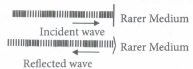
a) Reflection at the boundary of a rarer medium:
(i) Consider a wave travelling in a solid medium striking on the interface between the solid and the air.
(ii) The compression exerts a force F on the surface of the rarer medium.
(iii) As a rarer medium has smaller resistance for any deformation, the surface of separation is pushed backwards (Figure).
(iv) As the particles of the rarer medium are free to move, a rarefaction is produced at the interface.
(v) Thus, a compression is reflected as a rarefaction and a rarefaction travels from right to left.
b) Reflection at the boundary of a denser medium
(i) A longitudinal wave travels in a medium in the form of compressions and rare factions.
(ii) Suppose a compression travelling in air from left to right reaches a rigid wall. The compression exerts a force F on the rigid wall.
(iii) In turn, the wall exerts an equal and opposite reaction R = - F on the air molecules. This results in a compression near the rigid wall.
(iv) Thus, a compression travelling towards the rigid wall is reflected back as a compression. That is, the direction of compression is reversed.
c) Reflection of sound in plane and curved surfaces:
(i) When sound waves are reflected from curved surfaces, the intensity of reflected waves is changed.
(ii) When reflected from a convex surface, the reflected waves are diverged out and the intensity is decreased.
(iii) When sound is reflected from a concave surface, the reflected waves are converged and focused at a point. So the intensity of reflected waves is concentrated at a point.
(iv) Parabolic surfaces are used when it is required to focus the sound at a particular point.
(v) Hence, many halls are designed with parabolic reflecting surfaces.
(vi) In elliptical surfaces, sound from one focus will always be reflected to the other focus no matter where it strikes the wall.
2.
Factors affecting velocity of sound:
(i) The following factors affect the velocity of sound waves.
Effect of density:
(i) The velocity of sound in a gas is inversely proportional to the square root of the density of the gas.
(ii) Hence, the velocity decreases as the density of the gas increases.
\(V \propto \frac{1}{\sqrt{d}}\)
Effect of temperature:
(i) The velocity of sound in a gas is directly proportional to the square root of its temperature.
(ii) The velocity of sound in a gas increases with the increase in temperature. \(v \propto \sqrt{\mathrm{T}}.\)
(iii) Velocity at temperature T is given by the following equation:
\(\mathrm{v}_{\mathrm{T}}=\left(\mathrm{v}_{0}+0.61 \mathrm{~T}\right) \mathrm{m} \mathrm{s}^{-1}\)
(i) Here, vo is the velocity of sound in the gas at \(0^{\circ} \mathrm{C}\).
(ii) For air, \(\mathrm{v}_{\mathrm{o}}=331 \mathrm{~m} \mathrm{~s}^{-1}\).
(iii) Hence, the velocity of sound changes by 0.61 ms-1 when the temperature changes by one degree celsius.
Effect of relative humidity:
(i) When humidity increases, the speed of sound increases.
(ii) That is why you can hear sound from long distances clearly during rainy seasons.
3.
b) Light
The light wave has a longer wave length. Because, it has much greater speed.
4.
(i) The listener moves towards or away from a stationary source.
(ii) The source moves towards or away from a stationary listener.
(iii) Both source and listener move towards or away from each other.
(iv) The medium moves when both source and listener are at rest
5.
(i) SONAR stands for Sound Navigation And Ranging.
(ii) SONAR is a navigation system that sends ultra sound waves to locate objects under the water.
(iii) Use light waves of high frequency to transmit information from one place to another place, because its velocity is high and it can travel large distances in a short period of time.
(iv) However, light waves cannot not travel deep into the ocean. But Sound waves can travel more distance in sea water than light waves.
(v) Hence, sound waves are used to detect the objects in the ocean.
\(=\frac { 2d }{ t } \)= velocity of sound
(vi) The average speed of a sound wave in sea water is 1,500 ms", As the value of "t" is observed, the distance of the object can be determined.
(vii) In this way, they are able to determine the direction of the objects, as well as the distance.
(viii) Some animals in the ocean have their own natural sonar system. Dolphins and whales use the principle of SONAR to identify underwater objects.
6.
| S. No. |
Sound |
Light |
|---|---|---|
| i) | Medium is required for the propagation. | Medium is not required for the propagation. |
| ii) | Sound waves are longitudinal. | Light waves are transverse. |
| iii) | Wavelength ranges from 1.65 cm to 1.65m. | Wavelength ranges from 4 x 10⁻⁷m to 7 x 10⁻⁷m. |
| iv) | Sound waves travel in air with a speed of about 340 ms-1 at NTP. | Light waves travel in air with a speed of 3 x 10⁸ ms-1. |
7.
A source of sound pulses, a measuring tape, a sound receiver, and a stop watch.
Procedure:
(i) Measure the distance "d" between the source of sound pulse and the reflecting surface using the measuring tape.
(ii) The receiver is also placed adjacent to the source. A sound pulse is emitted by the source.
(iii) The stop watch is used to note the time interval between the instant at which the sound pulse is sent and the instant at which the echo is received by the receiver. Note the time interval as "t".
(iv) Repeat the experiment for three or four times. The average time taken for the given number of pulses is calculated.
Calculation of speed of sound:
(i) The sound pulse emitted by the source travels a total distance of 2d while travelling from the source to the wall and then back to the receiver.
(ii) The time taken for this has been observed to be "t", Hence, the speed of sound wave is given by
Speed of sound \(=\frac { Distance\ travelled }{ Time\ taken } \)
\(\\ =\frac { 2d }{ t } \)
8.
(a) Audible waves:
(i) Sound wave with frequency ranging between 20 Hz and 20,000 Hz.
(ii) These are generated by vibrating bodies such as vocal cords, stretched strings etc.
(b) Infrasonic waves:
(i) Sound wave with frequency below 20 Hz that cannot be heard by human ear.
(ii) E.g.: waves produced during earth quake, ocean waves, sound produced by whales, etc.
(c) Ultrasonic waves:
(i) Sound wave with frequency greater than 20 kHz.
(ii) Human ear cannot detect these waves, but certain creatures like mosquito, dogs, bats, dolphins can detect these waves.
(iii) E.g.: waves produced by bats.
9.
Given
Temperature, T 10°C
Time, t = 0.274 s
Distance, D = ?
Velocity, v = (vo + 0.61T) ms-1
v = [331.4 + 0.61 x 10]
= 331.4 + 6.1
v = 337.5 ms-1
Distance, D = v x t
D = 337.5 x 0.274
D = 92.48 m
Distance due to reflecting surface = \(\frac{distance}{2}\)
= 46.2 m
10.
Given
Air temperature = 23°C
Velocity of sound in air, Vs = (331.4 + 0.61T) ms-1
= 331.4 + 0.61 x 23
= 331.4 +13.8
Vs = 345.2 ms-1

10th Standard Syllabus & Materials
10th Standard
TN 10th English Prose - 2 - The Night the Ghost Got in Important Questions And Answers Study Material - QB365 Set A
NEW10th Standard
TN 10th English Supplementary - 1 - The Tempest Important Questions And Answers Study Material - QB365 Set A
NEW10th Standard
TN 10th English Poem - 1 - Life Important Questions And Answers Study Material - QB365 Set A
NEW10th Standard
TN 10th English Prose - 1 - His First Flight Important Questions And Answers Study Material - QB365 Set A



Tamilnadu Stateboard 10th Standard Subjects
Tamilnadu Stateboard Standards





