
 100% FREE ACCESS
10th Standard Syllabus & Materials
10th Standard
TN 10th English Prose - 4 - The Attic Important Questions And Answers Study Material - QB365 Set A
NEW10th Standard
TN 10th English Supplementary - 3 - The Story of Mulan Important Questions And Answers Study Material - QB365 Set A
NEW10th Standard
TN 10th English Poem - 3 - I am Every Woman Important Questions And Answers Study Material - QB365 Set A
NEW10th Standard
TN 10th English Prose - 3 - Empowered Women Navigating The World Important Questions And Answers Study Material - QB365 Set A
NEW10th Standard
TN 10th English Supplementary - 2 - Zigzag Important Questions And Answers Study Material - QB365 Set A
NEW10th Standard
TN 10th English Poem - 2 - The Grumble Family Important Questions And Answers Study Material - QB365 Set A

Published on: 19/09/2019
Algebra
Download Tamil Nadu 10th Standard Maths question papers, model tests, one-mark questions, important questions, and public exam papers in PDF format. Free study materials and answer keys for TN State Board students.
Questions + Answers key
Take MCQ Maths Test1.
If A = \(\left[ \begin{matrix} 1 & 1 \\ -1 & 3 \end{matrix} \right] \), B = \(\left[ \begin{matrix} 1 & 2 \\ -4 & 2 \end{matrix} \right] \), C = \(\left[ \begin{matrix} -7 & 6 \\ 3 & 2 \end{matrix} \right] \) verify that A(B + C) = AB + AC
2.
A ladder 17 feet long is leaning against a wall. If the ladder, vertical wall and the floor from the bottom of the wall to the ladder form a right triangle, find the height of the wall where the top of the ladder meets if the distance between bottom of the wall to bottom of the ladder is 7 feet less than the height of the wall?
3.
If 9x4 + 12x3 + 28x2 + ax + b is a perfect square, find the values of a and b.
4.
Find the square root of 64x4 - 16x3 + 17x2 - 2x + 1
5.
Find \(\frac { { x }^{ 2 }+20x+36 }{ { x }^{ 2 }-3x-28 } -\frac { { x }^{ 2 }+12x+4 }{ { x }^{ 2 }-3x-28 } \)
6.
The father’s age is six times his son’s age. Six years hence the age of father will be four times his son’s age. Find the present ages (in years) of the son and father.
7.
Find the values of k for which the following equation has equal roots.
(k - 12)r + 2(k - 12)x + 2 = 0
8.
Using quadratic formula solve the following equations.9x2-9(a+b)x+(2a2+5ab+2b2)=0
9.
Solve the following system of linear equations in three variables.
x + y + z = 6; 2x + 3y + 4z = 20;
3x + 2y + 5z = 22
10.
If α, β are the roots of the equation 3x2 + 7x - 2 = 0, find the values of
\(\frac { { \alpha }^{ 2 } }{ \beta } +\frac { { \beta }^{ 2 } }{ \alpha } \)
11.
If α and β are the roots of x2 + 7x + 10 = 0 find the values of
α4 + β4
12.
Find the excluded values of the following expressions (if any).
\(\frac { x }{ { x }^{ 2 }+1 } \)
13.
Construct a 3 x 3 matrix whose elements are aij = i2j2
14.
If the difference between the roots of the equation x2 - 13x + k = 0 is 17. find k
15.
Solve 2m2+ 19m + 30 = 0
1.
LHS = A(B + C)
B + C = \(\left[ \begin{matrix} 1 & 2 \\ -4 & 2 \end{matrix} \right] +\left[ \begin{matrix} -7 & 6 \\ 3 & 2 \end{matrix} \right] =\left[ \begin{matrix} -6 & 8 \\ -1 & 4 \end{matrix} \right] \)
A(B + C) = \(\left[ \begin{matrix} 1 & 1 \\ -1 & 3 \end{matrix} \right] \times \left[ \begin{matrix} -6 & 8 \\ -1 & 4 \end{matrix} \right] =\left[ \begin{matrix} -6-1 & 8+4 \\ 6-3 & -8+12 \end{matrix} \right] =\left[ \begin{matrix} -7 & 12 \\ 3 & 4 \end{matrix} \right] \) ......(1)
RHS = AB + AC
AB = \(\left[ \begin{matrix} 1 & 1 \\ -1 & 3 \end{matrix} \right] \times \left[ \begin{matrix} 1 & 2 \\ -4 & 2 \end{matrix} \right] =\left[ \begin{matrix} 1-4 & 2+2 \\ -1-12 & -2+6 \end{matrix} \right] =\left[ \begin{matrix} -3 & 4 \\ -13 & 4 \end{matrix} \right] \)
AC = \(\left[ \begin{matrix} 1 & 1 \\ -1 & 3 \end{matrix} \right] \times \left[ \begin{matrix} -7 & 6 \\ 3 & 2 \end{matrix} \right] =\left[ \begin{matrix} -7+3 & 6+2 \\ 7+9 & -6+6 \end{matrix} \right] =\left[ \begin{matrix} -4 & 8 \\ 16 & 0 \end{matrix} \right] \)
Therefore, AB + AC = \(\left[ \begin{matrix} -3 & 4 \\ -13 & 4 \end{matrix} \right] +\left[ \begin{matrix} -4 & 8 \\ 16 & 0 \end{matrix} \right] =\left[ \begin{matrix} -7 & 12 \\ 3 & 4 \end{matrix} \right] \) ....(2)
From (1) and (2), A(B + C) = AB + AC. Hence proved.
2.
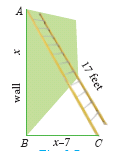
Let the height of the wall AB = x feet
As per the given data BC = (x – 7) feet
In the right triangle ABC, AC =17 ft, BC = (x – 7) feet
By Pythagoras theorem, AC2 = AB2 + BC2
(17)2 = x2+ (x − 7)2; 289 = x2 + x2 − 14x + 49
x2 − 7x − 120 = 0 hence, (x − 15)(x + 8) = 0 then, x = 15 (or) −8
Therefore, height of the wall AB = 15 ft (Rejecting −8 as height cannot be negative)
3.
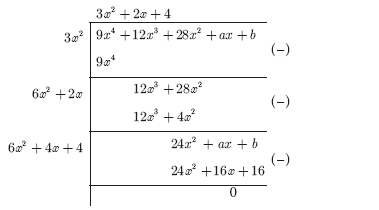
Because the given polynomial is a perfect square a - 16 = 0, b - 16 = 0
Therefore, a = 16, b = 16.
4.
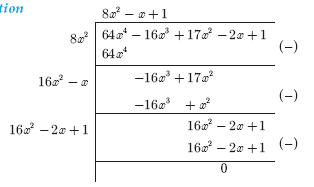
Therefore, \(\sqrt { 64{ x }^{ 2 }-16{ x }^{ 3 }+17{ x }^{ 2 }-2x+1 } \) = |8x2 - x + 1|
5.
\(\frac { { x }^{ 2 }+20x+36 }{ { x }^{ 2 }-3x-28 } -\frac { { x }^{ 2 }+12x+4 }{ { x }^{ 2 }-3x-28 } =\frac { \left( { x }^{ 2 }+20x+36 \right) -\left( { x }^{ 2 }+12x+4 \right) }{ { x }^{ 2 }-3x-28 } \)
= \(\frac { 8x+32 }{ { x }^{ 2 }-3x-28 } =\frac { 8\left( x+4 \right) }{ \left( x-7 \right) \left( x+4 \right) } =\frac { 8 }{ x-7 } \)
6.
Let the present age of father be x years and the present age of son be y years
Given, x = 6y … (1)
x + 6 = 4(y + 6) … (2)
Substituting (1) in (2), 6y + 6 = 4(y + 6)
6y + 6 = 4y + 24 gives, y = 9
Therefore, son’s age = 9 years and father’s age = 54 years.
7.
\(\frac { (k-12) }{ a } { x }^{ 2 }+\frac { 2(k-12) }{ b } x+\frac { 2 }{ c } =0\)
D2 = b2- 4ac = (2(k - 12))2 - 4(k - 12)(2)
= 4(k - 12)[(k - 12) - 2]
= 4(k-12)(k- 14)
The given equation will have equal roots, if D = 0
⇒ 4(k-12)(k-14) 0
k - 12 = 0 or k - 14 0
k 12, 14
8.
9x2-9(a+b)x+(2a2+5ab+2b2)=0
Comparing this with ax2 + bx + c = O.
a =9
b = -9(a + b)
c = (2a2 + 5ab + 2b2)
∴ ∆=B2-4AC
⇒ 81(a+b)2-36(2a2+5ab+2b2)
⇒ 9a2 + 9b2 - 18ab
⇒ 9(a - b)2> 0
∴ the roots are real and given by
\(\beta =\frac { -B-\sqrt { D } }{ 2A } =\frac { 9(a+b)+3(a-b) }{ 18 } \)
\(=\frac { 12a+6b }{ 18 } =\frac { 2a+b }{ 3 } \)
\(\beta =\frac { -B-\sqrt { D } }{ 2A } =\frac { 9(a+b)+3(a-b) }{ 18 } \)
\(=\frac { 6a+12b }{ 18 } =\frac { a+2b }{ 3 } \)
9.
x + y + z = 6 ....(1)
2x + 3y + 4z = 20 ...(2)
3x + 2y + 5z = 22 ....(3)
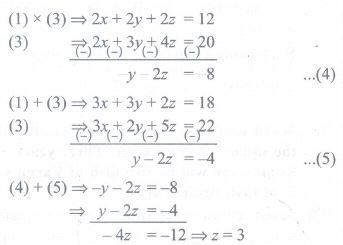
Sub. z = 3 in (5) ⇒ y - 2(3) =-4
y=2
Sub. y = 2, z = 3 in (1), we get
x+2+3=6
x=1
x= 1,y = 2, z = 3
10.
3x2 + 7x - 2 = 0 here, a = 3, b = 7, c = -2
since, α, β are the roots of the equation
\(\frac { { \alpha }^{ 2 } }{ \beta } +\frac { { \beta }^{ 2 } }{ \alpha } =\frac { { \alpha }^{ 3 }+{ \beta }^{ 3 } }{ \alpha \beta } =\frac { { \left( \alpha +\beta \right) }^{ 3 }-3\alpha \beta \left( \alpha +\beta \right) }{ \alpha \beta } =\frac { { \left( -\frac { 7 }{ 3 } \right) }^{ 3 }-3\left( -\frac { 2 }{ 3 } \right) \left( -\frac { 7 }{ 3 } \right) }{ -\frac { 7 }{ 3 } } =\frac { 469 }{ 18 } \)
11.
x2 + 7x + 10 here, a = -1, b = 7, c = 10
if α and β are roots of the equation then,
α + β = \(\frac {-b}{a} = \frac {-7}{1}\) = -7; αβ = \(\frac {c}{a} = \frac {10}{1}\) = 10
α4 + β4 = (α2 + β2)2 - 2α2β2 = 292 - 2 x (10)2 = 641 (since from (ii), α2 + β2 = 29)
12.
\(\frac { x }{ { x }^{ 2 }+1 } \)
Here x2 ≥ 0 for all x. Therefore, x2 + 1 ≥ 0 + 1 = 1. Hence, x2 + 1 ≠ 0 for any x.
Therefore, there can be no real excluded values for the given rational expression \(\frac { x }{ { x }^{ 2 }+1 } \).
13.
The general 3 x 3 matrix is given by A = \(\left( \begin{matrix} { a }_{ 11 } & { a }_{ 12 } & { a }_{ 13 } \\ { a }_{ 21 } & { a }_{ 22 } & { a }_{ 23 } \\ { a }_{ 31 } & { a }_{ 32 } & { a }_{ 33 } \end{matrix} \right) \) aij = i2j2
a11 = 12 x 12 = 1 x 1 = 1; a12 = 12 x 22 = 1 x 4 = 4; a13 = 12 x 32 = 1 x 9 = 9
a21 = 22 x 12 = 2 x 1 = 2; a22 = 22 x 22 = 4 x 4 = 16; a23 = 22 x 32 = 4 x 9 = 36
a31 = 32 x 12 = 3 x 1 = 3; a32 = 32 x 22 = 9 x 4 = 36; a33 = 32 x 32 = 9 x 9 = 81
Hence the required matrix is A = \(\left( \begin{matrix} 1 & 4 & 9 \\ 4 & 16 & 36 \\ 9 & 36 & 81 \end{matrix} \right) \)
14.
x2 - 13x + k = 0 here, a = 1, b = -13, c = k
Let α, β be the roots of the equation. Then
α + β = \(\frac {-b}{a} = \frac {-(-13)}{1}\) = 13 ...... (1) also α - β = 17 ......(2)
(1) + (2) we get, 2α = 30 gives α = 15
Therefore, 15 + β = 13 (from (1)) gives β = -2
But, αβ = \(\frac {c}{a} = \frac {k}{1}\) gives 15 x (-2) = k we get, k = -30
15.
2m2 + 19m + 30 = 2m2 + 4m + 15m + 30 = 2m(m + 2) + 15(m + 2)
= (m + 2)(2m + 15)
Now, equating the factors to zero we get,
(m + 2)(2m + 15) = 0
m + 2 gives, m = -2 or 2m + 15 = 0 we get, m = \(\frac {-15}{2}\)
Therefore the roots are -2, \(\frac {-15}{2}\)
Some equations which are not quadratic can be solved by reducing them to quadratic equations by suitable substitutions. Such examples are illustrated below.

10th Standard Syllabus & Materials
10th Standard
TN 10th English Prose - 2 - The Night the Ghost Got in Important Questions And Answers Study Material - QB365 Set A
NEW10th Standard
TN 10th English Supplementary - 1 - The Tempest Important Questions And Answers Study Material - QB365 Set A
NEW10th Standard
TN 10th English Poem - 1 - Life Important Questions And Answers Study Material - QB365 Set A
NEW10th Standard
TN 10th English Prose - 1 - His First Flight Important Questions And Answers Study Material - QB365 Set A



Tamilnadu Stateboard 10th Standard Subjects
Tamilnadu Stateboard Standards





