
 100% FREE ACCESS
10th Standard Syllabus & Materials
10th Standard
TN 10th English Prose - 4 - The Attic Important Questions And Answers Study Material - QB365 Set A
NEW10th Standard
TN 10th English Supplementary - 3 - The Story of Mulan Important Questions And Answers Study Material - QB365 Set A
NEW10th Standard
TN 10th English Poem - 3 - I am Every Woman Important Questions And Answers Study Material - QB365 Set A
NEW10th Standard
TN 10th English Prose - 3 - Empowered Women Navigating The World Important Questions And Answers Study Material - QB365 Set A
NEW10th Standard
TN 10th English Supplementary - 2 - Zigzag Important Questions And Answers Study Material - QB365 Set A
NEW10th Standard
TN 10th English Poem - 2 - The Grumble Family Important Questions And Answers Study Material - QB365 Set A

Published on: 15/10/2019
Breeding and Biotechnology
Download Tamil Nadu 10th Standard Science question papers, model tests, one-mark questions, important questions, and public exam papers in PDF format. Free study materials and answer keys for TN State Board students.
Questions + Answers key
Take MCQ Science Test1.
With a neat labelled diagram explain the techniques involved in gene cloning.
2.
Biofortification may help in removing hidden hunger. How?
3.
Describe mutation breeding with an example.
4.
Organic farming is better than Green Revolution. Give reasons.
5.
A breeder wishes to incorporate desirable characters into the crop plants. Prepare a list of characters he will incorporate.
6.
A farmer has lot of banana trees in his form. He wishes to go in for selection to improve the crop. Which method can he adopt in banana?
7.
Plants seeds got from other countries are tested in plant quarantine. Reason out.
8.
Why are Genetically modified organisms produced? Explain the purpose and advantages.
9.
Write a essay on polyploidy breeding.
10.
Write a note an selection.
1.
Gene Cloning:
(i) The carbon copy of an individual is often called a clone. However, more appropriately, a clone means to make a genetically exact copy of an organism.
Techniques involved in gene cloning:
(i) In gene cloning, a gene or a piece of DNA fragment is inserted into a bacterial cell where DNA will be multiplied (copied) as the cell divides.
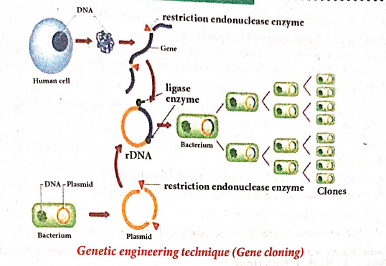
A brief outline of the basic steps involved in gene cloning are:
(i) Isolation of desired DNA fragment by using restriction enzyme
(ii) Insertion of the DNA fragment into a suitable vector (Plasmid) to make rDNA
(iii) Transfer of rDNA into bacterial host cell (Transformation)
(iv) Selection and multiplication of recombinant host cell to get a clone
(v) Expression of cloned gene in host cell.
(vi) Using this strategy several enzymes, hormones and vaccines can be produced.
2.
(i) Biofortification is the scientific process of developing crop plants enriched with high levels of desirable nutrients like vitamins, proteins and minerals.
(ii) Production of Bio fortification crops help in removing hidden hunger.
Examples:
(i) Protina, Shakti and Rathna are lysine rich maize hybrids (developed in India).
(ii) Atlas 66, a protein rich wheat variety.
(iii) Iron rich fortified rice variety.
(iv) Vitamin A enriched carrots, pumpkin and spinach.
(v) So in this way, Biofortification may help in removing hidden hunger.
3.
Mutation:
(i) Mutation is defined as the sudden heritable change in the nucleotide sequence of DNA in an organism.
(ii) It is a Process by which genetic variations are created which in turn brings about changes in the organism.
(iii) The organism which undergoes mutation is called a mutant.
(iv) The factors which induce mutations are known as mutagens or mutagenic agents.
(v) Mutagens are two types namely physical mutagens and chemical mutagens.
(i) Physical mutagens:
Radiations like X-rays, α, β and γ-rays, UV rays, temperature, etc. which induce mutations are called physical mutagens.
(ii) Chemical mutagens:
(i) Chemical substances that induce mutations are called chemical mutagens.
(ii) Eg: Mustard gas and nitrous acid. The utilization of induced mutation in crop improvement is called mutation breeding. Achievements of mutation breeding:
Achievements of mutation breeding:
(i) Sharbati Sonora wheat produced from Sonora-64 by using gamma rays.
(ii) Atomica 2 rice with saline tolerance and pest resistance.
(iii) Groundnuts with thick shells.
4.
Reason:
(i) No chemicals fertilisers are used on the soil.
(ii) No pesticides are sprayed on the plants.
(iii) The seeds used to produce plants have not been genetically altered.
5.
A breeder will incorporate the following characters:
(i) Tallness and profuse branching are desirable characters for fodder crops.
(ii) Dwarfness is desirable in cereals, so that less nutrients are consumed by these crops.
6.
He can adopt clonal selection since banana reproduces asexually from the underground stem.
7.
Plant materials brought into a country must be free from pathogens. It may lead to outbreak of new disease or introduction of a new pathogen into the environment. Thus plant materials (seeds / saplings) are tested in plant quarantine.
8.
Genetically Modified Organisms:
(i) Genetic modification refers to the alteration or manipulation of genes in the organisms using rDNA techniques in order to produce the desired characteristics.
(ii) The DNA fragment inserted is called transgene. Plants or animals expressing a modified endogenous gene or a foreign gene are also known as transgenic organisms.
Advantages:
(i) The transgenic plants are much stable, with improved nutritional quality, resistant to diseases and tolerant to various environment conditions.
(ii) Similarly transgenic animals are used to produce proteins of medicinal importance at low cost and improve livestock quality. eg Golden Rice is a genetically modified Rice which can produce Beta carotene.
9.
(i) Sexually reproducing organisms have two complete set of chromosomes in their somatic cells. This is called diploid (2n).
(ii) The gametic cells have only one set of chromosome. This is called haploid (n).
(iii) An organism having more than two sets of chromosomes is called polyploid. Such condition is called Polyploidy.
(iv) It can be induced by physical agents such as heat or cold treatments, X-rays, Chemical agents like colchicine.
Achievements of polyploidy breeding:
(i) Seedless watermelons (3n) and bananas (3n).
(ii) TV-29 (triploid variety of tea) with larger shoots and drought tolerance
(iii) Triticale (6n) is a hybrid of wheat and rye. To make this plant fertile polyploidy is induced. It has higher dietary fibre and protein.
(iv) Raphano brassica is a allotetraploid by colchicine treatment.
10.
Selection is one of the oldest methods of plant breeding in which individual plants or groups of plants are sorted out from a mixed population based on the morphological characters.
Methods of selection:
There are three methods of selection. They are
a) Mass selection
b) Pure line selection
c) Clonal selection
a) Mass selection:
(i) Seeds of best plants showing desired characters are collected from a mixed population.
(ii) The collected seeds are allowed to raise the second generation. This process is carried out for seven or eight generations.
(iii) At the end, they will be multiplied and distributed to the farmers for cultivation. Eg: Groundnut varieties like TMV-2 and AK-10.
b) Pureline selection :
(i) Pureline is "the progeny of a single individual obtained by self breeding":
(ii) This is also called as individual plant selection. In pureline selection large numbers of plants are selected from a self pollinated crop and harvested individually.
(iii) Individual plant progenies from them are evaluated separately. The best one is released as a pureline variety.
(iv) Progeny is similar both genotypically and phenotypically.
c) Clonal selection:
(i) A group of plants produced from a single plant through vegetative or asexual reproduction are called clones.
(ii) All the plants of a clone are similar both in genotype and phenotype.
(iii) Selection of desirable clones from the mixed population of vegetatively propagated crop is called clonal selection.

10th Standard Syllabus & Materials
10th Standard
TN 10th English Prose - 2 - The Night the Ghost Got in Important Questions And Answers Study Material - QB365 Set A
NEW10th Standard
TN 10th English Supplementary - 1 - The Tempest Important Questions And Answers Study Material - QB365 Set A
NEW10th Standard
TN 10th English Poem - 1 - Life Important Questions And Answers Study Material - QB365 Set A
NEW10th Standard
TN 10th English Prose - 1 - His First Flight Important Questions And Answers Study Material - QB365 Set A



Tamilnadu Stateboard 10th Standard Subjects
Tamilnadu Stateboard Standards





