
 100% FREE ACCESS
10th Standard Syllabus & Materials
10th Standard
TN 10th English Prose - 4 - The Attic Important Questions And Answers Study Material - QB365 Set A
NEW10th Standard
TN 10th English Supplementary - 3 - The Story of Mulan Important Questions And Answers Study Material - QB365 Set A
NEW10th Standard
TN 10th English Poem - 3 - I am Every Woman Important Questions And Answers Study Material - QB365 Set A
NEW10th Standard
TN 10th English Prose - 3 - Empowered Women Navigating The World Important Questions And Answers Study Material - QB365 Set A
NEW10th Standard
TN 10th English Supplementary - 2 - Zigzag Important Questions And Answers Study Material - QB365 Set A
NEW10th Standard
TN 10th English Poem - 2 - The Grumble Family Important Questions And Answers Study Material - QB365 Set A

Published on: 06/12/2019
Carbon and Its Compounds
Download Tamil Nadu 10th Standard Science question papers, model tests, one-mark questions, important questions, and public exam papers in PDF format. Free study materials and answer keys for TN State Board students.
Questions + Answers key
Take MCQ Science Test1.
An organic compound ‘A’ is widely used as a preservative and has the molecular formula C2H4O2. This compound reacts with ethanol to form a sweet smelling compound ‘B’.
(i) Identify the compound ‘A’.
(ii) Write the chemical equation for its reaction with ethanol to form compound ‘B’.
(iii) Name the process.
2.
The molecular formula of an alcohol is C4H10O. The locant number of its –OH group is 2.
(i) Draw its structural formula.
(ii) Give its IUPAC name.
(iii) Is it saturated or unsaturated?
3.
Which of the unique feature (s) of Carbon enables it to form a large number of compounds?
catenation
covalency
tetra valency
both (a) and (c)
4.
Ethanoic acid turns
red litmus blue
blue litmus red
red litmus green
blue litmus green
5.
Ethanol is used as ______________
a preservative for biological specimen
an antifreeze
an antiseptic
all the above
6.
Rectified spirit contains
95.5% of ethanol and 4.5% of water
100% pure alcohol
4.5% of ethanol and 95.5% of water
50% of ethanal and 50% of water
7.
The enzymes present in yeast is / are _____________
invertase
zymase
both (a) and (b)
neither (a) nor (b)
8.
Ethene is an ___________
alkane
alkene
alkyne
aromatic hydrocarbon
9.
Explain the reaction of carboxylic acids on metals
10.
Write the uses of ethanol.
11.
How will you convert ethanol to ethane?
12.
How is nitrogen content of molasses fortified?
13.
What is rectified spirit??
14.
How to identify saturated and unsaturated compounds?
15.
Explain how ethanol is manufactured from molasses?
16.
Write the characteristics of hydrocarbons.
17.
How will you classify hydrocarbons?
18.
Write the characteristics of organic compounds.
1.
(i) Compound 'A' is Ethanoic acid - CH3COOH [C2H4O2]
Compound 'B' is Ethyl Ethanoate - CH3COOH2CH3
(ii) 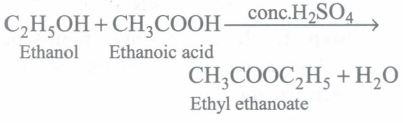
(iii) This reaction is known as Esterification reaction.
Reason: Ethyl ethanoate is an ester.
2.
(i) 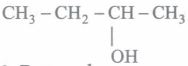
(ii) IUPAC name - Butane-2-ol (or) 2-Butanol.
(iii) The compound is saturated, because these compounds are do not decolourize with bromine water.
3.
(d)
both (a) and (c)
4.
(b)
blue litmus red
5.
(d)
all the above
6.
(a)
95.5% of ethanol and 4.5% of water
7.
(c)
both (a) and (b)
8.
(b)
alkene
9.
Ethanoic acid reacts with metals like Na, K, Zn, etc. to form metal ethanoate and hydrogen gas.
2CH3COOH + Zn ⟶ (CH3COO)2 Zn + H2 ↑
2CH3COOH + 2Na ⟶ 2CH3COONa + H2O
10.
Ethanol is used
(i) as an anti-freeze in automobile radiators.
(ii) as an antiseptic to sterilize wounds, in hospitals.
(iii) as a solvent for drugs, oils, fats, perfumes, dyes, etc..
11.
When ethanol is heated with are H2SO4 at 443K, it loses a water molecule to form ethane.
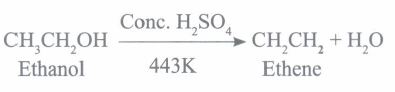
12.
The nitrogen content of the molasses fortified by the addition of ammonium sulphate or ammonium phosphate.
13.
Aqueous solution of ethanol which contain 95.5% of ethanol and 4.5% of water is called rectified spirit.
14.
(i) Take the given sample solution in a test tube.
(ii) Add a few drops of bromine water and observe any characteristic change in colour
(iii) If the given compound is unsaturated it will decolorise bromine water. Saturated compounds do not decolorise bromine
15.
(i) Dilution: Molasses is first diluted with water to bring down the concentration of sugar to about 8 to 10 percent.
(ii) Addition of yeast: Yeast is added to this solution and the mixture is kept at about 300 K for a few days during this period, the enzymes invertase and zymase present in yeast, bring about the conversion of sucrose into ethanol.
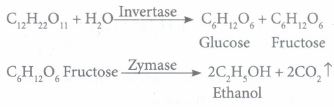
(iii) Distillation of wash: The fermented liquid (i.e. wash), containing 15 to 18 percent alcohol, is now subjected to fractional distillation. The main fraction drawn is an aqueous solution of ethanol which contain 95.5% of ethanol and 4.5% of water. This is called rectified spirit. This mixture is then refluxed over quicklime for about 5 to 6 hours and then allowed to stand for 12 hours. On distillation of this mixture, pure alcohol (100%) is obtained. This is called absolute alcohol.
16.
Characteristics of hydrocarbons
(i) Lower hydrocarbons are gases at room temperature
(ii) Alkanes are least reactive where Alkynes are most reactive due to presence triple bond
(iii) Alkanes are saturated whereas alkenes and alkynes are unsaturated
(iv) They are insoluble in water
17.
Hydrocarbons are classified into three classes such as:
(i) Alkanes
(ii) Alkenes
(iii) Alkynes
(i) Alkanes: These are hydrocarbons which contain only single bonds. They are represented by the general formula CnH2n + 2 (where n = 1,2,3, ).
Ex: Methane (CH4).
(ii) Alkenes: The hydrocarbons which contain one or more C=C bonds are called alkenes. These are unsaturated compounds. They are represented by the general formula CnH2n.
(iii) Alkynes: The hydrocarbons containing carbon to carbon triple bond are called alkynes. They have the general formula CnH2n-2.
Ex: Acetylene (C2H2)
18.
(i) Organic compounds have high molecular weight and complex structure
(ii) They are mostly insoluble in water and soluble in organic solvents such as ether, carbon tetrachloride, toluene, etc.
(iii) They are highly flammable.
(iv) Organic compounds are less reactive compared to inorganic compounds.
(v) Organic compounds form covalent bonds.
(vi) They have lower melting point and boiling point.
(vii) They exhibit the phenomenon of isomerism.
(viii) They are volatile in nature.
(ix) They can be prepared in the laboratory.

10th Standard Syllabus & Materials
10th Standard
TN 10th English Prose - 2 - The Night the Ghost Got in Important Questions And Answers Study Material - QB365 Set A
NEW10th Standard
TN 10th English Supplementary - 1 - The Tempest Important Questions And Answers Study Material - QB365 Set A
NEW10th Standard
TN 10th English Poem - 1 - Life Important Questions And Answers Study Material - QB365 Set A
NEW10th Standard
TN 10th English Prose - 1 - His First Flight Important Questions And Answers Study Material - QB365 Set A



Tamilnadu Stateboard 10th Standard Subjects
Tamilnadu Stateboard Standards





