
 100% FREE ACCESS
10th Standard Syllabus & Materials
10th Standard
TN 10th English Prose - 4 - The Attic Important Questions And Answers Study Material - QB365 Set A
NEW10th Standard
TN 10th English Supplementary - 3 - The Story of Mulan Important Questions And Answers Study Material - QB365 Set A
NEW10th Standard
TN 10th English Poem - 3 - I am Every Woman Important Questions And Answers Study Material - QB365 Set A
NEW10th Standard
TN 10th English Prose - 3 - Empowered Women Navigating The World Important Questions And Answers Study Material - QB365 Set A
NEW10th Standard
TN 10th English Supplementary - 2 - Zigzag Important Questions And Answers Study Material - QB365 Set A
NEW10th Standard
TN 10th English Poem - 2 - The Grumble Family Important Questions And Answers Study Material - QB365 Set A

Published on: 06/09/2019
Periodic Classification of Elements
Download Tamil Nadu 10th Standard Science question papers, model tests, one-mark questions, important questions, and public exam papers in PDF format. Free study materials and answer keys for TN State Board students.
Questions + Answers key
Take MCQ Science Test1.
2.
_____ is a relative periodic property.
atomic radii
ionic radii
electron affinity
electronegativity
3.
The chemical name of rust is____________
4.
________ and ________ are called inner transition elements
5.
The scientist who propounded the modern periodic law is ________.
6.
State two conditions necessary for rusting of iron.
7.
What is rust? Give the equation for formation of rust.
8.
A is a reddish brown metal, which combines with O2 at < 1370 K gives B, a black coloured compound. At a temperature > 1370 K, A gives C which is red in colour. Find A, B and C with reaction.
9.
Explain smelting process.
10.
a) State the reason for addition of caustic alkali to bauxite ore during purification of bauxite.
b) Along with cryolite and alumina, another substance is added to the electrolyte mixture. Name the substance and give one reason for the addition
11.
Metal A belongs to period 3 and group 13. A in red hot condition reacts with steam to form B. A with strong alkali forms C. Find A, B and C with reactions.
12.
Group 18 elements
13.
Dental filling
14.
Redox reaction
15.
Galvanisation
1.
(b)
2.
(d)
electronegativity
3.
()
hydrated ferric oxide
4.
()
Lanthanides, Actinides
5.
()
Hendry Moseley
6.
Conditions necessary for rusting of iron:
(i) Iron is exposed to moist air.
(ii) Presence of water droplets in the atmosphere.
(iii) Presence of Oxygen.
7.
(i) Rust is the formation of scaling reddish brown hydrated ferric oxide on the surface of iron containing materials.
(ii) This compound is known as rust and the phenomenon of formation of rust in known as rusting.
(iii) \( 4 \mathrm{Fe}+3 \mathrm{O}_{2}+\mathrm{xH}_{2} \mathrm{O} \rightarrow 2 \mathrm{Fe}_{2} \mathrm{O}_{3} \cdot \mathrm{xH}_{2} \mathrm{O}\\ \quad \quad \quad \quad \quad\quad\text { (Rust hydrated ferric oxide) } \)
8.
(i) A - reddish brown metal - Copper
(ii) When copper is heated at < 1370 K in the presence of oxygen, copper forms black colour Copper (II) oxide (CuO).
(iii) \(2 \mathrm{Cu}+\mathrm{O}_{2} \stackrel{\text { below } 1370 \mathrm{~K}}{\longrightarrow} \underset{\text { (copper (Il)oxide-black) }}{2 \mathrm{CuO}}\)
(iv) When copper is heated at >1370 K in the presence of oxygen, copper forms red colour Cop-per (I) oxide \((\mathrm{Cu}_{2} \mathrm{O} )\)
(v) \(4 \mathrm{Cu}+\mathrm{O}_{2} \stackrel{\text { above } 1370 \mathrm{~K}}{\longrightarrow} \underset{\text { (copper-I-oxide-red) }}{2 \mathrm{Cu_2O}}\)
(vi) A - copper (Cu)
(vii) B - copper (II) oxide (CuO) - Black coloured
(viii) \(\mathbf{C} - copper-I-oxide \left(\mathrm{Cu}_{2} \mathbf{O}\right)-\operatorname{Red}\) coloured
9.
Smelting (in a Blast Furnace):
(i) The charge consisting of roasted ore, coke and limestone in the ratio 8:4:1 is smelted in a blast furnace by introducing it through the hopper arrangement at the top.
(ii) There are three important regions in the furnace.
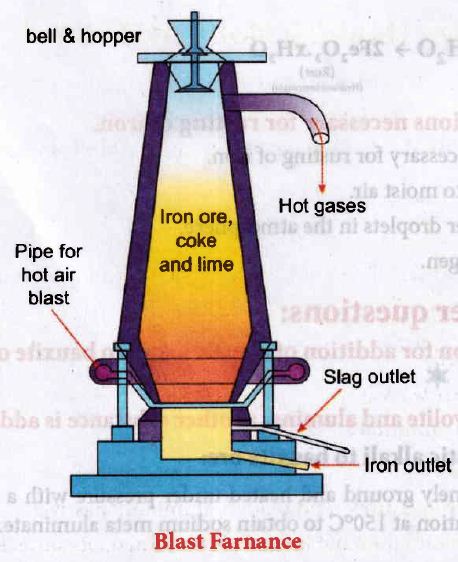
a) The Lower Region (Combustion Zone):
(i) The temperature is at \(1500^{\circ} \mathrm{C}\).
(ii) In this region, coke burns with oxygen to form CO2 when the charge comes in contact with a hot blast of air.
(iii) It is an exothermic reaction since heat is liberated.
\(\mathbf{C}+\mathbf{O}_{2} \underset{\Delta}{\stackrel{1500^{\circ} \mathrm{C}}{\longrightarrow}} \mathrm{CO}_{2}+ Heat\)
b) The Middle Region (Fusion Zone):
(i) The temperature prevails at \(1000^{\circ} \mathrm{C}\).
(ii) In this region, CO2 is reduced to CO.
\(\mathrm{CO}_{2}+\mathrm{C} \underset{\Delta}{\stackrel{1000^{\circ} \mathrm{C}}{\longrightarrow}} 2 \mathrm{CO}-\text { Heat }\)
(iii) Limestone decomposes to calcium oxide and CO2.
\(\mathrm{CaCO}_{3} \underset{\Delta}{\stackrel{1000^{\circ} \mathrm{C}}{\longrightarrow}} \mathrm{CaO}+CO_2-\text { Heat }\)
(iv) These two reactions are endothermic due to absorption of heat.
(v) Calcium oxide combines with silica to form calcium silicate slag.
\(\mathrm{CaO}+\mathrm{SiO}_{2} \longrightarrow \mathrm{CaSiO}_{3}\)
c) The Upper Region (Reduction Zone):
(i) The temperature prevails at \(\mathbf{4 0 0 ^ { \circ } \mathrm { C } \text { . }}\)
(ii) In this region carbon monoxide reduces ferric oxide to form a fairly pure spongy iron.
\(\mathrm{Fe}_{2} \mathrm{O}_{3}+3 \mathrm{CO} \stackrel{400^{\circ} \mathrm{C}}{\longrightarrow} 2 \mathrm{Fe}+3 \mathrm{CO}_{2}\uparrow\)
(iii) The molten iron is collected at the bottom of the furnace after removing the slag.
(iv) The iron thus formed is called pig iron.
(v) It is remelted and cast into different molds.
(vi) This iron is called cast iron.
10.
a) Addition of caustic alkali to bauxite ore:
(i) Bauxite ore is finely ground and heated under pressure with a solution of concentrated caustic soda solution at 150oC to obtain sodium meta aluminate.
(ii) Al2O3 + 2 NaOH → 2 NaAlO2 + H2O
(iii) On diluting sodium meta aluminate with water, a precipitate of aluminium hydroxide is formed.
(iv) NaAlO2 + 2 H2O → Al(OH)3 + NaOH
(v) The precipitate is filtered, washed, dried and ignited at 1000oC to get alumina.
(iv) \(2 \mathrm{Al}(\mathrm{OH})_{3} \stackrel{1000^{\circ} \mathrm{C}}{\longrightarrow} \mathrm{Al}_{2} \mathrm{O}_{3}+3 \mathrm{H}_{2} \mathrm{O}\)
b) (i) Electrolyte : Pure alumina + molten cryolite +fluorspar
(ii) Fluorspar is added to lowers the fusion temperature of electrolyte.
11.
i) Metal A belongs to periods 3 and group 13 is Aluminium.
ii) When steam is passed over red hot aluminium, Aluminium oxide and Hydrogen is produced.
iii) when Aluminium react with strong caustic alkalis forming aluminates
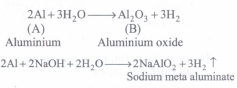
| A | Al | Aluminium |
| B | Al2O3 | Aluminium oxide |
| C | NaAlO2 | Sodium meta aluminate |
12.
Noble gas elements
13.
silver-tin amalgam
14.
Aluminothermic process
15.
coating with Zn

10th Standard Syllabus & Materials
10th Standard
TN 10th English Prose - 2 - The Night the Ghost Got in Important Questions And Answers Study Material - QB365 Set A
NEW10th Standard
TN 10th English Supplementary - 1 - The Tempest Important Questions And Answers Study Material - QB365 Set A
NEW10th Standard
TN 10th English Poem - 1 - Life Important Questions And Answers Study Material - QB365 Set A
NEW10th Standard
TN 10th English Prose - 1 - His First Flight Important Questions And Answers Study Material - QB365 Set A



Tamilnadu Stateboard 10th Standard Subjects
Tamilnadu Stateboard Standards





