
 100% FREE ACCESS
10th Standard Syllabus & Materials
10th Standard
TN 10th English Prose - 4 - The Attic Important Questions And Answers Study Material - QB365 Set A
NEW10th Standard
TN 10th English Supplementary - 3 - The Story of Mulan Important Questions And Answers Study Material - QB365 Set A
NEW10th Standard
TN 10th English Poem - 3 - I am Every Woman Important Questions And Answers Study Material - QB365 Set A
NEW10th Standard
TN 10th English Prose - 3 - Empowered Women Navigating The World Important Questions And Answers Study Material - QB365 Set A
NEW10th Standard
TN 10th English Supplementary - 2 - Zigzag Important Questions And Answers Study Material - QB365 Set A
NEW10th Standard
TN 10th English Poem - 2 - The Grumble Family Important Questions And Answers Study Material - QB365 Set A

Published on: 20/01/2020
Download Tamil Nadu 10th Standard Science question papers, model tests, one-mark questions, important questions, and public exam papers in PDF format. Free study materials and answer keys for TN State Board students.
Questions + Answers key
Take MCQ Science Test1.
Write notes on
i) saturated solution
ii) unsaturated solution
2.
Calculate the number of moles in
(i) 27g of Al
(ii) 1.51 × 10²³ molecules of NH4Cl
3.
Write a note an prevention and control of AIDS.
4.
In a biology period, the teacher drew the heart of rabbit on the board and explained its structure and functions. After the class, your friend told you that he finds it difficult to understand the concept and felt he wanted a detailed explanation.
(i) In what way the teaching can be made easily understandable?
(ii) Do you think using technologies like Visual Communication help students to understand the difficult concepts in a simple way?
(iii) By what means the Visual Communication improve the learning ability?
5.
How will you classify hydrocarbons?
6.
Two kittens (Leo and Joe) from the same mother were separated and sent to different habitual conditions. Leo was sent to a high mountain wild region and Joe was domesticated and lived in a city. After a good 5 years) it was found that Leo was aggressive and built strong with hunting skills. Leo looked tall with strong legs and muscled structure) whereas Joe was a well mannered cat looked puffy with soft legs.
(i) Do you think habitual condition impact animal characters?
(ii) What acquired characters does Leo inherit?
(iii) Is it true but Leo's offspring would be a hunter?
7.
Define and describe thermal expansion.
8.
When you place your ear on rails, it allows you to hear the approach of a train long before you can hear the sound of train in the air. How?
9.
Man is a mammal and has incisors and canine. Rabbits are mammals but lack canines. Explain.
10.
How is zinc blende concentrated? Explain it with a neat diagram
11.
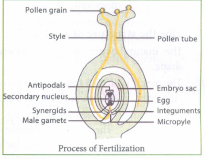
Explain the process of fertilization in plants?
12.
Luteal phase of the menstrual cycle is also called the secretory phase. Give reason.
13.
The complete events of cardiac cycle last for 0.8 sec. What is the timing for each event?
14.
State Soddy and Fajans displacement law.
15.
A person who is sitting at a distance of 400 m from a source of sound is listening to a sound of 600 Hz. Find the time period between successive compressions from the source?
1.
(i) Saturated solution:
a) A solution in which no more solute can be dissolved in a definite amount of the solvent at a given temperature is called saturated solution.
b) E.g. 36 g of sodium chloride in 100 g of water at 25° C forms saturated solution.
c) Further addition of sodium chloride, leaves it undissolved.
(ii) Unsaturated solution:
a) Unsaturated solution is one that contains less solute than that of the saturated solution at a given temperature.
b) E.g. 10 g or 20 g or 30 g of Sodium chloride in 100 g of water at 25°C forms an unsaturated solution.
2.
(i) 27 g of AI
Number of moles = \(\frac{Given\ Mass}{Atomic \ Mass}=\frac{27}{27}=1\)
Number of moles of 27 g of Al is 1 mole
(ii) 1.51 x 10²³ molecules of NH4Cl
Number of moles = \(\frac{Number \ of \ molecules}{6.023 \times 10^\text{23}}\)
= \(\frac{1.51 \times10^{23}}{6.023 \times10^{23}}\)
\(\frac{1.51}{6.023}\)
Number of moles of 1.51 x 10²³ molecules of NH4Cl = 0.25 mole
3.
The following steps may help in controlling and prevent the spreading of HIV infection:
(i) Screening of blood from blood banks for HIV before transfusion.
(ii) Ensuring the use of disposable needles and syringes in hospitals and clinics.
(iii) Advocating safe sex and advantages of using condoms.
(iv) Creating awareness campaign and educating people on the consequences of AIDS.
(v) Persons with HIV/AIDS should not be isolated from the family and society.
4.
(i) Pictures and Audio-Visuals give us more understanding than teaching and writing on black board. So, any visual representation of the concepts would help us to understand better and make teaching simple
(ii) Yes. Visual Communication helps us to easily conceptualize complicated theorems and concepts. When the teacher shows pictures / videos that represent the concept, we would easily relate to its application and firmly understand the concept without any mis-perception
(iii) Pictures, Audio-Visuals, animations provide additional information and helps us to easily correlate the concepts. We could easily remember the visuals than black board writing, and visualize it, so that we do not forget and we could easily recollect at the time of examination.
5.
Hydrocarbons are classified into three classes such as:
(i) Alkanes
(ii) Alkenes
(iii) Alkynes
(i) Alkanes: These are hydrocarbons which contain only single bonds. They are represented by the general formula CnH2n + 2 (where n = 1,2,3, ).
Ex: Methane (CH4).
(ii) Alkenes: The hydrocarbons which contain one or more C=C bonds are called alkenes. These are unsaturated compounds. They are represented by the general formula CnH2n.
(iii) Alkynes: The hydrocarbons containing carbon to carbon triple bond are called alkynes. They have the general formula CnH2n-2.
Ex: Acetylene (C2H2)
6.
Yes. When there is a change in the environment, the animals respond to the change. They develop adaptive structures. The characters developed by the animals during their life time, in response to the environmental changes are called acquired characters.
(i) Leo lived in the mountain region and it was wild. It developed hunting skills for survival and this made his legs and body strong. So the muscled physical body, strong legs and hunting skills were the acquired characters inherited by Leo.
(ii) According to Lamarck, the. acquired characters are transmitted to the offspring by the process of inheritance.
7.
(i) When heat energy is supplied to a body, there can be an increase in the dimension of the object. This change in the dimension due to rise in temperature is called thermal expansion of the object.
(ii) The expansion of liquids (eg. mercury) can be seen when a thermometer is placed in warm water. All forms of matter (solid, liquid and gas) undergo expansion on heating.
(iii) When a solid is heated, the atoms gain energy and vibrate more vigorously. This results in the expansion of the solid.
(iv) The different types of expansion of solid are
i) Linear expansion
ii) Superficial expansion
iii) Cubical expansion
(v) When heated, the atoms in a liquid or gas gain energy and are forced further apart. The extent of expansion varies from substance to substance. For a given rise in temperature, a liquid will have more expansion than a solid and a gaseous substance has the highest expansion when compared with the other two.
8.
The velocity of sound waves is maximum in solids because they are more elastic in nature than liquids and gases.
Velocity = \(\frac{Distance}{Time Taken}\)
If the distance traveled by one wave is taken as one wavelength (A) and, the taken for this propagation is one time period (T), then, velocity can be written as
\(v=\frac { \lambda }{ T } \quad ....(1)\)
Therefore, velocity can be defined as the distance traveled per second by a sound wave. Since, Frequency (n) = 1/T, equation (1) can be written as
v = nλ
9.
Man is omnivorous in his food habit. He eats plant and animal food. Therefore he has well CI developed incisors and canines. Rabbits are herbivorous in mode of nutrition. They need sharp incisors only. Canines or tearing teeth are hence absent in rabbits.
10.
Froth floatation:
(i) Principle: This process depends on the preferential wettability of the ore with oil (pine oil) and the gangue particles by water. Lighter ores, such as sulphide ores, are concentrated by this method. E.g. Zinc blende ZnS
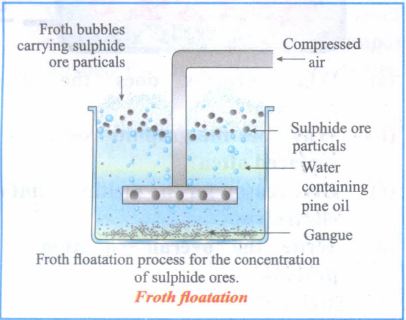
(ii) Method: The crushed ore is taken in a large tank containing oil and water and agitated with a current of compressed air. The ore is wetted by the oil and gets separated from the gangue in the form of froth. Since the 4 ore is lighter, it comes on the surface with the froth and impurities are left behind
11.
(i) Pollen grains reach the right stigma and begin to germinate.
(ii) Pollen grain forms a small tube-like structure called pollen tube which emerges through the germ pore. The contents of the pollen grain move into the tube.
(iii) Pollen tube grows through the tissues of the stigma and style and finally the ovule through the micropyle.
(iv) Vegetative cell degenerates and the generative cell divides to form two sperms (or male gametes).
(v) Tip of pollen tube bursts and the two sperms enter the embryo sac
(vi) One sperm fuses with the egg (syngamy) and forms a diploid zygote.
(vii) The other sperm fuses with the secondary nucleus (Triple fusion) to form the primary endosperm nucleus which is triploid in nature.
(viii)Since two types of fusion syngamy and triple fusion take place in an embryo sac the process is termed as double fertilization.
(ix) After triple fusion, primary endosperm nucleus develops into an endosperm.
(x) Endosperm provides food to the developing embryo.
(xi) Later the synergids and antipodal cells degenerate.
12.
(i) Corpus leuteum produces progestrone and its level increases followed by a decline if menstrual bleeding occurs.
(ii) Uterine wall ruptures bleeding starts and infertilized egg is expelled.
13.
Each cardiac cycle lasts for about 0.8 seconds. The events during a single cardiac cycle involves,
a) Atrial systole - 0.1 sec
(Contraction of auricles)
b) Ventricular systole - 0.3 sec
( Contraction of ventricles)
c) Ventricular diastole - 0.4 sec
(Relaxation of ventricles)
Total time - 0.8 sec
14.
Soddy and Fagan's displacement laws:
(i) When a parent element emits an alpha particle the new element is formed with a decrease in atomic number by two and mass number by four.
(ii) When a parent nucleus emits a beta particle the daughter nucleus is formed with an increase in atomic number by one and has same mass number of the parent nucleus.
(iii) In gamma decay, the energy level of nucleus only changes. No new elements are formed.
15.
Given:
Frequency of sound, n = 600 Hz
T = ?
\(T = \frac{1}{n}\)
\(=\frac{1}{600}=0.0016 \ s\)
(or)
T = 1.6 ms

10th Standard Syllabus & Materials
10th Standard
TN 10th English Prose - 2 - The Night the Ghost Got in Important Questions And Answers Study Material - QB365 Set A
NEW10th Standard
TN 10th English Supplementary - 1 - The Tempest Important Questions And Answers Study Material - QB365 Set A
NEW10th Standard
TN 10th English Poem - 1 - Life Important Questions And Answers Study Material - QB365 Set A
NEW10th Standard
TN 10th English Prose - 1 - His First Flight Important Questions And Answers Study Material - QB365 Set A



Tamilnadu Stateboard 10th Standard Subjects
Tamilnadu Stateboard Standards





