
 100% FREE ACCESS
10th Standard Syllabus & Materials
10th Standard
TN 10th English Prose - 4 - The Attic Important Questions And Answers Study Material - QB365 Set A
NEW10th Standard
TN 10th English Supplementary - 3 - The Story of Mulan Important Questions And Answers Study Material - QB365 Set A
NEW10th Standard
TN 10th English Poem - 3 - I am Every Woman Important Questions And Answers Study Material - QB365 Set A
NEW10th Standard
TN 10th English Prose - 3 - Empowered Women Navigating The World Important Questions And Answers Study Material - QB365 Set A
NEW10th Standard
TN 10th English Supplementary - 2 - Zigzag Important Questions And Answers Study Material - QB365 Set A
NEW10th Standard
TN 10th English Poem - 2 - The Grumble Family Important Questions And Answers Study Material - QB365 Set A

Published on: 20/01/2020
Download Tamil Nadu 10th Standard Science question papers, model tests, one-mark questions, important questions, and public exam papers in PDF format. Free study materials and answer keys for TN State Board students.
Questions + Answers key
Take MCQ Science Test1.
Classify neurons based on its structure.
2.
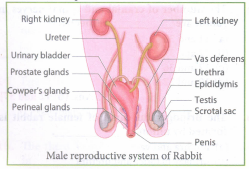
Explain the male reproductive system of rabbit with a labelled diagram.
3.
Explain about domestic electric circuits. (circuit diagram not required)
4.
Deduce the equation of a force using Newton’s second law of motion.
5.
Explain the experiment of measuring the real and apparent expansion of a liquid with a neat diagram.
6.
1.5 g of solute is dissolved in 15 g of water to form a saturated solution at 298K. Find out the solubility of the solute at the temperature.
7.
Name the acid that renders aluminium passive. Why?
8.
An organic compound ‘A’ is widely used as a preservative and has the molecular formula C2H4O2. This compound reacts with ethanol to form a sweet smelling compound ‘B’.
(i) Identify the compound ‘A’.
(ii) Write the chemical equation for its reaction with ethanol to form compound ‘B’.
(iii) Name the process.
9.
Suppose that a sound wave and a light wave have the same frequency, then which one has a longer wavelength?
a) Sound
b) Light
c) both a and b
d) data not sufficient.
10.
How much energy will have been produced if the loss in mass during a fission reaction was 0.025 g?
11.
A convex lens of power +6D and a concave lens of power -4D are combined together (in contact). Find the power of the combination of two lenses.
12.
Wire is 1 m long, 0.4 mm in diameter & has resistance of 20 Ω. Calculate its resistivity.
13.
100 W bulb draws 680 mA current. How much time will be required to pass 30 C of charge through the bulb?
14.
A body of mass 20 x 10-3 kg when acted upon by a force for 4 second, attains a velocity of 100 m/s. If the same force is applied for 2 minutes, on a body of mass 10 kg at rest, what will be its velocity?
15.
Find the mass of 2.5 mole of oxygen atom.
1.
The neurons may be of different types based on their structure and functions.
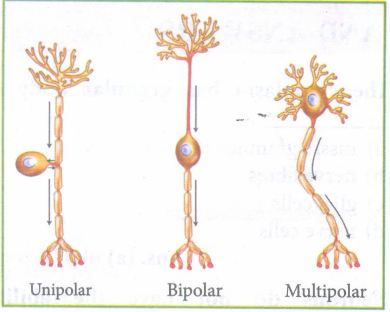
Structurally the neurons may be of the following types:
(i) Unipolar neurons
(ii) Bipolar neurons
(iii) Multipolar neurons
(i) Unipolar neurons:
i) Only one nerve process arises from the cyton which acts as both axon and dendron.
ii) Unipolar neurons found in early embryos but not in adults.
(ii) Bipolar neurons:
i) The cyton gives rise to two nerve processes of which one acts as an axon while another as a dendron.
ii) Bipolar neurons found in retina of eye and olfactory epithelium of nasal chambers.
(iii) Multipolar neurons:
i) The cyton gives rise to many dendrons and an axon.
ii) Multipolar neurons found in cerebral cortex of brain.
2.
Male Reproductive system
(i) Male reproductive system of rabbit consists of a pair of testes which are ovoid in shape.
(ii) Testes are enclosed by scrotal sacs in the abdominal cavity
(iii) Each testis consists of numerous fine tubules called seminiferous tubules
(iv) This network of tubules lead into a coiled tubule called epididymis, which lead into the sperm duct called vas deferens.
(v) Below the urinary bladder is the urethra. Vas deferens joins the urethra.
(vi) Urethra runs backward and passes into the penis.
(vii) There are three accessory glands namely prostate gland, cowper's gland and perineal gland. Their secretions are involved in reproduction.
3.
i) The electricity produced in power stations is distributed to all the domestic and industrial consumers through overhead and underground cables.
ii) In our homes, electricity is distributed through the domestic electric circuits wired by the electricians.
iii) The first stage of the domestic circuit is to bring the power supply to the main-box from a distribution panel, such as a transformer.
Main Box Contains:
a) Fuse Box:
i) The fuse box contains either a fuse wire or a miniature circuit breaker (MCB).
ii) The function of the fuse wire or a MCB is to protect the house hold electrical appliances from overloading due to excess current.
iii) An MCB is a switching device, which can be activated automatically as well as manually. It has a spring attached to the switch, which is attracted by an electromagnet when an excess current passes through the circuit.
iv) It has a spring attached to the switch, which is attracted by an electromagnet when an excess current passes through the circuit.
v) Hence, the circuit is broken and the protection of the appliance is ensured.
b) Meter:
i) The meter is used to record the consumption of electrical energy.
Insulated Wire:
i) The electricity is brought to houses by two insulated wires.
ii) Out of these two wires, one wire has a red insulation and is called the "live wire'.
iii) The other wire has a black insulation and is called the 'neutral wire'.
iv) Both, the live wire and the neutral wire enter into a box where the main fuse is connected with the live wire.
v) After the electricity meter, these wires enter into the main switch, which is used to discontinue the electricity supply whenever required.
vi) After the main switch, these wires are connected to live wires of two separate circuits.
5A rating circuit:
i) Out of these two circuits, one circuit is of a 5 A rating, which is used to run the electric appliances with a lower power rating, such as tube lights, bulbs and fans.
15 A rating circuit:
i) The other circuit is of a 15 A rating, which is used to run electric appliances with a high power rating, such as air-conditioners, refrigerators, electric iron and heaters.
ii) It should be noted that all the circuits in a house are connected in parallel, so that the disconnection of one circuit does not affect the other circuit.
iii) One more advantage of the parallel connection of circuits is that each electric appliance gets an equal voltage.
iv) The electricity supplied to your house is actually an alternating current having an electric potential of 220 V.
4.
(i) According to Newton's second law, "the force acting on a body is directly proportional to the rate of change of linear momentum of the body and the change in momentum takes place in the direction of the force".
(ii) This law helps us to measure the amount of force. So it is called as law of force'
(iii) Let, "m" be the mass of a moving body, moving along a straight line with an initial speed 'u'.
(iv) After a time interval of 't', the velocity of the body changes to 'v' due to the impact of an unbalanced external force F.
Initial momentum of the body, \( P_{i}=m u \)
Final momentum of the body, \( P_{f}=m v \)
Change in momentum, \( \Delta \mathrm{p}=\mathrm{P}_{\mathrm{f}}-\mathrm{P}_{\mathrm{i}} \)
\(=m v-m u \)
By Newton's second law of motion,
\(\text {Force, } \ F \propto\) rate of change of momentum
\(\mathrm{F} \propto \) change in momentum / time
\(\mathrm{F} \propto \frac{\mathrm{mv}-\mathrm{mu}}{\mathrm{t}}\)
\(\mathrm{F}=\frac{\mathrm{km}(\mathrm{v}-\mathrm{u})}{\mathrm{t}}\)
Here, k is the proportionality constant.
k = 1 in all system of units. Hence,
\(F=\cfrac { m(v-u) }{ t } \)
Since acceleration = change in velocity / time, a = (v-u) / t. Hence, we have
F = m x a
Force = mass x acceleration
5.
Aim:
To measure real and apparent expansion of liquid.
Apparatus Required:
a) Round bottomed flask, a narrow glass tube with a scale, burner.
Procedure:
b) The liquid whose real and apparent expansion is to be determined is poured in a container up to a level.
c) Mark this level as L1.
d) Now, heat the container and the liquid using a burner.
e) Initially, the container receives the thermal energy and it expands.
f) As a result, the volume of the liquid appears to have reduced.
g) Mark this reduced level of liquid as L2.
h) On further heating, the thermal energy is supplied to the liquid through the container results in the expansion of the liquid.
i) Hence, the level of liquid rises to L3
j) Now, the difference between the levels L1 and L3 is called apparent expansion. Apparent expansion = L3 - L1.
k) The difference between the levels L2 and L3 is called real expansion. Real expansion = L3 - L2.
Result:
The real expansion is always more than the apparent expansion.

6.
Mass of the solute = 1.5 g
Mass of the solvent = 15 g
Solubility of the solute = \(\frac{\text { Mass of the solute }}{\text { Mass of the solvent }} \times 100\)
Solubility of the solute = \(\frac{1.5}{15}\times 100\)
= 10 g
7.
(i) Dilute or concentrated nitric acid renders aluminum passive.
(ii) It does not attack aluminium but it forms oxide film on its surface.
8.
(i) Compound 'A' is Ethanoic acid - CH3COOH [C2H4O2]
Compound 'B' is Ethyl Ethanoate - CH3COOH2CH3
(ii) 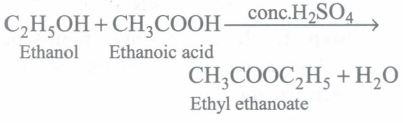
(iii) This reaction is known as Esterification reaction.
Reason: Ethyl ethanoate is an ester.
9.
b) Light
The light wave has a longer wave length. Because, it has much greater speed.
10.
Given
Loss in mass, m = 0.026 g = 2.6 x 10⁻⁵ kg
To find: E= mc2
Solution
E = 2.6 x 10-5 x (3 X 108)2
Energy, E = 2.3 x 10¹²J
11.
Power of convex lens, P1 = + 6 D
Power of concave lens, P2 = - 4 D
Power of combination of two lenses
P = ?
P = P1 + P2 = 6 - 4 = 2D
P = 2D.
12.
Length of the wire I = 1 m
Area A = πr2
Diameter of the wire, d = 0.4mm
radius of the wire, r\(\frac { d }{ 2 } =0.2\times { 10 }^{ -3 }m\)
\(=3.14\times (0.2\times { 10 }^{ -3 })\)
Resistance of the wire R = 20Ω
Resisting Power =?
\(\rho =\frac { RA }{ l } \)
\(A={ \pi r }^{ 2 }\)
= 3.14 x 0.2 x 10-3 x 0.2 x 10-3
= 0.1256 x 10⁻⁶m2
ρ = 20 x 0.1256 x 10-6
ρ = 2.512 x 10⁻⁶Ωm
13.
Given :
Charge passing through bulb, q = 30C
Current drawn by 100 W bulb, I = 680 x 10-3 A
To find: Time taken to pass
through the bulb t =? t=\(\frac{q}{I}\)
Solution :
\(I=\frac { q }{ t } =\frac { 30 }{ 680\times { 10 }^{ -3 } } \)
=441.173
Time required, t =7.35 min
14.
During impulse on first body:
Mass of the first body,
m1 = 20 x 10-3 kg
Time, t1 = 4 s
Initial velocity, u1= 0
Final velocity, v1 =100 m/s
During impulse on second body:
Mass of the second body,
m2 =10kg
Time, t2 = 2 minutes
= 2 x 60 s = 120 s
To find: Final velocity, v2 =?
Initial velocity, u2 = 0
(i) Impulse on the first body,
F.t1 =m1(v1-u1) [∵ u1=0]
F.t1 =m1v1
F.t1 =20 x 10-3 x 100
F.t1 =2 x 10-3 x 103 =2 Js .............(1)
(ii) Impulse on the second body
F.t2 =m2(v2-u2) [∵ u2=0]
F.t2 =m2v2
Ft2 =10 x v2 ...............(2)
Dividing al and CD, we get
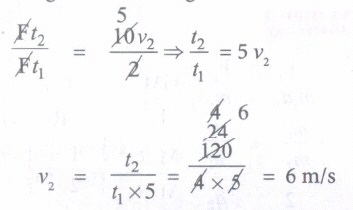
Velocity of the second body, v2 =6 m/s.
15.
Number of moles = \(\frac{Mass}{Atomic \ mass}\)
∴ Mass = Number of moles x Atomic mass
= 0.5 x 16
= 8g.

10th Standard Syllabus & Materials
10th Standard
TN 10th English Prose - 2 - The Night the Ghost Got in Important Questions And Answers Study Material - QB365 Set A
NEW10th Standard
TN 10th English Supplementary - 1 - The Tempest Important Questions And Answers Study Material - QB365 Set A
NEW10th Standard
TN 10th English Poem - 1 - Life Important Questions And Answers Study Material - QB365 Set A
NEW10th Standard
TN 10th English Prose - 1 - His First Flight Important Questions And Answers Study Material - QB365 Set A



Tamilnadu Stateboard 10th Standard Subjects
Tamilnadu Stateboard Standards





