
 100% FREE ACCESS
10th Standard Syllabus & Materials
10th Standard
TN 10th English Prose - 4 - The Attic Important Questions And Answers Study Material - QB365 Set A
NEW10th Standard
TN 10th English Supplementary - 3 - The Story of Mulan Important Questions And Answers Study Material - QB365 Set A
NEW10th Standard
TN 10th English Poem - 3 - I am Every Woman Important Questions And Answers Study Material - QB365 Set A
NEW10th Standard
TN 10th English Prose - 3 - Empowered Women Navigating The World Important Questions And Answers Study Material - QB365 Set A
NEW10th Standard
TN 10th English Supplementary - 2 - Zigzag Important Questions And Answers Study Material - QB365 Set A
NEW10th Standard
TN 10th English Poem - 2 - The Grumble Family Important Questions And Answers Study Material - QB365 Set A

Published on: 20/01/2020
Download Tamil Nadu 10th Standard Science question papers, model tests, one-mark questions, important questions, and public exam papers in PDF format. Free study materials and answer keys for TN State Board students.
Questions + Answers key
Take MCQ Science Test1.
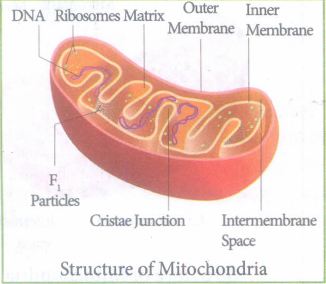
Draw the ultrastructure of mitochondria and label the parts.
2.
Name the tissue systems as classified by Sachs.
3.
Mention two provisions of the wild life protection Act.
4.
What is Van Mahotsav?
5.
What is cancer.
6.
Mention two characteristics of stem cells.
7.
What do you mean by decarboxylation?
8.
What is Paleobotany?
9.
Write the chemical equations for the following and identify the type of chemical reactions
i) Burning of magnesium in air
ii) Electric current is passed aqueous solution of sodium chloride
iii) Ammonium hydroxide reacts with nitric acid
10.
5 g of copper sulphate are dissolved in 100 g of water to form a saturated solution at 298K. Find out the solubility of the solute at the temperature.
11.
What is Electroplating?
12.
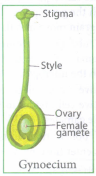
Explain Gynoecium with a neat labelled diagram.
13.
Write the components of the blood.
14.
What is aqueous and non-aqueous solution? Give an example.
15.
What organs are attached to the two bronchi?
16.
What is the common step in aerobic and anaerobic pathway?
17.
Write the name of the electromagnetic radiation which is emitted during a natural radioactivity.
18.
What is the minimum distance needed for an echo?
19.
Define one calorie.
20.
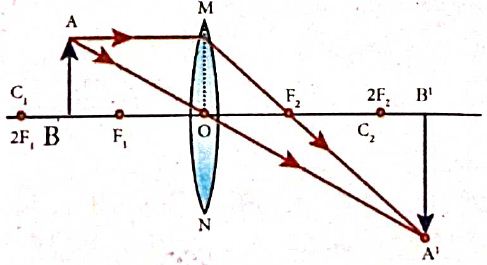
Draw a ray diagram to show the image formed by a convex lens when the object is placed between F and 2F.
21.
State two conditions necessary for rusting of iron.
22.
Mention one disadvantage of using Nuclear power.
23.
A to F are the structural formulae of some organic compounds:
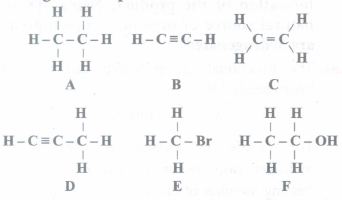
(i) Give the letters which represent the same family.
(ii) Give the letters which do not represent hydrocarbons.
(iii) Flow can 'C' be converted into A?
24.
A, B and C are three elements which undergo chemical reactions according to following equations.
A2O3 + 2B ⟶ B2O3 + 2A
3CSO4 + 2B ⟶ B2(SO4)3 + 3C
3CO + 2A ⟶ A2O3 + 3C
Answer the following questions:
(a) Which element is the most reactive?
(b) Which element is the least reactive?
25.
Though human are heterogeneous in external dimension and colour. The colour of blood is identical. Give reason.
1.
2.
(i) Dermal or Epidermal tissue system
(ii) Ground tissue system
(iii) Vascular tissue system
3.
(i) Prohibit killing and hunting of specified animals.
(ii) Constitute sanctuaries, national parks, and closed areas for wild life conservation.
4.
It refers to afforestation programmes which includes planting and protecting trees with multiple uses and helps in restoration of green cover.
5.
(i) Cancer is an abnormal and uncontrolled division of cells that invade and destroy surrounding tissue forming a tumor or neoplasm (new growth).
6.
The two important properties of stem cells that differentiate them from other cells are:
(i) Its ability to divide and give rise to more stem cells by self-renewal
(ii) Its ability to give rise to specialised cells with specific functions by the process of differentiation.
7.
Decarboxylation means removal of CO2
8.
Paleobotany is derived from Greek words paleon that means "old" and botany the study of plants. It is the branch of Paleontology that deals with recovery and identification or plant remains of geological past.
9.
(i) 2 Mg + O2 ⟶ 2 MgO ⟶ Combination reaction
(ii) 
(iii) Ammonium hydroxide reacts with nitric acid.
HNO3(aq) +NH4OH(aq) ⟶ NH4NO3(aq)+H2O(l) - Neutralization reaction
10.
Solubility = \(\frac{Mass \ of \ the \ solute}{Mass \ of \ the \ solvent}\) x 100
= \(\frac{5}{100}\) x 100
= 5 g
11.
Electroplating is a method of coating one metal over another metal by passing electric current.
12.
13.
(i) Components of blood: The blood consists of two main components. The fluid plasma and the formed elements (blood cells) which are found suspended in the plasma.
(ii) Blood cells are classified into erythrocytes, leucocytes and platelets.
14.
(i) Aqueous solution:
a) The solution in which water acts as a solvent is called aqueous solution.
b) Example: common salt in water, Copper Sulphate in water.
(ii) Non - Aqueous solution:
a) The solution in which any liquid, other than water, acts as a solvent is called non-aqueous solution.
b) Example: Sulphur dissolved in carbon disulphide, Iodine dissolved in carbon tetrachloride
15.
Lungs are attached to the two bronchi.
16.
Glycolysis is the common step in both aerobic and anaerobic pathway.
17.
Gamma radiation
18.
The minimum distance required to hear an echo is 1/20th part of the magnitude of the velocity of sound in air.
i.e. \(\frac{1}{20} \times 344 = 16.7m\)
19.
One calorie is defined as the amount of heat energy required to raise the temperature of 1 gram of water through 1o C.
20.
21.
Conditions necessary for rusting of iron:
(i) Iron is exposed to moist air.
(ii) Presence of water droplets in the atmosphere.
(iii) Presence of Oxygen.
22.
(i) The radio active by products cannot be disposed easily.
(ii) Improper storage of nuclear waste can cause contamination of the environment.
23.
(i) Letters 'B' and 'D' represent the family of alkynes.
(ii) Letters 'E' and 'F' do not represent any hydrocarbon.
(iii) 'C' can be converted into 'A' by passing hydrogen (H2) in the presence of Ni at 473 K.
.JPG)
24.
(a) The most reactive element is 'B' as it has displaced both 'A' and 'C' from their compounds
(b) The least reactive element is 'C' as it has been replaced by both 'A' and 'B'.
25.
All human beings have blood which is of uniform composition. Blood is red in colour due to presence of red blood cells containing the respiratory pigment hemoglobin. Therefore colour of blood will be identical in all human beings irrespective of external appearance.

10th Standard Syllabus & Materials
10th Standard
TN 10th English Prose - 2 - The Night the Ghost Got in Important Questions And Answers Study Material - QB365 Set A
NEW10th Standard
TN 10th English Supplementary - 1 - The Tempest Important Questions And Answers Study Material - QB365 Set A
NEW10th Standard
TN 10th English Poem - 1 - Life Important Questions And Answers Study Material - QB365 Set A
NEW10th Standard
TN 10th English Prose - 1 - His First Flight Important Questions And Answers Study Material - QB365 Set A



Tamilnadu Stateboard 10th Standard Subjects
Tamilnadu Stateboard Standards





