
 100% FREE ACCESS
10th Standard Syllabus & Materials
10th Standard
TN 10th English Prose - 4 - The Attic Important Questions And Answers Study Material - QB365 Set A
NEW10th Standard
TN 10th English Supplementary - 3 - The Story of Mulan Important Questions And Answers Study Material - QB365 Set A
NEW10th Standard
TN 10th English Poem - 3 - I am Every Woman Important Questions And Answers Study Material - QB365 Set A
NEW10th Standard
TN 10th English Prose - 3 - Empowered Women Navigating The World Important Questions And Answers Study Material - QB365 Set A
NEW10th Standard
TN 10th English Supplementary - 2 - Zigzag Important Questions And Answers Study Material - QB365 Set A
NEW10th Standard
TN 10th English Poem - 2 - The Grumble Family Important Questions And Answers Study Material - QB365 Set A

Published on: 25/10/2019
Nervous System
Download Tamil Nadu 10th Standard Science question papers, model tests, one-mark questions, important questions, and public exam papers in PDF format. Free study materials and answer keys for TN State Board students.
Questions + Answers key
Take MCQ Science Test1.
Nerve cells do not possess
neurilemma
sarcolemma
axon
dendrites
2.
Node of Ranvier is found in
muscles
axons
dendrites
cyton
3.
Which nervous band connects the two cerebral hemispheres of brain?
thalamus
hypothalamus
corpus callosum
pons
4.
The neurons which carries impulse from the central nervous system to the muscle fibre.
afferent neurons
association neurons
efferent neurons
unipolar neurons
5.
There are ________ pairs of cranial nerves and _______ pairs of spinal nerves.
12, 31
31, 12
12, 13
12, 21
6.
The outer most of the three cranial meninges is
arachnoid membrane
piamater
duramater
myelin sheath
7.
Dendrites transmit impulse ______ cell body and axon transmit impulse ______ cell body.
away from, away from
towards, away from
towards, towards
away from, towards
8.
In reflex action, the reflex arc is formed by
brain, spinal cord, muscle
receptor, muscle, spinal cord
muscle, receptor, brain
receptor, spinal cord, muscle
9.
Site for processing of vision, hearing, memory, speech, intelligence and thought is
kidney
ear
brain
lungs
10.
Bipolar neurons are found in
retina of eye
cerebral cortex
embryo
respiratory epithelium
11.
_______ supplies nutrients to the brain.
12.
The bridge of nerve fibers which connects lobes of cerebellum is _______
13.
The efferent neurons are also called _____
14.
The axon is covered with protective _______
15.
The part of human brain which acts as relay center is _______
16.
_________ maintains the constant pressure inside the cranium.
17.
Impulses travels rapidly in _______ neurons.
18.
Name the meninges.
19.
Name the parts of a neuron.
20.
Define reflex arc.
21.
Give an example for conditioned reflexes.
22.
Name the parts of the hind brain.
23.
Differentiate between Medullated and non-medullated nerve fibre.
24.
Differentiate between Voluntary and involuntary actions.
25.
Describe the structure of spinal cord.
26.
Acquired reflexes
27.
Granular body
28.
Myelin sheath
29.
Schwann cell
30.
Nissil’s granules
31.
Special fluid nourishing the brain.
32.
What does the word 'pons' mean.
33.
Tissue connecting lobes of cerebrum.
1.
(b)
sarcolemma
2.
(b)
axons
3.
(c)
corpus callosum
4.
(c)
efferent neurons
5.
(a)
12, 31
6.
(c)
duramater
7.
(b)
towards, away from
8.
(d)
receptor, spinal cord, muscle
9.
(c)
brain
10.
(a)
retina of eye
11.
()
Cerebro spinal fluid
12.
()
pons
13.
()
motor neurons
14.
()
myelin sheath
15.
()
thalamus
16.
()
cerebrospinal fluid
17.
()
myelinated
18.
Outer Duramater, Middle Arachnoid and Inner Piamater.
19.
A neuron typically consists of three basic parts: cyton, dendrites and axon.
20.
The pathway taken by nerve impulse to accomplish reflex action is called reflex arc.
21.
Conditional reflexes are the result of practice and learning. Playing harmonium by striking a particular key on seeing a music note is an example of conditioned reflex which requires conscious training effort.
22.
Hind brain is formed of three parts (1) cerebellum, (2) pons and (3) medulla oblongata.
23.
| S.No | Medullated nerve fibre | Non-medullated nerve fibre |
|---|---|---|
| i) | Medullated Nerve fibre is also known as myelinated or white neuron. Because axon is covered with myelin sheath. | Non-Medullated Nerve fibre is also known as non-myelinated or grey neuron Because axon is not covered myelin sheath. |
| ii) | Myelin sheath is produced by a layer of Schwann cells or neurilemma. | Schwann cells are absent. |
| iii) | Node of Ranvier is present. | Node of Ranvier is absent. |
| iv) | They conduct impulse at a faster speed. | Conduct impulses slower than medullated fibres. |
| v) | These are present in the white matter of brain, spinal cord and in cranial and spinal nerves. |
These are present in autonomic nerves and axons within the CNS as Grey matter. |
24.
| S.No | Voluntary actions | Involuntary actions |
|---|---|---|
| i) | An action which is under conscious control. |
An action which is not under conscious control. |
| ii) | Voluntary action is controlled by the brain. | Involuntary action is controlled by the spinal cord. |
| iii) | All voluntary actions result in a muscular action. | Involuntary actions result in a muscular action (or) secretion from some gland. |
25.
Spinal Cord :
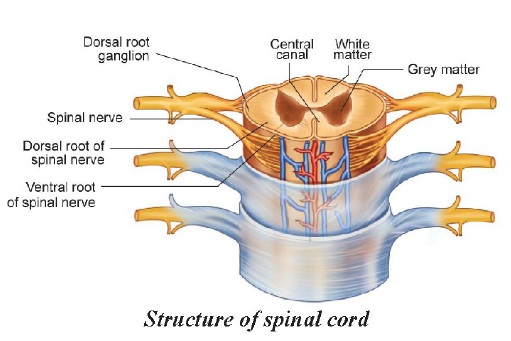
i) Spinal cord is a cylindrical structure lying in the neural canal of the vertebral column.
ii) It is also covered by meninges.
iii) It extends from the lower end of medulla oblongata to the first lumbar vertebra.
iv) The posterior most region of spinal cord tapers into a thin fibrous thread like structure called filum terminale.
v) Internally, the spinal cord contains a cerebrospinal fluid filled cavity known as the central canal.
vi) The grey matter of spinal cord is 'H' shaped.
vii) The upper end of letter 'H' forms posterior horns and lower end forms anterior horns.
viii) A bundle of fibres pass into the posterior horn forming dorsal or afferent root.
ix) Fibres pass outward from the anterior horn forming ventral or efferent root.
x) These two roots joins to form spinal nerves.
xi) The white matter is external and have bundle of nerve tracts.
xii) Spinal cord conducts sensory and motor impulses to and from the brain.
xiii) It controls reflex actions of the body.
26.
Conditioned reflexes
27.
Nissl's granules
28.
Insulator
29.
Peripheral Nervous system
30.
Cyton
31.
()
Cerebrospinal fluid
32.
()
Bridge
33.
()
Corpus callosum

10th Standard Syllabus & Materials
10th Standard
TN 10th English Prose - 2 - The Night the Ghost Got in Important Questions And Answers Study Material - QB365 Set A
NEW10th Standard
TN 10th English Supplementary - 1 - The Tempest Important Questions And Answers Study Material - QB365 Set A
NEW10th Standard
TN 10th English Poem - 1 - Life Important Questions And Answers Study Material - QB365 Set A
NEW10th Standard
TN 10th English Prose - 1 - His First Flight Important Questions And Answers Study Material - QB365 Set A



Tamilnadu Stateboard 10th Standard Subjects
Tamilnadu Stateboard Standards





