
 100% FREE ACCESS
10th Standard Syllabus & Materials
10th Standard
TN 10th English Prose - 4 - The Attic Important Questions And Answers Study Material - QB365 Set A
NEW10th Standard
TN 10th English Supplementary - 3 - The Story of Mulan Important Questions And Answers Study Material - QB365 Set A
NEW10th Standard
TN 10th English Poem - 3 - I am Every Woman Important Questions And Answers Study Material - QB365 Set A
NEW10th Standard
TN 10th English Prose - 3 - Empowered Women Navigating The World Important Questions And Answers Study Material - QB365 Set A
NEW10th Standard
TN 10th English Supplementary - 2 - Zigzag Important Questions And Answers Study Material - QB365 Set A
NEW10th Standard
TN 10th English Poem - 2 - The Grumble Family Important Questions And Answers Study Material - QB365 Set A

Published on: 06/12/2019
Nervous System
Download Tamil Nadu 10th Standard Science question papers, model tests, one-mark questions, important questions, and public exam papers in PDF format. Free study materials and answer keys for TN State Board students.
Questions + Answers key
Take MCQ Science Test1.
Rani fell from her bike and had a head injury. She was hospitalized and discharged later. What do you think she could have done to save herself from this accident.
2.
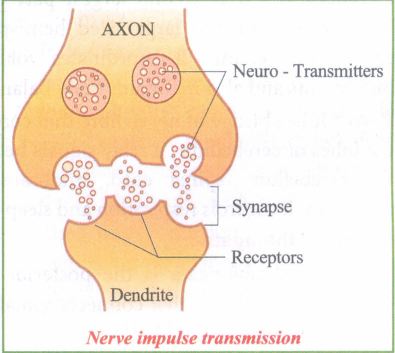
How nerve impulses are transferred from one neuron to next neuron?
3.
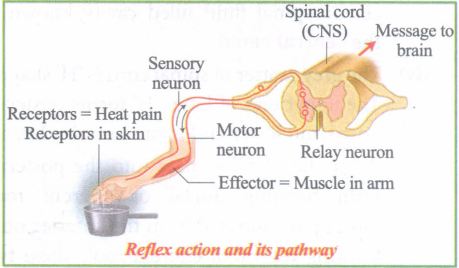
What will you do if someone pricks your hand with a needle? Elucidate the pathway of response with a neat labelled diagram.
4.
Illustrate the structure and functions of brain.
5.
Each neuron can transmit ______ nerve impulses per second.
10
1000
10,000
1,00,000
6.
______ acts as a insulator.
myelin sheath(b)
synaptic junction
nodes of ranvier
glial cells
7.
The axons may be covered by a protective sheath called ______
Myelin
Nodes of ranvier
Schwann cells
Nissl's granules
8.
______ is not a characteristic of neuron.
dendrites
axon
axolemma
can divide
9.
Sneezing, yawning etc are examples of _______
voluntary actions
involuntary actions
reflex actions
planned actions
10.
What is peripheral nervous system.
11.
Name the meninges.
12.
Name the parts of a neuron.
13.
What are neuroglia.
14.
'A' contains a cerebrospinal fluid filled cavity known as 'B'. How many nerves are produced from A.
(i) What is A?
(ii) What is 'B'?
15.
Differentiate simple reflexes and conditional reflexes.
16.
Tabulate the different parts of the brain and their functions.
1.
Rani did not wear a helmet. Some people wear a helmet but don't fasten the strap. When they fall down from the bike, the helmet falls off and they are injured. Thus a helmet worn properly can save lives.
2.
(i) All the information from the environment ate detected by the receptors located in our sense organs such as the eyes, the nose, the skin etc.
(ii) Information from the receptors is transmitted as electrical impulse and is received by the dendritic tips of the neuron.
(iii) This impulse travels from the dendrite to the cell body and then along the axon to its terminal end
(iv) On reaching the axonal end, it causes the nerve endings to release a chemical (neurotransmitter) which diffuses across a synapse and starts a similar electrical impulse in the dendrites of the next neuron, then to their cell body to be carried along the axon.
(v) In this way, the electrical signal reaches the brain or spinal cord. The response from brain (or spinal cord) is similarly passed on to the effector organs such as the muscle or gland cell, that undergoes the desired response.
(vi) The flow of nerve impulses from axonal end of one neuron to dendrite of another neuron through a synapse is called synaptic transmission.
(vii) Neurotransmitters are the chemicals which allow the transmission of nerve impulse.
(viii) The important neurotransmitter released by neurons is called Acetylcholine.
3.
(i) If someone pricks our hand with a needle, a reflex action occurs in one body that makes our hand to withdraw immediately without our consciousness
(ii) The stimulus is the pain which is sensed by receptors in our hand. This stimulus in turn triggers an impulse in sensory neuron.
(iii) The sensory neuron. transmits or conveys the message to the spinal cord.
(iv) Spinal cord interprets the stimulus and the impulse is passed on to the relay neuron which in turn transmits it to a motor neuron.
(v) Motor neurons carry command from spinal cord to our arm.
(vi) Muscle in our arm contracts and we withdraw our hand immediately from the pan.
(vii) In this example, muscle is an effector organ which has responded to the pain.
4.
A human brain is formed of three main parts:
(a) forebrain
(b) midbrain and
(c) hindbrain.
(1) Forebrain:
A. Cerebrum(cortex)
B. Diencephalon
i) Thalamus ii) Hypothalamus
(2) Midbrain
(3) Hindbrain:
A. Cerebellum
B. Pons
C. Medulla Oblongata
| Part of brain | Structure | Description | Functions |
| Forebrain | Cerebrum (cortex) |
(i) It is the largest portion forming nearly two-third of the brain. (ii) It is divided into 2 halves (Right and Left hemispheres) interconnected by Corpus collosum. (iii) The outer portion is called cortex (grey matter) and inner portion is called medulla (white matter) (iv) The cortex is extremely folder forming elevations (gyri) and abd depressions (sulci) in between. (v) Each cerebral hemisphere is divided into frontal lobe, parietal lobe, temporal lobe and occipital lobe. |
(i) Sensory perception (ii) Control of voluntary functions (iii) Language (iv) Thinking (intelligence) (v) Memory (vi) Decision making (vii) Creativity |
| Thalamus | It is present in cerebral medulla is a major conducting centre for sensory and motor signalling. | Acts as a relay centre | |
| Hypothalamus | (i) It lies at the base of the thalamus (ii) It is an important link between nervous system and endocrine glands |
(i) Controls involuntary functions (ii) Temperature control (iii) Thirst, hunger control (iv) Urinationi (v) Controls the secretion of hormones from anterior pituitary gland |
|
| Midbrain | Corpora quadrigemina |
(i) It is located between thalamus and hindbrain (ii) It is made of four rounded bodies |
Controls visual and auditory (hearing) reflexes |
| Hindbrain | Cerebellum | It is seçond largest part of the brain formed of two large sized hemispheres and middle vermis |
(i) Coordinates voluntary movements (ii) Maintains body balance |
| Pons | (i) 'Pons' a latin word, meaning bridge (ii) It is a bridge of nerve fibre that connects the lobes of cerebellum. |
(i) Relays signals between the cerebellum, spinal cord, midbrain and cerebrum (ii) Controls respiration and sleep cycle. |
|
| Medulla Oblongata | It is the posterior most part of the brain that connects spinal cord and various parts of brain. |
(i) Has cardiac centre, respiratory centres, vasomotor centres and digestive centre (ii) Also regulates vomiting and salivation |
5.
(b)
1000
6.
(a)
myelin sheath(b)
7.
(a)
Myelin
8.
(d)
can divide
9.
(c)
reflex actions
10.
Peripheral nervous system is formed by the nerves arising from the brain and the spinal cord. The nerves arising from the brain are called cranial nerves. Nerves arising from spinal cord are called spinal nerves. In man, there are 12 pairs of cranial nerves and 31 pairs of spinal nerves.
11.
Outer Duramater, Middle Arachnoid and Inner Piamater.
12.
A neuron typically consists of three basic parts: cyton, dendrites and axon.
13.
Neuroglia: Neuroglia are also called as glial cells. They are the non-exciting, supporting cell of the nervous system. They do not initiate or conduct nerve impulse.
14.
(i) Spinal cord.
(ii) Central canal.
31 pairs of nerves are produced from spinal cord.
15.
| Simple reflexes | Conditional reflexes | |
| i) | These reflexes are inbuilt and unlearned responses. | These reflexes are the result of practice and learning. |
| ii) | Eg: Winking of eyes when any dust particle enters. | Eg: Playing harmonium by striking a particular key on seeing a music note. |
16.
| Structure | Functions |
| Cerebral cortex | Sensory perception, control of voluntary functions, language, thinking, memory, decision making, creativity. |
| Thalamus | Acts as relay station. |
| Hypothalamus | Temperature control, thirst, hunger, urination, important link between nervous system and endocrine glands. |
| Cerebellum | Maintenance of posture and balance, coordinate voluntary muscle activity. |
| Pons and medulla | Role in sleep-awake cycle, cardiovascular, respiratory and digestive control centers. |

10th Standard Syllabus & Materials
10th Standard
TN 10th English Prose - 2 - The Night the Ghost Got in Important Questions And Answers Study Material - QB365 Set A
NEW10th Standard
TN 10th English Supplementary - 1 - The Tempest Important Questions And Answers Study Material - QB365 Set A
NEW10th Standard
TN 10th English Poem - 1 - Life Important Questions And Answers Study Material - QB365 Set A
NEW10th Standard
TN 10th English Prose - 1 - His First Flight Important Questions And Answers Study Material - QB365 Set A



Tamilnadu Stateboard 10th Standard Subjects
Tamilnadu Stateboard Standards





