
 100% FREE ACCESS
10th Standard Syllabus & Materials
10th Standard
TN 10th English Prose - 4 - The Attic Important Questions And Answers Study Material - QB365 Set A
NEW10th Standard
TN 10th English Supplementary - 3 - The Story of Mulan Important Questions And Answers Study Material - QB365 Set A
NEW10th Standard
TN 10th English Poem - 3 - I am Every Woman Important Questions And Answers Study Material - QB365 Set A
NEW10th Standard
TN 10th English Prose - 3 - Empowered Women Navigating The World Important Questions And Answers Study Material - QB365 Set A
NEW10th Standard
TN 10th English Supplementary - 2 - Zigzag Important Questions And Answers Study Material - QB365 Set A
NEW10th Standard
TN 10th English Poem - 2 - The Grumble Family Important Questions And Answers Study Material - QB365 Set A

Published on: 29/11/2019
Optics
Download Tamil Nadu 10th Standard Science question papers, model tests, one-mark questions, important questions, and public exam papers in PDF format. Free study materials and answer keys for TN State Board students.
Questions + Answers key
Take MCQ Science Test1.
A magnifying glass is also called
Telescope
Compound microscope
Simple microscope
Astronomical telescope
2.
In compound microscope, as compare to eye piece, objective lens has _____ focal length.
-ve focal length
Zero
Small
Large
3.
A lens which collects image at back of telescope
Objective lens
Diverging
Converging
Polars
4.
The resolving power depends on
Dimetal of the lens
Wavelength
Refractive index
a & b
5.
We can see objects because of
reflection
refraction
transmission
diffraction
6.
Violet and red light ______ wavelengths.
lowest, highest
highest, lowest
same
standard
7.
Which of the following lens would you prefer to use while reading small letters found in a dictionary?
A convex lens of focal length 5 cm
A concave lens of focal length 5 cm
A convex lens of focal length 10 cm
A concave lens of focal length 10 cm
8.
9.
In a myopic eye, the image of the object is formed
behind the retina
on the retina
in front of the retina
on the blind spot
10.
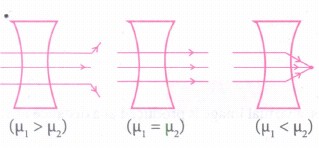
A concave lens of refractive in μ1 is kept in a medium of refractive index (μ2). A parallel beam of light is incident on the lens. Draw the path of the rays of light emerging from a lens.
11.
What are the advantages of telescopes?
12.
When does Mie scattering take place? Write the causes.
13.
What are the causes of ‘Myopia’?
14.
Differentiate convex lens and concave lens.
15.
State Snell’s law.
16.
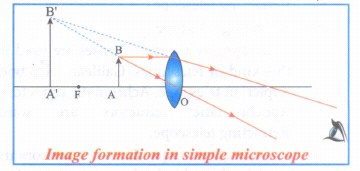
Explain the construction of Simple Microscope and derive its magnification power.
17.
Explain the working of the eye.
18.
An object of height 3cm is placed at 10cm from a concave lens of focal length 15cm. Find the size of the image.
19.
While doing an experiment for the determination of focal length of a convex lens, Raja Suddenly dropped the lens. It got broken into two halves along the axis. If he continues his experiment with the same lens,
(a) can he get the image?
(b) Is there any change in the focal length?
20.
The far position of a myopic person is 90 cm in front of the eye. What is the nature and power of the lens required to correct the problem?
1.
(c)
Simple microscope
2.
(c)
Small
3.
(a)
Objective lens
4.
(d)
a & b
5.
(a)
reflection
6.
(a)
lowest, highest
7.
(a)
A convex lens of focal length 5 cm
8.
(d)
9.
(c)
in front of the retina
10.
11.
(i) Elaborate view of the Galaxies, Planets, stars and other heavenly bodies.
(ii) Camera can be attached for taking photograph for the celestial objects.
(iii) Telescope can be viewed even with the low intensity of light.
12.
(i) Mie scattering takes place when the diameter of the scatterer is similar to or larger than the wavelength of the incident light. It is also an elastic scattering. The amount of scattering is independent of wave length.
(ii) Mie scattering is caused by pollen, dust, smoke, water droplets, and other particles in the lower portion of the atmosphere.
13.
(i) The focal length of eye lens is reduced or the distance between eye lens and retina increases.
(ii) Hence the far point will not be infinity for such eyes and the far point has come closer, with this defect, nearby object can be seen clearly but distant objects cannot be seen clearly.
14.
| S. No. |
Convex Lens |
Concave Lens |
|---|---|---|
| (i) | A convex lens is thicker in the middle than at edges. | A concave lens is thinner in the middle than at edges. |
| (ii) | It is a converging lens. | It is diverging lens. |
| (iii) | It produces mostly real images. | It produces a virtual image. |
| (iv) | It is used to treat hypermetropia. | It is used to treat myopia. |
15.
Snell's law state that, the ratio of the sine of the angle of incidence and sine of the angle of refraction is equal to the ratio of refractive indices of the two media.
\(\frac{\sin i}{\sin r}=\frac{\mu_2}{\mu_1}\)
16.
(i) Simple Microscope: Simple microscope is a convex lens of short focal length. It is held near the eye to get enlarged image of small objects.
(ii) Let an object (AB) of height 'h' is placed at a point within the principal focus (u < f) of the convex lens and the observer's eye placed just behind the lens.
(iii) As per this position the convex lens CJ produces an erect, virtual and enlarged image (A'B'). The image formed is in the same side of the object and the distance equal to the least distance of distinct vision (D) (D = 25 cm for normal human eye).
(iv) Magnification power (M): Ratio of the height of the image produced by the microscope h2) to the original height of the object (h1) is called magnification.
M=\(\frac { A'B' }{ AB } \)
Magnification M =\(\frac { height\ of\ the\ image }{ height\ of\ the\ object } \)
=\(\frac { { h }_{ 2 } }{ { h }_{ 1 } } \)
Magnification can also be defined as the ratio of distance of image (v) to the distance of object (u)
Magnification M =\(\frac { Distance\ of\ the\ image }{ Distance\ of\ the\ object } \)
=\(\frac { v }{ u } \)
Since, the image is virtual and erect; the Magnification (M) is taken as positive In simple Microscope,
when the image is formed at the near point
M=1+\(\frac { D }{ f } \)
when the image is formed at infinity
M=\(\frac { D }{ f } \).
17.
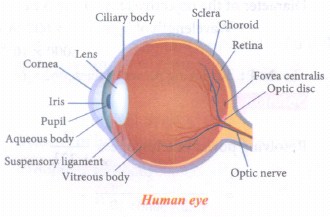
(i) The transparent layer cornea bends the light rays through pupil located at the centre part of the Iris.
(ii) The adjusted light passes through the eye lens. Eye lens is convex in nature. So, the light rays from the objects are converged and a real and inverted image is formed on retina.
(iii) Then, retina passes the received real and inverted image to the brain through optical nerves. Finally, the brain senses it as erect image.
18.
Given:
\(\mathrm{f}=-15 \mathrm{~cm}, \mathrm{u}=-10 \mathrm{~cm}, \mathrm{v}=?, \mathrm{~h}=3 \mathrm{~cm} \)
\(\frac{1}{f} =\frac{1}{v}-\frac{1}{u} \Rightarrow \frac{1}{v}-\frac{1}{u} =\frac{1}{f} \)
\(\frac{1}{v} =\frac{1}{f}+\frac{1}{u} \)
.JPG)
\(\frac{1}{v}=\frac{-5}{30}=-\frac{1}{6} \)
\(v=-6 \mathrm{~cm} \)
Size of the image:
Magnification \(=\frac{+v}{u} \quad\left(m=\frac{h^{\prime}}{h}\right) \)
\(\frac{h^{\prime}}{h} =\frac{-v}{u} \)
\(\frac{h^{\prime}}{3} =\frac{-6}{-10}=0.6 \)
\(h^{\prime} =0.6 \times 3=1.8 \mathrm{~cm}\)
Size of the image =1.8 cm
19.
a) Yes, he got the image. But the image is not clear.
b) There is no change in the focal length. Because, no change in radius of curvature.
20.
Concave lens should be used to correct myopic eye.
Object distance u = Infinity
Far position of the defective eye v = -90 cm
To find: Power of the lens, P = ?
Nature of the lens =?
\(\frac { 1 }{ f } =\frac { 1 }{ v } -\frac { 1 }{ u } \)
\(\frac { 1 }{ f } =\frac { 1 }{ -90 } +\frac { 1 }{ \infty } \)
\(\frac { 1 }{ f } =\frac { 1 }{ -90 } \)
∴ f=-90 cm (or) 0.9 m
Power of the lens, P \(\frac { 1 }{ f } =\frac { 1 }{ 0.9 } \) =1.11 D
Concave lens of 1.11D is used to see distance object.

10th Standard Syllabus & Materials
10th Standard
TN 10th English Prose - 2 - The Night the Ghost Got in Important Questions And Answers Study Material - QB365 Set A
NEW10th Standard
TN 10th English Supplementary - 1 - The Tempest Important Questions And Answers Study Material - QB365 Set A
NEW10th Standard
TN 10th English Poem - 1 - Life Important Questions And Answers Study Material - QB365 Set A
NEW10th Standard
TN 10th English Prose - 1 - His First Flight Important Questions And Answers Study Material - QB365 Set A



Tamilnadu Stateboard 10th Standard Subjects
Tamilnadu Stateboard Standards





