
 100% FREE ACCESS
10th Standard Syllabus & Materials
10th Standard
TN 10th English Prose - 4 - The Attic Important Questions And Answers Study Material - QB365 Set A
NEW10th Standard
TN 10th English Supplementary - 3 - The Story of Mulan Important Questions And Answers Study Material - QB365 Set A
NEW10th Standard
TN 10th English Poem - 3 - I am Every Woman Important Questions And Answers Study Material - QB365 Set A
NEW10th Standard
TN 10th English Prose - 3 - Empowered Women Navigating The World Important Questions And Answers Study Material - QB365 Set A
NEW10th Standard
TN 10th English Supplementary - 2 - Zigzag Important Questions And Answers Study Material - QB365 Set A
NEW10th Standard
TN 10th English Poem - 2 - The Grumble Family Important Questions And Answers Study Material - QB365 Set A

Published on: 06/12/2019
Periodic Classification of Elements
Download Tamil Nadu 10th Standard Science question papers, model tests, one-mark questions, important questions, and public exam papers in PDF format. Free study materials and answer keys for TN State Board students.
Questions + Answers key
Take MCQ Science Test1.
a) Identify the bond between H and F in HF molecule.
b) What property forms the basis of identification?
c) How does the property vary in periods and in groups?
2.
Name the acid that renders aluminium passive. Why?
3.
Metal A belongs to period 3 and group 13. A in red hot condition reacts with steam to form B. A with strong alkali forms C. Find A, B and C with reactions.
4.
The chemical formula of sodium meta aluminate is ___________
NaAlO2
Na2AlO2
NaAl2O2
Na2Al2O3
5.
Slag is.
Metal + Ore
Ore + Gangue
Flux + Gangue
Ore + Flux
6.
Electronegativity values are based on ______________
bond energy
electron affinity
ionisation energy
all the above
7.
8.
Noble gases belong to group ___________
14
15
17
18
9.
Define the term Ionic Radii.
10.
What does the term "ion" mean?
11.
Define metallic radius.
12.
Define atomic radius.
13.
Explain the types of corrosion.
14.
How is Bauxite ore concentrated?
15.
Explain the salient features of groups in the modern periodic table.
16.
Explain the salient features of periods in the modern periodic table.
1.
(a) Ionic bond.
(b) Electronegativity property.
(c) (i) Along the period, from left to right in the periodic table, the electronegativity increases, because of the increase in the nuclear charge which in turn attracts the electrons more strongly.
(ii) On moving down a group, the electronegativity of the element decreases because of the increased number of valence shells.
2.
(i) Dilute or concentrated nitric acid renders aluminum passive.
(ii) It does not attack aluminium but it forms oxide film on its surface.
3.
i) Metal A belongs to periods 3 and group 13 is Aluminium.
ii) When steam is passed over red hot aluminium, Aluminium oxide and Hydrogen is produced.
iii) when Aluminium react with strong caustic alkalis forming aluminates
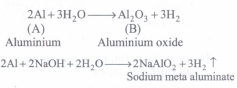
| A | Al | Aluminium |
| B | Al2O3 | Aluminium oxide |
| C | NaAlO2 | Sodium meta aluminate |
4.
(a)
NaAlO2
5.
(c)
Flux + Gangue
6.
(d)
all the above
7.
(d)
8.
(d)
18
9.
Atomic radii is defined as the distance from the centre of the nucleus of the ion upto the point where it exerts its influence on the electron cloud of the ion.
10.
Ions are formed when an atom loses or gains electrons.
11.
It is defined as half the distance between nuclei of adjacent metal atoms.
12.
Atomic radius is of an atom defined as the distance between the centre of its nucleus and the outermost shell containing the valence electron.
13.
Types of Corrosion:
(i) Dry Corrosion or Chemical Corrosion :
The corrosive action in the absence of moisture is called dry corrosion. It is the process of a chemical attack on a metal by a corrosive liquids or gases such as O2, N2, SO2, H2S etc. It occurs at high temperature.
(ii) Wet Corrosion or Electrochemical Corrosion: The corrosive action in the presence of moisture is called wet corrosion. It occurs as a result of electrochemical reaction of metal with water or aqueous solution of salt or acids or bases.
14.
Chemical method or Leaching:
(i) This method is employed when the ore is in a very pure form.
(ii) The ore is treated with a suitable reagent such that the ore is soluble in it but the impurities are not. The impurities are removed by filtration.
(iii) The solution of the ore, ie., the filtrate is treated with a suitable reagent which precipitates the ore.
15.
(i) The vertical columns in the periodic table starting from top to bottom are called groups. There are 18 groups in the periodic table.
(ii) As the elements present in a group have identical valence shell electronic configurations, they possess similar chemical properties.
(iii) Vertical columns in the periodic table starting from top to bottom are called groups. There are 18 groups in the periodic table.
(iv) The Lanthanides and Actinides which form part of Group 3 are called inner transition elements.
(v) Except group 0, all the elements present in each groups have same valency. The elements present in a group possess similar chemical properties.
(vi) The physical properties of the elements in a group such as melting point, boiling point and density vary gradually.
(vii) The atoms of the group 0 elements have stable electronic configuration in their valence shells and hence they are unreactive.
16.
(i) The horizontal rows are called periods. There are seven periods in the periodic table.
(ii) First period (Atomic number 1 and 2): This is the shortest period. It contains only two elements (Hydrogen and Helium).
(iii) Second period (Atomic number 3 to 10): This is a short period. It contains eight elements (Lithium to Neon).
(iv) Third period (Atomic number 11 to 18): This is also a short period. It contains eight elements (Sodium to Argon).
(v) Fourth period (Atomic number 19 to 36): This is a long period. It contains eighteen elements (Potassium to Krypton). This includes 8 representative elements and 10 transition eIements.
(vi) Fifth period (Atomic number 37 to 54): This is also a long period. It contains 18 elements (Rubidium to Xenon). This includes 8 representative elements and 10 transition elements.
(vii) Sixth period (Atomic number 55 to 86): This is the longest period. It contains 32 elements (Cesium to Radon). This includes 8 representative elements, 10 transition elements and 14 inner transition elements (Lanthanides).
(viii) Seventh period (Atomic number 87 to 118): Like the sixth period, this period also accommodates 32 elements. Recently 4 elements have been included by IUPAC.

10th Standard Syllabus & Materials
10th Standard
TN 10th English Prose - 2 - The Night the Ghost Got in Important Questions And Answers Study Material - QB365 Set A
NEW10th Standard
TN 10th English Supplementary - 1 - The Tempest Important Questions And Answers Study Material - QB365 Set A
NEW10th Standard
TN 10th English Poem - 1 - Life Important Questions And Answers Study Material - QB365 Set A
NEW10th Standard
TN 10th English Prose - 1 - His First Flight Important Questions And Answers Study Material - QB365 Set A



Tamilnadu Stateboard 10th Standard Subjects
Tamilnadu Stateboard Standards





