
 100% FREE ACCESS
10th Standard Syllabus & Materials
10th Standard
TN 10th English Prose - 4 - The Attic Important Questions And Answers Study Material - QB365 Set A
NEW10th Standard
TN 10th English Supplementary - 3 - The Story of Mulan Important Questions And Answers Study Material - QB365 Set A
NEW10th Standard
TN 10th English Poem - 3 - I am Every Woman Important Questions And Answers Study Material - QB365 Set A
NEW10th Standard
TN 10th English Prose - 3 - Empowered Women Navigating The World Important Questions And Answers Study Material - QB365 Set A
NEW10th Standard
TN 10th English Supplementary - 2 - Zigzag Important Questions And Answers Study Material - QB365 Set A
NEW10th Standard
TN 10th English Poem - 2 - The Grumble Family Important Questions And Answers Study Material - QB365 Set A

Published on: 12/08/2019
Plant Anatomy and Plant Physiology
Download Tamil Nadu 10th Standard Science question papers, model tests, one-mark questions, important questions, and public exam papers in PDF format. Free study materials and answer keys for TN State Board students.
Questions + Answers key
Take MCQ Science Test1.
Leucoplasts are __________ plastids.
colourless
yellow
orange
red
2.
Name the tissue present between the upper and lower epidermis.
Lower epidermis tissue
Pith
Upper epidermis tissue
Mesophyll
3.
Exarch and tetrarch xylem are a feature of ___________.
dicot stem
dicot leaf
monocot root
dicot root
4.
Oxygen is produced at what point during photosynthesis ?
when ATP is converted to ADP
when CO2 is fixed
when H2O is splitted
All of these
5.
The endarch condition is the characteristic feature of
root
stem
leaves
flower
6.
7.
All tissues inner to endodermis constitute ____________
8.
The vascular bundles in cucurbita are described as _____________
9.
__________ is ATP factory of the cells
10.
Glycolysis takes place in ________.
11.
Cortex lies between _______.
12.
Father of Plant Anatomy
13.
Biosynthetic phase
14.
Artificial photosynthesis
15.
Cambium
16.
Amphicribal
17.
Draw diagrams to represent the types of concentric vascular bundles.
18.
What are casparian strips?
19.
Name the tissue systems as classified by Sachs.
20.
What is the common step in aerobic and anaerobic pathway?
21.
What is collateral vascular bundle?
22.
Why is a dicot leaf described as dorsiventral?
23.
Describe the structure of mitochondria. Why is it called the "Power house of the cell"?
24.
Write a note on vascular tissue system.
25.
Draw and label the structure of oxysomes.
26.
Write a short note on mesophyll.
27.
Describe and name three stages of cellular respiration that aerobic organisms use to obtain energy from glucose.
1.
(a)
colourless
2.
(d)
Mesophyll
3.
(d)
dicot root
4.
(c)
when H2O is splitted
5.
(b)
stem
6.
(d)
7.
()
stele
8.
()
bicollateral
9.
()
Mitochondria
10.
()
cytoplasm
11.
()
epidermal and vascular tissues
12.
Nehemiah Grew
13.
Melvin Calvin
14.
C. N. R. Rao
15.
Secondary growth
16.
Fern
17.
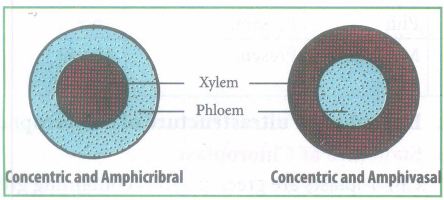
18.
The cells of endodermis in roots of show band like thickenings on their radial and inner tangential walls called casparian strips.
19.
(i) Dermal or Epidermal tissue system
(ii) Ground tissue system
(iii) Vascular tissue system
20.
Glycolysis is the common step in both aerobic and anaerobic pathway.
21.
When xylem lies towards the centre and phloem lies towards the periphery, it is called collateral vascular bundle.
22.
(i) The dorsal and ventral surfaces of a dicot leaf can be clearly distinguished
(ii) The dorsal surface is darker is appearance and the ventral surface is lighter.
(iii) This is due to distribution of palisade parenchyma below the upper epidermis which as rich in chloroplasts.
(iv) Hence the dicot left is described as dorsiventral.
23.
Mitochondria:
(i) Mitochondria are organelles within eukaryotic cells that produce Adenosine Triphosphate (ATP) which form the energy currency of the cell. The mitochondria is referred to as the "Power house of the cell".
Structure of mitochondira:
(i) Mitochondrial membranes: It consists two membranes called inner and outer membrane. Each membrane is 60-70 Â thick.
(ii) Outer mitochondrial membrane is smooth and freely permeable to most small molecules. It contains enzymes, proteins and lipids
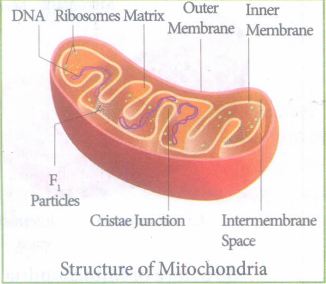
(iii) It has porin molecules (proteins) which form channels for passage of molecules through it.
(iv) Inner mitochondrial membrane is semi permeable membrane and regulates the passage of materials into and out of the mitochondria. It is rich in enzymes and carrier proteins.
Cristae:
(i) The inner mitochondrial membrane gives rise to finger like projections called cristae.
(ii) These cristae increase the inner surface area (fold in inner membrane) of the mitochondria to hold variety of enzymes
Oxysomes:
(i) The inner mitochondrial membrane bear minute regularly spaced tennis racket shaped particles known as oxysomes (F1 particle).
(ii) They involve in ATP synthesis.
24.
(i) It consists of xylem and phloem tissues.
(ii) They are present in the form of bundles called vascular bundles.
(iii) Xylem conducts water and minerals to different parts of the plant.
(iv) Phloem conducts food materials to different parts of the plant.
There are three different types of vascular bundles namely:
(i) Radial
(ii) Conjoint
(iii) Concentric
(i) Radial Bundles:
(i) Xylem and phloem are present in different radii alternating with each other. Eg: roots.
(ii) Conjoint bundles: Xylem and phloem lie on the same radius. There are two types of conjoint bundles
a) Collateral:
(i) Xylem lies towards the centre and phloem lies towards the periphery.
(ii) When cambium is present in collateral bundles, it is called open. Eg: dicot stem and collateral bundle without cambium is called closed. Eg: monocot stem.
b) Bicollateral:
In this type of bundle, the phloem is present on both outer and inner side of xylem. Eg: cucurbita.
(iii) Concentric bundles: Vascular bundle in which xylem completely surrounds the phloem or vice versa is called concentric vascular bundle. It is of two types:
Types:
a) Amphivasal:
Xylem surrounds phloem. Eg: Dracaena
b) Amphicribral:
Phloem surrounds xylem. Eg: Ferns Endarch: Protoxylem lies towards the centre and metaxylem lies towards the periphery. Eg: stem. Exarch: Protoxylem lies towards the periphery and metaxylem lies towards the centre. Eg: roots.
25.
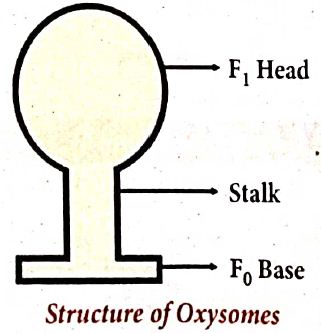
26.
(i) The tissue present between the upper and the lower epidermis is called mesophyll.
(ii) Mesophyll cells contain chloroplasts.
(iii) In dicot leaf, the mesophyll is differentiated into palisade parenchyma and spongy parenchyma.
(iv) Palisade cells do not have intercellular spaces and take active part in photosynthesis.
(v) Whereas, spongy parenchyma cells have large intercellular spaces and helps in gaseous exchange.
27.
The 3 stages of erobic respiration are Glycolysis, Krebs cycle and Electron Transport Chain.
(a) Glycolysis (Glucose splitting):
(i) Glycolysis takes place in the cytoplasm of the cell.
(ii) It is the breakdown of one molecule of glucose (6 carbon) into two molecules of Pyruvic acid (3 carbon).
(b) Krebs Cycle:
(i) This cycle occurs in mitochondrial matrix.
(ii) At the end of glycolysis, 2 molecules of pyruvic acid enter into mitochondria.
(iii) The oxidation of pyruvic acid into CO2 and water takes place.
(iv) It is also called Tricarboxylic Acid Cycle (TAC).
(c) Electron Transport Chain:
(i) NADH2 and FADH2 molecules formed during glycolysis and Krebs cycle are oxidised to NAD+ and FAD+ to release the energy through electrons.
(ii) These electrons move through the electron transport chain and release energy.
(iii) This energy is used by ADP to synthesize ATP.
(iv) This is called oxidative phosphorylation.
(v) In this process O2 gets reduced to water.
(vi) \(\mathrm{C}_{6} \mathrm{H}_{12} \mathrm{O}_{6}+6 \mathrm{O}_{2} \rightarrow 6 \mathrm{CO}_{2}+6 \mathrm{H}_{2} \mathrm{O}+\mathrm{ATP}\)

10th Standard Syllabus & Materials
10th Standard
TN 10th English Prose - 2 - The Night the Ghost Got in Important Questions And Answers Study Material - QB365 Set A
NEW10th Standard
TN 10th English Supplementary - 1 - The Tempest Important Questions And Answers Study Material - QB365 Set A
NEW10th Standard
TN 10th English Poem - 1 - Life Important Questions And Answers Study Material - QB365 Set A
NEW10th Standard
TN 10th English Prose - 1 - His First Flight Important Questions And Answers Study Material - QB365 Set A



Tamilnadu Stateboard 10th Standard Subjects
Tamilnadu Stateboard Standards





