
 100% FREE ACCESS
10th Standard Syllabus & Materials
10th Standard
TN 10th English Prose - 4 - The Attic Important Questions And Answers Study Material - QB365 Set A
NEW10th Standard
TN 10th English Supplementary - 3 - The Story of Mulan Important Questions And Answers Study Material - QB365 Set A
NEW10th Standard
TN 10th English Poem - 3 - I am Every Woman Important Questions And Answers Study Material - QB365 Set A
NEW10th Standard
TN 10th English Prose - 3 - Empowered Women Navigating The World Important Questions And Answers Study Material - QB365 Set A
NEW10th Standard
TN 10th English Supplementary - 2 - Zigzag Important Questions And Answers Study Material - QB365 Set A
NEW10th Standard
TN 10th English Poem - 2 - The Grumble Family Important Questions And Answers Study Material - QB365 Set A

Published on: 15/10/2019
Plant and Animal Hormones
Download Tamil Nadu 10th Standard Science question papers, model tests, one-mark questions, important questions, and public exam papers in PDF format. Free study materials and answer keys for TN State Board students.
Questions + Answers key
Take MCQ Science Test1.
Write the physiological effects of gibberellins.
2.
Describe an experiment which demonstrates that growth stimulating hormone is produced at the tip of coleoptile.
3.
(a) Name the gaseous plant hormone. Describe its three different actions in plants.
(b) Which hormone is known as stress hormone in plants ? Why?
4.
Susan’s father feels very tired and frequently urinates. After clinical diagnosis he was advised to take an injection daily to maintain his blood glucose level. What would be the possible cause for this? Suggest preventive measures.
5.
Sanjay is sitting in the exam hall. Before the start of the exam, he sweats a lot, with increased rate of heart beat. Why does this condition occur?
6.
In botanical gardens and tea gardens the gardeners trim the plants regularly so that they remain bushy. Write the scientific explanation of this practice.
7.
Describe the role of pancreas in maintenance of blood sugar level.
8.
Write a note on Thyroid Dysfunctions.
9.
(a) Describe the structure of thyroid gland?
(b) List the functions of thyroid hormones.
10.
Explain the physiological effects of Auxins.
1.
(i) Application of gibberellins on plants stimulate extraordinary elongation of internode. E.g: Corn and Pea.
(ii) Treatment of rosette plants with gibberellin induces sudden shoot elongation followed by flowering. This is called bolting.
(iii) Gibberellins promote the production of male flowers in monoecious plants (Cucurbits).
(iv) Gibberellins break dormancy of Potato tubers.
(v) Gibberellins are efficient than auxins in inducing the formation of seedless fruit - Parthenocarpic fruits (Development of fruits without fertilization) E.g: Tomato.
2.
(i) Warmolt Went (1903 -1990), a Dutch biologist demonstrated the existence and effect of auxin in plants.
(ii) He did a series of experiments in Avena coleoptiles.
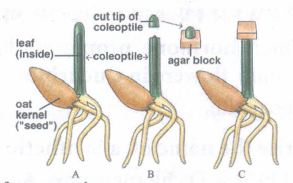
First Experiment:
(i) In his first experiment he removed the tips of Avena coleoptiles.
(ii) The cut tips did not grow indicating that the tips produced something essential for growth.
Second Experiment:
(i) In his second experiment he placed the agar blocks on the decapitated coleoptile tips.
(ii) The coleoptile tips did not show any response.
Third Experiment:
(i) In his next experiment he placed the detached coleoptile tips on agar blocks.
(ii) After an hour, he discarded the tips and placed this agar block on the decapitated coleoptile.
(iii) It grew straight up indicating that some chemical had diffused from the cut coleoptile tips into the agar block which stimulated the growth.
Conclusion:
(i) He concluded that a chemical diffusing from the tip of coleoptiles was responsible for growth.
(ii) He named it as "Auxin" meaning "to grow".
3.
(a) Ethylene is the gaseous plant hormone. Its physiological effects are:
(i) It is mainly concerned with maturation and ripening of fruits.
(ii) Ethylene inhibits the elongation of stem and root in dicots.
(iii) Ethylene hastens the senescence of leaves and flowers.
(b) Abscisic Acid is also called as stress hormone in plants because it increases tolerance of plants to various kinds of stress.
4.
(i) Polyuria occurs in people diagnosed with Diabetes mellitus, if blood glucose levels have risen too high.
(ii) Regular exercise, along with a good diet, can reduce the risk of diabetes.
5.
Adrenaline is known to cause physical symptoms that accompany test anxiety such as increased heart rate, sweating, and rapid breathing.
6.
When the plants are trimmed, their apical are cut off and the apical bud is removed. Thus in the absence of apical dominance, the lateral buds show active growth and produce more branches making the plant bushy.
7.
The endocrine portion of pancreas is made up of Islets of Langerhans.
Structure of Pancreas:
The Islets of Langerhans consists of two types of cells namely alpha cells and beta cells. The alpha cells secrete glucagon and beta cells secrete insulin.
Functions of Pancreatic hormones:
A balance between insulin and glucagon production is necessary to maintain blood glucose concentration.
Insulin :
(i) Insulin helps in the conversion of glucose into glycogen which is stored in liver and skeletal muscles.
(ii) It promotes the transport of glucose into the cells.
(iii) It decreases the concentration of glucose in blood.
Glucagon:
(i) Glucagon helps in the breakdown of glycogen to glucose in the liver.
(ii) It increases blood glucose levels.
Diabetes mellitus :
The deficiency of insulin causes Diabetes mellitus. It is characterised by
(i) Increase in blood sugar level (Hyperglycemia)
(ii) Excretion of excess glucose in the urine (Glycosuria).
(iii) Frequent urination (Polyuria).
(iv) Increased thirst (Polydipsia).
(v) Increase in appetite (Polyphagia).
8.
When the thyroid gland fails to secrete the normal level of hormones, the condition is called thyroid dysfunction. It leads to the following conditions.
Hypothyroidism: It is caused due to the decreased secretion of the thyroid hormones. The abnormal conditions are simple goitre, cretinism and myxoedema.
Goitre:
(i) It is caused due to the inadequate supply of iodine in our diet.
(ii) This is commonly prevalent in Himalayan regions due to low level of iodine content in the soil.
(iii) It leads to the enlargement of thyroid gland which protrudes as a marked swelling in the neck and is called as goitre.
Cretinism:
(i) It is caused due to decreased secretion of the thyroid hormones in children.
(ii) The conditions are stunted growth, mental defect, lack of skeletal development and deformed bones. They are called as cretins
Myxoedema:
(i) It is caused by deficiency of thyroid hormones in adults.
(ii) They are mentally sluggish, increase in body weight, puffiness of the face and hand, oedematous appearance.
Hyperthyroidism:
(i) It is caused due to the excess secretion of the thyroid hormones which leads to Grave's disease (Exopthalmic goitre).
(ii) The symptoms are protrusion of the eyeballs (Exopthalmia), increased metabolic rate, high body temperature, profuse sweating, loss of body weight and nervousness.
9.
(i) The thyroid gland is composed of two distinct lobes lying one on either side of the trachea.
(ii) The two lobes are connected by means of a narrow band of tissue known as the isthmus.
(iii) This gland is composed of glandular follicles and lined by cuboidal epithelium.
(iv) The follicles are filled with colloid material called thyroglobulin.
An amino acid tyrosine and iodine are involved in the formation of thyroid hormone. The hormones secreted by the thyroid gland are
(a) Triiodothyronine (T3)
(b) Tetraiodothyronine or Thyroxine (T4)
Functions of thyroid hormones:
(i) Production of energy by maintaining the Basal Metabolic Rate (BMR) of the body.
(ii) Helps to maintain normal body temperature.
(iii) Influences the activity of central nervous system.
(iv) Controls growth of the body and bone formation.
(v) Essential for normal physical, mental and personality development. It is also known as personality hormone.
(vi) Regulates cell metabolism.
10.
Auxins bring about a variety of physiological effects in different parts of the plant body. Some of them are discussed below:
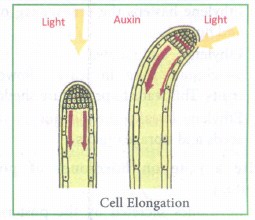
(i) Auxins promote the elongation of stems and coleoptiles which makes them to grow.
(ii) Auxins induce root formation at low concentration and inhibit it at higher concentration.
(iii) The auxins produced by the apical buds suppress growth of lateral buds. This is called Apical Dominance.
(iv) Seedless fruits without fertilization are induced by the external application of auxins. (Parthenocarpy). Examples: Watermelon, Grapes, Lime etc.
(v) Auxins prevent the formation of abscission layer.

10th Standard Syllabus & Materials
10th Standard
TN 10th English Prose - 2 - The Night the Ghost Got in Important Questions And Answers Study Material - QB365 Set A
NEW10th Standard
TN 10th English Supplementary - 1 - The Tempest Important Questions And Answers Study Material - QB365 Set A
NEW10th Standard
TN 10th English Poem - 1 - Life Important Questions And Answers Study Material - QB365 Set A
NEW10th Standard
TN 10th English Prose - 1 - His First Flight Important Questions And Answers Study Material - QB365 Set A



Tamilnadu Stateboard 10th Standard Subjects
Tamilnadu Stateboard Standards





