
 100% FREE ACCESS
10th Standard Syllabus & Materials
10th Standard
TN 10th English Prose - 4 - The Attic Important Questions And Answers Study Material - QB365 Set A
NEW10th Standard
TN 10th English Supplementary - 3 - The Story of Mulan Important Questions And Answers Study Material - QB365 Set A
NEW10th Standard
TN 10th English Poem - 3 - I am Every Woman Important Questions And Answers Study Material - QB365 Set A
NEW10th Standard
TN 10th English Prose - 3 - Empowered Women Navigating The World Important Questions And Answers Study Material - QB365 Set A
NEW10th Standard
TN 10th English Supplementary - 2 - Zigzag Important Questions And Answers Study Material - QB365 Set A
NEW10th Standard
TN 10th English Poem - 2 - The Grumble Family Important Questions And Answers Study Material - QB365 Set A

Published on: 14/09/2019
Download Tamil Nadu 10th Standard Science question papers, model tests, one-mark questions, important questions, and public exam papers in PDF format. Free study materials and answer keys for TN State Board students.
Questions + Answers key
Take MCQ Science Test1.
Gibberellins are efficient than _____ in inducing the formation of seedless fruit.
Auxin
Cytokinin
Ethylene
Abscisic Acid
2.
In human, each cell normally consists _________of chromosomes.
23 pairs
22 pairs
20 pairs
12 pairs
3.
4.
_______from anterior pituitary stimulates milk secretion
Oxytocin
Prolactin
Progestrone
Oestrogen
5.
The other name of red blood corpuscles is _________
erythrocytes
leucocytes
granulocytes
agranulocytes
6.
Which of the following statement regarding an atom is always correct?
An atom has equal number of electrons and protons
An atom has equal number of electrons and neutrons
An atom has equal number of electrons, protons and neutrons
An atom has equal number of protons and neutrons
7.
The resistance of a body to change its direction of motion is
force
momentum
inertia of motion
inertia of direction
8.
Which one of the following is an IUCD?
Copper – T
Oral pills
Diaphragm
Tubectomy
9.
In a simple circuit, why does the bulb glow when you close the switch?
The switch produces electricity
Closing the switch completes the circuit.
Closing the switch breaks the circuit.
The bulb is getting charged.
10.
11.
Inertia of a body depends on
weight of the object
acceleration due to gravity of the planet
mass of the object
Both a & b
12.
What are the conclusions obtained from laws of refraction?
13.
Give examples for the cases in which the time of action of force is very short to have a large force?
14.
Out of 100 W and 40 W bulbs, which has high electrical resistance when in use.
15.
What is Torque? Give examples moment of force.
16.
What is gram molecular mass?
17.
What is the shape of RBC in human blood?
18.
Two bulbs are having the ratings as 60 W, 220 V and 40 W, 220 V respectively. Which one has a greater resistance?
19.
State Rayleigh’s law of scattering.
20.
What are the phases of menstrual cycle? Indicate the changes in the ovary and uterus.
21.
N2 + 3 H2 → 2 NH3
(The atomic mass of nitrogen is 14, and that of hydrogen is 1)
1 mole of nitrogen (_______g) +
3 moles of hydrogen ( _________ g) →
2 moles of ammonia ( _________ g)
22.
Explain Solid solution, Liquid solution and Gaseous solution.
23.
How are chromosomes classified based on the position of centromere?
24.
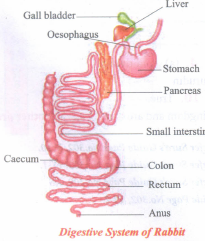
Explain the Digestive System of Rabbit.
25.
Luteal phase of the menstrual cycle is also called the secretory phase. Give reason.
26.
What is colostrum? How is milk production hormonally regulated?
27.
List out the parasitic adaptations in leech.
28.
A force of 60 N acts on a body for 10 s. What is the change in momentum?
1.
(a)
Auxin
2.
(a)
23 pairs
3.
(a)
4.
(b)
Prolactin
5.
(a)
erythrocytes
6.
(a)
An atom has equal number of electrons and protons
7.
(d)
inertia of direction
8.
(a)
Copper – T
9.
(b)
Closing the switch completes the circuit.
10.
(c)
11.
(c)
mass of the object
12.
(i) The speed of light in a medium is low if the refractive index of the medium is high and vice versa.
(ii) When light travels from a denser medium into a rarer medium, the refracted ray is bent away from the normal drawn to the interface.
(iii) When light travels from a rarer medium into a denser medium, the refracted ray is bent towards the normal drawn to the interface.
13.
(i) Striking a hammer on a nail.
(ii) Hitting cricket ball with the bat.
(iii) We get hurt more while we slip down on a concrete floor than on a mud floor.
(iv) Both the floors experience same amount of change in momentum. But in concrete floor the large amount of force acts in shorter interval of time. So it hurts more.
(v) When the fielder pulls back his hands he experiences a smaller force for a longer interval of time leading to less damage to his hands.
14.
40W. for the same applied voltage, power \(\alpha \frac{1}{resistance}\) If the power is less, higher will be its resistance.
15.
(i) Torque is a vector quantity. It is acting along the direction which is perpendicular to the plane of action of force and distance.
(ii) Its SI unit is N m.
(iii) Examples : Turning a tap, winding or S unwinding a screw, spinning of a top etc.
16.
It the molecular mass of a given substance is expressed in gram, it is known as gram molecular mass of that substance.
17.
RBCs are biconcave and disc - shaped.
18.
Electric power \(P=\frac { { V }^{ 2 } }{ R } \)
For the same value of V, R is inversely proportional to P.
Therefore, lesser the power, greater the resistance
Hence, the bulb with 40 W, 220 V rating has a greater resistance.
19.
Rayleigh's scattering law states that "The amount of scattering of light is inversely proportional to the fourth power of its wavelength.
Amount of scattering \(\text { 's' } \propto \frac{1}{\lambda^{4}}\)
20.
The reproductive period is marked by characteristic events repeated almost every month in physiologically normal woman (28 days with minor variation) in the form of a menstrual flow
The menstrual cycle consists of 4 phases:
(i) Menstrual or Destructive phase
(ii) Follicular or Proliferative Phase
(iii) Ovulatory Phase
(iv) Luteal or Secretory Phase
|
Phase |
Days |
Changes in Ovary |
Changes in Uterus |
Hormonal Changes |
|---|---|---|---|---|
| Menstrual phase | 4-5 days | Development of primary follicles | Breakdown of uterine endometrial lining leads to bleeding | Decrease in progesterone and oestrogen |
| Follicular phase | 6th -13thday | Primary follicles grow to become a fully mature Graafian follicle | Endometrium regenerates through proliferation | FSH and oestrogen increase |
| Ovulatory phase | 14th day | The Graafian follicle ruptures, and releases the ovum( egg) | Increase in endometrial thickness | LH peak |
| Luteal phase | 15th-28th day | Emptied Graafian follicle develops into corpus luteum | Endometrium is prepared for implantation if fertilization of egg takes place. If fertilization does not occur corpus luteum degenerates, uterine wall ruptures, bleeding starts and unfertilized egg is expelled | LH and FSH decrease Corpus luteum produces progesterone and its level increases followed by a decline if menstrual bleeding occurs. |
21.
Mass of 1 mole of nitrogen \(\left(N_{2}\right)=2 \times N=2 \times 14=28 \mathrm{~g}\)
Mass of 3 moles of hydrogen \(\left(\mathrm{H}_{2}\right)=3[2 \times \mathrm{H}]\)
=3[2 x 1]=3[2]
=6 g
Mass of 2 moles of ammonia \(\left(\mathrm{NH}_{3}\right)=2\left[\mathrm{NH}_{3}\right]\)
=2[1 x N + 3 x H]
=2[1 x14 + 3 x 1]
=2[14 + 3]
=2[17] = 34 g
\(\left.\begin{array}{c}1 \text { mole of nitrogen }(28 \mathrm{~g}) \\ + \\ 3 \text { mole of hydrogen }(6 \mathrm{~g})\end{array}\right\}=\text {2 moles of ammonia} (34 \mathrm{~g})\)
22.
| Solute | Solvent | Example |
|---|---|---|
| Solid solution | ||
| Solid | Solid | Copper dissolved in gold (Alloys) |
| Liquid | Solid | Mercury with sodium (amalgam) |
| Liquid solution | ||
| Solid | Liquid | Sodium chloride dissolved in water |
| Liquid | Liquid | Ethyl alcohol dissolved in water |
| Gas | Liquid | carbon-di-oxide dissolved in water (Soda water) |
| Gaseous solution | ||
| Liquid | Gas | Water vapour in air (cloud) |
| Gas | Gas | Mixture of Helium-Oxygen gases, |
23.
Based on the position of centromere, the chromosomes are classified as Telocentric, Acrocentric, Submetacentric andMetacentric.
(i) Telocentric - The centromere is found on the proximal end. They are rod shaped chromosomes.
(ii) Acrocentric - The centromere is found at the one end with a short arm and long arm. They are also rod - shaped chromosomes.
(iii) Submetacentric - The centromere is found near the centre of the chromosome. Thus forming two unequal arms. They are J
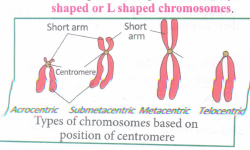
(iv) Metacentric - The centromere occurs in the centre of the chromosome and form two equal arms. They are V shaped chromosomes.
24.
i) The digestive system includes the alimentary canal and the associated digestive glands.
ii) The alimentary canal consists of mouth, buccal cavity, pharynx, oesophagus, stomach, small intestine, caecum, large intestine and anus.
iii) Mouth leads to the buccal cavity.
iv) Through the pharynx it reaches oesopbagus.
v) Oesophagus opens into the stomach followed by smallintestine.
vi) Caecum ispresent in between the snnall intestine and large intestine.
vii) Caecunm contains bacteria that helps in the digestion of cellulose.
viii) Large intestine has colon and rectum.
ix) It finally opens in to the anus.
x) The digestive glands are salivary glands, gastric glands, liver, pancreas and intestinal glands. The secretion of digestive glands help in digestion of food in the alimentary canal.
25.
(i) Corpus leuteum produces progestrone and its level increases followed by a decline if menstrual bleeding occurs.
(ii) Uterine wall ruptures bleeding starts and infertilized egg is expelled.
26.
(i) The first fluid which is released from the mammary gland after child birth is called as colostrum.
(ii) Milk production from alveoli of mammary glands is stimulated by prolactin secreted from the anterior pituitary.
(iii) The ejection of milk is stimulated by posterior pituitary hormone oxytocin.
27.
Leech is a parasite and sucks the blood of vertebrates and show adaptations.
(i) Suckers are present in the anterior and posterior ends of the body, by which the animal attaches itself to the body of the host.
(ii) The three jaws inside the mouth causes a triradiate or Y shaped wound in the skin of the host.
(iii) Saliva contains a protein called hirudin which prevents the blood clotting. Thus continuous supply of blood is maintained.
(iv) Blood is stored in the crop. It gives nourishment to the leech for several months. Hence, there is no digestive juices and enzyme.
28.
Impulse = Change in momentum
P = 60 N ; t = 10 s
Change in momentum = Force x time
= 60 x 10
Change in momentum = 600 Ns

10th Standard Syllabus & Materials
10th Standard
TN 10th English Prose - 2 - The Night the Ghost Got in Important Questions And Answers Study Material - QB365 Set A
NEW10th Standard
TN 10th English Supplementary - 1 - The Tempest Important Questions And Answers Study Material - QB365 Set A
NEW10th Standard
TN 10th English Poem - 1 - Life Important Questions And Answers Study Material - QB365 Set A
NEW10th Standard
TN 10th English Prose - 1 - His First Flight Important Questions And Answers Study Material - QB365 Set A



Tamilnadu Stateboard 10th Standard Subjects
Tamilnadu Stateboard Standards





