
 100% FREE ACCESS
10th Standard Syllabus & Materials
10th Standard
TN 10th English Prose - 4 - The Attic Important Questions And Answers Study Material - QB365 Set A
NEW10th Standard
TN 10th English Supplementary - 3 - The Story of Mulan Important Questions And Answers Study Material - QB365 Set A
NEW10th Standard
TN 10th English Poem - 3 - I am Every Woman Important Questions And Answers Study Material - QB365 Set A
NEW10th Standard
TN 10th English Prose - 3 - Empowered Women Navigating The World Important Questions And Answers Study Material - QB365 Set A
NEW10th Standard
TN 10th English Supplementary - 2 - Zigzag Important Questions And Answers Study Material - QB365 Set A
NEW10th Standard
TN 10th English Poem - 2 - The Grumble Family Important Questions And Answers Study Material - QB365 Set A

Published on: 06/12/2019
Reproduction in Plants and Animals
Download Tamil Nadu 10th Standard Science question papers, model tests, one-mark questions, important questions, and public exam papers in PDF format. Free study materials and answer keys for TN State Board students.
Questions + Answers key
Take MCQ Science Test1.
Read the following passage and answer the questions that follow Rahini and her parents were watching a television programme. An advertisement flashed on the screen which was promoting use of sanitary napkins. Rahini’s parents suddenly changed the channel, but she objected to her parents and explained the need and importance of such advertisement.
a) What is first menstruation called? When does it occur?
b) List out the napkin hygiene measures taken during menstruation?
c) Do you think that Rahini’s objection towards her parents was correct? If so, Why?
2.
Why menstrual cycle does not take place before puberty and during pregnancy?
3.
In angiosperms the pollen germinates to produce pollen tube that carries two gametes. What is the purpose of carrying two gametes when single gamete can fertilize the egg?
4.
Breaking of the filament into many fragments is called_____________
Fission
Fragmentation
Budding
Regeneratio
5.
The ejection of milk is stimulated by posterior pituitary hormone called_____
Prolactin
Insulin
Oxytocin
Estrogen
6.
Milk production from alveoli of mammary gland is stimulated by_______
Prolactin
Insulin
Oxytocin
Estrogen
7.
________is a disc shaped structure.
Uterus
Placenta
Ovary
Sperm
8.
Pollination with the help of insects like honey bees, flies are called_________
Entomophilly
Anemophily
Hydrophily
Zoophily
9.
Mention any two ways of maintaining toilet hygiene.
10.
How are identical twins formed in Human being?
11.
Define self-pollination.
12.
Define menstrual cycle?
13.
My friend Manisha received a marriage proposal from a boy living abroad. Before they met and finalised the wedding, Manisha requested her parents to get the boy's blood test report.
(i) Do you think blood test report is necessary for both boy & girl?
(ii) Do you think, blood test report is not " necessary for the boy living in India?
14.
Explain the process of fertilization in plants?
15.
Describe the structure of human sperm.
16.
Write a note on agents of pollination.
1.
a) The first menstruation is called menarche. It occurs at the age of 11 to 13 years.
b) Napkin hygiene measures are:
(i) The sanitary pad and tampons should be wrapped properly and discarded because they can spread infections.
(ii) Sanitary pad or tampon should not be flushed down the toilet.
(iii) Napkin incinerators are to be used properly for disposal of used napkins.
c) Rahini's objection is correct.
(i) The advertisement gives some knowledge about the napkin.
(ii) How to use the napkin and what is the purpose of it.
(iii) The advertisement is answers some more questions.
(iv) It create the awareness among the females. So the object are correct.
2.
(i) Before puberty and during development, the secretion of estrogen and progesterone are not secreted.
(ii) So it does not form ovary.
(iii) So menstrual does not take place before puberty and during pregnancy.
3.
(i) Vegetative cell degenerates and the generative cell divides to form two sperms (or male gametes)
(ii) Tip of pollen tube bursts and the two sperms enter the embryo sac.
(iii) One sperm fuses with the egg (syngamy) and forms a diploid zygote.
(iv) The other sperm fuses with the secondary nucleus (Triple fusion) to form the primary endosperm nucleus which is triploid in nature.
(v) Since two types of fusion syngamy and triple fusion take place in an embryo sac the process is termed as double fertilization.
(vi) After triple fusion, primary endosperm nucleus develops into an endosperm.
(v) Endosperm provides food to the developing embryo.
(vi) The purpose of carrying two gametes is one is to form zygote another is to form endosperm to provide food to the developing embryo.
4.
(b)
Fragmentation
5.
(c)
Oxytocin
6.
(a)
Prolactin
7.
(b)
Placenta
8.
(a)
Entomophilly
9.
(i) The floors of the toilet should be maintained clean and dry. This helps to reduce the bad odour and also infection.
(ii) Hands should be washed thoroughly with soap before and after toilet use
10.
During fertilization, if a single egg is fertilized and then the zygote divides into two foetus, identical twins are formed.
11.
Self-pollination is also known as autogamy. The transfer of pollen grains from the anther to the stigma of same flower or another flower borne on the same plant is known as self-pollination.
e.g. Hibiscus
12.
The cyclic events that take place in a rhythmic fashion during the reproductive period of a woman's life is called menstrual cycle.
13.
(i) Yes, it is necessary to take the blood reports for both boy and girl to ensure that he or she is free of any sexually transmitted diseases (STD) like syphilis, AIDS.
(ii) No, blood test report is necessary for both boys and girls living all over the world.
14.
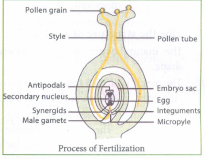
(i) Pollen grains reach the right stigma and begin to germinate.
(ii) Pollen grain forms a small tube-like structure called pollen tube which emerges through the germ pore. The contents of the pollen grain move into the tube.
(iii) Pollen tube grows through the tissues of the stigma and style and finally the ovule through the micropyle.
(iv) Vegetative cell degenerates and the generative cell divides to form two sperms (or male gametes).
(v) Tip of pollen tube bursts and the two sperms enter the embryo sac
(vi) One sperm fuses with the egg (syngamy) and forms a diploid zygote.
(vii) The other sperm fuses with the secondary nucleus (Triple fusion) to form the primary endosperm nucleus which is triploid in nature.
(viii)Since two types of fusion syngamy and triple fusion take place in an embryo sac the process is termed as double fertilization.
(ix) After triple fusion, primary endosperm nucleus develops into an endosperm.
(x) Endosperm provides food to the developing embryo.
(xi) Later the synergids and antipodal cells degenerate.
15.
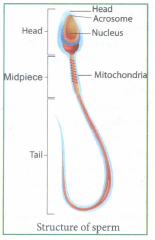
(i) The spermatozoan consists of head, a middle piece and tail.
(ii) The sperm head is elongated and formed by the condensation of nucleus.
(iii) The anterior portion has a cap like structure called acrosome.
(iv) It contains hyaluronidase, an enzyme that helps the sperm to enter the ovum during fertilization.
(v) A short neck connects the head and middle piece which comprises the centrioles.
(vi) The middle piece contains the mitochondria which provides energy for the movement of tail.
(vii) It brings about sperm motility which is essential for fertilization.
16.
Cross pollination takes place through the agency of animals, insects, wind and water.
Pollination by wind (Anemophily):
(i) The pollination with the help of wind is called anemophily.
(ii) The anemophilous flowers produce enormous amount of pollen grains.
(iii) The pollen grains are small, smooth, dry and light in weight.
(iv) The stigmas are comparatively large, protruding and sometimes hairy, to trap the pollen grains. E.g: Grasses and some cacti.
Pollination by insects (Entomophily):
(i) Pollination with the help of insects like honey bees, flies are called entomophily.
(ii) To attract insects these flowers are brightly coloured, have smell and nectar
(iii) The pollen grains are larger in size, the exine is pitted, spiny etc., so they can be adhered firmly on the sticky stigma. Approximately, 80% of the pollination done by the insects is carried by honey bees.
Pollination by Water: The pollination with the help of water is called hydrophily. This takes place in aquatic plants.
(i) Pollen grains are produced in large numbers.
(ii) Pollen grains float on surface of water till they land on the stigma of female flowers. E.g:Hydrilla, Vallisneria. Pollination by Animals :
(i) When pollination takes place with the help of animals, it is called Zoophily.
(ii) Flowers of such plants attract animals by their bright color, size, scent etc. E.g: Sun bird pollinates flowers of Canna, Gladioli etc., Squirrels pollinate flowers of silk cotton tree.

10th Standard Syllabus & Materials
10th Standard
TN 10th English Prose - 2 - The Night the Ghost Got in Important Questions And Answers Study Material - QB365 Set A
NEW10th Standard
TN 10th English Supplementary - 1 - The Tempest Important Questions And Answers Study Material - QB365 Set A
NEW10th Standard
TN 10th English Poem - 1 - Life Important Questions And Answers Study Material - QB365 Set A
NEW10th Standard
TN 10th English Prose - 1 - His First Flight Important Questions And Answers Study Material - QB365 Set A



Tamilnadu Stateboard 10th Standard Subjects
Tamilnadu Stateboard Standards





