
 100% FREE ACCESS
10th Standard Syllabus & Materials
10th Standard
TN 10th English Prose - 4 - The Attic Important Questions And Answers Study Material - QB365 Set A
NEW10th Standard
TN 10th English Supplementary - 3 - The Story of Mulan Important Questions And Answers Study Material - QB365 Set A
NEW10th Standard
TN 10th English Poem - 3 - I am Every Woman Important Questions And Answers Study Material - QB365 Set A
NEW10th Standard
TN 10th English Prose - 3 - Empowered Women Navigating The World Important Questions And Answers Study Material - QB365 Set A
NEW10th Standard
TN 10th English Supplementary - 2 - Zigzag Important Questions And Answers Study Material - QB365 Set A
NEW10th Standard
TN 10th English Poem - 2 - The Grumble Family Important Questions And Answers Study Material - QB365 Set A

Published on: 06/12/2019
Solutions
Download Tamil Nadu 10th Standard Science question papers, model tests, one-mark questions, important questions, and public exam papers in PDF format. Free study materials and answer keys for TN State Board students.
Questions + Answers key
Take MCQ Science Test1.
Write some solubility substances in water at 25°C.
2.
Explain Solid solution, Liquid solution and Gaseous solution.
3.
A solution is made from 35 ml of Methanol and 65 ml of water. Calculate the volume percentage.
4.
a) What happens when MgSO4.7H2O is heated? Write the appropriate equation
b) Define solubility
5.
Write notes on various factors affecting solubility.
6.
Will the cool drinks give more fizz at top of the hills or at the foot? Explain.
7.
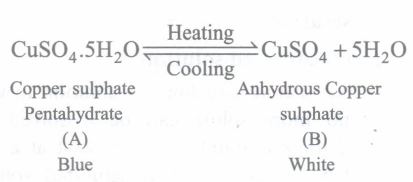
'A' is a blue coloured crystalline salt. On heating it loses blue colour and to give 'B'. When water is added, 'B' gives back to 'A'. Identify A and B, write the equation.
8.
Solubility of KNO3 ____________ with the increases in temperature.
increases
decreases
remains constant
None of these
9.
In which of the following solutions, both solute and solvent are solids?
cork
cheese
alloys
smoke
10.
Example for solid in solid ___________
Soda water
Camphor in air
Charcoal
alloy
11.
Quick lime is dissolved in water is a ______________ process.
exothermic
endothermic
reversible
both (a) and (b)
12.
Define hydration
13.
Define trinary solution
14.
Find the concentration of solution in terms of weight percent if 20g of sugar is dissolved in 40g of water
15.
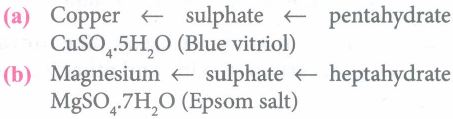
What is (a) Blue vitriol (b) Epsom
1.
| Name of the solute | Formula of the solute | Solubility g/100 g water |
|---|---|---|
| Calcium carbonate | CaCO3(s) | 0.0013 |
| Sodium chloride | NaCI (s) | 36 |
| Ammonia | NH3(g) | 48 |
| Sodium hydroxide | NaOH(s) | 80 |
| Glucose | C6H12O6(s) | 91 |
| Sodium bromide | NaBr(s) | 95 |
| Sodium iodide | NaI(s) | 184 |
2.
| Solute | Solvent | Example |
|---|---|---|
| Solid solution | ||
| Solid | Solid | Copper dissolved in gold (Alloys) |
| Liquid | Solid | Mercury with sodium (amalgam) |
| Liquid solution | ||
| Solid | Liquid | Sodium chloride dissolved in water |
| Liquid | Liquid | Ethyl alcohol dissolved in water |
| Gas | Liquid | carbon-di-oxide dissolved in water (Soda water) |
| Gaseous solution | ||
| Liquid | Gas | Water vapour in air (cloud) |
| Gas | Gas | Mixture of Helium-Oxygen gases, |
3.
Volume of the ethanol = 35 ml
Volume of the water = 65 ml
Volume percentage = \(\frac{\text { Volume of the solute }}{\text { Volume of the solution }} \times 100\)
Volume percentage =\(\frac{\text { Volume of the solute }}{\text { Volume of the solute + Volume of the solvent }} \times 100\)
Volume percentage = \(\frac{35}{35+65}\times\)100
Volume percentage = \(\frac{35}{100 }\) x 100
= 35%
4.
a) MgSO4.7H2O is heating process:
(i) Magnesium Sulphate heptahydrate or Epsom salt MgSO4.7H2O water of crystallization is 7.
(ii) When magnesium sulphate heptahydrate crystals are gently heated, it loses seven water molecules, and becomes anhydrous magnesium sulphate.
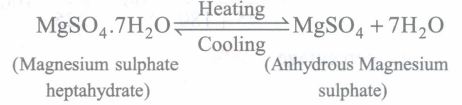
(iii) If you add few drops of water or allow it to cool, the colourless anhydrous salt again turns back into hydrated salt.
b) Solubility:
b) Solubility is defined as the number of grams of a solute that can be dissolved in 100g of a solvent to form its saturated solution at a given temperature and pressure.
Solubility = \(\frac{Mass \ of \ the \ solute}{Mass \ of \ the \ solvent}\) x 100
5.
There are three main factors which govern the solubility of a solute. They are:
a) Nature of the solute and solvent
b) Temperature
c) Pressure
a) Nature of the solute and solvent:
(i) The nature of the solute and solvent plays an important role in solubility.
(ii) Although water dissolves an enormous variety of substances, both ionic and covalent, it does not dissolve everything.
(iii) The phrase that scientists often use when predicting solubility is "like dissolves like".
(iv) The expression means that dissolving occurs when similarities exist between the solvent and the solute.
(v) For example: Common salt is a polar compound 4 and dissolves readily in polar solvent like water.
(vi) Non-polar compounds are soluble in non-polar solvents. For example: Fat dissolved in ether.
(vii) But non-polar compounds, do not dissolve in polar solvents; polar compounds do not dissolve in non-polar solvents.
b) Effect of Temperature:
Solubility of Solids in Liquid:
(i) Generally, solubility of a solid solute in a liquid solvent increases with increase in temperature.
(ii) For example, a greater amount of sugar will dissolve in warm water than in cold water.
(iii) In endothermic process, solubility increases with increase in temperature.
(iv) In exothermic process, solubility decreases with increase in temperature.
Solubility of Gases in liquid:
(i) Solubility of gases in liquid decrease with increase in temperature.
(ii) Generally, water contains dissolved oxygen.
(iii) When water is boiled, the solubility of oxygen in water decreases, so oxygen escapes in the form of bubbles.
(iv) Aquatic animals live more in cold regions because, more amount of dissolved oxygen is present in the water of cold regions.
(v) This shows that the solubility of oxygen in water is more at low temperatures.
c) Effect of Pressure:
(i) Effect of pressure is observed only in the case of solubility of a gas in a liquid.
(ii) When the pressure is increased, the solubility of a gas in liquid increases.
(iii) The common examples for solubility of gases in liquids are carbonated beverages, i.e. soft drinks, household cleaners containing aqueous solution of ammonia, formalin aqueous solution of formaldehyde, etc.
6.
(i) Cool drinks give more fizz at the foot of mountain because the atmospheric pressure is less at the top of the mountain.
(ii) So the pressure affects the fizz of the cool drink.
7.
(i) 'A' is copper sulphate pentahydrate (CuSO4.5H2O).
(ii) 'B' is Anhydrous copper sulphate (CuSO4)
8.
(a)
increases
9.
(c)
alloys
10.
(d)
alloy
11.
(a)
exothermic
12.
When ionic substances are dissolved in water to make their saturated aqueous solution, their ions attract water molecules which then attached chemically in certain ratio. This process is called hydration.
13.
Two solutes are dissolved in one solvent. Such kind of solutions which contain three components are called trinary solutions.
14.
Concentration of a solution
= \(\frac{Amount \ of \ the \ solute}{Amount \ of \ solvent }\) x 100
= \(\frac{20}{40}\) x 100
= 50
15.

10th Standard Syllabus & Materials
10th Standard
TN 10th English Prose - 2 - The Night the Ghost Got in Important Questions And Answers Study Material - QB365 Set A
NEW10th Standard
TN 10th English Supplementary - 1 - The Tempest Important Questions And Answers Study Material - QB365 Set A
NEW10th Standard
TN 10th English Poem - 1 - Life Important Questions And Answers Study Material - QB365 Set A
NEW10th Standard
TN 10th English Prose - 1 - His First Flight Important Questions And Answers Study Material - QB365 Set A



Tamilnadu Stateboard 10th Standard Subjects
Tamilnadu Stateboard Standards





