
 100% FREE ACCESS
10th Standard Syllabus & Materials
10th Standard
TN 10th English Prose - 4 - The Attic Important Questions And Answers Study Material - QB365 Set A
NEW10th Standard
TN 10th English Supplementary - 3 - The Story of Mulan Important Questions And Answers Study Material - QB365 Set A
NEW10th Standard
TN 10th English Poem - 3 - I am Every Woman Important Questions And Answers Study Material - QB365 Set A
NEW10th Standard
TN 10th English Prose - 3 - Empowered Women Navigating The World Important Questions And Answers Study Material - QB365 Set A
NEW10th Standard
TN 10th English Supplementary - 2 - Zigzag Important Questions And Answers Study Material - QB365 Set A
NEW10th Standard
TN 10th English Poem - 2 - The Grumble Family Important Questions And Answers Study Material - QB365 Set A

Published on: 19/08/2019
Structural Organisation of Animals
Download Tamil Nadu 10th Standard Science question papers, model tests, one-mark questions, important questions, and public exam papers in PDF format. Free study materials and answer keys for TN State Board students.
Questions + Answers key
Take MCQ Science Test1.
Egg cells of Rabbit are released in_________
uterus
vagina
fallopian tube
ovary
2.
3.
In leeches sperms are stored in
epididymis
vas deferens
testis
ejaculatory duct
4.
The animals which give birth to young ones are
Oviparous
Viviparous
Ovoviviparous
All the above
5.
Mammals are ______________ animals.
Cold blooded
Warm blooded
Poikilothermic
All the above
6.
Write a note on female reproductive system of rabbit.
7.
Explain respiratory system of a rabbit.
8.
Write the dental formula of rabbit.
9.
How does leech respire?
10.
Is hirudin used in medical science.
11.
Describe the heart of rabbit.
12.
Why are the rings of cartilages found in trachea of rabbit?
13.
Why does a leech die if you put some salt on it?
14.
How is the circulatory system designed in leech to compensate the heart structure?
15.
Shylesh has some pet animals at his home. He has few rabbits too, one day while feeding them he observed something different with the teeth. He asked his grandfather, why is it so? What would have been the explanation of his grandfather?
16.
The enlarged anterior part of the Trachea or wind pipe is_________
17.
The thoracic and abdominal cavity of rabbit is separated by_______
18.
Excretion in leech is brought about by__________
19.
In leech the walls of the buccal cavity bear_________ jaws
20.
Ovary
21.
Fallopian tube
22.
Digested blood
23.
Jaws
24.
Hirudin
1.
(c)
fallopian tube
2.
(b)
3.
(a)
epididymis
4.
(b)
Viviparous
5.
(b)
Warm blooded
6.
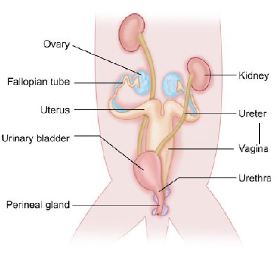
(i) The female reproductive system of rabbit consists of a pair of ovaries which are small ovoid structures. They are located behind the kidneys in the abdominal cavity.
(ii) A pair of oviducts opens into the body cavity by a funnel shaped opening from each side of the ovary.
(iii) The anterior part of the oviduct is the fallopian tube. It leads into a wider tube called the uterus.
(iv) The uterus join together to form a median tube called vagina.
(v) The common tube is formed by the union of urinary bladder and the vagina and is called the urinogenital canal or vestibule. It runs backwards and opens to the exterior by a slit-like aperture called vulva.
(vi) A pair of Cowper's gland and perineal gland are the accessory glands present in the female reproductive system
7.
(i) Respiration takes place by a pair of lungs, which are light spongy tissues enclosed in the thoracic cavity.
(ii) Each lung is enclosed by a double membranous pleura.
(iii) Atmospheric air passes through the external nostril and nasal passages into the pharynx. From the pharynx it passes through the glottis into the wind pipe.
(iv) The anterior part of the wind pipe is enlarged to form the larynx or voice box with its wall supported by four cartilaginous plates. Inside the larynx lies the vocal cord and its vibrations result in the production of sound.
(v) The larynx leads into trachea or wind pipe. Tracheal walls are supported by rings of cartilage which help in the free passage of air.
(vi) The epiglottis prevents the entry of food into the trachea through the glottis.
(vii) The trachea divides into two branches called the bronchi one entering into each lung and dividing into further branches called bronchioles which end in alveoli.
8.
\(\text{Dental formula is }\left( 1\cfrac { 2 }{ 1 } ,C\cfrac { 0 }{ 0 } ,PM\cfrac { 3 }{ 2 } ,H\cfrac { 3 }{ 3 } \right)\text{in rabbit which is written as }\frac{2033}{1023} \)
9.
Respiration takes place through skin.
10.
Yes. Hirudin is used as an anticoagulant in medical science.
11.
(i) The heart is pear shaped and lies in the thoracic cavity in between the lungs. It is enclosed by pericardium, a double layered membrane.
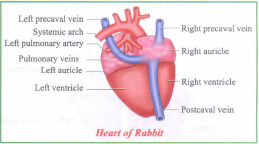
(ii) The heart is four chambered with two auricles and two ventricles. The right and left auricles are separated by interauricular septum, similarly right and left ventricles are separated by interventricular septum.
(iii) The right auricle opens into the right ventricle by right auriculoventricular aperture, guarded by a tricuspid valve.
(iv) The left auricle opens into the left ventricle by left auriculoventricular aperture guarded by a bicuspid valve or mitral valve.
(v) The opening of the pulmonary artery and aorta are guarded by three semilunar valves.
(vi) The right auricle receives deoxygenated blood through two precaval (superior vena cava) and one postcaval (inferior vena cava) veins from all parts of the body.
(vii) The left auricle receives oxygenated blood from the pulmonary veins from the lungs.
(viii) From the right ventricle arises pulmonary trunk which carries the deoxygenated blood to the lungs and from the left ventricle arises the systemic arch (aorta) which supplies oxygenated blood to all parts of the body.
12.
Rings of cartilages are found in the tracheal walls of rabbit to help in the free passage of air.
13.
The skin of leeches is permeable. If salt is added, it creates an osmotic pressure. Water is pulled out from the body of leeches. It can lead to dehydration. Thus leeches immediately fall off when salt is applied.
14.
(i) Circulation is brought about by haemocoelic system.
(ii) There are no true blood vessels.
(iii) The blood vessels are replaced by channels called haemocoelic channels or canals filled with blood-like fluid. The coelomic fluid contains hemoglobin
(iv) There are four longitudinal channels. One lies above the alimentary canal (dorsal), one below the alimentary canal (ventral) and two on either side of the alimentary canal (lateral), which serve as the heart and have inner valves.
15.
(i) Canines are absent.
(ii) Hence, a gap is seen between the incisors and premolars.
(iii) This is called diastema.
(iv) It helps in mastication and chewing of food in herbivorous animals.
16.
()
Larynx or Voice box
17.
()
diaphragm
18.
()
nephridia
19.
()
three
20.
Follicle
21.
Egg
22.
Intestine
23.
Papillae
24.
Protein

10th Standard Syllabus & Materials
10th Standard
TN 10th English Prose - 2 - The Night the Ghost Got in Important Questions And Answers Study Material - QB365 Set A
NEW10th Standard
TN 10th English Supplementary - 1 - The Tempest Important Questions And Answers Study Material - QB365 Set A
NEW10th Standard
TN 10th English Poem - 1 - Life Important Questions And Answers Study Material - QB365 Set A
NEW10th Standard
TN 10th English Prose - 1 - His First Flight Important Questions And Answers Study Material - QB365 Set A



Tamilnadu Stateboard 10th Standard Subjects
Tamilnadu Stateboard Standards





