
 100% FREE ACCESS
10th Standard Syllabus & Materials
10th Standard
TN 10th English Prose - 4 - The Attic Important Questions And Answers Study Material - QB365 Set A
NEW10th Standard
TN 10th English Supplementary - 3 - The Story of Mulan Important Questions And Answers Study Material - QB365 Set A
NEW10th Standard
TN 10th English Poem - 3 - I am Every Woman Important Questions And Answers Study Material - QB365 Set A
NEW10th Standard
TN 10th English Prose - 3 - Empowered Women Navigating The World Important Questions And Answers Study Material - QB365 Set A
NEW10th Standard
TN 10th English Supplementary - 2 - Zigzag Important Questions And Answers Study Material - QB365 Set A
NEW10th Standard
TN 10th English Poem - 2 - The Grumble Family Important Questions And Answers Study Material - QB365 Set A

Published on: 04/10/2019
Thermal Physics
Download Tamil Nadu 10th Standard Science question papers, model tests, one-mark questions, important questions, and public exam papers in PDF format. Free study materials and answer keys for TN State Board students.
Questions + Answers key
Take MCQ Science Test1.
Distinguish between the resistivity and conductivity of a conductor.
2.
State Ohm’s law.
3.
Define electric potential and potential difference.
4.
A piece of wire having a resistance R is cut into five equal parts.
a) How will the resistance of each part of the wire change compared with the original resistance?
b) If the five parts of the wire are placed in parallel, how will the resistance of the combination change?
c) What will be ratio of the effective resistance in series connection to that of the parallel connection?
5.
A 100 watt electric bulb is used for 5 hours daily and four 60 watt bulbs are used for 5 hours daily. Calculate the energy consumed (in kWh) in the month of January.
6.
a) What are the advantages of LED TV over the normal TV?
b) List the merits of LED bulb.
7.
a) State Joule’s law of heating.
b) An alloy of nickel and chromium is used as the heating element. Why?
c) How does a fuse wire protect electrical appliances?
8.
9.
With the help of a circuit diagram derive the formula for the resultant resistance of three resistances connected:
a) in series and
b) in parallel.
10.
A piece of wire of resistance 10 ohm is drawn out so that its length is increased to three times its original length. Calculate the new resistance.
1.
| S.No |
Resistivity |
Conductivity |
|---|---|---|
| (i) |
It is the resistance of a conductor of unit length and unit area of cross section. |
The reciprocal of electrical resistivity of a material is called electrical conductivity. |
| (ii) | Its unit is ohm meter | Its unit is ohm-1 meter-1 |
| (iii) | Resistivity is less for conductor than for insulators | Conductivity is more for conductors than for insulators. |
| (iv) | ρ = RA / L | σ = 1 / ρ |
2.
According to Ohm's law, at a constant temperature, the steady current 'I' flowing through a conductor is directly proportional to the potential difference 'V' between the two ends of the conductor.
\(I\alpha V \Rightarrow\) V = IR
3.
Electric potential : The electric potential at a point is defined as the amount of work done in moving a unit positive charge from infinity to that point against the electric force.
Electric potential difference : The electric potential difference between two points is defined as the amount of work done in moving a unit positive charge from one point to another point against the electric force.
4.
a) Wire is cut into 5 equal parts. Since all dimensions are same, resistance of each wire is equal and has a value = \(\frac {R}{5}\)
b) Formula for finding the effective resistance when connected in parallel is
\(\frac{1}{R_{p}^{\prime}}=\frac{1}{R_{1}}+\frac{1}{R_{2}}+\frac{1}{R_{3}}+\frac{1}{R_{4}}+\frac{1}{R_{5}}\)
Here, \(\mathrm{R}_{1}=\mathrm{R}_{2}=\mathrm{R}_{3}=\mathrm{R}_{4}=\mathrm{R}_{5}=\frac{\mathrm{R}}{5}\)
\(\frac{1}{R_{p}}=\frac{5}{R}+\frac{5}{R}+\frac{5}{R}+\frac{5}{R}+\frac{5}{R}\)
\(\frac{1}{R_{p}}=\frac{25}{R} \)
\(R_{p}=\frac{R}{25} \Omega\)
c) If the resistors are connected in series, then the effective resistance will be
\(\mathrm{R}_{\mathrm{s}}=\frac{\mathrm{R}}{5}+\frac{\mathrm{R}}{5}+\frac{\mathrm{R}}{5}+\frac{\mathrm{R}}{5}+\frac{\mathrm{R}}{5} \)
\(\mathrm{R}_{\mathrm{s}}=\frac{5 \mathrm{R}}{5}=\mathrm{R}\)
Ratio of effective resistance in series connection to that of the parallel connection is
\(\frac{R_{s}}{R_{p}}=\frac{R}{R / 25}=\frac{25}{1}\Rightarrow R_s:R_p=25:1\)
5.
Given:
Power of the first electric bulb \(=100 \mathrm{~W}=100 / 1000=0.1 \mathrm{~kW}\)
Time = 5 hours
Power of the second electric bulb \(=60 \ \mathrm{watt}=\frac{60}{1000}=0.06 \mathrm{~kW}\)
Total number of bulbs = 4,
∴ 4 x 0.06 = 0.24 kW
Time = 5 hours.
Energy consumed in the month of January = ?
Energy = Power x time
Energy consumed by the first bulb in a day = 0.1 x 5 = 0.5 kWh
Energy consumed by the four 60 W bulb in a day =0.06 x 4 x 5 = 1.2 kWh
Total energy consumed by both the bulbs = 0.5 + 1.2 = 1.7 kWh
Total energy consumed in the month of January = 31 x 1.7 = 52.7 kWh
6.
(a) Advantages of LED television:
(i) LED television has brighter picture quality
(ii) It is thinner in size
(iii) It uses less power and consumes very less energy.
(iv) Its life span is more.
(v) It is more reliable
(b) Merits of LED bulb:
(i) As there is no filament, there is no loss of energy in the form of heat. It is cooler than the incandescent bulbs
(ii) In comparison with the fluorescent light, the LED bulbs have significantly low power requirement.
(iii) It is not harmful to the environment
(iv) A wide range of colours is possible here.
(v) It is cost-efficient and energy efficient.
(vi) Mercury and other toxic materials are not required.
(vii) One way of overcoming the energy crisis is to use more LED bulbs.
7.
a) Joule's law of heating:
a) Joule's law of heating states that the heat produced in any resistor is:
(i) Directly proportional to the square of the current passing through the resistor.
(ii) Directly proportional to the resistance of the resistor.
(iii) Directly proportional to the time for which the current is passing through the resistor.
b) Alloy of nickel and chromium have the following properties:
(i) It has high resistivity,
(ii) It has a high melting point,
(iii) It is not easily oxidized.
c) The fuse wire is connected in series, in an electric circuit. When a large current passes through the circuit, the fuse wire melts due to Joule's heating effect and hence the circuit gets disconnected. Therefore, the circuit and the electric appliances are saved from any damage. The fuse wire is made up of a material whose melting point is relatively low.
8.
9.
Resistors in series:
i) A series circuit connects the components one after the other to form a 'single loop'.
ii) A series circuit has only one loop through which current can pass.
iii) If the circuit is interrupted at any point in the loop, no current can pass through the circuit and hence no electric appliances connected in the circuit will work.
iv) Series circuits are commonly used in devices such as flashlights.
v) Thus, if resistors are connected end to end, so that the same current passes through each of them, then they are said to be connected in series.
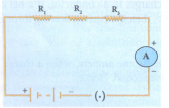
vi) Let, three resistances R1, R2 and R3 be connected in series.
vii) Let the current flowing through them be I.
viii) According to Ohm's Law, the potential differences V1, V2 and V3 across R1, R2 and R3 respectively, are given by:
\(V_{1}=I R_{1} \) ........(1)
\(V_{2}=I R_{2} \) .........(2)
\(V_{3}=I R_{3}\) ..........(3)
The sum of the potential differences across the ends of each resistor is given by:
\(V=V_{1}+V_{2}+V_{3}\)
Using equations (1), (2) and (3), we get
\(\mathbf{V}=\mathbf{I} \mathbf{R}_{1}+\mathbf{I} \mathbf{R}_{2}+\mathbf{I} \mathbf{R}_{3}\) .........(4)
ix) The effective resistor is a single resistor, which can replace the resistors effectively, so as to allow the same current through the electric circuit.
x) Let, the effective resistance of the series-combination of the resistors, be R5. Then,
\(\mathbf{V}=\text { I }R_{\mathbf{S}}\)..........(5)
Combining equations (4) and (5), you get,
\(I R_{S} =I R_{1}+I R_{2}+I R_{3} \)
\(\mathbf{R}_{\mathrm{S}} =R_{1}+R_{2}+R_{3}\) ...........(6)
xi) Thus, you can understand that when a number of resistors are connected in series, their equivalent resistance or effective resistance is equal to the sum of the individual resistances.
xii) When 'n' resistors of equal resistance R are connected in series, the equivalent resistance is 'n R'.
\(\text { i.e., } \mathbf{R}_{\mathrm{S}}=\mathbf{n} \mathbf{R}\)
xiii) The equivalent resistance in a series combination is greater than the highest of the individual resistances.
Resistances in Parallel:
i) A parallel circuit has two or more loops through which current can pass.
ii) If the circuit is disconnected in one of the loops, the current can still pass through the other loop(s).
iii) The wiring in a house consists of parallel circuits.
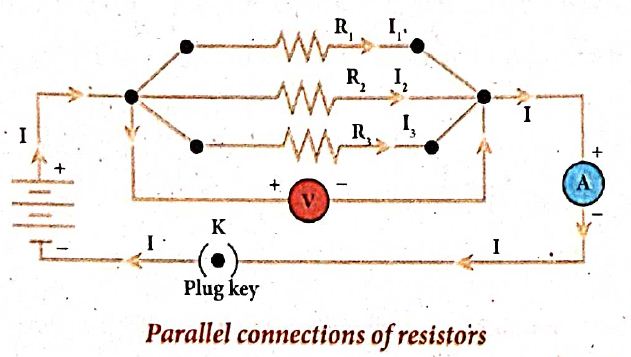
iv) Consider that three resistors \(R_{1}, R_{2}\) and \(R_{3}\) are connected across two common points A and B.
v) The potential difference across each resistance is the same and equal to the potential difference between A and B.
vi) This is measured using the voltmeter.
vii) The current I arriving at A divides into three branches \(I_{1}, I_{2}\) and \(I_{3}\) passing through \(\mathbf{R}_{1}, \mathbf{R}_{2}\) and \(\mathbf{R}_{3}\) respectively.
According to the Ohm's law, you have,
\(I_{1}=\frac{V}{R_{1}}\) ........ (7)
\(\mathrm{I}_{2}=\frac{\mathbf{V}}{\mathbf{R}_{2}} \) .........(8)
\(\mathbf{I}_{3}=\frac{\mathbf{V}}{\mathbf{R}_{3}}\) .........(9)
The total current through the circuit is given by,
\(\mathbf{I}=\mathrm{I}_{1}+\mathrm{I}_{\mathbf{2}}+\mathrm{I}_{\mathbf{3}}\)
Using equations (7),(8) and (9), you get,
\(I=\frac{V}{R_{1}}+\frac{V}{R_{2}}+\frac{V}{R_{3}}\) ..........(10)
Let the effective resistance of the parallel combination of resistors be RP. Then,
\(I=\frac{V}{R_{P}}\) ........ (11)
Combining equations (10) and (11), you have
\(\frac{V}{R_{P}}=\frac{V}{R_{1}}+\frac{V}{R_{2}}+\frac{V}{R_{3}} \)
\(\frac{1}{R_{P}}=\frac{1}{R_{1}}+\frac{1}{R_{2}}+\frac{1}{R_{3}}\) ......(12)
viii) Thus, when a number of resistors are connected in parallel, the sum of the reciprocals of the individual resistances is equal to the reciprocal of the effective or equivalent resistance.
ix) When 'n' resistors of equal resistances R are connected in parallel, the equivalent resistance is \(\frac{\mathbf{R}}{\mathbf{n}}\).
i.e., \(\frac{1}{R_{p}}=\frac{1}{R}+\frac{1}{R}+\frac{1}{R} \ldots+\frac{1}{R}=\frac{n}{R}\) ......(13)
Hence, \(\mathbf{R}_{\mathbf{P}}=\frac{\mathbf{R}}{\mathbf{n}}\)
x) The equivalent resistance in a parallel combination is less than the lowest of the individual resistances.
10.
Given:
\(\mathrm{R}=10 \Omega\) ; original length = l, new length l' = 3l; Area will decrease by 3 times.
\(R^{\prime}=\rho \frac{l^{\prime}}{A^{\prime}}=\rho \frac{31}{A / 3}=\frac{9 \rho l}{A}=9 R=9(10)=90 \Omega\)

10th Standard Syllabus & Materials
10th Standard
TN 10th English Prose - 2 - The Night the Ghost Got in Important Questions And Answers Study Material - QB365 Set A
NEW10th Standard
TN 10th English Supplementary - 1 - The Tempest Important Questions And Answers Study Material - QB365 Set A
NEW10th Standard
TN 10th English Poem - 1 - Life Important Questions And Answers Study Material - QB365 Set A
NEW10th Standard
TN 10th English Prose - 1 - His First Flight Important Questions And Answers Study Material - QB365 Set A



Tamilnadu Stateboard 10th Standard Subjects
Tamilnadu Stateboard Standards





