
 100% FREE ACCESS
10th Standard Syllabus & Materials
10th Standard
TN 10th English Prose - 4 - The Attic Important Questions And Answers Study Material - QB365 Set A
NEW10th Standard
TN 10th English Supplementary - 3 - The Story of Mulan Important Questions And Answers Study Material - QB365 Set A
NEW10th Standard
TN 10th English Poem - 3 - I am Every Woman Important Questions And Answers Study Material - QB365 Set A
NEW10th Standard
TN 10th English Prose - 3 - Empowered Women Navigating The World Important Questions And Answers Study Material - QB365 Set A
NEW10th Standard
TN 10th English Supplementary - 2 - Zigzag Important Questions And Answers Study Material - QB365 Set A
NEW10th Standard
TN 10th English Poem - 2 - The Grumble Family Important Questions And Answers Study Material - QB365 Set A

Published on: 15/10/2019
Transportation in Plants Circulation in Animals
Download Tamil Nadu 10th Standard Science question papers, model tests, one-mark questions, important questions, and public exam papers in PDF format. Free study materials and answer keys for TN State Board students.
Questions + Answers key
Take MCQ Science Test1.
List the difference between RBC and WBC.
2.
Write a note an ABO blood grouping.
3.
Why is the circulation in man referred to as double circulation?
4.
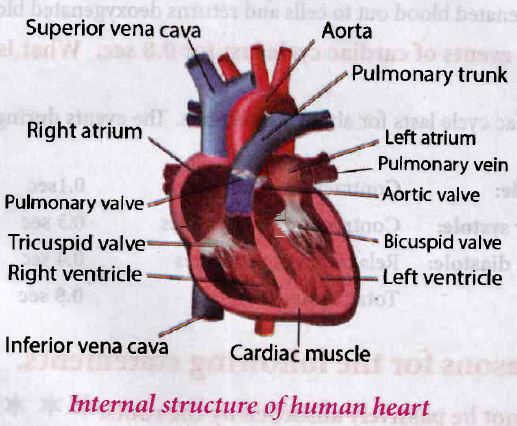
Describe the structure and working of the human heart.
5.
What would happen to the leaves of a plant that transpires more water than its absorption in the roots?
6.
Enumerate the functions of blood.
7.
Differentiate between systole and diastole. Explain the conduction of heart beat.
8.
Why are leucocytes classified as granulocytes and agranulocytes? Name each cell and mention its functions.
9.
What is Transpiration? Give the importance of transpiration.
10.
How does the pulmonary artery and pulmonary vein differ in their function when compared to a normal artery and vein?
1.
| S.No |
RBC |
WBC |
|---|---|---|
| i | They are red in colour due to the presence of respiratory pigment hemoglobin. | They are colourless. |
| ii | They are biconcave/disc-shaped. | They are amoeboid in shape. |
| iii | The RBC is not classified into types, all red blood cells are the same. | They are classified into granulocytes and agranulocytes. |
| iv | The mature RBC's lack a nucleus. | They are nucleated. |
| v | They cannot change their shape. | They can change their shape and are capable of amoeboid movement. |
| vi | They are smaller than leucocytes. | They are larger than erythrocytes. |
| vii | They are responsible for the transport of respiratory gases (CO2 and O2). | They help to defend the body against pathogens. |
2.
Blood Groups
(i) The concept of blood grouping was discovered by Karl Landsteiner. He identified blood groups A, B and O. AB blood group was recognized by Decastello and Steini.
(ii) Human blood contains certain specific substances called agglutinogens or antigens (Ag) and agglutinins or antibodies (Ab). Antigens are found on the membrane surface of RBC. Antibodies are present in blood plasma. Based on the presence or absence of antigen and antibodies human blood group is classified into four groups called A, B, AB, and O. An individual has one of the four blood groups.
(iii) 'A' group individuals: Antigen 'A' is present on the surface of RBC and antibody b (anti-b) is present in the plasma.
(iv) 'B' group individuals: Antigen 'B' is present on the surface of RBC and antibody an (anti-a) is present in the plasma.
(v) 'AB' group individuals: Antigens A and B are present on the surface of RBC and antibodies are absent in the plasma.
(vi) 'O' group individuals: No antigen A or B are absent on the surface of RBC. However, the plasma contains both antibodies 'a' and 'b' (anti a and b).
Blood donation :
(i) In blood transfusion one must consider the antigen and antibody compatibility (matching) between the donor and the person receiving blood (recipient). When an individual receives a mismatched blood group from the donor agglutination (clumping) of blood occurs in the body which leads to death.
3.
(i) When the blood circulates twice through the heart in one complete cycle it is called double circulation.
(ii) In double circulation oxygenated blood does not mix with deoxygenated blood.
4.
Structure of heart:
(i) Heart is a muscular pumping organ that pumps out blood into the blood vessels.
(ii) It is enclosed in a double walled sac called pericardium.
(iii) The two upper thin walled chambers are called auricles and the two thick walled chambers are called ventricles.
(iv) The chambers are separated by septum
(v) Heart contains pericardial fluid.
Working of heart:
(i) Contraction of heart is called systole and relaxation is called diastole.
(ii) When the auricles are filled with blood they are in diastole. The tricuspid and bicuspid valves remain closed. This is called atrial diastole.
(iii) When the auricles are full they contract. This leads to the opening of tricuspid and bicuspid valves. Blood from the auricles are pushed to the ventricles. This is called atrial systole.
(iv) Now the valves are closed. The ventricles contract. The deoxygenated blood from the right ventricle enters the pulmonary artery and the oxygenated blood from the left ventricle enters the aorta. This is called ventricular systole.
(v) These three events constitute the cardiac cycle.
5.
(i) Transpiration often results in water deficit which causes injury to the plants by desiccation.
(ii) Excessive rate of transpiration leads to stunted growth of plants.
6.
(i) Transport of respiratory gases (Oxygen and CO2).
(ii) Transport of digested food materials to the different body cells.
(iii) Transport of hormones.
(iv) Transport of nitrogenous excretory products like ammonia, urea, and uric acid.
(v) It is involved in protection of the body and defense against diseases.
(vi) It acts as buffer and also helps in regulation of pH and body temperature.
(vii) It maintains proper water balance in the body.
7.
| S.No | Systole | Diastole |
| (i) | It is the contraction of atrium and ventricles. | It is the relaxation of atrium and ventricles. |
| (ii) | During contraction, the atrium and ventricle push the blood out. | During relaxation, the blood enters into them passively. |
| (iii) | Atrial systole lasts for 0.1 sec Ventricular systole lasts for 0.3 sec |
Atrial diastole lasts for 0.7 sec Ventricular diastole lasts for 0.4 sec |
Initiation and conduction of heart beat:
(i) Human heart is myogenic in nature.
(ii) Contraction is initiated by a specialised portion of the heart muscle, the sino-atrial (SA) node which is situated in the wall of the right atrium near the opening of the superior vena cava.
(iii) The Sino-atrial node acts as the 'pacemaker' of the heart because it is capable of initiating impulse which can stimulate the heart muscles to contract.
(iv) This impulse is spread by the contraction of right and the left atrial walls pushing the blood into the ventricles.
(v) The wave of contraction from SA node reaches the (AV) atrio ventricular node which is stimulated to emit an impulse of contraction spreading to the ventricular muscle through the atrioventricular bundle and the purkinje fibres.
(vi) In an healthy adult during normal resting condition systolic and diastolic blood pressure is expressed as 120mm / 80mm Hg.
8.
WBC's are colourless and nucleated cells. Granulocytes contain granules in their cytoplasm. Agranulocytes do not contain granules in their cytoplasm, So they are classified as Granulocytes and Agranulocytes.
Granulocytes: Granulocytes contain granules in their cytoplasm. They are of three types.
(i) Neutrophils:
i) They are large in size and have a 2-7 lobed nucleus.
ii) These corpuscles form 60% - 65% of the total leucocytes.
iii) Their number are increased during infection and inflammation.
(ii) Eosinophils:
i) Eosinophils has a bilobed nucleus and constitute 2% - 3% of the total leucocytes.
ii) Their number increases during conditions of allergy and parasitic infections.
iii) It brings about detoxification of toxins.
(iii) Basophils:
i) Basophils have lobed nucleus.
ii) They form 0.5% - 1.0 % of the total leucocytes.
iii) They release chemicals during the process of inflammation.
(iv) Agranulocytes:
i) Granules are found in the cytoplasm of these cells.
ii) The Agranulocytes are of two types:
(i) Lymphocytes:
i) These are about 20 - 25% of the total leucocytes.
ii) They produce antibodies during bacterial and viral infections.
(ii) Monocytes:
i) They are the largest of the leucocytes and are amoeboid in shape.
ii) These cells form 5 - 6% of the total leucocytes.
iii) They are phagocytic and can engulf bacteria.
9.
Definition: Transpiration is the evaporation of water from the aerial parts of the plant especially through stomata in the leaves.
Importance of Transpiration:
(i) Creates transpirational pull for transport of water.
(ii) Supplies water for photosynthesis.
(iii) Transports minerals from soil to all parts of the plant.
(iv) Cools the surface of the leaves by evaporation.
(v) Keeps the cells turgid; hence, maintains their shape.
10.
| S.No | Pulmonary Artery | Normal Artery |
| (i) | It carries blood from heart to lungs. | It carries blood from heart to other parts of body. |
| (ii) | It carries deoxygenated blood. | It carries oxygenated blood. |
| S.No | Pulmonary Vein | Normal Vein |
| (i) | It carries blood from lungs to heart. | It carries blood from parts of body to heart. |
| (ii) | It carries oxygenated blood. | It carries deoxygenated blood. |

10th Standard Syllabus & Materials
10th Standard
TN 10th English Prose - 2 - The Night the Ghost Got in Important Questions And Answers Study Material - QB365 Set A
NEW10th Standard
TN 10th English Supplementary - 1 - The Tempest Important Questions And Answers Study Material - QB365 Set A
NEW10th Standard
TN 10th English Poem - 1 - Life Important Questions And Answers Study Material - QB365 Set A
NEW10th Standard
TN 10th English Prose - 1 - His First Flight Important Questions And Answers Study Material - QB365 Set A



Tamilnadu Stateboard 10th Standard Subjects
Tamilnadu Stateboard Standards





