
 100% FREE ACCESS
10th Standard Syllabus & Materials
10th Standard
TN 10th English Prose - 4 - The Attic Important Questions And Answers Study Material - QB365 Set A
NEW10th Standard
TN 10th English Supplementary - 3 - The Story of Mulan Important Questions And Answers Study Material - QB365 Set A
NEW10th Standard
TN 10th English Poem - 3 - I am Every Woman Important Questions And Answers Study Material - QB365 Set A
NEW10th Standard
TN 10th English Prose - 3 - Empowered Women Navigating The World Important Questions And Answers Study Material - QB365 Set A
NEW10th Standard
TN 10th English Supplementary - 2 - Zigzag Important Questions And Answers Study Material - QB365 Set A
NEW10th Standard
TN 10th English Poem - 2 - The Grumble Family Important Questions And Answers Study Material - QB365 Set A

Published on: 20/08/2019
Transportation in Plants Circulation in Animals
Download Tamil Nadu 10th Standard Science question papers, model tests, one-mark questions, important questions, and public exam papers in PDF format. Free study materials and answer keys for TN State Board students.
Questions + Answers key
Take MCQ Science Test1.
_______is not a feature of veins.
Red in colour
Non-elastic walls
Lack internal valves
Blood flow with low pressure
2.
3.
The _________are the largest of leucocytes.
neutrophil
monocyte
basophil
lymphocyte·
4.
‘Heart of Heart’ is called
SA node
AV node
Purkinje fibres
Bundle of His
5.
A patient with blood group O was injured in an accident and has blood loss. Which group of blood should be used by doctor for transfusion?
O group
AB group
A and B group
All blood group
6.
Which is the correct sequence of blood flow
Ventricle → atrium → vein → arteries
Atrium → ventricle → veins → arteries
Atrium → ventricle → arteries → vein
Ventricles → vein → atrium → arteries
7.
Why are people with AB blood group called as "Universal Recipients"?
8.
Differentiate between blood and lymph.
9.
Mention the artery which supplies blood to the heart muscle.
10.
Name the heart valve associated with the major arteries leaving the ventricles.
11.
Why is the colour of the blood red?
12.
List the difference between RBC and WBC.
13.
Write a note an ABO blood grouping.
14.
The complete events of cardiac cycle last for 0.8 sec. What is the timing for each event?
15.
Differentiate between systemic circulation and pulmonary circulation.
16.
Why is the Sinoatrial node called the pacemaker of heart?
17.
How do plants absorb water? Explain.
18.
Transpiration is a necessary evil in plants. Explain.
1.
(c)
Lack internal valves
2.
(c)
3.
(b)
monocyte
4.
(a)
SA node
5.
(a)
O group
6.
(c)
Atrium → ventricle → arteries → vein
7.
'AB' blood group individuals have both the antigens A and B. Therefore they do not produce antibodies against 'A' group blood 'B' group blood or 'O' group (No antigens). Hence people with AB blood group are compatible with other groups (A, B and O) and are called "Universal Recipients".
8.
|
Blood |
Lymph |
|
|---|---|---|
| (a) | Blood is red in colour | Lymph is colorless |
| (b) | Blood contains plasma, RBC, WBC and Platelets | Lymph contains plasma and WBC with lesser nutrients and oxygen than blood. |
| (c) | Blood flows through veins, capillaries, arteries | Lymph is found in the space between cells and blood capillaries and lows, through lymphatic capillaries. |
9.
Coronary artery supply blood to the heart.
10.
Semilunar valves associated with the major arteries leaving the ventricles.
11.
RBCs impart red colour to the blood due to the presence of the respiratory pigment hemoglobin.
12.
| S.No |
RBC |
WBC |
|---|---|---|
| i | They are red in colour due to the presence of respiratory pigment hemoglobin. | They are colourless. |
| ii | They are biconcave/disc-shaped. | They are amoeboid in shape. |
| iii | The RBC is not classified into types, all red blood cells are the same. | They are classified into granulocytes and agranulocytes. |
| iv | The mature RBC's lack a nucleus. | They are nucleated. |
| v | They cannot change their shape. | They can change their shape and are capable of amoeboid movement. |
| vi | They are smaller than leucocytes. | They are larger than erythrocytes. |
| vii | They are responsible for the transport of respiratory gases (CO2 and O2). | They help to defend the body against pathogens. |
13.
Blood Groups
(i) The concept of blood grouping was discovered by Karl Landsteiner. He identified blood groups A, B and O. AB blood group was recognized by Decastello and Steini.
(ii) Human blood contains certain specific substances called agglutinogens or antigens (Ag) and agglutinins or antibodies (Ab). Antigens are found on the membrane surface of RBC. Antibodies are present in blood plasma. Based on the presence or absence of antigen and antibodies human blood group is classified into four groups called A, B, AB, and O. An individual has one of the four blood groups.
(iii) 'A' group individuals: Antigen 'A' is present on the surface of RBC and antibody b (anti-b) is present in the plasma.
(iv) 'B' group individuals: Antigen 'B' is present on the surface of RBC and antibody an (anti-a) is present in the plasma.
(v) 'AB' group individuals: Antigens A and B are present on the surface of RBC and antibodies are absent in the plasma.
(vi) 'O' group individuals: No antigen A or B are absent on the surface of RBC. However, the plasma contains both antibodies 'a' and 'b' (anti a and b).
Blood donation :
(i) In blood transfusion one must consider the antigen and antibody compatibility (matching) between the donor and the person receiving blood (recipient). When an individual receives a mismatched blood group from the donor agglutination (clumping) of blood occurs in the body which leads to death.
14.
Each cardiac cycle lasts for about 0.8 seconds. The events during a single cardiac cycle involves,
a) Atrial systole - 0.1 sec
(Contraction of auricles)
b) Ventricular systole - 0.3 sec
( Contraction of ventricles)
c) Ventricular diastole - 0.4 sec
(Relaxation of ventricles)
Total time - 0.8 sec
15.
| Systemic circulation | Pulmonary circulation |
| Systemic circulation moves blood between the heart and the rest of the body. | Pulmonary circulation moves blood between the heart and the lungs. |
| It sends oxygenated blood out to cells and returns deoxygenated blood to the heart. | It transports deoxygenated blood to the lungs to absorb oxygen and release carbon dioxide. The oxygenated blood then flows back to the heart. |
16.
Sino-atrial node is called the 'pacemaker' of heart because it is capable of initiating impulse which can stimulate the heart muscles to contract thereby pushing the blood into the ventricles.
17.
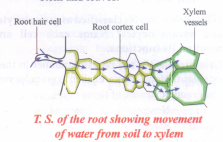
(i) There are millions of root hairs on the tip of the root which absorb water and minerals by diffusion
(ii) Root hairs are thin walled, slender extension of epidermal cell that increase the surface area of absorption.
Pathway of water absorbed by roots:
(i) Once the water enters the root hairs, the concentration of water molecules in the root hair cells become more than that of the cortex.
(ii) Thus, water from the root hair moves to the cortical cells by osmosis and then reaches the xylem.
(iii) From there, the water is transported to the stem and leaves.
18.
(i) During transpiration, water is lost from leaves.
(ii) Still transpiration is essential for the movement of water and minerals from the root to the healthy parts of the plant.
(iii) But excess transpiration may result in drying up of the leaves or wilting and loss of soil water.
(iv) Hence it is termed as a necessary evil.

10th Standard Syllabus & Materials
10th Standard
TN 10th English Prose - 2 - The Night the Ghost Got in Important Questions And Answers Study Material - QB365 Set A
NEW10th Standard
TN 10th English Supplementary - 1 - The Tempest Important Questions And Answers Study Material - QB365 Set A
NEW10th Standard
TN 10th English Poem - 1 - Life Important Questions And Answers Study Material - QB365 Set A
NEW10th Standard
TN 10th English Prose - 1 - His First Flight Important Questions And Answers Study Material - QB365 Set A



Tamilnadu Stateboard 10th Standard Subjects
Tamilnadu Stateboard Standards





