
 100% FREE ACCESS
10th Standard Syllabus & Materials
10th Standard
TN 10th English Prose - 4 - The Attic Important Questions And Answers Study Material - QB365 Set A
NEW10th Standard
TN 10th English Supplementary - 3 - The Story of Mulan Important Questions And Answers Study Material - QB365 Set A
NEW10th Standard
TN 10th English Poem - 3 - I am Every Woman Important Questions And Answers Study Material - QB365 Set A
NEW10th Standard
TN 10th English Prose - 3 - Empowered Women Navigating The World Important Questions And Answers Study Material - QB365 Set A
NEW10th Standard
TN 10th English Supplementary - 2 - Zigzag Important Questions And Answers Study Material - QB365 Set A
NEW10th Standard
TN 10th English Poem - 2 - The Grumble Family Important Questions And Answers Study Material - QB365 Set A

Published on: 06/12/2019
Transportation in Plants Circulation in Animals
Download Tamil Nadu 10th Standard Science question papers, model tests, one-mark questions, important questions, and public exam papers in PDF format. Free study materials and answer keys for TN State Board students.
Questions + Answers key
Take MCQ Science Test1.
List the difference between RBC and WBC.
2.
Write a note an ABO blood grouping.
3.
Who discovered Rh factor? Why was it named so?
4.
What is the importance of valves in the heart?
5.
What is Transpiration? Give the importance of transpiration.
6.
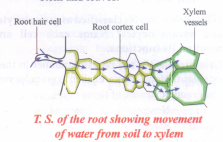
How do plants absorb water? Explain.
7.
How does the pulmonary artery and pulmonary vein differ in their function when compared to a normal artery and vein?
8.
Water from soil enters the root hairs due to___________
capillary Action
capillary Action
adhesion
osmosis
9.
Identify the wrong statement
Guttation occurs through stomata
Water molecules stick to xylem because of adhesion
Stomata closes when guard cells are not turgid
Elements like calcium are not remobilised
10.
11.
The _________are the largest of leucocytes.
neutrophil
monocyte
basophil
lymphocyte·
12.
The_______ are also called polymorpho nuclear leucocytes
eosinophil
thrombocyte
neutrophil
lymphocyte
13.
What is ascent of sap?
14.
What is plasmolysis?
15.
Write the types of granulocytes
16.
Write the functions of RBC?
1.
| S.No |
RBC |
WBC |
|---|---|---|
| i | They are red in colour due to the presence of respiratory pigment hemoglobin. | They are colourless. |
| ii | They are biconcave/disc-shaped. | They are amoeboid in shape. |
| iii | The RBC is not classified into types, all red blood cells are the same. | They are classified into granulocytes and agranulocytes. |
| iv | The mature RBC's lack a nucleus. | They are nucleated. |
| v | They cannot change their shape. | They can change their shape and are capable of amoeboid movement. |
| vi | They are smaller than leucocytes. | They are larger than erythrocytes. |
| vii | They are responsible for the transport of respiratory gases (CO2 and O2). | They help to defend the body against pathogens. |
2.
Blood Groups
(i) The concept of blood grouping was discovered by Karl Landsteiner. He identified blood groups A, B and O. AB blood group was recognized by Decastello and Steini.
(ii) Human blood contains certain specific substances called agglutinogens or antigens (Ag) and agglutinins or antibodies (Ab). Antigens are found on the membrane surface of RBC. Antibodies are present in blood plasma. Based on the presence or absence of antigen and antibodies human blood group is classified into four groups called A, B, AB, and O. An individual has one of the four blood groups.
(iii) 'A' group individuals: Antigen 'A' is present on the surface of RBC and antibody b (anti-b) is present in the plasma.
(iv) 'B' group individuals: Antigen 'B' is present on the surface of RBC and antibody an (anti-a) is present in the plasma.
(v) 'AB' group individuals: Antigens A and B are present on the surface of RBC and antibodies are absent in the plasma.
(vi) 'O' group individuals: No antigen A or B are absent on the surface of RBC. However, the plasma contains both antibodies 'a' and 'b' (anti a and b).
Blood donation :
(i) In blood transfusion one must consider the antigen and antibody compatibility (matching) between the donor and the person receiving blood (recipient). When an individual receives a mismatched blood group from the donor agglutination (clumping) of blood occurs in the body which leads to death.
3.
(i) Rh factor was discovered by Landsteiner and Wiener in 1940. It was named so because it was first discovered in Rhesus monkey.
4.
Valves are the muscular flaps that regulate the flow of blood in a single direction and prevent back flow of blood.
5.
Definition: Transpiration is the evaporation of water from the aerial parts of the plant especially through stomata in the leaves.
Importance of Transpiration:
(i) Creates transpirational pull for transport of water.
(ii) Supplies water for photosynthesis.
(iii) Transports minerals from soil to all parts of the plant.
(iv) Cools the surface of the leaves by evaporation.
(v) Keeps the cells turgid; hence, maintains their shape.
6.
(i) There are millions of root hairs on the tip of the root which absorb water and minerals by diffusion
(ii) Root hairs are thin walled, slender extension of epidermal cell that increase the surface area of absorption.
Pathway of water absorbed by roots:
(i) Once the water enters the root hairs, the concentration of water molecules in the root hair cells become more than that of the cortex.
(ii) Thus, water from the root hair moves to the cortical cells by osmosis and then reaches the xylem.
(iii) From there, the water is transported to the stem and leaves.
7.
| S.No | Pulmonary Artery | Normal Artery |
| (i) | It carries blood from heart to lungs. | It carries blood from heart to other parts of body. |
| (ii) | It carries deoxygenated blood. | It carries oxygenated blood. |
| S.No | Pulmonary Vein | Normal Vein |
| (i) | It carries blood from lungs to heart. | It carries blood from parts of body to heart. |
| (ii) | It carries oxygenated blood. | It carries deoxygenated blood. |
8.
(d)
osmosis
9.
(a)
Guttation occurs through stomata
10.
(d)
11.
(b)
monocyte
12.
(c)
neutrophil
13.
The upward movement of water and minerals from roots to different plant parts of the plant is called ascent of sap.
14.
It occurs when water moves out of the cell and resulting in the shrinkage of cell membrane awayfrom the cell wall
15.
(i) Neutrophils
(ii) Eosinophils
(iii) Basophils
16.
(i) It transports oxygen from lungs to tissues.
(ii) It transports carbon dioxide from tissues to lungs

10th Standard Syllabus & Materials
10th Standard
TN 10th English Prose - 2 - The Night the Ghost Got in Important Questions And Answers Study Material - QB365 Set A
NEW10th Standard
TN 10th English Supplementary - 1 - The Tempest Important Questions And Answers Study Material - QB365 Set A
NEW10th Standard
TN 10th English Poem - 1 - Life Important Questions And Answers Study Material - QB365 Set A
NEW10th Standard
TN 10th English Prose - 1 - His First Flight Important Questions And Answers Study Material - QB365 Set A



Tamilnadu Stateboard 10th Standard Subjects
Tamilnadu Stateboard Standards





