
 100% FREE ACCESS
10th Standard Syllabus & Materials
10th Standard
TN 10th English Prose - 4 - The Attic Important Questions And Answers Study Material - QB365 Set A
NEW10th Standard
TN 10th English Supplementary - 3 - The Story of Mulan Important Questions And Answers Study Material - QB365 Set A
NEW10th Standard
TN 10th English Poem - 3 - I am Every Woman Important Questions And Answers Study Material - QB365 Set A
NEW10th Standard
TN 10th English Prose - 3 - Empowered Women Navigating The World Important Questions And Answers Study Material - QB365 Set A
NEW10th Standard
TN 10th English Supplementary - 2 - Zigzag Important Questions And Answers Study Material - QB365 Set A
NEW10th Standard
TN 10th English Poem - 2 - The Grumble Family Important Questions And Answers Study Material - QB365 Set A

Published on: 22/10/2025
Download Tamil Nadu 10th Standard Social Science question papers, model tests, one-mark questions, important questions, and public exam papers in PDF format. Free study materials and answer keys for TN State Board students.
Questions + Answers key
Take MCQ Social Science Test
1.
The Chief Justice and other Judges of the Supreme court are appointed by:
The President
The Attorney General
The Governor
The Prime Minister
2.
Under which Article the President is vested with the power to proclaim Financial Emergency
Article 352
Article 360
Article 356
Article 365
3.
Which of the following committees/commissions made recommendations about the Centre-State Relations?
1. Sarkaria Commission
2. Rajamannar Committee
3. M.N.Venkatachaliah Commission
Select the correct answer from the codes given below
1, 2 & 3
1 & 2
1 & 3
2 & 3
4.
Find the odd one out.
Right to Equality
Right against Exploitation
Right to Property
Cultural and Educational Rights
5.
Who was the founder of Namdhari Movement?
Baba Dayal Das
Baba Ram Singh
Guru Nanak
Jyotiba Phule
6.
Whose voice was Rast Goftar?
Parsi Movement
Aligarh Movement
Ramakrishna Mission
Dravida Mahajana Sabha
7.
When was People’s Political Consultative Conference held in China?
September 1959
September 1948
September 1954
September 1949
8.
Which American President followed the policy of containment of Communism?
Woodrow Wilson
Truman
Theodore Roosevelt
Franklin Roosevelt
9.
Who initiated the formation of League of Nations?
Roosevelt
Chamberlain
Woodrow Wilson
Baldwin
10.
When did the Japanese formally sign of their surrender?
2 September, 1945
2 October, 1945
15 August, 1945
12 October, 1945
11.
Who made Peru as part of their dominions?
English
Spaniards
Russians
French
12.
With whose conquest did the Mexican civilization collapse?
Hernan Cortes
Francisco Pizarro
Toussaint Louverture
Pedro I
13.
Which country was expelled from the League of Nations for attacking Finland?
Germany
Russia
Italy
France
14.
What were the three major empires shattered by the end of First World War?
Germany, Austria Hungary, and the Ottomans
Germany, Austria-Hungary, and Russia
Spain, Portugal and Italy
Germany, Austria-Hungary, Italy
15.
Mark the following countries on the world map.
1. Great Britain
2. Germany
3. France
4. Italy
5. Morocco
6. Turkey
7. Serbia
8. Bosnia
9. Greece
10. Austria-Hungary
11. Bulgaria
12. Rumania
16.
17.
What are the qualifications for the appointment of Governor?
18.
List out any two special powers of the Attorney General of India.
19.
Write short note: Money Bill.
20.
What is a Writ?
21.
Write a note on reforms of Ramalinga Adigal.
22.
What do you know of Baghdad Pact?
23.
Describe the Pearl Harbour incident.
24.
How did Great Depression impact on Indian agriculture?
25.
What were the three militant forms of nationalism in Europe?
26.
Time line:
Important any 5 events of Indian History. ( 1900 -1930 ).
27.
Describe the legislative powers of the Governor.
28.
Critically examine the Powers and Functions of the Parliament.
29.
Point out the Fundamental Rights.
30.
Evaluate the contributions of Ramakrishna Paramahamsa and Swami Vivekananda to regenerate Indian society.
31.
Estimate the role of Mao Tse tung in making China a communist country.
32.
Analyse the effects of the World War II.
33.
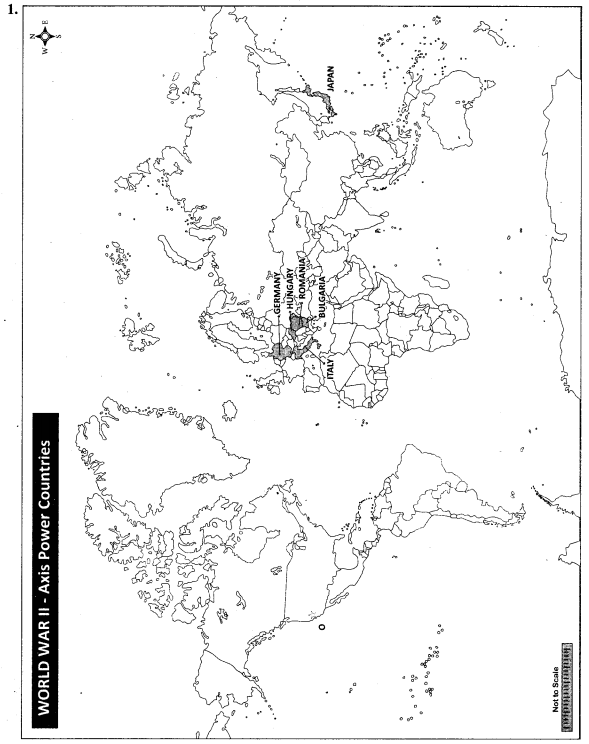
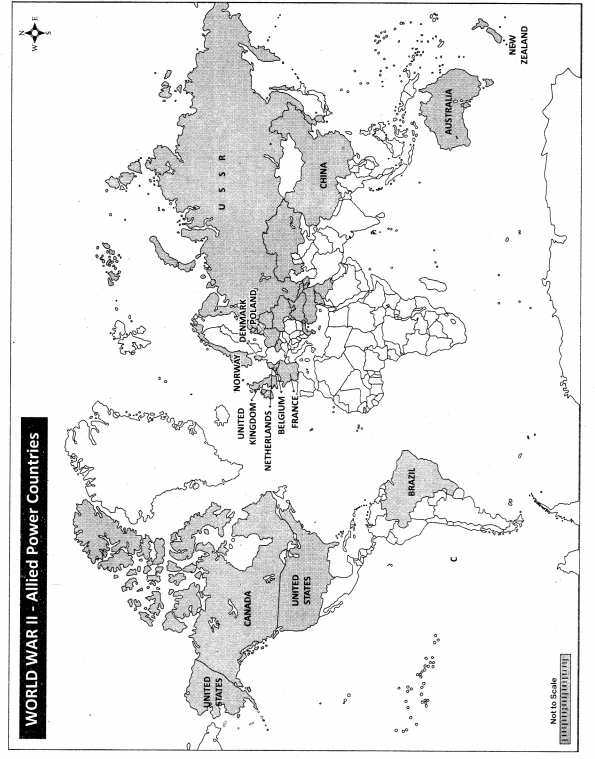
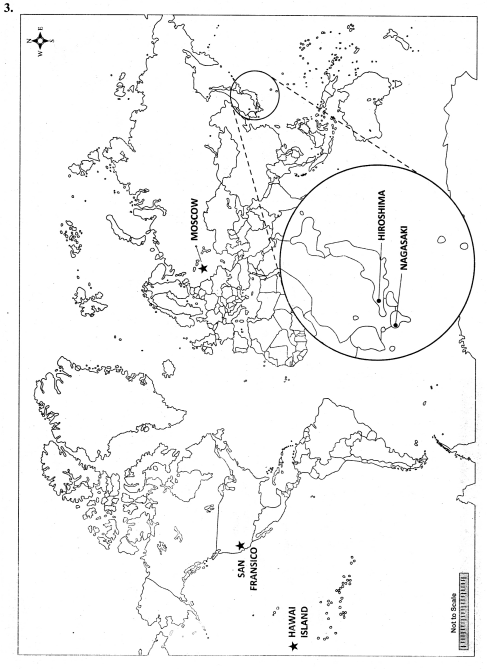
Mark the following on the world map.
1. Axis Power Countries
2. Allied Power Countries
3. Hiroshima, Nagasaki, Hawaii Island, Moscow, San Francisco
1.
(a)
The President
2.
(b)
Article 360
3.
(b)
1 & 2
4.
(c)
Right to Property
5.
(b)
Baba Ram Singh
6.
(a)
Parsi Movement
7.
(d)
September 1949
8.
(b)
Truman
9.
(c)
Woodrow Wilson
10.
(a)
2 September, 1945
11.
(b)
Spaniards
12.
(a)
Hernan Cortes
13.
(b)
Russia
14.
(a)
Germany, Austria Hungary, and the Ottomans
15.
16.
17.
a) He should be a citizen of India.
b) He must have completed 35 years of age.
c) He should not be a Member of Parliament or of any State Legislature. If he is a member of any of the Legislatures, he automatically vacates his seat on assuming the office.
d) He should not hold any other profitable occupation.
18.
i) To give advice to the Government of India upon such legal matters which are referred to him by the president.
ii) Attorney General of India has the right of audience in all courts in the territory of India.
iii) Further he has the right to speak and to take part in the proceedings of both Houses of the Parliament or their joint sitting.
iv) He enjoys all the privileges and immunities that are available to a member of Parliament.
19.
a) A bill which covers income and expenditure of the government is called Money Bill.
b) Bills connected with tax policy of the government is also called Money Bill.
c) Lok Sabha can only introduce Money bill and once it is approved by the Lok Sabha, it is passed to Rajya Sabha for its approval.
20.
i) A writ is an order or command issued by a court in writing under its seal.
ii) It is in the nature of a command or prohibition from performing certain acts that are specified in the orders of the court.
iii) Both the Supreme Court and the High Courts are empowered to issue five kinds of writs.
iv) They are Habeas Corpus, Mandamus, Prohibition, Certiorari and Quo Warranto.
21.
i) Ramalinga emphasised the bonds of responsibility and compassion between living beings.
ii) Ramalinga showed his compassion and mercy on all living things including plants. This he called 'Jeeva Karunya'.
iii) He established Samarasa Vedha Sanmarga Sangam.
iv) He also established a free feeding house for everyone irrespective of caste at Vadalur.
v) His songs were compiled under the title "Thiruvarutpa".
22.
i) In 1955 Turkey, Iraq, Great Britain, Pakistan and Iran signed a pact known as Baghdad Pact.
ii) In 1958 the United States joined the organization and thereafter it came to be known as the Central Treaty Organization.
iii) This treaty was open to any Arab nation desiring peace and security in the region. CENTO was dissolved in 1979.
23.
i) On December 1941, Japan attacked American naval installations in Pearl Harbour, Hawaii without any warning
ii) The idea was to cripple America's Pacific fleet so that Japan would not face any opposition
iii) Many battleships and numerous fighter planes were destroyed.
iv) The United States declared war on Japan, with Britain and China also joining in.
v) This brought together both the Asia Pacific and the European war into one common cause.
vi) Most importantly, it brought the United States with its enormous resources into the war as a part of the Allies.
24.
a) The 'Great Depression' dealt a death blow to Indian agriculture and the indigenous manufacturing sector.
b) The value of farm produce, declined by half. But the land rent to be paid by the peasant remained unchanged. In terms of prices of agricultural commodities, the obligation of the farmers to the state doubled.
c) The great fall in prices prompted Indian nationalists to demand protection for the internal economy.
25.
The three militant forms of nationalism in Europe:
i) England's jingoism
ii) France's chauvinism
iii) Germany's Kultur.
26.
27.
The Governor is an integral part of the state legislature. But, he is not a member in the either house of the legislature
Legislative powers:
i) He has the right to summon, prorogue the state legislature and dissolve the State Legislative Assembly
ii) He can address the state legislature at the commencement of the first session after each general election and the first session of each year.
iii) He can send messages to the houses of the state legislature relating to a bill pending in the legislature
iv) He can appoint any member of the Legislative Assembly to preside over its proceedings when the offices of both the Speaker and the Deputy Speaker fall vacant.
v) He can nominate one member to the State Legislative Assembly from the Anglo-Indian Community
vi) He nominates 1/6 of the members of the State Legislative Council from amongst the persons having special knowledge or practical experience in literature, science, art, cooperative movement and social service.
vii) Every bill passed by the state legislature will become law only after his signature. But, when a bill is sent to the Governor after it is passed by the legislature, he has the options to give his assent to the bill or withhold his assent to the bill or return the bill for the reconsideration of the legislature.
viii) He can promulgate ordinances when the state legislature is not in session under Article 213 But, these ordinances must be approved by the legislature within six months. He can also withdraw an ordinance at anytime.
ix) He has to lay the annual reports of the State Finance Commission, the State Public Service Commission and the Comptroller and Auditor General relating to the accounts of the state, before the state legislature.
28.
i) The Parliament of India has the functions of Legislation, overseeing of administration, passing of budget, ventilation of public grievances, discussion of various subjects like development plans, international relations and internal policies.
ii) Parliament is also vested with powers to impeach the President and to remove Judges of Auditor the Supreme Court and High Courts, Chief Election Commissioner and Comptroller and General of India in accordance with the procedure laid down in the Constitution.
iii) The Parliament exercises control over supplementary the executive through asking questions and questions, moving motions of adjournment, discussing and passing resolutions discussing and passing censure motion or vote of no-confidence.
iv) The Parliament has the power to change the boundaries of the states.
29.
There are six Fundamental Rights. They are
i) Right to Equality
ii) Right to Freedom
iii) Right against Exploitation
iv) Right to Religion
v) Cultural & Educational Rights
vi) Right to Constitutional Remedies
Right to Equality
i) Article 14 : Equality before law
ii) Article 15 : Prohibition of discrimination on grounds of religion, race, caste, sex or place of birth
iii) Article 16 : Equality of opportunity in matters of public employment.
iv) Article 17 : Abolition of untouchability.
v) Article 18 : Abolition of titles except military and academic.
Right to freedom
i) Article 19 : Freedom of speech and expression assembly association, movement, residence and profession.
ii) Article 20 : Protection in respect of conviction for offences.
iii) Article 21 : Protection of life and personal liberty.
iv) Article 21A : Right to elementary education.
v) Article 22 : Protection against arrest and detention in certain cases.
Right against exploitation
i) Article 23 : Prohibition of traffic in human beings and forced labour
ii) Article 24 : Prohibition of employment of children in factories, etc.
Rights to Religion
i) Aticle 25 : Freedom of conscience and free profession, practice and propagation of religion.
ii) Article 26 : Freedom to manage religious affairs.
iii) Article 27: Freedom from payment of taxes for promotion of any religion.
iv) Aricle 28 : Freedom from attending religious instruction or worship in certain educational insitutions.
cultural & Educational Rights
i) Article 29 : Protection of language, script and culture of minorities.
ii) Article 30 : Right of minorities to establish and administer educational institutions.
Right to Constitutional remedies
iii) Article 32: It allows individuals to seek redressal for the violation of their fundamental rights.
30.
Ramakrishna:
i) Ramakrishna was a simple priest of Dakshineswar Kali temple.
ii) He emphasised the spiritual union with God through ecstatic practices such as singing bhajans.
iii) In his view, all religions contain the universal elements which if practised would lead to salvation.
iv) He said, "Jiva is Siva".
v) He said not mercy, but service for man must be regarded as God.
vi) Ramakrishna's primary achievement was his ability to attract educated youth who were dissatisfied with the rational orientation of religious reform organizations such as the Brahmo Samaj.
vii) After his death, his disciples organised themselves as a religious community and undertook the task of making his life and teaching known in India and abroad.
viii) Vivekananda established the Ramakrishna Mission. It did not restrict itself to religious activities.
ix) But it was involved in social causes such as education, health care and relief in times of calamities.
Swami Vivekananda:
i) Swami Vivekananda was the prime follower of Ramakrishna Paramahamsa.
ii) He was dissatisfied with conventional philosophical positions and practices.
iii) He advocated the practical vedanta of service to humanity.
iv) He attacked the tendency to defend every institution simply because it was connected with religion.
v) He made a call to Indian youth to regenerate Hindu society.
vi) His ideas bread a sense of self confidence among Indians.
vii) He became famous for his address on Hinduism at the World Congress of Religions at Chicago.
viii) Many youths were inspired by Vivekananda.
31.
a) After the death of Sun Yat - Sen, Chiang Kai Shek became the leader of the Kuomintang,
b) The communist party was under Mao Tse -Tung and Chou En Lai.
c) The communists increased their influence among the workers and peasants and recruited them in the army
Retreat of Communists:
i) The Kuomintang represented the interests of the landlords and capitalists.
ii) Mao understood that the Kuomintang grip on the towns was very strong. A few hundred communists led by Mao retreated into the wild mountains. There they stayed for seven years.
iii) Kuomintang was unable to enter the mountains as Chiang Kai Shek had deal with a lot of problems.
Long March:
i) In 1934, the communist army of about 100,000 set out on a Long March. In 1935 only 20,000 reached northern Sheni after crossing 6,000 miles.
ii) By 1937, Mao had become the leader of over 10 million people of China.
Rise of Mao:
i) However Mao was keen on getting the support of the middle class.
ii) He declared that the communists wanted the rule of the people but not of the dictator.
iii) In 1949, the People's Republic of China emerged under the leadership of Mao Tse-tung.
32.
i) World War II began in 1939 and ended in 1945.
ii) In World War II, had an extensive area of conflict and very high death toll of civilians as well as armed combatants.
New geo-political power Alignment:
i) The world was polarized into two main blocs led by superpowers:
a) United States (Anti communist ideology)
b) Soviet Russia (Communist ideology)
ii) Europe was divided into,
a) Communist
b) Non-Communist
Nuclear Proliferation:
i) The United States and the Soviet Union entered into a race to have more nuclear powered weapons. They built a large stockpile of such weapons.
ii) Defence spending sky-rocketed in many countries.
International Agencies:
i) Many international agencies, in particular the United Nations, the World Bank and the International Monetary Fund came into existence providing a forum for countries large and small.
Social and Economic changes:
i) Social and Economic changes took place in the post-war world.
ii) Colonial powers were forced to give independence to former colonies in a process of decolonization. India was the first to achieve Independence.
33.

10th Standard Syllabus & Materials
10th Standard
TN 10th English Prose - 2 - The Night the Ghost Got in Important Questions And Answers Study Material - QB365 Set A
NEW10th Standard
TN 10th English Supplementary - 1 - The Tempest Important Questions And Answers Study Material - QB365 Set A
NEW10th Standard
TN 10th English Poem - 1 - Life Important Questions And Answers Study Material - QB365 Set A
NEW10th Standard
TN 10th English Prose - 1 - His First Flight Important Questions And Answers Study Material - QB365 Set A



Tamilnadu Stateboard 10th Standard Subjects
Tamilnadu Stateboard Standards




