
 100% FREE ACCESS
10th Standard Syllabus & Materials
10th Standard
TN 10th English Prose - 4 - The Attic Important Questions And Answers Study Material - QB365 Set A
NEW10th Standard
TN 10th English Supplementary - 3 - The Story of Mulan Important Questions And Answers Study Material - QB365 Set A
NEW10th Standard
TN 10th English Poem - 3 - I am Every Woman Important Questions And Answers Study Material - QB365 Set A
NEW10th Standard
TN 10th English Prose - 3 - Empowered Women Navigating The World Important Questions And Answers Study Material - QB365 Set A
NEW10th Standard
TN 10th English Supplementary - 2 - Zigzag Important Questions And Answers Study Material - QB365 Set A
NEW10th Standard
TN 10th English Poem - 2 - The Grumble Family Important Questions And Answers Study Material - QB365 Set A

Published on: 06/12/2019
Components of Agriculture
Download Tamil Nadu 10th Standard Social Science question papers, model tests, one-mark questions, important questions, and public exam papers in PDF format. Free study materials and answer keys for TN State Board students.
Questions + Answers key
Take MCQ Social Science Test
1.
Major issues faced by farmers in India.
2.
Tank irrigation is popular in Peninsular India.
3.
Bring out the characteristics of Intensive and Plantation farming.
4.
What is Multipurpose projects and write about any two Multipurpose projects of India.
5.
6.
1. Demarcate the major tracts of alluvial soils.
2. Delineate the main regions of black soil.
3. Shade the regions of jute cultivation.
4. Mark any three tea and coffee growing areas.
5. Demarcate the regions of desert soil.
7.
Watering of plants through artificial means _____________.
Soil erosion
Soil conservation
Irrigation
None of these
8.
The capacity of hydro power generation of Bhakra Nangal project is ______________ Megawatts.
1500
1200
1000
1700
9.
The states benefitted from Bhakra Nangal project are
Punjab, Haryana and Gujarat
Punjab, Haryana, Rajasthan
Punjab, Haryana, Himachal Pradesh
Punjab, Haryana, Uttaranchal
10.
The removal of soil along drainage lines by surface water run off forming large gullies is called ___________
Gully erosion
Rill erosion
Sheet erosion
Ravine erosion
11.
The Indian Council of Agriculture Research was set up in India in __________________
1950
1952
1953
1951
12.
Name the states that account for 78%of micro irrigation scheme.
13.
Write a note on cotton cultivation in India.
14.
What are the three ways in which rice is sown in India?
15.
What are the categories of major crops cultivated in India?
16.
Write any two improved methods of agricultural practices.
1.
Indian agriculture and Indian farmers are plagued by several problems; some of them are natural and some others are manmade.
(i) Small and fragmented land-holdings: The problem of small and fragmented holdings is more serious in densely populated and intensively cultivated states in India.
(ii) High Costs of Inputs: Seed is a critical and basic input for attaining higher crop yields and sustained growth in agricultural production.
(iii) Infertile Soil: Indian soils have been used for growing crops over thousands of years without caring much for replenishing. This has led to depletion and exhaustion of soils resulting low productivity.
(iv) Lack of Irrigation: Only one- third of the cropped area falls under irrigated area. To make agriculture reliable, irrigation facility has to be developed.
(v) Soil erosion: Large tracts of fertile land suffer from soil erosion by wind and water. Such kind of areas must be properly treated and restored to its original fertility.
(vi) Agricultural marketing: In rural India, agricultural marketing continues in bad shape. Due to the absence of sound marketing facility, the farmers have to depend on local traders and middlemen for the disposal of their farm products which is sold at a low price.
(vii) Inadequate storage facilities: Storage facilities in the rural areas are either totally absent or grossly inadequate. Under such conditions, the farmers are compelled to sell their products immediately after the harvest irrespective of the condition of market.
2.
A tank is a natural or man-made hollow on the surface developed by constructing a small bund around it across a stream. It is used to collect and store water for irrigation and other purposes. Irrigation by tanks is a very old system in India. It also includes irrigation from lakes and ponds. The tank irrigation is popular in the peninsular India due to the following reasons:
(i) The undulating relief and hard rocks make difficult to dig canals and wells.
(ii) Natural depressions serve as reservoirs.
(iii) Absence of perennial rivers.
(iv) Impermeable rock structure which do not permit percolation.
(v) The scattered nature of population and agricultural fields
3.
Intensive farming:
i) Intensive farming is an agricultural intensification and mechanization system. It aims to maximise yields from available land through various means, such as heavy use of pesticides and chemical fertilizers.
ii) Plantation forming is practices in West Bengal, Kerala, Tamilnadu and Karnataka.
Plantation farming:
i) Plantation crops are cultivated for the purpose of exports. These are cultivated in large estates on hilly slopes. Tea, coffee, rubber and spices are the major plantation crops of India.
4.
(i) Multipurpose Project is a scientific management of water resources in our country. Construction of dam across rivers is aimed at many purposes.
(ii) The various purposes of a dam serves are irrigation, hydro power generation, water supply for drinking and industrial purpose, controlling floods, development of fisheries,navigation,etc. Irrigation and hydro-power are the major aims of the projects.
Two import river valley projects (Multipurpose projects):
Bhakra Nangal project:
i) Bhakra Nangal project is constructed across the river Sutlej.
ii) It is the highest gravity dam in India.
iii) The states of Punjab, Haryana and Rajasthan are benefited by this project.
Hirakud project:
i) Hirakud project is constructed across the river Mahanadi in Odisha.
ii) This is the longest dam in the world.
iii) The state benefited by this project is Odisha.
5.
6.
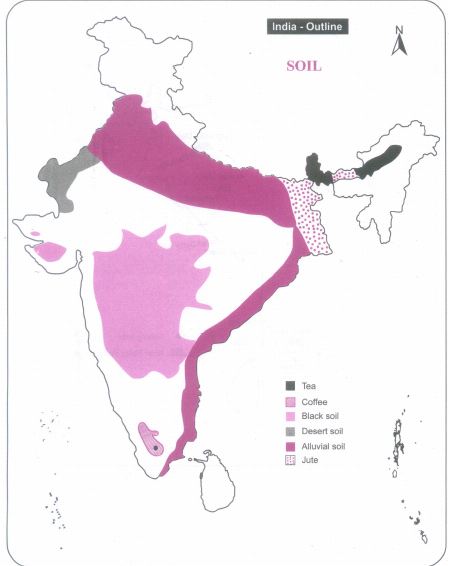
7.
(c)
Irrigation
8.
(a)
1500
9.
(b)
Punjab, Haryana, Rajasthan
10.
(a)
Gully erosion
11.
(c)
1953
12.
The following are the five leading states which account for 78% of the total progress under Micro Irrigation scheme
(i) Andhra Pradesh
(ii) Karnataka
(iii) Gujarat
(iv) Maharashtra
(v) Tamil Nadu
13.
Cotton is the most important cash crop of India. It provides raw material to the largest industry of India. India ranks second next to China in the production of cotton.
14.
Rice in India is sown in three ways:
(i) Broadcasting
(ii) Ploughing or drilling
(iii) Transplanting
15.
The major crops of India are divided into four major categories as follows:
(i) Food crops (wheat, maize, rice, millets, pulses, etc.).
(ii) Cash crops (sugarcane, tobacco, cotton, jute, oilseeds, etc.).
(iii) Plantation crops (tea, coffee, and rubber).
(iv) Horticulture crops (fruits, flowers, and vegetables).
16.
Methods of Conservation and Management of Soil
(i) Contour method
(ii) Rotation of crops
(iii) Contour bunding
(iv) Strip cropping

10th Standard Syllabus & Materials
10th Standard
TN 10th English Prose - 2 - The Night the Ghost Got in Important Questions And Answers Study Material - QB365 Set A
NEW10th Standard
TN 10th English Supplementary - 1 - The Tempest Important Questions And Answers Study Material - QB365 Set A
NEW10th Standard
TN 10th English Poem - 1 - Life Important Questions And Answers Study Material - QB365 Set A
NEW10th Standard
TN 10th English Prose - 1 - His First Flight Important Questions And Answers Study Material - QB365 Set A



Tamilnadu Stateboard 10th Standard Subjects
Tamilnadu Stateboard Standards




