
 100% FREE ACCESS
10th Standard Syllabus & Materials
10th Standard
TN 10th English Prose - 4 - The Attic Important Questions And Answers Study Material - QB365 Set A
NEW10th Standard
TN 10th English Supplementary - 3 - The Story of Mulan Important Questions And Answers Study Material - QB365 Set A
NEW10th Standard
TN 10th English Poem - 3 - I am Every Woman Important Questions And Answers Study Material - QB365 Set A
NEW10th Standard
TN 10th English Prose - 3 - Empowered Women Navigating The World Important Questions And Answers Study Material - QB365 Set A
NEW10th Standard
TN 10th English Supplementary - 2 - Zigzag Important Questions And Answers Study Material - QB365 Set A
NEW10th Standard
TN 10th English Poem - 2 - The Grumble Family Important Questions And Answers Study Material - QB365 Set A

Published on: 06/12/2019
Gross Domestic Product and its Growth: an Introduction
Download Tamil Nadu 10th Standard Social Science question papers, model tests, one-mark questions, important questions, and public exam papers in PDF format. Free study materials and answer keys for TN State Board students.
Questions + Answers key
Take MCQ Social Science Test
1.
Draw the pie chart for sector wise Contribution of GDP Growth in India for the year 2018 - 2019
2.
Explain the limitations of GDP
3.
Write the classification of different sectors contribution in GDP.
4.
Write any five differences between the growth and development.
5.
Write about the composition of GDP in India.
6.
CPI Stands for
Consumer Price Index
Consumption Product Index
Consumer Product Index
Consumption Price Index
7.
NDP =_________
GDP + Depreciation
GNP - Depreciation
GDP - Depreciation
GDP x Depreciation
8.
__________sector is known as primary sector
Agriculture
Industry
Service
Manufacture
9.
In India,___________ has the second rank in GDP among the states.
Kerala
Tamil Nadu
Maharashtra
Andhra Pradesh
10.
India is the_________ largest by Purchasing Power Parity (PPP)
Fifth
Sixth
Third
Second
11.
What is Economic Growth?
12.
Give an example for Industrial sectors
13.
Give the three methods of calculating National Income.
14.
What is Gross National Product?
15.
What are the four major components of GDP?
1.
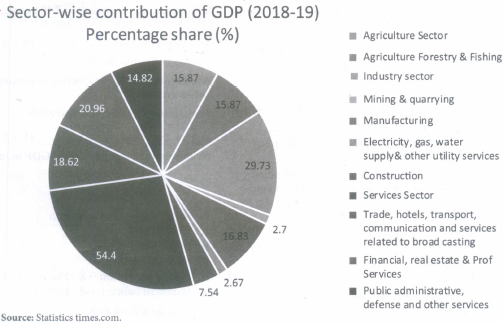
2.
a) Several important goods are services left out of the GDP:
i) The GDP includes only the goods and services sold in the market.
ii) The services provided by the parents to their children is very important but it is not included in the GDP because it is not sold in the market.
iii) Likewise clean air, which is vital for a healthy life, has no market value and is left out of the GDP.
b) GDP measures only quantity but not quality :
i) In the 1970s schools and banks did not permit the use of ballpoint pens.
ii) This is because, the ones available in India were of very poor quality.
iii) Since then, not only has there been a substantial increase in the quantity of ballpoint pens produced in India but their quality has also improved a lot.
iv) The improvement in quality of goods is very important but it is not captured by the GDP.
c) GDP does not tell us about the way income is described in the country:
The GDP of a country may be growing rapidly but income may be distributed so unequally that only a small percentage of people may be benefitting from it.
d) The GDP does not tell us about the kind of life people are living:
A high level of per capita real GDP can go hand - in - hand with very low health condition of people, an undemocratic political system, high pollution and high suicide rate.
3.
Contribution of different sectors GD P in India:
i) Gross Value Added (GVA) at current prices for services sector is estimated at 92.6 lakh crore in 2018 - 19.
ii) Services sector accounts for 54.40% of total India's (GVA) of 169.61 lakh crore Indian Rupees.
iii) With GVA of Rs. 50.43 lakh crore, Industry sector contributes 29.73%.
iv) Agriculture and allied sector shares 15.87%.
v) At 2011-12 prices, composition of Agriculture &allied, Industry and services sectors are 14.39%, 31.46% and 54.15% respectively.
vi) The share of primary like agriculture, forestry, fishing and mining and quarrying.
vii) Secondary (Industry) like, manufacturing, electricity, gas, water supply, utility services and construction, tertiary (services) like, trade, hotels, transport, communication etc. have been estimated as 18.57%, 27.03%, 54.40%.
viii) According to sector wise India GDP composition in 2017 are Agriculture (15.4%), Industry (23%) and services (61.5%).
ix) India is 2nd largest producer of agriculture product.
x) India accounts for 7.39% of total global agricultural output.
xi) In Industry sector, India world rank is 6.
xii) In service sector, India world rank is 8.
xiii) Contribution of Agriculture sector in Indian economy is much higher than world's average 6.4%.
xiv) Contribution of Industry and services sector is lower than world's average 30% for Industry sector and 63% for services sector.
xv) At previous methodology, composition of Agriculture & allied, Industry and services sector was 51.81%, 14.16% and 33.25% respectively at current prices in 1950-51.
(xvi) Share of Agriculture & allied sector has declined at 18.20% in 2013 - 14.
xvii) Share of services sector has improved to 57.03%.
xviii) Share of Industry sector has also increased to 24.77%.
4.
| S. No | Comparison between Economic Growth and Economic Development | Economic Growth | Economic Development |
|---|---|---|---|
| i) | Definition / Meaning | It is the positive quantitative change in the output of an economy in a particular time period. | It considers the rise in the output in an economy along with the advancement of HDI index which considers a rise in living standards, advancement in technology and overall happiness index of a nation. |
| ii) | Concept | Economic growth is the 'Narrower' concept | Economic development is the 'Broader' concept |
| iii) | Nature of Approach | Quantitative in nature | Quantitative in nature |
| iv) | Scope | Rise in parameters like GDP, GNP, FDI, FII etc. | Rise in life expectancy rate, infant, improvement in literacy rate, infant mortality rate and poverty rate, etc. |
| v) | Term / Tenure | Short term in nature | Long term in nature |
| vi) | Applicability | Developed nation | Developing economics |
| vii) | Measurement Techniques | Increase in National Income | Increase in real National Income(i.e.) Per capita Income |
| viii) | Frequency of occurrence | In a certain period of time | Continuous process. |
| ix) | Government Aid | It is an automatic process so may not require government support /aid or intervention | Highly dependent on government intervention as it includes widespread policies changes so without government intervention it is not possible |
5.
a. Primary sector:
i) Agricultural operations are undertaken.
ii) Allied activities of production of raw materials are concentrated
iii) Examples: Agriculture, cattle farm, fishing, mining, forestry, corn, coal
b. Secondary sector:
i) It is an industrial sector
ii) Commodities are produced by transforming the raw materials.
iii) Examples: Iron and steel industry, cotton textile, jute, sugar, cement, paper, petrochemical, automobile and small scale industries.
c. Tertiary sector:
i) It is known as service sector,
ii) Examples: Service of Government, Scientific research, Transport, communication, trade, postal and telegraph, banking, education, entertainment, healthcare and information technology.
6.
(a)
Consumer Price Index
7.
(c)
GDP - Depreciation
8.
(a)
Agriculture
9.
(b)
Tamil Nadu
10.
(c)
Third
11.
(i) Economic growth is the quantitative measure which considers the rise in the output produced in an economy or nation in a particular period in its monetary value.
(ii) GDP and GNP which helps in measuring the actual size of an economy.
12.
(i) Industry sector is secondary sectors.
(ii) For example : Manufacturing, Electricity, Gas, Water supply, Automobile, Iron and Steel other utility services and construction etc..
13.
(i) Product Method
(ii) Income Method
(iii) Expenditure Method
14.
(i) Gross National Product is the total value of (goods and services) produced and income received in a year by domestic residents of a country.
(ii) It includes profit earned from capital invested abroad.
(iii) GNP = C + I + G + (X - M) + NFIA
15.
The four major components of GDP are,
(i) C - Consumption expenditure
(ii) I - Investment expenditure
(iii) G - Government expenditure
(iv) X-M - Exports - Imports
(v) GDP = C + I + G + X-M

10th Standard Syllabus & Materials
10th Standard
TN 10th English Prose - 2 - The Night the Ghost Got in Important Questions And Answers Study Material - QB365 Set A
NEW10th Standard
TN 10th English Supplementary - 1 - The Tempest Important Questions And Answers Study Material - QB365 Set A
NEW10th Standard
TN 10th English Poem - 1 - Life Important Questions And Answers Study Material - QB365 Set A
NEW10th Standard
TN 10th English Prose - 1 - His First Flight Important Questions And Answers Study Material - QB365 Set A



Tamilnadu Stateboard 10th Standard Subjects
Tamilnadu Stateboard Standards




