
 100% FREE ACCESS
10th Standard Syllabus & Materials
10th Standard
TN 10th English Prose - 4 - The Attic Important Questions And Answers Study Material - QB365 Set A
NEW10th Standard
TN 10th English Supplementary - 3 - The Story of Mulan Important Questions And Answers Study Material - QB365 Set A
NEW10th Standard
TN 10th English Poem - 3 - I am Every Woman Important Questions And Answers Study Material - QB365 Set A
NEW10th Standard
TN 10th English Prose - 3 - Empowered Women Navigating The World Important Questions And Answers Study Material - QB365 Set A
NEW10th Standard
TN 10th English Supplementary - 2 - Zigzag Important Questions And Answers Study Material - QB365 Set A
NEW10th Standard
TN 10th English Poem - 2 - The Grumble Family Important Questions And Answers Study Material - QB365 Set A

Published on: 17/01/2020
Download Tamil Nadu 10th Standard Science question papers, model tests, one-mark questions, important questions, and public exam papers in PDF format. Free study materials and answer keys for TN State Board students.
Questions + Answers key
Take MCQ Science Test1.
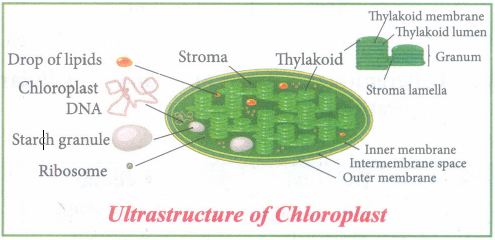
Draw the ultrastructure of a chloroplast and label the parts.
2.
Write the difference between conductor and insulator.
3.
What is Scratch?
4.
What is adult onset diabetes?
5.
A hot saturated solution of copper sulphate forms crystals as it cools. Why?
6.
Which organ acts as suction pump in leech?
7.
What is the audible range of frequency?
8.
What is Molar volume of a gas?
9.
Why a spanner with a long handle is preferred to tighten screws in heavy vehicles?
10.
'Our teeth and an elephant's tusks are homologous organs'. Justify this statement. What do the analogous organs indicate?
11.
Describe mutation breeding with an example.
12.
What is called homologous series? Give any three of its characteristics?
13.
Describe rocket propulsion.
14.
_____ carry command from spinal cord to our arm.
Motor neurons
Sensory neurons
Unipolar neurons
Afferent neurons
15.
16.
Radio ________ is used to locate brain tumors.
iron
iodine
indium
cobalt
17.
Blister copper contains _________
50% pure copper
99% pure copper and 1% impurities
98% pure copper and 2% impurities
75% pure copper and 25% impurities
18.
19.
20.
The term Ethnobotany was coined by
Khorana
J.W. Harshberger
Ronald Ross
Hugo de Vries
21.
The body of leech has
23 segments
33 segments
38 segments
30 segments
22.
When pressure is increased at constant temperature the solubility of gases in liquid _________
No change
increases
decreases
no reaction
23.
The volume occupied by 1 mole of a diatomic gas at S.T.P is
11.2 liters
5.6 liters
22.4 liters
44.8 liters
24.
In a myopic eye, the image of the object is formed
behind the retina
on the retina
in front of the retina
on the blind spot
25.
What is diabetes? Explain the types.
26.
Distinguish between Nuclear fission and nuclear fusion.
27.
Explain the refraction of light through a glass prism.
28.
Write a note on mutation.
29.
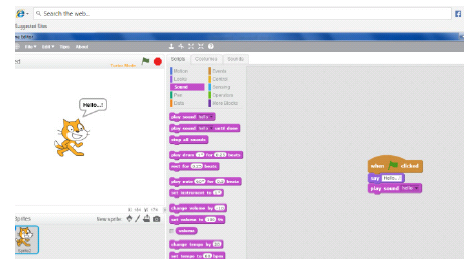
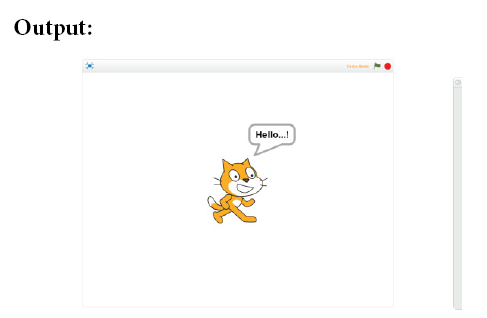
Program for print the word “Hello” with sound
30.
Differentiate between outbreeding and inbreeding.
31.
Differentiate between systemic circulation and pulmonary circulation.
32.
Define Ethnobotany and write its importance.
33.
Find the final temperature of a copper rod. Whose area of cross section changes from 10 m2 to 11 m2 due to heating. The copper rod is initially kept at 90 K. (Coefficient of superficial expansion is 0.0021 /K)
34.
What would be expected to happen if
a) Gibberellin is applied to rice seedlings.
b) A rotten fruit gets mixed with unripe fruits.
c) When cytokinin is not added to culture medium
35.
Will the cool drinks give more fizz at top of the hills or at the foot? Explain.
36.
Can a nickel spatula be used to stir copper sulphate solution? Justify your answer.
37.
Metal A belongs to period 3 and group 13. A in red hot condition reacts with steam to form B. A with strong alkali forms C. Find A, B and C with reactions.
1.
2.
| S. No | Conductor | Insulator |
| i) | Materials which | Materials which do not allow current |
| ii) | Resistivity is less | Resistivity is high |
3.
Scratch is a software used to create animations, cartoons and games easily. Scratch, on the other hand, is a visual programming language. It is developed in the Massachusetts Institute of Technology (MIT). Media Lab to make programming easier and more fun to learn.
4.
Type-2 Non-Insulin Dependent diabetes mellitus.
5.
(i) The number of water molecule in blue vitriol is five.
(ii) The hot saturated solution of copper sulphate has no water molecule.
(iii) When cooled the hot saturated solutions gain five molecules of water and it will turn to crystal.
6.
Blood is sucked by muscular pharynx, which act as a suction pump.
7.
(i) The audible range of frequency is 20 Hz to 20,000 Hz.
(ii) These are generated by vibrating bodies such as vocal cords, stretched strings, etc.
8.
(i) One mole (6.023 x 10²³ of entities) of any gas occupies 22.4 litre or 22400 ml at S.T.P.
(ii) This volume is called as molar volume of gas.
9.
(i) A spanner has a long handle to produce a larger moment of force by a small force applied normally at the end of its handle.
(ii) Moment of force = \(\overrightarrow{\mathbf{F}} \times \overrightarrow{\mathrm{d}}\)
10.
(i) Our teeth and an elephant's tusks are homologous organs as both of them have the same basic structure, but different functions (we chew with our teeth, whereas elephants use their tusks to hold things).
(ii) Analogous organs indicate that even organisms having different structures can adapt by modifying these structures to perform similar functions for their survival under the given environmental conditions.
11.
Mutation:
(i) Mutation is defined as the sudden heritable change in the nucleotide sequence of DNA in an organism.
(ii) It is a Process by which genetic variations are created which in turn brings about changes in the organism.
(iii) The organism which undergoes mutation is called a mutant.
(iv) The factors which induce mutations are known as mutagens or mutagenic agents.
(v) Mutagens are two types namely physical mutagens and chemical mutagens.
(i) Physical mutagens:
Radiations like X-rays, α, β and γ-rays, UV rays, temperature, etc. which induce mutations are called physical mutagens.
(ii) Chemical mutagens:
(i) Chemical substances that induce mutations are called chemical mutagens.
(ii) Eg: Mustard gas and nitrous acid. The utilization of induced mutation in crop improvement is called mutation breeding. Achievements of mutation breeding:
Achievements of mutation breeding:
(i) Sharbati Sonora wheat produced from Sonora-64 by using gamma rays.
(ii) Atomica 2 rice with saline tolerance and pest resistance.
(iii) Groundnuts with thick shells.
12.
Homologous series is a group or a class of organic compounds having same general formula and similar chemical properties in which the successive numbers differ by a -CH2 group.
E.g: Methane - CH4
Ethane - CH3CH3
Propane - CH3CH2CH3
Characteristics:
(i) Each member of the series differs from the preceding or succeeding member by one methylene group (-CH2) and hence by a molecular mass of 14 amu.
(ii) All members of a homologous series contain the same elements and functional group.
(iii) They are represented by a general molecular formula. e.g. Alkanes, CnH2n + 2
(iv) All the members can be prepared by a common method.
13.
(i) Propulsion of rockets is based on law of conservation of linear momentum as well as Newton's III law of motion.
(ii) Rockets are filled with a fuel (either liquid or solid) in the propellant tank.
(iii) When the rocket is fired, this fuel is burnt and a hot gas is ejected with high speed from the back nozzle producing a huge momentum.
(iv) To balance this momentum, an equal and opposite reaction force is produced combustion chamber which makes the rocket project forward.
(v) While in motion, the mass of the rocket gradually decreases, until the fuel is completely burnt out.
(vi) Since there is no net external force acting on it, the linear momentum of the system is conserved.
(vii) The mass of the rocket decreases with altitude, which results in the gradual increase in velocity of the rocket.
(viii) At one stage, it reaches a velocity, which is sufficient to just escape from the gravitational pull of the Earth. This velocity is called escape velocity.
14.
(a)
Motor neurons
15.
(a)
16.
(b)
iodine
17.
(c)
98% pure copper and 2% impurities
18.
(a)
19.
(a)
20.
(b)
J.W. Harshberger
21.
(b)
33 segments
22.
(b)
increases
23.
(c)
22.4 liters
24.
(c)
in front of the retina
25.
Diabetes Mellitus is a chronic metabolic disorder. It is characterized by increased blood glucose level due to insufficient, deficient or failure of insulin secretion. This is the most common pancreatic endocrine disorder.
Type I Insulin dependent diabetes mellitus (IDDM):
(i) IDDM accounts for 10 to 20% of the known diabetics.
(ii) The condition also occurs in children (Juvenile onset diabetes) and young adults, the onset is usually sudden and can be life threatening.
(iii) This is caused by the destruction of cells of the pancreas.
(iv) It is characterized by abnormally elevated blood glucose levels (hyperglycemia) resulting from inadequate insulin secretion.
Causes: Genetic inheritance and environmental factors (infections due to virus, acute stress) are the cause for this condition.
Type II Non-Insulin Dependent Diabetes Mellitus (NIDDM):
(i) This is also called as adult onset diabetes and accounting for 80 to 90% of the diabetic population.
(ii) It develops slowly, usually milder and more stable.
(iii) Insulin production by the pancreas is normal but its action is impaired. (iv) The target cells do not respond to insulin.
(v) It does not allow the movement of glucose into cells.
Causes: The causes are multifactorial which include increasing age obesity, sedentary lifestyle, overeating and physically inactive.
26.
| S. No |
Nuclear fission |
Nuclear fusion |
|---|---|---|
| i | The process of breaking (splitting) up of a heavy nucleus into two smaller nuclei is called "nuclear fission". | Nuclear fusion is the combination of two lighter nuclei to form a heavier nucleus. |
| ii | Can be performed at room temperature. | Extreme high temperature and pressure is needed. |
| iii | Alpha, beta and gamma radiations are emitted. | Alpha ray, Positron, and neutrinos are emitted. |
| iv | Fission leads to the emission of gamma radiation. This triggers mutation in the human genes and causes genetic transform diseases. | Only light and heat energy is emitted. No harmful radiation and will not cause any genetic transform diseases. |
| v | Deflected by both the fields; but the direction of deflection is opposite to alpha rays. (in accordance with Fleming's left hand rule). | They are not deflected by both fields. |
27.
(i) When a beam of white light or composite light is refracted through any transparent media such as glass or water, it is split into its component colours.
(ii) This phenomenon is called as 'dispersion of light'.
(iii) The band of colours is termed as spectrum. This spectrum consists of following colours: Violet, Indigo, Blue, Green, Yellow, Orange, and Red. These colours are represented by the acronym "VIBGYOR".
(iv ) When white light is refracted by a transparent medium. Different coloured lights are bent through different angles. That is the angle of refraction is different for different colours.
(v) Angle of refraction is the smallest for red and the highest for violet.
(vi) From Snell's law, we know that the angle of refraction is determined in terms of the refractive index of the medium.
(vii) Hence, the refractive index of the medium is different for different coloured lights.
28.
(i) The term mutation was introduced by Hugo De Vries in 1901 when he observed phenotypic changes in the evening Primrose plant, Oenothera lamarckiana.
(ii) Mutation is an inheritable sudden change in the genetic material (DNA) of an organism.
(iii) Mutations are classified into two main types, namely chromosomal mutation and gene mutation. Chromosomal mutation: The sudden change in the structure or number of chromosomes is called chromosomal mutation. This may result in
Changes in the structure of chromosomes:
Structural changes in the chromosomes usually occurs due to errors in cell division. Changes in the number and arrangement of genes takes place as a result of deletion, duplication, inversion and translocation in chromosomes. Changes in the number of chromosomes: They involve addition or deletion in the number of chromosomes present in a cell. This is called ploidy. There are 2 types of ploidy:
Euploidy in plants and animals:
(a) Euploidy: It is the condition in which the individual bears more than the usual number of diploid (2n) chromosomes. If an individual has three haploid sets of chromosomes, the condition is called triploidy (3n). If it has four haploid sets of chromosomes. It is called Tetraploidy. Tetraploid plants are advantageous as they often result in increased fruit and flower size.
(b) Aneuploidy: It is the loss or gain of one or more chromosomes in a set. It is of 3 types:
(i) Monosomy (2n-1),
(ii) Trisomy (2n+1)
(iii) Nullisomy (2n-2). In man, Down's syndrome is one of the commonly known aneuploid condition.
Gene or point mutation:
(i) Gene mutation is the changes occurring in nucleotide sequence of a gene.
(ii) It involves substitution, deletion, insertion or inversion of a single or more than one nitrogenous base.
(iii) Gene alteration results in abnormal protein formation in an organism.
29.
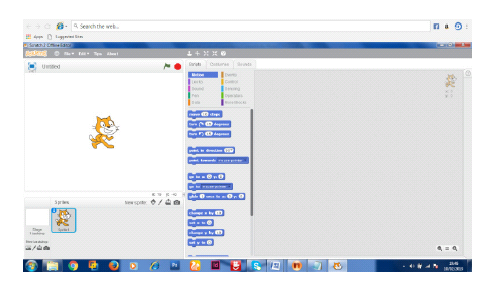
1. Click events in script option
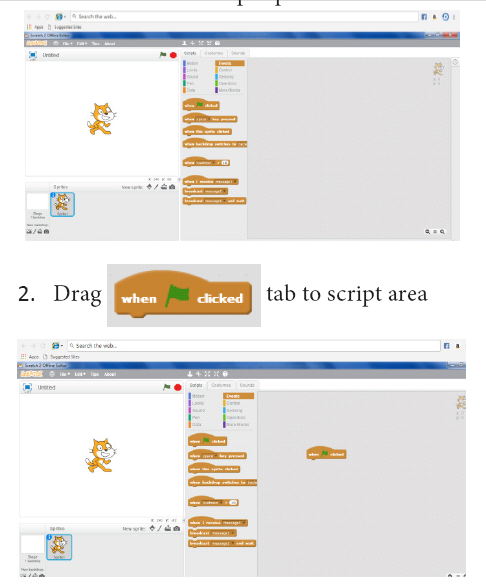
3. Click Looks in script option. Drag “say” to script area.
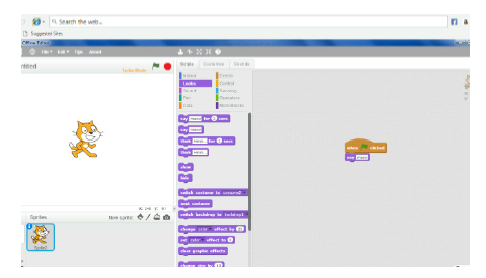
4. Type “Hello “ word in say tab.
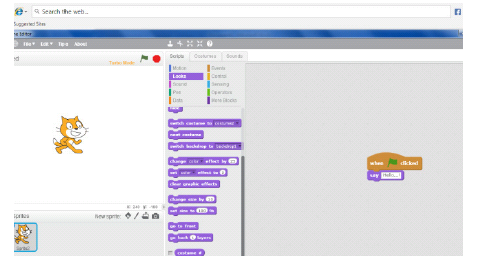
5.Click sounds in script option. Drag play sound to script area. Choose the hello sound from the audio file.
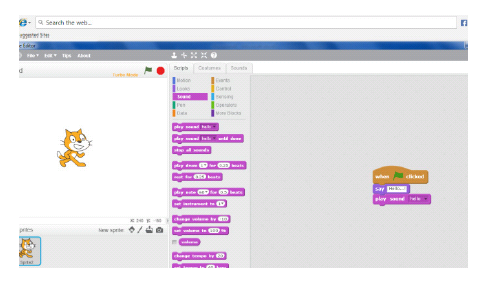
6. From File menu choose the Save option.
7. Click the green flag at the top right corner of the stage window to run the program
30.
| S.No. |
Outbreeding |
Inbreeding |
|---|---|---|
| i. | Cross between two different species (unrelated) with desirable features of economic value are mated. | Mating of closely related animals within the same breed for about 4 - 6 generations. |
| ii. | It is the breeding of unrelated animals. The offsprings formed are called hybrids. | Superior males and superior females of the same breed are identified and mated in pairs. |
| iii. | The hybrids are stronger and vigorous than their parents. E.g: Mule | It helps in the accumulation of superior genes and elimination of genes which are undesirable. E.g: Hisardale. |
31.
| Systemic circulation | Pulmonary circulation |
| Systemic circulation moves blood between the heart and the rest of the body. | Pulmonary circulation moves blood between the heart and the lungs. |
| It sends oxygenated blood out to cells and returns deoxygenated blood to the heart. | It transports deoxygenated blood to the lungs to absorb oxygen and release carbon dioxide. The oxygenated blood then flows back to the heart. |
32.
(i) Ethnobotany is the study of a region's plants and their practical uses through the traditional knowledge of the local culture of people.
Importance of Ethnobotany :
(i) It provides traditional uses of plant.
(ii) It gives information about certain unknown and known useful plants.
(iii) The ethnomedicinal data will serve as a useful source of information for the chemists, pharmacologists and practitioners of herbal medicine.
(iv) Tribal communities utilize ethnomedicinal plant and prepare medicine to cure many diseases.
33.
Area of copper rod, Ao = 10 m2
Changes of Area of cross section,
Initial temperature \(\Delta \mathrm{A} =11 -10 =1 \mathrm{~m}^{2} \)
\(\mathrm{~T}_{1} =90 \mathrm{~K} \)
\(a_{\mathrm{A}} =0.0021 / \mathrm{K} \)
\(\mathrm{T}_{2} =? \)
\(\frac{\Delta A}{A_{0}} =a_{\mathrm{A}} \Delta \mathrm{T} \)
\(\frac{1 }{10 } =0.0021\left[\mathrm{~T}_{2}-90\right] \)
\(0.1 =0.0021\left[\mathrm{~T}_{2}-90\right]=\frac{0.1}{0.0021}+90=\mathrm{T}_{2} \)
\(\mathrm{~T}_{2} =137.61 \mathrm{~K}\)
So the final temperature of a copper rod is 137.61 K
34.
a) When Gibberellin is applied to rice seedlings, it would induce bolting. It is a natural attempt to boost seed production.
b) When a rotten fruit gets mixed with unripe fruits, the ethylene produced from the rotten fruits will hasten the ripening of the unripe fruits.
c) When cytokinin is not added to culture medium, then cell division, growth and differentiation will not be observed.
35.
(i) Cool drinks give more fizz at the foot of mountain because the atmospheric pressure is less at the top of the mountain.
(ii) So the pressure affects the fizz of the cool drink.
36.
(i) No, because Nickel is more reactive than Copper.
(ii) So Nickel easily reacts and displaces copper from copper sulphate solution.
(iii) \(\mathrm{Ni}_{(\mathrm{s})}+\mathrm{CuSO_4}_{(\mathrm{aq})} \rightarrow \mathrm{NiSO_4}_{(\mathrm{aq})}+\mathrm{Cu}_{(\mathrm{S})}\)
37.
i) Metal A belongs to periods 3 and group 13 is Aluminium.
ii) When steam is passed over red hot aluminium, Aluminium oxide and Hydrogen is produced.
iii) when Aluminium react with strong caustic alkalis forming aluminates
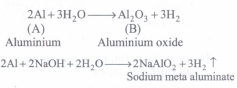
| A | Al | Aluminium |
| B | Al2O3 | Aluminium oxide |
| C | NaAlO2 | Sodium meta aluminate |

10th Standard Syllabus & Materials
10th Standard
TN 10th English Prose - 2 - The Night the Ghost Got in Important Questions And Answers Study Material - QB365 Set A
NEW10th Standard
TN 10th English Supplementary - 1 - The Tempest Important Questions And Answers Study Material - QB365 Set A
NEW10th Standard
TN 10th English Poem - 1 - Life Important Questions And Answers Study Material - QB365 Set A
NEW10th Standard
TN 10th English Prose - 1 - His First Flight Important Questions And Answers Study Material - QB365 Set A



Tamilnadu Stateboard 10th Standard Subjects
Tamilnadu Stateboard Standards





