
 100% FREE ACCESS
10th Standard Syllabus & Materials
10th Standard
TN 10th English Prose - 4 - The Attic Important Questions And Answers Study Material - QB365 Set A
NEW10th Standard
TN 10th English Supplementary - 3 - The Story of Mulan Important Questions And Answers Study Material - QB365 Set A
NEW10th Standard
TN 10th English Poem - 3 - I am Every Woman Important Questions And Answers Study Material - QB365 Set A
NEW10th Standard
TN 10th English Prose - 3 - Empowered Women Navigating The World Important Questions And Answers Study Material - QB365 Set A
NEW10th Standard
TN 10th English Supplementary - 2 - Zigzag Important Questions And Answers Study Material - QB365 Set A
NEW10th Standard
TN 10th English Poem - 2 - The Grumble Family Important Questions And Answers Study Material - QB365 Set A

Published on: 13/05/2022
QB365 provides detailed and simple solution for every book back questions in class 10 Maths subject.It will helps to get more idea about question pattern in every book back questions with solution.
latest Book back QuestionsDownload Tamil Nadu 10th Standard Maths question papers, model tests, one-mark questions, important questions, and public exam papers in PDF format. Free study materials and answer keys for TN State Board students.
Questions + Answers key
Take MCQ Maths Test1.
Find the range and coefficient of range of the following data.
43.5, 13.6, 18.9, 38.4, 61.4, 29.8
2.
Find the LCM and GCD for the following and verify that f(x) x g(x) = LCM x GCD
(x3 - 1)(x + 1), (x3 + 1)
3.
Find the equation of a straight line whose Inclination is 450 and y intercept is 11
4.
What is the probability of drawing either a king or a queen in a single draw from a well shuffled pack of 52 cards?
5.
Two coins are tossed together. What is the probability of getting different faces on the coins?
6.
The standard deviation and mean of a data are 6.5 and 12.5 respectively. Find the coefficient of variation.
7.
Find the sum of the following series
1 + 2 + 3 +...+ 60
8.
Two circles with centres O and O' of radii 3 cm and 4 cm, respectively intersect at two points P and Q, such that OP and O'P are tangents to the two circles. Find the length of the common chord PQ.
9.
Find the first term and common difference of the Arithmetic Progressions whose nth terms are given below tn = -3 + 2n
10.
If the base area of a hemispherical solid is 1386 sq. metres, then find its total surface area?
11.
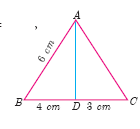
In the figure, AD is the bisector of \(\angle\)A. If BD = 4 cm, DC = 3 cm and AB = 6 cm, find AC.
12.
If A = {-2, -1, 0, 1, 2} and f: A ⟶ B is an onto function defined by f(x) = x2 + x + 1 then find B.
13.
Find the next three terms of the following sequence.
8, 24, 72, …
14.
A plane is flying at a speed of 500 km per hour. Express the distance travelled by the plane as function of time t in hours.
15.
Let f(x) = 2x + 5. If x ≠ 0 then find \(\frac { f(x+2)-f(2) }{ x } \).
16.
Let f{(x, y)| x, y \(\in \) N and y = 2x}. be a relation on ℕ. Find the domain, co-domain and range. Is this relation a function?
17.
A relation ‘f’ \(X \rightarrow Y\) is defined by f(x) = x2 - 2 where x \(\in \) {-2, -1, 0, 3} and Y = R
(i) List the elements of f
(ii) Is f a function?
18.
Determine the value of d such that 15 \(\equiv \) 3 (mod d).
19.
For what values of natural number n, 4n can end with the digit 6?
20.
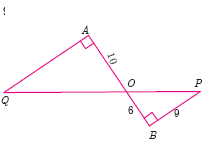
QA and PB are perpendiculars to AB. If AO = 10 cm, BO = 6 cm and PB = 9 cm. Find AQ.
21.
A Relation R is given by the set {(x, y) / y = x + 3, x \(\in \) {0, 1, 2, 3, 4, 5}}. Determine its domain and range.
22.
Let A = {3,4,7,8} and B = {1,7,10}. Which of the following sets are relations from A to B?
R1 = {(3,7), (4,7), (7,10), (8,1)}
23.
24.
If A x B = {(3,2), (3, 4), (5,2), (5, 4)} then find A and B.
25.
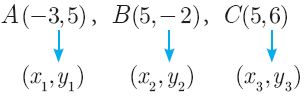
Find the area of the triangle whose vertices are (-3, 5) , (5, 6) and (5, - 2)
1.
43.5, 13.6, 18.9,38.4,61.4,29.8
Largest value L= 61.4
Smallest value S = 13.6
R = L - S
= 61.4 - 13.6 = 4
Co-efficient of range = \(\frac { L-S }{ L+S } \)
= \(\frac { 47.8 }{ 75 } =0.64\)
Range = 47.8; co-efficient of range = 0.64.
2.
f(x) = (x3 - 1) (x + 1)
= (x - 1) (x2 + x + 1) (x + 1)
g(x) = x3 + 1 = (x + 1) (x2 - x + 1)
GCD = x + 1
LCM = (x + 1) (x - 1) (x2 + x + 1) (x2 - x + 1)
f(x) x g(x) = (x3 - 1) (x + 1) (x3 + 1)
= ( x + 1) ((x3)2 - (1)2 )
= ( x + 1) (x6 - 1)
LCM x GCD = (x + 1) (x - 1) (x2 + x + 1) (x2 - x + 1) (x + 1)
= (x + 1) (x2 - x + 1) (x - 1) (x2 + x + 1) (x + 1)
= (x3 + 1) (x - 1)(x + 1)
= (x6 - 1)(x + 1)
f(x) x g(x) = LCM x GCD
Hence verified.
3.
Given, θ = 450, y intercept, c = 11
Slope m = tan θ = tan 450 = 1
Therefore, equation of a straight line is of the form y = mx + c
Hence we get, y = x + 11 gives x − y + 11 = 0
4.
Total number of cards = 52
Number of king cards = 4
Probability of drawing a king card = \(\frac{4}{52}\)
Number of queen cards = 4
Probability of drawing a queen card = \(\frac{4}{52}\)
Both the events of drawing a king and a queen are mutually exclusive
⇒ P(AUB) = P(A) + P(B)
Therefore, probability of drawing either a king or a queen = \(\frac { 4 }{ 52 } +\frac { 4 }{ 52 } =\frac { 2 }{ 13 } \).
5.
When two coins are tossed together, the sample space is
S = {HH, HT, TH, TT} n(S) = 4
Let A be the event of getting different faces on the coins.
A = {HT, TH}; n(A) = 2
Probability of getting different faces on the coins is P(A) = \(\frac { n(A) }{ n(S) } =\frac { 2 }{ 4 } =\frac { 1 }{ 2 } \).
6.
Standard deviation \(\sigma=6.5\)
Mean \(\bar{x}=12.5\)
Coefficient of variation C.V \(=\frac{\sigma}{x} \times 100 \%
\)
\(=\frac{6.5}{12.5} \times 100 \%
\)
\(=\frac{65}{125} \times 100 \%
\)
\(=\frac{13}{25} \times 100 \%
\)
= 52 %
Co-efficient of variation is 52%
7.
1 + 2 + 3 +...+ 60
1 + 2 + 3 +...+ n \(=\frac{n(n+1)}{2}\)
1 + 2 + 3 +...+ 60 \(=\frac{60 \times(60+1)}{2}=\frac{60 \times 61}{2}\)
1 + 2 + 3 +...+ 60 = 1830
8.
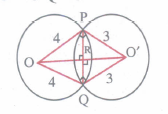
Since the tangents at a point to a circle is
perpendicular to the radius through the point of contact
\(\therefore \angle O P O^{\prime}=90^{\circ}\)
OP2 + OP2 = (OO')2
[By Pythagoras theorem]
32 + 42 = (OO')2
9+16 = (OO')2
25 = (OO')2
OO' = 5cm
Since the line joining the centres of two intersecting circles is perpendicular bisector of their common chord.
\(\mathrm{OR} \perp \mathrm{PQ} \text { and } O^{\prime} \mathrm{R} \perp \mathrm{PQ}\)
AIso PR = QR
Let OR = x, then O'R = 5 - x
AIso at PR = QR = y cm
\(\text { In } \triangle O R P \text { and } \Delta O^{\prime} R P\)
Applying Pythagoras theorem
OP2 = OR3 + RP2 and O'P'2 = O'R2 + RP2
\(3^{2}=x^{2}+y^{2} and 4^{2}=(5-x)^{2}+y_{i}^{2} \)
\(Subtracting \Rightarrow 4^{2}-3^{2}=\left\{(5-x)^{2}+y^{2}\right\}-\left(x^{2}+y^{2}\right) \)
\(16-9=25-10 x+x^{2}+y^{2}-x^{2}-y^{2} \)
7 - 25 = 10x
10x = 25 - 7
10x = 18
x = 1.8 cm
32 = x2 + y2
\(y=\sqrt{9-(1.8)^{2}}=\sqrt{5.76}\)
y = 2.4cm
Hence PR = QR = 2.4 cm
PQ = 2y = 4.8 cm
9.
Given the nth term of the A.P. is tn = - 3 + 2n
Put n = 1
t1 = -3 + 2(1) = - 3 + 2
a = t1 = -1
Put n = 2
t2 = -3 + 2(2) = - 3 + 4
t2 = 1
Common difference d = t2 - t1 = 1 - (-1)
= 1 + 1 = 2
First term a = - 1; Common difference d = 2
10.
Let r be the radius of the hemisphere.
Given that, base area = \(\pi\)r2 = 1386 sq. m
T.S.A. = 3 \(\pi\)r2 sq.m
= 3 x 1386 = 4158
Therefore, T.S.A. of the hemispherical solid is 4158 m2.
11.
In \(\triangle\)ABC, AD is the bisector of \(\angle\)A
Therefore by Angle Bisector of \(\angle\)A
\(\frac { AB }{ AC } =\frac { BD }{ DC } \)
\(\frac{4}{3}=\frac{6}{A C}\) gives 4AC = 18. Hence, AC \(=\frac{9}{2}=4.5 \mathrm{~cm}\)
12.
Given A = {-2, -1, 0, 1, 2} and f(x) = x2 + x + 1
f(-2) = (-2)2 + (-2) + 1 = 3;
f(-1) = (-1)2 + (-1) + 1 = 1
f(0) = 02 + 0 + 1 = 1;
f(1) = 1 2 + 1 + 1 = 3
f(2) = 22 + 2 + 1 = 7
Therefore, B = {1,3,7}
13.
8, 24, 72, .......

Each term is obtained by multiplying the previous term by 3.
Next three terms are 216, 648, 1944.
14.
Let the distance be 'd'
Speed = 500 km/hr
Time = 't' hours
Distance = Time x Speed
d(t) = 500 t
15.
f(x) = 2x + 5, x ≠ 0.
\(\frac{f(x+2)-f(2)}{x} =\frac{[2(x+2)+5]-[2(2)+5]}{x} \)
\(=\frac{2 x+4+5-9}{x}=\frac{2 x+9-9}{x} \)
\(=\frac{2 x}{x}=2\)
16.
f = {(x, y) / x, y \(\in \) N and y = 2x}
Given that y = 2x
x = {1,2,3,..}
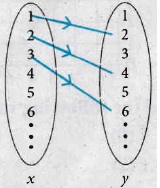
f = {(1,2), (2, 4), (3, 6), (4, 8)..}
Domain of f = {1, 2, 3, 4...........}
Codomain = {1,2,3, 4.......}
Range of f = {2,4,6, 8......}
Here, the first elements (x) are having unique images. So, this relation is a function.
17.
f(x) = x2 - 2 where x \(\in \){ -2, -1, 0, 3}
(i) f( -2) = ( -2)2 - 2 = 2; f( -1) = ( -1)2 - 2 = -1
f(0) = (0)2 - 2 = - 2 ; f(3) = (3)2 - 2 = 7
Therefore, f = {(-2, 2), (-1, -1), (0, -2), (3, 7)}
(ii) We note that each element in the domain of f has a unique image. Therefore f is a function.
18.
15 \(\equiv \) 3 (mod d) means 15 - 3 = kd, for some integer k,
12 = kd
gives d divides 12.
The divisors of 12 are 1,2,3,4,6,12. But d should be larger than 3 and so the possible values for d are 4, 6, 12.
19.
for some natural number n,
4n = (2)n
So 2 is a factor of 4n
By fundamental theorem of arithmetic, we know the factorization of 4n is unique.
Only factor of 4n is 2, even number of times.
But 4n always end with 4 or 6.
If n is odd then 4n end with 4.
If n is even, then 4n end with the digit 6.
20.
\(\Delta AOQ\) and \(\Delta BOP,\angle OAQ=\angle OBP=90^{ 0 } \)
\(\angle AOQ=\angle BOP\) (Vertically opposite angles)
Therefore, by AA Criterion of similarity,
\(\Delta AOQ\sim \Delta BOP\)
\(\frac { AO }{ BO } =\frac { OQ }{ OP } =\frac { AQ }{ BP } \)
\(\frac { 10 }{ 6 } =\frac { AQ }{ 9 } \) gives \(AQ=\frac { 10\times 9 }{ 6 } =15cm\)
21.
Given Set = {(x, y) / y = x + 3, x \(\in \) {0, 1, 2, 3, 4, 5}}
When x = 0, y = 0 + 3 = 3
When x = 1, y = 1 + 3 = 4
When x = 2,y = 2 + 3 = 5
When x = 3, y = 3 + 3 = 6
When x = 4, y = 4 + 3 = 7
When x = 5, y = 5 + 3 = 8
Relation R = {(0, 3), (1,4), (2,5), (3,6), (4,7), (5,8)}
Domain of R = {0, 1, 2, 3, 4, 5}
Range of R = {3, 4, 5, 6, 7, 8}
22.
A x B = {(3,1), (3,7), (3,10), (4,1), (4,7), (4,10), (7,1), (7,7), (7,10), (8,1), (8,7), (8,10)}
We note that, R1 ⊆ A x B. Thus, R1 is a relation from A to B.
23.
24.
A x B = {(3,2), (3,4), (5,2), (5,4)}
We have A = {set of all first coordinates of elements of A x B}. Therefore, A = {3,5}
B = {set of all second coordinates of elements of A x B}. Therefore, B = {2,4}
Thus A = {3,5} and B = {2,4}.
25.
Plot the points in a rough diagram and take them in counter-clockwise order.
Let the vertices be
JPG.JPG)
The area of Δ ABC is
= \(\frac{1}{2}\) { (x1y2 + x2y3 + x3y1) - (x2y1 + x3y2 + x1y3) }
= \(\frac{1}{2}\) { (6 + 30 + 25) - (25 - 10 18) }
= \(\frac{1}{2}\) { 61 + 3 }
= \(\frac{1}{2}\) (64) = 32 sq. units

10th Standard Syllabus & Materials
10th Standard
TN 10th English Prose - 2 - The Night the Ghost Got in Important Questions And Answers Study Material - QB365 Set A
NEW10th Standard
TN 10th English Supplementary - 1 - The Tempest Important Questions And Answers Study Material - QB365 Set A
NEW10th Standard
TN 10th English Poem - 1 - Life Important Questions And Answers Study Material - QB365 Set A
NEW10th Standard
TN 10th English Prose - 1 - His First Flight Important Questions And Answers Study Material - QB365 Set A



Tamilnadu Stateboard 10th Standard Subjects
Tamilnadu Stateboard Standards





