
 100% FREE ACCESS
10th Standard Syllabus & Materials
10th Standard
TN 10th English Prose - 4 - The Attic Important Questions And Answers Study Material - QB365 Set A
NEW10th Standard
TN 10th English Supplementary - 3 - The Story of Mulan Important Questions And Answers Study Material - QB365 Set A
NEW10th Standard
TN 10th English Poem - 3 - I am Every Woman Important Questions And Answers Study Material - QB365 Set A
NEW10th Standard
TN 10th English Prose - 3 - Empowered Women Navigating The World Important Questions And Answers Study Material - QB365 Set A
NEW10th Standard
TN 10th English Supplementary - 2 - Zigzag Important Questions And Answers Study Material - QB365 Set A
NEW10th Standard
TN 10th English Poem - 2 - The Grumble Family Important Questions And Answers Study Material - QB365 Set A

Published on: 13/05/2022
QB365 provides detailed and simple solution for every book back questions in class 10 Maths subject.It will helps to get more idea about question pattern in every book back questions with solution.
latest Book back QuestionsDownload Tamil Nadu 10th Standard Maths question papers, model tests, one-mark questions, important questions, and public exam papers in PDF format. Free study materials and answer keys for TN State Board students.
Questions + Answers key
Take MCQ Maths Test1.
Find the square root of the following expressions
(6x2 + x - 1)(3x2 + 2x - 1)(2x2 + 3x + 1)
2.
If A = \(\left[ \begin{matrix} 3 & 1 \\ -1 & 2 \end{matrix} \right] \) show that A2 - 5A + 7I2 = 0
3.
The probability that a person will get an electrification contract is \(\frac{3}{5}\) and the probability that he will not get plumbing contract is \(\frac{5}{8}\). The probability of getting atleast one contract is \(\frac{5}{7}\). What is the probability that he will get both?
4.
When the positive integers a, b and c are divided by 13 the respective remainders are 9, 7 and 10. Find the remainder When a + b + c is divided by 13.
5.
A pole has to be erected at a point on the boundary of a circular ground of diameter 20 m in such a way that the difference of its distances from two diametrically opposite fixed gates P and Q on the boundary is 4 m. Is it possible to do so? If answer is yes at what distance from the two gates should the pole be erected?
6.
Show that the angle bisectors of a triangle are concurrent.
7.
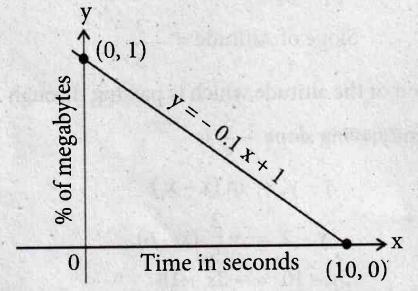
You are downloading a song. The percent y (in decimal form) of mega bytes remaining to get downloaded in x seconds is given by y = -0.1x + 1.
Graph the equation.
8.
Find the square root of 64x4 - 16x3 + 17x2 - 2x + 1
9.
5 m long ladder is placed leaning towards a vertical wall such that it reaches the wall at a point 4m high. If the foot of the ladder is moved 1.6 m towards the wall, then find the distance by which the top of the ladder would slide upwards on the wall
10.
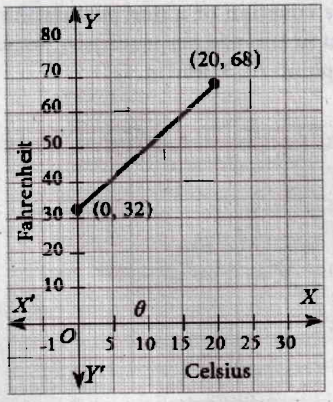
The graph relates temperatures y (in Fahrenheit degree) to temperatures x (in Celsius degree) Find the slope and y intercept
11.
Find the sum of 0.40 + 0.43 + 0.46 + ....+ 1
12.
A function f: [-5,9] ⟶ R is defined as follows:
\(f(x)=\left[\begin{array}{ll} 6 x+1 & \text { if }-5 \leq x<2 \\ 5 x^{2}-1 & \text { if } 2 \leq x<6 \\ 3 x-4 & \text { if } 6 \leq x \leq 9 \end{array}\right.\)
Find
i) f(-3) + f(2)
ii) f(7) - f(1)
iii) 2f(4) + f(8)
iv) \(\frac { 2f(-2)-f(6) }{ f(4)+f(-2) } \)
13.
Construct a triangle \(\triangle\)PQR such that QR = 5 cm, \(\angle\)P = 30o and the altitude from P to QR is of length 4.2 cm.
14.
Vani, her father and her grandfather have an average age of 53. One-half of her grandfather’s age plus one-third of her father’s age plus one fourth of Vani’s age is 65. Four years ago if Vani’s grandfather was four times as old as Vani then how old are they all now?
15.
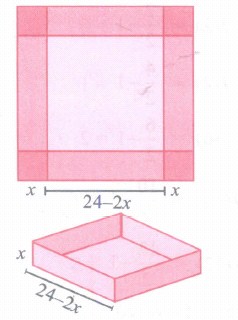
An open box is to be made from a square piece of material, 24 cm on a side, by cutting equal squares from the corners and turning up the sides as shown Fig. Express the volume V of the box as a function of x.
16.
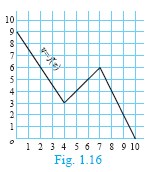
A graph representing the function f (x) is given in Fig it is clear that f (9) = 2.
(i) Find the following values of the function
(a) f(0)
(b) f(7)
(c) f(2)
(d) f(10)
(ii) For what value of x is f (x) = 1?
(iii) Describe the following (i) Domain (ii) Range.
(iv) What is the image of 6 under f ?
17.
At t minutes past 2 pm, the time needed to 3 pm is 3 minutes less than \(\frac {t^{2}}{4}\). Find t.
18.
A boat takes 1.6 hours longer to go 36 kms up a river than down the river. If the speed of the water current is 4 km per hr, what is the speed of the boat in still water?
19.
Find the HCF of 252525 and 363636
20.
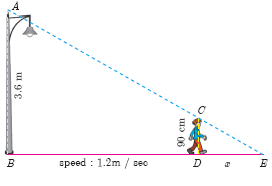
A boy of height 90cm is walking away from the base of a lamp post at a speed of 1.2m/sec. If the lamppost is 3.6m above the ground, find the length of his shadow cast after 4 seconds.
21.
Use Euclid’s Division Algorithm to find the Highest Common Factor (HCF) of
340 and 412
22.
Let A = {x \(\in \) W| x < 2}, B = {x \(\in \) N| 1 < x ≤ 4} and C = (3,5). Verify that
A x (B U C) = (A x B) U (A x C)
23.
If A = {5,6}, B = {4,5,6}, C = {5,6,7}, Show that A x A = (B x B) ∩ (C x C)
24.
Find the HCF of 396, 504, 636.
25.
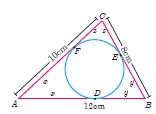
A circle is inscribed in \(\triangle\)ABC having sides 8 cm, 10 cm and 12 cm as shown in figure, find AD, BE and CF.
1.
\(\sqrt { \left( 6{ x }^{ 2 }+x-1 \right) \left( 3{ x }^{ 2 }+2x-1 \right) \left( 2{ x }^{ 2 }+3x+1 \right) } \)
= \(\sqrt { \left( 3x-1 \right) \left( 2x+1 \right) \left( 3x-1 \right) \left( x+1 \right) \left( 2x+1 \right) \left( x+1 \right) } \)
= |(3x - 1)(2x + 1)(x + 1)|
2.
\(A=\left[\begin{array}{rr} 3 & 1 \\ -1 & 2 \end{array}\right]\)
A2 = A.A
\(=\left[\begin{array}{rr} 3 & 1 \\ -1 & 2 \end{array}\right]\left[\begin{array}{rr} 3 & 1 \\ -1 & 2 \end{array}\right]\)
\(=\left[\begin{array}{rr} 9-1 & 3+2 \\ -3-2 & -1+4 \end{array}\right]=\left[\begin{array}{rr} 8 & 5 \\ -5 & 3 \end{array}\right]\)
\(5 A=5\left[\begin{array}{rr} 3 & 1 \\ -1 & 2 \end{array}\right]=\left[\begin{array}{rr} 15 & 5 \\ -5 & 10 \end{array}\right]\)
\(7 I_{2}=7\left[\begin{array}{ll} 1 & 0 \\ 0 & 1 \end{array}\right]=\left[\begin{array}{ll} 7 & 0 \\ 0 & 7 \end{array}\right]\)
\(\therefore A^{2}-5 A+7 I_{2}=\left[\begin{array}{rr} 8 & 5 \\ -5 & 3 \end{array}\right]-\left[\begin{array}{rr} 15 & 5 \\ -5 & 10 \end{array}\right]+\left[\begin{array}{ll} 7 & 0 \\ 0 & 7 \end{array}\right]\)
\(=\left[\begin{array}{cc} 8-15+7 & 5-5+0 \\ -5+5+0 & 3-10+7 \end{array}\right]\)
\(=\left[\begin{array}{ll} 0 & 0 \\ 0 & 0 \end{array}\right]=0\)
Hence Proved.
3.
Let A be the event of getting electrification contract
\(P(A)=\frac{3}{5}\)
Let B be the event of getting plumbing contract
\(
P(\bar{B}) =\frac{5}{8}
\)
\(1-P(B) =\frac{5}{8}
\)
\(P(B) =1-\frac{5}{8}=\frac{3}{8}
\)
\(Also\ P(A \cup B)=\frac{5}{7}\)
\(\mathrm{P}(A \cup B)=\mathrm{P}(\mathrm{A})+\mathrm{P}(\mathrm{B})-\mathrm{P}(A \cap B)
\)
\(\frac{5}{7} =\frac{3}{5}+\frac{3}{8}-\mathrm{P}(A \cap B)
\)
\(\mathrm{P}(A \cap B) =\frac{3}{5}+\frac{3}{8}-\frac{5}{7}
\)
\(=\frac{168+105-200}{280}=\frac{73}{280}
\)
Probability of getting both contracts \(=\frac{73}{280}\)
4.
When a, b, c are divided by 13 leaves the remainder 9, 7, 10 respectively
a = 13q1 + 9
b = 13q2 + 7
c = 13q3 + 10
Now a + 2b + 3c = (13q1 + 9) + 2 (13q2 + 7) + 3 (13q3 + 10)
= 13q1 + 9 + 26q2 + 14 + 39q3 + 30
= 13 (q1 + 2q2 + 3q3) + 53
= 13 (q1 + 2q2 + 3q3) + (4 x 13 + 1)
= 13 (q1 + 2q2 + 3q3 + 4) + 1
a + 2b + 3c is divided by 13, the remainder is 1.
5.
PQ = 20 m
PX - XQ = 4 m ...(1)
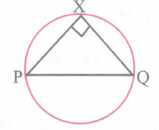
Squaring both sides,
PX2 + XQ2 - 2PX . QX = 16 (∵ PQ2-2P x QX = 16
400-16 = 2PX x QX
384 = 2PX· QX
\(\therefore { (PX+QX) }^{ 2 }=\underbrace { { PX }^{ 2 }+{ QX }^{ 2 } } +2PX.QX\)
= 400 + 2 x 192
= 784 = 282.
∴ PX + QX = 28
From(1) & (2)2 PX = 32 ⇒ PX = 16 m
QX = 12 m
∴ The distance from the two gates to the pole PX and QX is 12m, 16m
6.
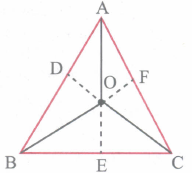
Let \(\triangle\)ABC be B triangle points D, E, F are angular bisectors of \(\angle A, \angle B \text { and } \angle C\) respectively. By angular bisector theorem we have
\( \frac{B D}{D C}=\frac{A B}{A C} \Rightarrow \mathrm{AB}=\frac{B D \times A C}{D C} \)
\(\frac{A C}{B C}=\frac{A F}{F B} \Rightarrow \mathrm{AC}=\frac{A F \times B C}{F B} \)
\(\frac{A E}{E C}=\frac{A B}{B C} \Rightarrow \mathrm{AB}=\frac{A E \times B C}{E C}\)
From (1) and (3), we have
\(\frac{B D \times A C}{D C}=\frac{A E \times B C}{E C}\)
Now substituting (2) in (4) we have
\( \frac{B D \times\left(\frac{A F \times B C}{F B}\right)}{D C} =\frac{A E \times B C}{E C} \)
\(\frac{B D \times A F \times B C}{D C \times F B} =\frac{A E \times B C}{E C} \)
\(B D \times A F \times E C =\frac{A E \times B C \times D C \times F B}{B C} \)
\(B D \times A F \times C E =E A \times F B \times D C \)
\(\therefore \frac{B D \times A F \times C E}{E A \times F B \times D C}=1\)
Hence by Ceva's theorem we conclude that the angle bisectors of a triangle are concurrent.
7.
Given equation is y = - 0.1 x + 1 where 'x' is time (in seconds) and 'y' is percentage of megabytes remaining.
Graph of y = -0.1x + 1
\(y=-\frac{x}{10}+1\)
10y = -x + 10
Points to be plotted
| x | 0 | 10 |
| y | 1 | 0 |
8.
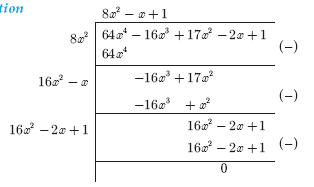
Therefore, \(\sqrt { 64{ x }^{ 2 }-16{ x }^{ 3 }+17{ x }^{ 2 }-2x+1 } \) = |8x2 - x + 1|
9.
Clearly the ladder AC make a right triangle with the wall AB force at a distance BC. \(\angle\)B - 90o
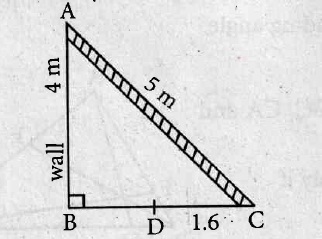
By Pythagoras theorem
AC2 = AB2 + BC2
52 = 42 + BC2
BC2 = 25 - 16
BC2 = 9
BC = 3m
If C moves 1.6 m towards the wall BC becomes
3m - 1.6m = 1.4m
Now in \(\triangle\)ABC
AC2 = AB2 + BC2
52 = AB2 +(1.4)2
25 - 1.96 = AB2
AB2 = 23.04
AB = 4.8m
The new height of the wall = 4.8 m
Difference =4.8 - 4 = -0.8m
The ladder would be placed 0.8 m upward the wall.
10.
From the figure,
slope = \(\frac { change\quad in\quad y\quad coordinate }{ change\quad is\quad x\quad coordinate } \)
=\(\frac { 68-32 }{ 20-0 } =\frac { 36 }{ 20 } =\frac { 9 }{ 5 } \)= 1.8
The line crosses the Y axis at (0, 32)
So the slope is \(\frac { 9 }{ 5 } \) and y intercept is 32.
11.
Here the value of n is not given. But the last term is given. From this, we can find the value of n.
Given a = 0.40 and l = 1, we find d = 0.43 - 0.40 = 0.03
Therefore, n = \(\left( \frac { l-a }{ d } \right) +1\)
= \(\left( \frac { 1-0.40 }{ 0.03 } \right) +1=21\)
Sum of first n terms of an A.P Sn = \(\frac { n }{ 2 } \left[ a+l \right] \)
Here, n = 21. Therefore, S21 = \(\frac { 21 }{ 2 } \left[ 0.40+1 \right] =14.7\)
So, the sum of 21 term of the given series is 14,7.
12.
f: [-5,9] ⟶ R
(i) f(-3) + f(2)
= [6(-3) + 1 ] + [ 5(2)2 - 1]
= ( -18 + 1) + ( 20 - 1)
= -17 + 19 = 2.
(ii) f(7) - f(1)
= [ 3(7) - 4 ] - [6(1) + 1 ]
= (21 - 4) - (6 + 1)
=17 - 7 = 10
(iii) 2 f(4) + f(8)
= 2 [ 5(4)2 - 1] + [3(8) - 4]
= 2[80 - 1] + [ 24 - 4]
= 158 + 20 = 178
(iv) \(\frac { 2f(-2)-f(6) }{ f(4)+f(-2) } \)
f(-2) = 6x + 1 = 6(-2) + 1 = -11
f(6) = 3x - 4 = 3(6) - 4 = 14
f(4) = 5x2 - 1 = 5(42) - 1 = 79
f(-2) = 6x + 1 = 6(-2) + 1 =-11
\(\frac { 2f(-2)-f(6) }{ f(4)+f(-2) } =\frac { 2(-11)-14 }{ 79+(-11) } =\frac { -22-14 }{ 68 } \)
= \(\frac { -36 }{ 68 } =\frac { -9 }{ 17 } \)
13.
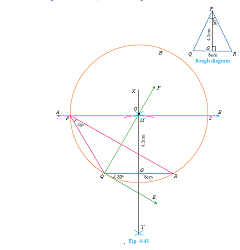
Construction
Step 1 : Draw a line segment QR = 5 cm.
Step 2 : At Q draw QE such that \(\angle\)RQE = 30o.
Step 3 : At Q draw QF such that \(\angle EQF\) = 90o
Step 4 : Draw the perpendicular bisector XY to QR which intersects QF at O and QR at G.
Step 5 : With O as centre and OQ as radius draw a circle.
Step 6: From G mark an arc in the line XY at M, such that GM = 42. cm.
Step 7 : Draw AB through M which is parallel to QR.
Step 8 : AB meets the circle at P and S.
Step 9 : Join QP and RP. Then\(\triangle\)PQR is the required triangle
14.
Let the present ages of Vani, her father and her grand father be x, y, z respectively
Given
\(\frac { x+y+z }{ 3 } =53\Rightarrow x+y+z=159\quad \quad ...(1)\)
\(\frac{z}{2}+\frac{y}{3}+\frac{x}{4}=65\)
6z + 4y + 3x = 780 ...(2)
(z - 4) = 4(x - 4)
4x - z = 12 ..........(3)
Consider (1) and (3
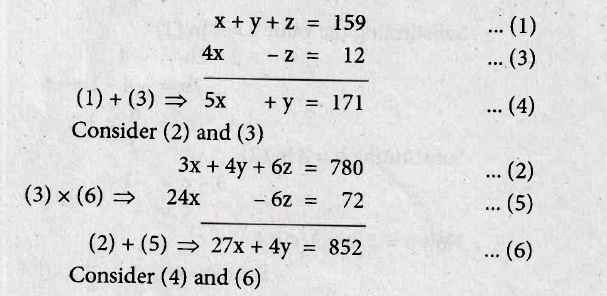
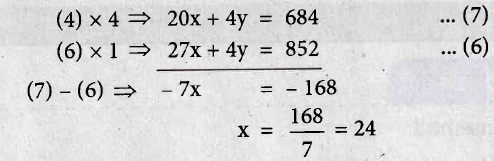
Substituting x = 24 in (4)
5(24) + y = 171
y = 171 - 120 = 51
Substituting x = 24, y = 51 in (1)
24 + 51 + z = 159
z = 159 - 75 = 84
Present age of Vani = 24 years
Present age of her father = 51 years
Present age of her grandfather = 84 years.
15.
From the diagram,
The solid is a cuboid volume of cuboid = length x breadth x height
where l = 24 - 2x, b - 24 - 2x,. h = x
Volume V (x) = (24 - 2x) (24 - 2x) x
V(x) = x(24 - 2x)2, x > 0
= 4x3 - 96x2 + 576x, x > 0
So, the domain is 0 < x < 12
16.
(i) From the given graph
(a) f(0) = 9
(b) f(7) = 6
(c) = f(2)
(d) = f(10) = 0
(ii) From the graph, it is known that
when x = 9.5, f(x) = 1
(iii) (a) Domain = {x|0 ≤ x ≤ 10, x \(\in \) R}
(b) Range = {x|0 ≤ x ≤ 9, x \(\in \) R}
(iv) The image of '6' under f is '5'.
17.
\(60-t=\frac { { t }^{ 2 } }{ 4 } -3\)
⇒ t2-12 = 240-4t
⇒ t2+4t-252 = 0
⇒ t2+18t-14t-252 = 0
⇒ t(t +18)-14(t +18) = 0
⇒ (t +18)(t-14) = 0
∴ t = 14 or t = -18 is not possible
18.
Let the speed of boat in still water be 'v'
\(\because speed=\frac { distance }{ time } \Rightarrow time=\frac { distance }{ speed } \)
\(\therefore \frac { 36 }{ v-4 } -\frac { 36 }{ v+4 } =\frac { 96 }{ 60 } =\frac { 8 }{ 5 } (\because 1.6hrs=\frac { 96 }{ 60 } )\)
\(\Rightarrow 36(v+4)-36(v-4)=\frac { 8 }{ 5 } (v-4)(v+4)\)
\(\Rightarrow 36v+144-36v+144=\frac { 8 }{ 5 } ({ v }^{ 2 }+4v+4v-16)\)
\(\Rightarrow 288=\frac { 8 }{ 5 } { v }^{ 2 }-\frac { 128 }{ 5 } \Rightarrow 8{ v }^{ 2 }-128=1440\)
\(\Rightarrow 8{ v }^{ 2 }=1568\Rightarrow { v }^{ 2 }=196{ v }^{ 2 }=\pm 14\)
∴ Speed of the boat = 144m/hr.
(∵ speed cannot be -ve)
19.
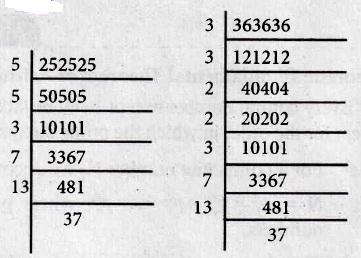
252525 = 31 x 52 x 71 x 131 x 371
363636 = 22 x 33 x 71 x 131 x 371
H.C.F. = 31 x 71 x 131 x 371
= 3 x 3367
= 10101
20.
Given, Speed = 1.2 m/s,
time = 4 seconds
Distance = speed x time
= 1.2 x 4
= 4.8 m
Let x be the length of the shadow after 4 seconds
\(\Delta ABE\sim \Delta CDE,\frac { BE }{ DE } =\frac { AB }{ CD } \) gives \(\frac { 4.8+x }{ x } =\frac { 3.6 }{ 0.9 } =\frac { 3.6 }{ 0.9 } =4\) (since 90 cm = 0.9 m)
4.8 + x = 4x, gives 3x = 4.8 so, x = 1.6m
The length of his DE = 1.6m
21.
To find the H.C.F. of (340 , 412)
412 > 340 = H.C.F. (412, 340)
Using Euclid's division algorithm we have
412 = 340 x 1 + 72
The remainder 72 ≠ 0
Again applying Euclid's division algorithm
340 = 72 x 4 + 52
The remainder 52 ≠ 0.
Again applying Euclid's division algorithm
72 = 52 x 1 + 20
The remainder 20 ≠ 0.
Again applying Euclid's division algorithm,
52 = 20 x 2 + 12
The remainder 12 ≠ 0.
Again applying Euclid's division algorithm.
20 = 12 x 1 + 8
The remainder 8 ≠ 0.
Again applying Euclid's division algorithm
12 = 8 x 1 + 4
The remainder 4 ≠ 0.
Again applying Euclid's division algorithm
8 = 4 x 2+0
The remainder is 0.
Therefore H.C.F. of 340 and 412 is 4.
22.
Given A = {x \(\in \) W| x < 2} A = {0,1}
B = {x \(\in \) N| 1 < x ≤ 4} B = {2,3,4}
C = {3,5}
A x (B U C) = (A x B) U (A x C)
\(B\cup C\) = {2,3,4,5}
A x (B U C) = {0,1} x {2,3,4,5}
= {{0,2},(0,3),(0,4),(0,5),(1,2),(1,3),(1,4),(1,5)} ...(1)
A x B = {0,1} x {2,3,4}
= {(0,2),(0,3),(0,4),(1,2),(1,3),(1,4)}
A x C = {0,1} x {3,5}
= {{0,3},(0,5),(1,3),(1,5)}
\((A\times B)\cup (A\cup C)\) = {(0,2),(0,3),(0,4),(0,5),(1,2),(1,3),(1,4),(1,5)} ...(2)
From (1) and (2),it is clear that
\(A\times (B\cup C)=(A\times B)\cup (A\times C)\)
Hence verified
23.
Given A = {5,6} , B = {4,5,6} , C = {5,6,7}
L.H.S: A x A = {5,6} x {5,6}
= {(5,6),(5,6),(6,5),(6,6)}
R.H.S: B x B = {4,5,6} x {4,5,6}
= {(4,4),(4,5),(4,6),(5,4),(5,5),(5,6),(6,4),(6,5),(6,6)}
C x C = {5,6,7} x {5,6,7}
= {(5,5),(5,6),(5,7),(6,5),(6,6),(6,7),(7,5),(7,6),(7,7)}
(B x B) ∩ (C x C) = {(5,5),(5,6),(6,5),(6,6)}
LHS = RHS
A x A = (B x B) ∩ (C x C)
Hence proved
24.
To find HCF of three given numbers, first we have to find HCF of the first two numbers.
To find HCF of 396 and 504
Using Euclid’s division algorithm we get 504 = 396 x 1 + 108
The remainder is 108 \(\neq \) 0
Again applying Euclid’s division algorithm 396 = 108 x 3 + 72
The remainder is 72 \(\neq \) 0
Again applying Euclid’s division algorithm 108 = 72 x 1 + 36
The remainder is 36 \(\neq \) 0
Again applying Euclid division algorithm 72 = 36 x 2 + 0
Here the remainder is zero. Therefore HCF of 396 , 504 = 36, To find the HCF of 636 and 36
Using Euclid’s division algorithm we get 636 = 36 x 17 + 24
The remainder is 24 \(\neq \) 0
Again applying Euclid's division algorithm 36 = 24 x 1 + 12
The remainder is 12 \(\neq \) 0
Again applying Euclid's division algorithm 24 = 12 x 2 + 0
Here the remainder is zero. Therefore HCF of 636,36 = 12
Therefore Highest Common Factor of 396, 504 and 636 is 12.
25.
We know that the tangents drawn from are external point to a circle are equal.
Therefore AD AF = x
BD = BE = y
and CE = CF = z
Now, AB = 12 cm, BC = 8 cm, and CA = 10 cm.
x + y = 12,y + z = 8 and z + x = 10
(x + y) + (y + z) + (z + x) = 12 + 8 + 10
2(x + y + z) = 30
x+ y + z = 15
Now, x + y = 12 and x + y + z = 15
12 + z = 15
Z = 3
y + z = 8 and x + y + z = 15
\(x+8=15\Rightarrow x=7\)
and z + x = 10 and x + y + z = 15
\(10+y=15\Rightarrow y=5\)
Hence, AD = x = 7cm,
BE = y = 5 cm and
CF = z = 3 cm

10th Standard Syllabus & Materials
10th Standard
TN 10th English Prose - 2 - The Night the Ghost Got in Important Questions And Answers Study Material - QB365 Set A
NEW10th Standard
TN 10th English Supplementary - 1 - The Tempest Important Questions And Answers Study Material - QB365 Set A
NEW10th Standard
TN 10th English Poem - 1 - Life Important Questions And Answers Study Material - QB365 Set A
NEW10th Standard
TN 10th English Prose - 1 - His First Flight Important Questions And Answers Study Material - QB365 Set A



Tamilnadu Stateboard 10th Standard Subjects
Tamilnadu Stateboard Standards





