
 100% FREE ACCESS
10th Standard Syllabus & Materials
10th Standard
TN 10th English Prose - 4 - The Attic Important Questions And Answers Study Material - QB365 Set A
NEW10th Standard
TN 10th English Supplementary - 3 - The Story of Mulan Important Questions And Answers Study Material - QB365 Set A
NEW10th Standard
TN 10th English Poem - 3 - I am Every Woman Important Questions And Answers Study Material - QB365 Set A
NEW10th Standard
TN 10th English Prose - 3 - Empowered Women Navigating The World Important Questions And Answers Study Material - QB365 Set A
NEW10th Standard
TN 10th English Supplementary - 2 - Zigzag Important Questions And Answers Study Material - QB365 Set A
NEW10th Standard
TN 10th English Poem - 2 - The Grumble Family Important Questions And Answers Study Material - QB365 Set A

Published on: 13/05/2022
QB365 provides detailed and simple solution for every book back questions in class 10 Maths subject.It will helps to get more idea about question pattern in every book back questions with solution.
latest Book back QuestionsDownload Tamil Nadu 10th Standard Maths question papers, model tests, one-mark questions, important questions, and public exam papers in PDF format. Free study materials and answer keys for TN State Board students.
Questions + Answers key
Take MCQ Maths Test1.
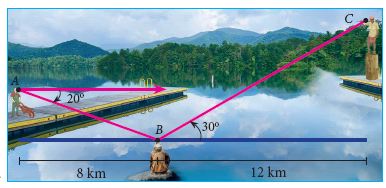
Three villagers A, B and C can see each other across a valley. The horizontal distance between A and B is 8 km and the horizontal distance between B and C is 12 km. The angle of depression of B from A is 20° and the angle of elevation of C from B is 30° . Calculate the vertical height between B and C (tan20° = 0.3640,(\(\sqrt { 3 } \)=1.732)
2.
If α, β are the roots of the equation 2x2 - x - 1 = 0, then form the equation whose roots are
2α + β, 2β + α
3.
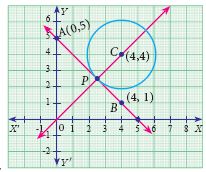
The line joining the points A(0,5) and B(4,1) is a tangent to a circle whose centre C is at the point (4, 4) find The coordinates of the point of contact of tangent line AB with the circle
4.
If A = \(\left[ \begin{matrix} 1 & 2 & 1 \\ 2 & -1 & 1 \end{matrix} \right] \) and B = \(\left[ \begin{matrix} 2 & -1 \\ -1 & 4 \\ 0 & 2 \end{matrix} \right] \) show that (AB)T = BTAT
5.
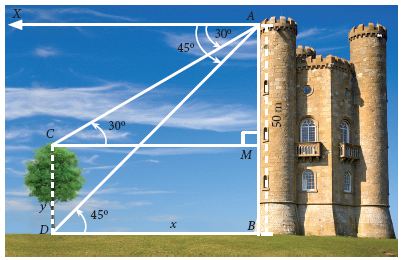
From the top of a tower 50 m high, the angles of depression of the top and bottom of a tree are observed to be 30° and 45° respectively. Find the height of the tree.(\(\sqrt { 3 } \) = 1.732)
6.
The measurements of the diameters (in cms) of the plates prepared in a factory are given below. Find its standard deviation.
| Diameter(cm) | 21-24 | 25-28 | 29-32 | 3-6 | 37-40 | 41-44 |
| Number of plates | 15 | 18 | 20 | 16 | 8 | 7 |
7.
Three villagers A, B and C can see each other across a valley. The horizontal distance between A and B is 8 km and the horizontal distance between B and C is 12 km. The angle of depression of B from A is 20° and the angle of elevation of C from B is 30° . Calculate : the vertical height between A and B.(tan20° = 0.3640,(\(\sqrt { 3 } \) = 1.732)
8.
A traveler approaches a mountain on highway. He measures the angle of elevation to the peak at each milestone. At two consecutive milestones the angles measured are 4° and 8°. What is the height of the peak if the distance between consecutive milestones is 1 mile. (tan4° =0.0699, tan8° =0.1405)
9.
To a man standing outside his house, the angles of elevation of the top and bottom of a window are 60° and 45° respectively. If the height of the man is 180 cm and if he is 5 m away from the wall, what is the height of the window?(\( \sqrt { 3 } \) = 1.732)
10.
The line joining the points A(0,5) and B(4,1) is a tangent to a circle whose centre C is at the point (4,4) Find the equation of the line AB.
11.
An oil funnel of tin sheet consists of a cylindrical portion 10 cm long attached to a frustum of a cone. If the total height is 22 cm, the diameter of the cylindrical portion be 8cm and the diameter of the top of the funnel be 18 cm, then find the area of the tin sheet required to make the funnel.
12.
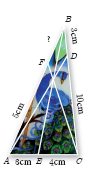
An artist has created a triangular stained glass window and has one strip of small length left before completing the window. She needs to figure out the length of left out portion based on the lengths of the other sides as shown in the figure.
13.
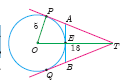
In figure, O is the centre of the circle with radius 5 cm. T is a point such that OT = 13 cm and OT intersects the circle E, if AB is the tangent to the circle at E, find the length of AB
14.
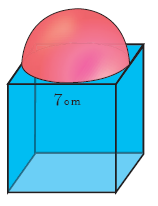
As shown in figure a cubical block of side 7 cm is surmounted by a hemisphere. Find the surface area of the solid.
15.
Find the values of a and b if the following polynomials are perfect squares
4x4 - 12x3 + 37x2 + bx + a
16.
prove the following identities.
\(\frac { sinA-sinB }{ cosA+cosB } +\frac { cosA-cosB }{ sinA+sinB } =0\)
17.
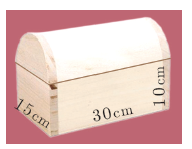
A jewel box is in the shape of a cuboid of dimensions 30 cm x 15 cm x 10 cm surmounted by a half part of a cylinder as shown in the figure. Find the volume and T.S.A. of the box.
18.
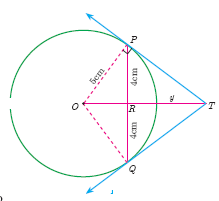
PQ is a chord of length 8 cm to a circle of radius 5 cm. The tangents at P and Q intersect at a point T. Find the length of the tangent TP.
19.
Calculate the mass of a hollow brass sphere if the inner diameter is 14 cm and thickness is 1mm, and whose density is 17.3 g/ cm3.
20.
To get from point A to point B you must avoid walking through a pond. You must walk 34 m south and 41 m east. To the nearest meter, how many meters would be saved if it were possible to make a way through the pond?
21.
Simplify
\(\frac { 4{ x }^{ 2 }y }{ 2{ x }^{ 2 } } \times \frac { 6x{ z }^{ 3 } }{ 20{ y }^{ 4 } } \)
22.
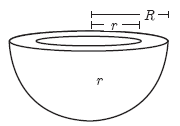
The internal and external radii of a hollow hemispherical shell are 3 m and 5 m respectively. Find the T.S.A. and C.S.A. of the shell.
23.
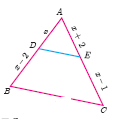
In \(\triangle\) ABC, if DE||BC, AD = x, DB = x − 2, AE = x +2 and EC = x − 1 then find the lengths of the sides AB and AC.
24.
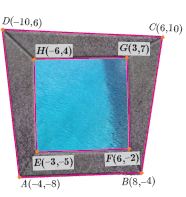
In the figure, the quadrilateral swimming pool shown is surrounded by concrete patio. Find the area of the patio.
25.
Solve \(\sqrt { y+1 } +\sqrt { 2y-5 } \) = 3
1.
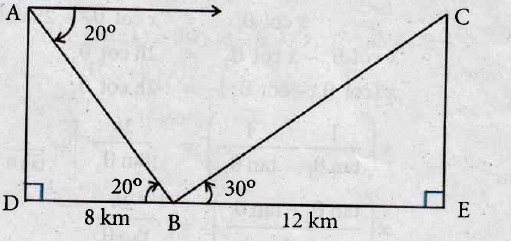
In the right \(\triangle\)CEB
\(
\tan 30^{\circ} =\frac{C E}{B E}
\)
\(\frac{1}{\sqrt{3}} =\frac{C E}{12}
\)
\(C E =\frac{12}{\sqrt{3}}
\)
\(=\frac{12 \sqrt{3}}{\sqrt{3} \sqrt{3}}
\)
\(=\frac{12 \times 1.732}{3}=4 \times 1.732
\)
= 6.928
= 6.93 km
Vertical height between B and C = 6.93 km.
2.
2x2 - x - 1 = 0 here, a = 2, b = -1, c = -1
α + β = \(\frac {-b}{a} = \frac {-(-1)}{2} = \frac {1}{2}\), αβ = \(\frac {c}{a} = -\frac {1}{2}\)
2α + β, 2β + α
Sum of the roots 2α + β + 2β + α = 3(α + β) = \(3\left( \frac { 1 }{ 2 } \right) =\frac { 3 }{ 2 } \)
Product of the roots = (2α + β) (2β + α) = 4αβ + 2α2 + 2β2 + αβ
= 5αβ + 2(α2 + β2) = 5αβ + 2[(α + β)2 - 2αβ]
= \(5\left( -\frac { 1 }{ 2 } \right) +2\left[ \frac { 1 }{ 4 } -2\times -\frac { 1 }{ 2 } \right] \) = 0
The required equation is x2 - (Sum of the roots)x + (Product of the roots) = 0
x2 - \(\frac { 3 }{ 2 } x\) + 0 = 0 gives 2x2 - 3x = 0
3.
The coordinate of the point of contact P of the tangent line AB with the circle is point of intersection of line.
x + y − 5 = 0 and x − y = 0
solving, we get x = \(\frac { 5 }{ 2 } \) and y = \(\frac { 5 }{ 2 } \)
Therefore, the coordinate of the P\(\left( \frac { 5 }{ 2 } ,\frac { 5 }{ 2 } \right) \)
4.
LHS = (AB)T
AB = \({ \left[ \begin{matrix} 1 & 2 & 1 \\ 2 & -1 & 1 \end{matrix} \right] }_{ 2\times 3 }\times { \left[ \begin{matrix} 2 & -1 \\ -1 & 4 \\ 0 & 2 \end{matrix} \right] }_{ 3\times 2 }\)
= \(\left[ \begin{matrix} 2-2+0 & -1+8+2 \\ 4+1+0 & -2-4+2 \end{matrix} \right] =\left[ \begin{matrix} 0 & 9 \\ 5 & -4 \end{matrix} \right] \)
(AB)T = \({ \left[ \begin{matrix} 0 & 9 \\ 5 & -4 \end{matrix} \right] }^{ T }=\left[ \begin{matrix} 0 & 5 \\ 9 & -4 \end{matrix} \right] \) ....(1)
RHS = (BTAT)
BT = \(\left[ \begin{matrix} 2 & -1 & 0 \\ -1 & 4 & 2 \end{matrix} \right] \), AT = \(\left[ \begin{matrix} 1 & 2 \\ 2 & -1 \\ 1 & 1 \end{matrix} \right] \)
BTAT = \({ \left[ \begin{matrix} 2 & -1 & 0 \\ -1 & 4 & 2 \end{matrix} \right] }_{ 2\times 3 }\times { \left[ \begin{matrix} 1 & 2 \\ 2 & -1 \\ 1 & 1 \end{matrix} \right] }_{ 3\times 2 }\)
= \(\left[ \begin{matrix} 2-2+0 & 4+1+0 \\ -1+8+2 & -2-4+2 \end{matrix} \right] \)
BTAT = \(\left[ \begin{matrix} 0 & 5 \\ 9 & -4 \end{matrix} \right] \)...(2)}
From (1) and (2), (AB)T = BTAT.
Hence proved.
5.
The height of the tower AB = 50 m
Let the height of the tree CD = y and BD = x
From the diagram,\(\angle \)XAC = 30° = \(\angle \)ACM and\(\angle \) = XAD = 45° =\(\angle \) ADB
In right triangle ABD,
tan45° = \(\frac { AB }{ BD } \)
1 = \(\frac { 50 }{ x } \) gives x = 50 m
In right triangle AMC,
tan30° = \(\frac { AM }{ CM } \)
\(\frac { 1 }{ \sqrt { 3 } } =\frac { AM }{ 50 } \)[since DB = CM]
AM = \(\frac { 50 }{ \sqrt { 3 } } =\frac { 50\sqrt { 3 } }{ 3 } =\frac { 50\times 1.732 }{ 3 } \) = 28.87 m.
Therefore, height of the tree = CD = MB = AB − AM = 50 – 28.87 = 21.13 m
6.
Let the assumed mean A = 34.5
| Diameter (cm) | Mid (value) xi | fi | \(\mathrm{d}_{\mathrm{i}} =\frac{x_{i}-A}{2}
\) \(\mathrm{~d}_{\mathrm{i}} =\frac{x_{i}-34.5}{2} \) |
fidi | \({ d }_{ i}^{ 2 }\) | \({ f }_{ i }{ d }_{ i }^{ 2 }\) | |
|---|---|---|---|---|---|---|---|
| 20.5-24.5 | 22.5 | 15 | -6 | -90 | 36 | 540 | |
| 24.5-28.5 | 26.5 | 18 | -4 | -72 | 16 | 288 | |
| 28.5-32.5 | 30.5 | 20 | -2 | -40 | 4 | 80 | |
| 32.5-36.5 | 34.5 | 16 | 0 | 0 | 0 | 0 | |
| 36.5-40.5 | 38.5 | 8 | 2 | 16 | 4 | 32 | |
| 40.5-44.5 | 42.5 | 7 | 4 | 28 | 16 | 112 | |
| \(\Sigma f_{i}\) = N = 84 | \(\Sigma f_{i} d_{i}\) = -158 | \(\Sigma f_{1} d_{i}^{2}\) = 1052 | |||||
Standard deviation \(\sigma=C \times \sqrt{\frac{\Sigma f_{i} d_{i}^{2}}{N}-\left(\frac{\Sigma f_{i} d_{i}}{N}\right)^{2}}
\)
\(\sigma=2 \times \sqrt{\frac{1052}{84}-\left(\frac{-158}{84}\right)^{2}}
\)
\(\sigma=2 \times \sqrt{\frac{22092}{1764}-\frac{6241}{1764}}
\)
\(\sigma=2 \times \sqrt{\frac{15851}{1764}}=2 \times \sqrt{8.98}
\)
\(\sigma=2 \times 2.99 \simeq 5.99
\)
Standard deviation \(\sigma \simeq 5.99 \simeq 6\)
7.
In the right \(\triangle\)ADB
\( \tan 20^{\circ} =\frac{A D}{D B} \)
\(0.3640 =\frac{A D}{8}\)
AD = 8 x 0.3640 = 2.91 km
Vertical height between A and B = 2.91 km
8.
Let AB denote the height of the peak and be 'h'.
In ΔABC,
tan 8o = \(\frac { AB }{ BC } =\frac { h }{ m } \)
m = \(\frac { AB }{ BC } =\frac { h }{ m } \) ...(1)
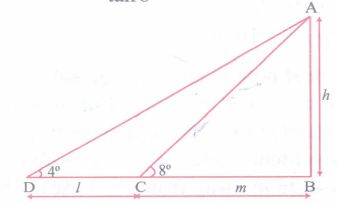
In Δ ABC,
tan 40o =\(\frac { AB }{ BC } =\frac { h }{ m } \)
m+1 = \(\frac { h }{ tan4 } \) ..(2)
From (1) and (2)
\(\frac { h }{ tan8 } +1=\frac { h }{ tan4 } \)
\(1=\frac { h }{ tan4 } -\frac { h }{ tan8 } \)
\(h\left[ \frac { tan8-tan4 }{ tan4tan8 } \right] =1\)
h = \(\frac { tan4\times tan8 }{ tan8-tan4 } \)
= 0.14 mile (approx)
9.
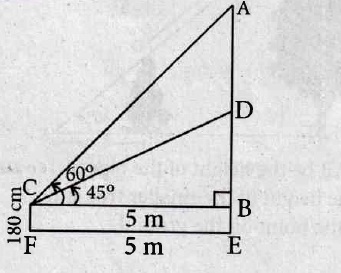
Let CF be the height of the man; AD be the height of the window; BC is the distance between the observer and the house.
From the right triangle \(\triangle\)CBD
\( \tan 45^{\circ} =\frac{D B}{B C} \)
\(1 =\frac{D B}{5} \)
DB = 5m ...(1)
From the right triangle CBA
\( \tan 60^{\circ} =\frac{A B}{C B} \)
\(\sqrt{3} =\frac{A D+D B}{5} \)
\(5 \sqrt{3} =\mathrm{AD}+5 \quad[\because \text { from }(1) D B=5 \mathrm{~m}] \)
\(\mathrm{AD} =5 \sqrt{3}-5=5(\sqrt{3}-1) \)
\(\mathrm{AD} =5(1.732-1) \)
\( {[\text {Given } \sqrt{3}=1.732] }\)
= 5 x 0.732 = 3.660
Height of the window = 3.66 m
10.
Equation of line AB, A(0, 5) and B(4,1)
\(\frac { { y-y }_{ 1 } }{ { y }_{ 2 }-{ y }_{ 1 } } =\frac { { x-x }_{ 1 } }{ { x }_{ 2 }-{ x }_{ 1 } } \)
\(\frac { y-5 }{ 1-5 } =\frac { x-0 }{ 4-0 } \)
4(y - 5) = -4x gives y - 5 = - x
x + y - 5 = 0
11.
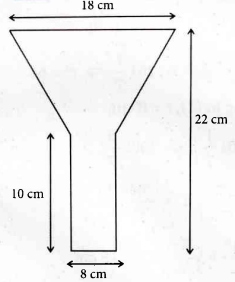
Area of tin sheet required
= C.S.A of cylinder + C.S.A of frustum
Cylinder:
Radius = 4 cm
Height = 10 cm
C.S.A \(=2 \pi r h\ sq. units \)
\(=2 \times \frac{22}{7} \times 4 \times 10=\frac{1760}{7}\ sq. units\)
Frustum of a cone
r1 = radius of top = 9 cm
r2 = radius of bottom = 4 cm
Height = 22 - 10 = 12 cm
Slant height \(l =\sqrt{h^{2}+\left(r_{1}-r_{2}\right)^{2}} \)
\(=\sqrt{12^{2}+(9-4)^{2}} \)
\(=\sqrt{144+25}=\sqrt{169}=13 \mathrm{~cm} \)
C.S.A \(=\pi\left(r_{1}+r_{2}\right) l \text { sq, units } \)
\(=\frac{22}{7}(9+4)(13) \)
\(=\frac{3718}{7} \text { sq. units } \)
Area of tin sheet \(=\frac{1760}{7}+\frac{3718}{7}\)
\(=\frac{5478}{7}=782.57 \mathrm{~cm}^{2}\)
12.
Clearly In \(\triangle\)ABC, D, E, F are points on lines BC, CA, AB respectively using Ceva's theorem, we have
\(\frac{A E}{E C} \times \frac{C D}{D B} \times \frac{B F}{F A}=1\) ...(1)
From the diagram it is clear that
AE = 3, EC = 4, CD = 10, DB = 3, FA = 5
Substituting these values in (1)
\(
\frac{3}{4} \times \frac{10}{3} \times \frac{B F}{5} =1
\)
\(B F =\frac{1 \times 4 \times 3 \times 5}{3 \times 10}=2 \mathrm{~cm}\)
13.
Since OP is the radius and PT tangent
\(\angle O P T=90^{\circ}\)
Applying Pythagoras theorem in \(\triangle\)OPT, we have
OT2 = OP2 + PT2
132 = 52 + PT2
PT2 = 169 - 25
PT2 = 144
PT = 12cm
Since the lengths of tangents drawn from an exterior point to a circle are equal.
AP = AE = x(say)
AT = PT - AP = (12-x)cm
Since AB is the tangent to the circle at E
\( \therefore \mathrm{OE} \perp \mathrm{AB} \)
\(\ \Rightarrow \angle O E A =90^{\circ} \)
\(\\ \Rightarrow \angle A E T =90^{\circ}\)
\( \\ \mathrm{AT}^{2} =\mathrm{AE}^{2}+\mathrm{ET}^{2}\)
[Applying Pythagoras theorem in \(\triangle\)AET ]
(12 - x)2 = x2 +(13 -5)2
144 - 24 + x2 = x2 +64
24x = 144 - 64
24x = 80
3x = 10
\( x=\frac{10}{3} \mathrm{~cm} \)
\(Similarly\ B E=\frac{10}{3} \mathrm{~cm}\)
AB = AE + BE
\( =\left(\frac{10}{3}+\frac{10}{3}\right) \mathrm{cm} \)
\(A B =\frac{20}{3} \mathrm{~cm}\)
14.
Edge of cube = 7 cm
surface area of a cube = 6a2 sq. units
= 6(7)2
= 294 cm2
radius of hemisphere = \(\frac{7}{2} \mathrm{~cm}\)
[Only C.S.A is considered as the hemisphere surmounted]
C.S.A of hemisphere \(=2 \pi r^{2} \text { sq. units } \)
\(=2 \times \frac{22}{7} \times \frac{7}{2} \times \frac{7}{2} \)
= 77 Cm2
Surface area of = T.S.A of cube + C.S.A the solid of hemisphere area of circular region (bottom of hemisphere)
\(=294+77-\left(\frac{22}{7} \times \frac{7}{2} \times \frac{7}{2}\right)\)
= 371 - 38.5
= 332.5 cm2
15.
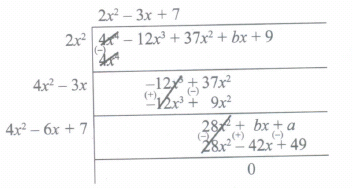
b=-42
a=49
16.
\(\frac { sinA-sinB }{ cosA+cosB } +\frac { cosA-cosB }{ sinA+sinB } =0\)
\(\mathrm{LHS}=\frac{\sin A-\sin B}{\cos A+\cos B}+\frac{\cos A-\cos D}{\sin A+\sin B}
\)
\(=\frac{(\sin A-\sin B)(\sin A+\sin B)+(\cos A-\cos B)(\cos A+\cos B)}{(\cos A+\cos B)(\sin A+\sin B)}
\)
\(=\frac{\left(\sin ^{2} A-\sin ^{2} B\right)+\left(\cos ^{2} A-\cos ^{2} B\right)}{(\cos A+\cos B)(\sin A+\sin B)}
\)
\(=\frac{\sin ^{2} A-\sin ^{2} B+\cos ^{2} A-\cos ^{2} B}{(\cos A+\cos B)(\sin A+\sin B)}
\)
\(=\frac{\left(\sin ^{2} A+\cos ^{2} A\right)-\left(\sin ^{2} B+\cos ^{2} B\right)}{(\cos A+\cos B)(\sin A+\sin B)}
\)
\(=\frac{1-1}{(\cos A+\cos B)(\sin A+\sin B)}
\)
\(=\frac{0}{(\cos A+\cos B)(\sin A+\sin B)}=0=\mathrm{RHS}\)
17.
Let l, b and h1 be the length, breadth and height of the cuboid. Also let us take r and h2 be the radius and height of the cylinder.
Now, Volume of the box = Volume of the cuboid + \(\frac{1}{2}\) (Volume of cylinder)
\((l\times b\times { h }_{ 1 })+\frac { 1 }{ 2 } ({ \pi r }^{ 2 }{ h }_{ 2 })cu.units\)
\(=\left( 30\times 15\times 10 \right) +\frac { 1 }{ 2 } \left( \frac { 22 }{ 7 } \times \frac { 15 }{ 2 } \times 30 \right) \)
= 4500 + 2651.79 = 7151. 79
Therefore, Volume of the box = 7151.79 cm3
18.
Let TR = y. Since, OT is perpendicular bisector of PQ
PR = QR = 4 cm
In\(\triangle\)ORP, OP2 = OR2 + PR2
OR2 = OP2 - PR2
OR2 = 52 - 42 = 25 - 16 = 9 \(\Rightarrow\) OR = 3cm
OT = OR + RT = 3 + y ..(1)
In \(\triangle\)PRT, TP2 + TR2 + PR2 ..(2)
and \(\triangle\)OPT we have, OT2 = TP2 + OP2
OT2 = (TR2 + PR2) + OP2 (substitute for TP2 from (2))
(3 + y)2 = y2 + 42 + 52 (substitute for OT from (1))
9 + 6y2 + 16 + 25 therefore \(y=TR=\frac { 16 }{ 3 } \)
6y = 41 - 9 we get \(y=\frac { 16 }{ 3 } \)
From (2), TP2 = TR2 + PR2
\(TP2=\left( \frac { 16 }{ 3 } \right) +4^{ 2 }=\frac { 256 }{ 9 } +16=\frac { 400 }{ 9 } \)so, \(TP=\frac { 20 }{ 3 } \)
19.
Let r and R be the inner and outer radii of the hollow sphere.
Given that, inner diameter d = 14 cm; inner radius r = 7 cm; thickness = 1 mm = \(\frac{1}{10}\)cm
Outer radius R = 7 + \(\frac { 1 }{ 10 } =\frac { 71 }{ 10 } =7.1cm\)
Volume of hollow sphere \(=\frac { 4 }{ 3 } \pi \left( { R }^{ 3 }-{ r }^{ 3 } \right) cu.cm\)
\(=\frac { 4 }{ 3 } \times \frac { 22 }{ 7 } (357.91-343)=62.48cm^{ 3 }\)
But, weight of brass in 1 cm3 = 17.3 gm
Total weight = 17362 x 62.48 = 1080.90 gm
Therefore, total weight is 1080.90 grams.
20.
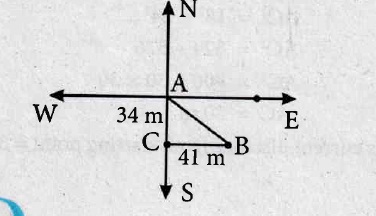
Let A be the starting position and 'B' be the final position. C be the position south of A at 34 m distance.
Clearly C = 90o in \(\triangle\)ACB
AC2 + CB2 = AB2
[By Pythagoras theorem]
342 + 412 = AB2
1156 + 1681 = AB2
2837 = AB2
AB = 53.26 m
Distance from A to B through the pond = 53.26 m
Distance through C = 34m + 41 m = 75 m
Difference = 75 - 53.26 = 21.74 m
21.74 m would be saved if it is possible to walk through the pond.
21.
\(\frac { 4{ x }^{ 2 }y }{ 2{ x }^{ 2 } } \times \frac { 6x{ z }^{ 3 } }{ 20{ y }^{ 4 } } =\frac { { 3x }^{ 3 }z }{ 5{ y }^{ 3 } } \)
22.
Let the internal and external radii of the hemispherical shell be r and R
respectively.
Given that, R = 5 m, r = 3 m
C.S.A. of the shell = 2\(\pi\)(R2 + r2) sq. units
\(=2\times \frac { 22 }{ 7 } \times \left( 25+9 \right) =213.71\)
T.S.A. of the shell = \(\pi\)(3R2 + r2) sq. units
\(=\frac { 22 }{ 7 } (75+9)=264\)
Therefore, C.S.A. = 213.71 m2 and T.S.A. = 264 m2.
23.
In \(\triangle\) ABC we have DE || BC.
By Thales theorem, we have \(\frac { AD }{ DB } =\frac { AE }{ EC } \)
\(\frac { x }{ x-2 } =\frac { x+2 }{ x-1 } \) gives x(x - 1) = (x - 2)(x + 2)
When x = 4, AD = 4, DB = x - 2, AE + x + 2 = 6, EC = x - 1 = 3
Hence, AB = AD + DB = 4 + 2 = 6, AC = AE + EC = 6 + 3 = 9
Therefore, AB = 6, AC = 9
24.
Area of the patio = Area of the quadrilateral ABCD - Area of the swimming pool EFGH
Area of Quadrilateral ABCD
A(- 4,- 8), B (8, - 4), C (6, 10) and D ( - 10, 6)
\(\text { Area } =\frac{1}{2}\left[\left(x_{1}-x_{3}\right)\left(y_{2}-y_{4}\right)-\left(x_{2}-x_{4}\right)\left(y_{1}-y_{3}\right)\right]
\)
\(= \frac{1}{2}[(-4-6)(-4-6)-(8+10)(-8-10)]
\)
\(= \frac{1}{2}[100+324]=\frac{424}{2}=212 \text { sq. units }
\)
Area of Quadrilateral EFGH
E (- 3, - 5), F (6,- 2),G (3, 7) and H (- 6, 4)
Area \(=\frac{1}{2}[(-3,-3)(-2-4)-(6+6)(-5-7)]
\)
\(=\frac{1}{2}[36+144]=\frac{180}{2}=90 \text { sq. units }
\)
Area of patio = Area of quadrilateral ABCD - Area of Quadrilateral EFGH
= 212 - 90 = 122 sq. units
25.
Squaring both sides(\(\sqrt { y+1 } +\sqrt { 2y-5 } \) )2 = 32
y+1+2y-5+2(\(\sqrt { y+1 } +\sqrt { 2y-5 } \)) = 9
3y-4-9 = -2\(\sqrt { y+1 } +\sqrt { 2y-5 } \)
Again squaring both sides
(3y-13)2(-2\(\sqrt { y+1 } +\sqrt { 2y-5 } \))2
9y2-78y+169 = 4(y+1)(2y-5)
9y2-78y+169 = 4(2y2+2y-5y-5)
9y2-78y+169 = 8y2+8y-20y-20
9y2-78y+169-8y2+12y+20 = 0
y2-66y+189 = 0
y2-63-3y+189 = 0
y(y-63)-3(y-63) = 0
(y-63)(y-3) = 0
y = 63, 3

10th Standard Syllabus & Materials
10th Standard
TN 10th English Prose - 2 - The Night the Ghost Got in Important Questions And Answers Study Material - QB365 Set A
NEW10th Standard
TN 10th English Supplementary - 1 - The Tempest Important Questions And Answers Study Material - QB365 Set A
NEW10th Standard
TN 10th English Poem - 1 - Life Important Questions And Answers Study Material - QB365 Set A
NEW10th Standard
TN 10th English Prose - 1 - His First Flight Important Questions And Answers Study Material - QB365 Set A



Tamilnadu Stateboard 10th Standard Subjects
Tamilnadu Stateboard Standards





