
 100% FREE ACCESS
10th Standard Syllabus & Materials
10th Standard
TN 10th English Prose - 4 - The Attic Important Questions And Answers Study Material - QB365 Set A
NEW10th Standard
TN 10th English Supplementary - 3 - The Story of Mulan Important Questions And Answers Study Material - QB365 Set A
NEW10th Standard
TN 10th English Poem - 3 - I am Every Woman Important Questions And Answers Study Material - QB365 Set A
NEW10th Standard
TN 10th English Prose - 3 - Empowered Women Navigating The World Important Questions And Answers Study Material - QB365 Set A
NEW10th Standard
TN 10th English Supplementary - 2 - Zigzag Important Questions And Answers Study Material - QB365 Set A
NEW10th Standard
TN 10th English Poem - 2 - The Grumble Family Important Questions And Answers Study Material - QB365 Set A

Published on: 13/05/2022
QB365 provides detailed and simple solution for every book back questions in class 10 Maths subject.It will helps to get more idea about question pattern in every book back questions with solution.
latest Book back QuestionsDownload Tamil Nadu 10th Standard Maths question papers, model tests, one-mark questions, important questions, and public exam papers in PDF format. Free study materials and answer keys for TN State Board students.
Questions + Answers key
Take MCQ Maths Test1.
A(1, -2) , B(6, -2), C(5, 1) and D(2, 1) be four points Find the slope of the line segment (a) AB (b) CD
2.
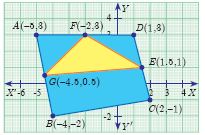
In the figure, find the area of triangle AGF
3.
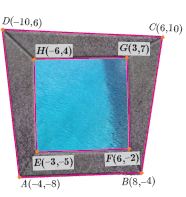
In the figure, the quadrilateral swimming pool shown is surrounded by concrete patio. Find the area of the patio.
4.
Let P(11, 7), Q(13.5, 4) and R(9.5, 4) be the midpoints of the sides AB, BC and AC respectively of Δ ABC. Find the coordinates of the vertices A, B and C. Hence find the area of Δ ABC and compare this with area of ΔPQR.
5.
If the points A(- 3, 9) , B(a, b) and C(4, - 5) are collinear and if a + b = 1 , then find a and b.
6.
Find the value of k, if the area of a quadrilateral is 28 sq. units, whose vertices are (–4, –2), (–3, k), (3, –2) and (2, 3)
7.
Find the area of the quadrilateral whose vertices are at (–9, –2), (–8, –4), (2, 2) and (1, –3)
8.
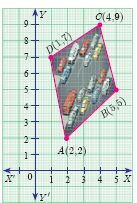
The given diagram shows a plan for constructing a new parking lot at a campus. It is estimated that such construction would cost Rs. 1300 per square feet. What will be the total cost for making the parking lot?
9.
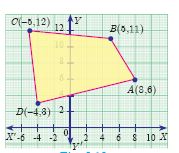
Find the area of the quadrilateral formed by the points (8, 6), (5, 11), (-5, 12) and (-4, 3).
10.
If the points P(-1, -4), Q (b, c) and R(5, -1) are collinear and if 2b + c = 4, then find the values of b and c.
1.
(a) Slope of AB = \(\frac { { y }_{ 2 }-{ y }_{ 1 } }{ { x }_{ 2 }-{ x }_{ 1 } } =\frac { -2+2 }{ 6-1 } =0\)
(b) Slope of CD \(\frac { 1-1 }{ 2-5 } =\frac { 0 }{ -3 } =0\)
2.
Area of triangle AGF
Vertices A (- 5,3), G (- 4.5,0.5) and F (- 2,3).
Area of triangle \(=\frac{1}{2}\left[x_{1}\left(y_{2}-y_{3}\right)+\right.
\left.x_{2}\left(y_{3}-y_{1}\right)+x_{3}\left(y_{1}-y_{2}\right)\right] \text { sq. units }
\)
\(=\frac{1}{2}[-5(0.5-3)-4.5(3-3)-2(3-0.5)]
\)
\(=\frac{1}{2}[12.5-5]=\frac{7.5}{2}=3.75 \text { sq. units }
\)
3.
Area of the patio = Area of the quadrilateral ABCD - Area of the swimming pool EFGH
Area of Quadrilateral ABCD
A(- 4,- 8), B (8, - 4), C (6, 10) and D ( - 10, 6)
\(\text { Area } =\frac{1}{2}\left[\left(x_{1}-x_{3}\right)\left(y_{2}-y_{4}\right)-\left(x_{2}-x_{4}\right)\left(y_{1}-y_{3}\right)\right]
\)
\(= \frac{1}{2}[(-4-6)(-4-6)-(8+10)(-8-10)]
\)
\(= \frac{1}{2}[100+324]=\frac{424}{2}=212 \text { sq. units }
\)
Area of Quadrilateral EFGH
E (- 3, - 5), F (6,- 2),G (3, 7) and H (- 6, 4)
Area \(=\frac{1}{2}[(-3,-3)(-2-4)-(6+6)(-5-7)]
\)
\(=\frac{1}{2}[36+144]=\frac{180}{2}=90 \text { sq. units }
\)
Area of patio = Area of quadrilateral ABCD - Area of Quadrilateral EFGH
= 212 - 90 = 122 sq. units
4.
.JPG)
Given B Q, R are the mid points of the sides of a triangle.
Let the vertices of triangle ABC be A (x1 , y1),
B (x2, y2) and C (x3, y3)
P is the mid point of AB
\(\Rightarrow \ \left[\frac{x_{1}+x_{2}}{2}, \frac{y_{1}+y_{2}}{2}\right]=(11,7)\)
Comparing the co-ordinates, we get
x1+ x2 = 22 and ......(1)
y2 + y3 = 8 .....(2)
Q is the mid point of BC
\(\Rightarrow \ \left[\frac{x_{2}+x_{3}}{2}, \frac{y_{2}+y_{3}}{2}\right]=(13.5,4)\)
x2 + x3 = 27 ......(3)
y2 + y3 = 8 ......(4)
R is the mid point of AC
\(\Rightarrow \ \left[\frac{x_{1}+x_{3}}{2}, \frac{y_{1}+y_{3}}{2}\right]=(9.5,4)\)
x1 + x3 = 19 ......(5)
y1 + y3 = 8 ......(6)
Solving (1), (3) and (5), we get
x1 = 7, x2 = 15 and x3 = 12.
Solving (2), (4) and (6)
we get y1 = 7,y2 = 7,y3 = 1
The vertices are A (7, 7), B (15, 7) and C(12, 1)
Area of ABC \(=\frac{1}{2}\left[\mathrm{x}_{1}\left(\mathrm{y}_{2}-\mathrm{y}_{3}\right)+\mathrm{x}_{2}\left(\mathrm{y}_{3}-\mathrm{y}_{1}\right)\right. \left.+\mathrm{x}_{3}\left(\mathrm{y}_{1}-\mathrm{y}_{2}\right)\right] \)
\(=\frac{1}{2}[7(7-1)+15(1-7)+12(7-7)] \)
\(=\frac{1}{2}[42-90]=\frac{1}{2}(-48)=-24 \)
= 24 sq. units [ Area cannot be negative]
Area of PQR
\(=\frac{1}{2}[11(4-4)+13.5(4-7)+9.5(7-4)] \)
\(=\frac{1}{2}[0-40.5+28.5]=\frac{-12}{2}=-6 \)
Area = 6 sq. units [Area cannot be negative]
Area of ABC = 4 (Area of PQR ).
5.
Given points A (- 3, 9), B(a, b) and C (4, - 5)
Since the points are collinear, Area of triangle ABC = 0
\(\frac{1}{2}\left[x_{1}\left(y_{2}-y_{3}\right)+x_{2}\left(y_{3}-y_{1}\right)+x_{3}\left(y_{1}-y_{2}\right)\right]=0\)
-3(b + 5) + a( -5 -9) + 4(9 - b) = 0
-3b - 15- 14a + 36 - 4b = 0
-14a - 7b + 21 = 0
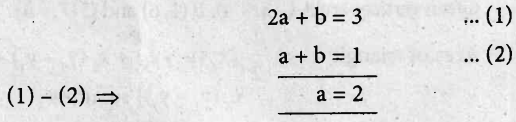
2a + b = 3 .........(1)
Given that a + b = 1 .........(2)
Solving (1) and (2)
Substituting in (2)
2 + b = 1
b = 1 - 2 = -1
a = 2, b = -1.
6.
Given vertices are (- 4, - 2),(- 3, k), (3, - 2) and (2,3) and area of quadrilateral is 28 sq. units.
Area of quadrilateral \(=\frac{1}{2}\left[\left(x_{1}-x_{3}\right)\left(y_{2}-y_{4}\right)-\right. \left.\left(x_{2}-x_{4}\right)\left(y_{1}-y_{3}\right)\right] \)
\(\frac{1}{2}\) [(- 4 - 3) (k - 3) - (- 3 - 2) (- 2 + 2)] = 28
(-7) (k - 3) - (- 5) (0) = 56
-7k + 21 = 56
-7k = 56 - 21 = 35
\(k=\frac{35}{-7}=-5\)
k = -5
7.
.JPG)
Given vertices are A (–9, –2), B(–8, –4), C(1, –3) and D(2, 2)
Area of the Quadrilateral ABCD
\( =\frac{1}{2}\left[\left(x_{1} y_{2}+x_{2} y_{3}+x_{3} y_{4}+x_{4} y_{1}\right)-\left(x_{2} y_{1}+x_{3} y_{2}\right.\right. \left.\left.+x_{4} y_{3}+x_{1} y_{4}\right)\right] sq. units\)
= \(\frac{1}{2}\) [(- 9) (- 4) + (- 8) (-3) + (1) (2) + (2) (- 2)] - [(- 8) (- 2) + (1) (- 4) + (2) (-3) + (- 9) (2)]
= \(\frac{1}{2}\) [(36 + 24 + 2 - 4)- (16 - 4 - 6 - 18)]
= \(\frac{1}{2}\) [58 - (-12)] = \(\frac{1}{2}\) [70] = 35 sq. units
Area of quadrilateral = 35 sq. units.
8.
The parking lot is a quadrilateral whose vertices are at A(2, 2), B(5, 5), C(4, 9) and D(1, 7).
Therefore, Area of parking lot
= \(\frac{1}{2}\) {(10 + 45 + 28 + 2) - (10 + 20 + 9 + 14)}
= \(\frac{1}{2}\) {85 - 53}
JPG.JPG)
= \(\frac{1}{2}\) (32) = 16.units.
So, area of parking lot = 16 sq feet
Construction rate per square feet = Rs. 1300
Therefore, total cost for constructing the parking lot = 16 x 1300 = Rs. 20800
9.
Before determining the area of quadrilateral, plot the vertices in a graph.
Let the vertices be A(8, 6), B(5, 11), C(-5, 12) and D(-4, 3).
Therefore, area of the quadrilateral ABCD
=\(\frac{1}{2}\) { (x1y2 + x2y3 + x3y1) - (x2y1 + x3y2 + x1y3) }
=\(\frac{1}{2}\) { (80 + 60 - 15 - 24) - (30 - 55 - 48 + 24)}
=\(\frac{1}{2}\) {109 + 49 }
=\(\frac{1}{2}\) { 158 } = 79 sq. units
10.
Since the three points P(-1, -4), Q(b, c) and R(5, -1) are collinear,
Area of triangle PQR = 0
\(\frac{1}{2}\) { (x1y2 + x2y3 + x3y1) - (x2y1 + x3y2 + x1y3) } = 0
\(\frac{1}{2}\) { (- c - b - 20) - (- 4b + 5c + 1) } = 0
- c - b - 20 + 4b - 5c - 1 = 0
b - 2c = 7 ...(1)
Also, 2b + c = 4 .....(2) (from given information)
Solving (1) and (2) we get b = 3, c = -2

10th Standard Syllabus & Materials
10th Standard
TN 10th English Prose - 2 - The Night the Ghost Got in Important Questions And Answers Study Material - QB365 Set A
NEW10th Standard
TN 10th English Supplementary - 1 - The Tempest Important Questions And Answers Study Material - QB365 Set A
NEW10th Standard
TN 10th English Poem - 1 - Life Important Questions And Answers Study Material - QB365 Set A
NEW10th Standard
TN 10th English Prose - 1 - His First Flight Important Questions And Answers Study Material - QB365 Set A



Tamilnadu Stateboard 10th Standard Subjects
Tamilnadu Stateboard Standards





