
 100% FREE ACCESS
10th Standard Syllabus & Materials
10th Standard
TN 10th English Prose - 4 - The Attic Important Questions And Answers Study Material - QB365 Set A
NEW10th Standard
TN 10th English Supplementary - 3 - The Story of Mulan Important Questions And Answers Study Material - QB365 Set A
NEW10th Standard
TN 10th English Poem - 3 - I am Every Woman Important Questions And Answers Study Material - QB365 Set A
NEW10th Standard
TN 10th English Prose - 3 - Empowered Women Navigating The World Important Questions And Answers Study Material - QB365 Set A
NEW10th Standard
TN 10th English Supplementary - 2 - Zigzag Important Questions And Answers Study Material - QB365 Set A
NEW10th Standard
TN 10th English Poem - 2 - The Grumble Family Important Questions And Answers Study Material - QB365 Set A

Published on: 13/05/2022
QB365 provides detailed and simple solution for every Creative Questions in class 10 Maths Subject. It will helps to get more idea about question pattern in every Creative questions with solution.
latest Creative QuestionsDownload Tamil Nadu 10th Standard Maths question papers, model tests, one-mark questions, important questions, and public exam papers in PDF format. Free study materials and answer keys for TN State Board students.
Questions + Answers key
Take MCQ Maths Test1.
Prove that sec A (1 - sin A) (sec A + tan A) = 1.
2.
Find the depth of a cylindrical tank of radius 28 m, if its capacity is equal to that of a rectangular tank of size 28 m x 16 m x 11 m.
3.
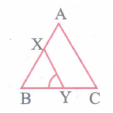
In figure the line segment XY is parallel to side AC of \(\Delta ABC\) and it divides the triangle into two parts of equal areas. Find the ratio \(\cfrac { AX }{ AB } \)
4.
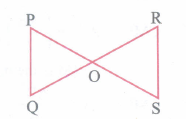
In figure if PQ || RS Prove that \(\Delta POQ\sim \Delta SOQ\)
5.
Find the standard deviation for the following data. 5, 10, 15, 20, 25. And also find the new S.D. if three is added to each value.
6.
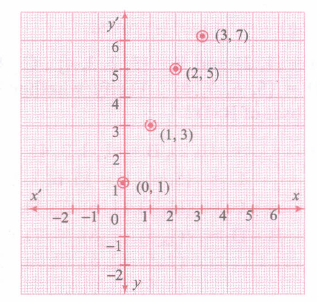
Let A = {0, 1, 2, 3} and B = {1, 3, 5, 7, 9} be two sets. Let f: A \(\rightarrow\)B be a function given by f(x) = 2x + 1. Represent this function as a graph.
7.
Let A = {0, 1, 2, 3} and B = {1, 3, 5, 7, 9} be two sets. Let f: A \(\rightarrow\)B be a function given by f(x) = 2x + 1. Represent this function as a table.
8.
Find the values of k for which the following equation has equal roots.
(k - 12)r + 2(k - 12)x + 2 = 0
9.
Using quadratic formula solve the following equations.
p2x2 + (P2 -q2) X - q2 = 0
10.
Prove that \(\sqrt { 3 } \) is irrational
11.
Show that any positive odd integer is of the form 4q + 1 or 4q + 3, where q is some integer.
12.
Show that the points (1, 7), (4, 2), (-1,-1) and (-4,4) are the vertices of a square.
13.
Let A = {0, 1, 2, 3} and B = {1, 3, 5, 7, 9} be two sets. Let f: A \(\rightarrow\)B be a function given by f(x) = 2x + 1. Represent this function as a set of ordered pairs.
1.
LHS = sec A (1 - sin A) (sec A + tan A)
= \(\left[ \frac { 1 }{ cosA } \right] (1-sinA)\left[ \frac { 1 }{ cosA } +\frac { sinA }{ cosA } \right] \)
= \(\frac { (1-sinA)(1+cosA) }{ { cos }^{ 2 }A } \)
= \(\frac { 1-{ sin }^{ 2 }A }{ { cos }^{ 2 }A } \)
= \(\frac { { cos }^{ 2 }A }{ { cos }^{ 2 }A } \) = 1 = RHS
2.
Volume of the cylindrical tank = Volume of the rectangle tank
πr2h = 28 x 16 x 11 m3

\(h=\frac { 16\times 11 }{ 88 } =2m\)
3.
Given XY IIA C
So,
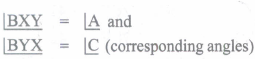
\(\therefore \Delta ABC\sim \Delta XbY\) (AAA similarity criterion)
So, \(\cfrac { ar(ABC) }{ ar(XBY) } =\left( \cfrac { AB }{ XB } \right) ^{ 2 }\) ...(1)
ar(ABC) = 2ar(XBY)
\(\cfrac { ar(ABC) }{ ar(ABC) } =\cfrac { 2 }{ 1 } \) ...(2)
From (1) and (2),
\(\left( \cfrac { AB }{ XB } \right) ^{ 2 }=\cfrac { 2 }{ 1 } i.e.,\cfrac { AB }{ XB } =\cfrac { \sqrt { 2 } }{ 1 } \)
\(\cfrac { XB }{ AB } =\cfrac { 1 }{ \sqrt { 2 } } \)
\(1-\frac{X B}{A B}=1-\frac{1}{\sqrt{2}}\)
\(\cfrac { AB-XB }{ AB } =\cfrac { \sqrt { 2 } -1 }{ \sqrt { 2 } } \)
\(\cfrac { AX }{ AB } =\cfrac { \sqrt { 2 } -1 }{ \sqrt { 2 } } =\cfrac { 2-\sqrt { 2 } }{ 2 } \)
4.
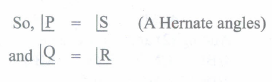
PQ II RS
Also

\(\angle \therefore \Delta POQ\sim \Delta SOR\) (AAA similarity criterion)
5.
| x | d' = \(\frac { x-15 }{ 5 } \) | d'2 |
| 5 | -2 | 4 |
| 10 | -1 | 1 |
| 15 | 0 | 0 |
| 20 | 1 | 1 |
| 25 | 2 | 4 |
| Σd = 0 | Σd'2 = 10 |
\(\bar { x } =\frac { \Sigma x }{ n } =\frac { 75 }{ 5 } \)=15
d'=\(\frac { x-\bar { x } }{ c } =\frac { x-A }{ c } \)
A is assumed mean c is common factor.
Here A= 15, C = 5
σ =\(\sqrt { \left( \frac { \Sigma d'^{ 2 } }{ n } \right) -\left( \frac { \Sigma d' }{ n } \right) ^{ 2 } } \) x c
=\(\sqrt { \frac { 10 }{ 5 } -0 } \) x c
=\(\sqrt { 2 } \) x 5
= 5\(\sqrt { 2 } \)
If 3 is added to each value, we get 8, 13, 18,23, 28 as new values.
| x | d' = \(\frac { x-18 }{ 5 } \) | d'2 |
| 8 | -2 | 4 |
| 13 | -1 | 1 |
| 18 | 0 | 0 |
| 23 | 1 | 1 |
| 28 | 2 | 4 |
| Σd' = 10 | Σd'2 = 10 |
∴ σ =\(\sqrt { \left( \frac { \Sigma d'^{ 2 } }{ n } \right) -\left( \frac { \Sigma d' }{ n } \right) ^{ 2 } } \) x c
=\(\sqrt { \frac { 10 }{ 5 } -0 } \) x 5
=\(\sqrt { 2 } \) x 5
= 5\(\sqrt { 2 } \)
S.D. doesn't change when a number is added or subtracted to the values.
6.
A Graph f = {(x, f(x) / x \(\epsilon \) A}
{(0, 1), (1, 3), (2, 5), (3, 7)}
7.
A table
| x | 0 | 1 | 2 | 3 |
|---|---|---|---|---|
| f(x) | 1 | 3 | 5 | 7 |
8.
\(\frac { (k-12) }{ a } { x }^{ 2 }+\frac { 2(k-12) }{ b } x+\frac { 2 }{ c } =0\)
D2 = b2- 4ac = (2(k - 12))2 - 4(k - 12)(2)
= 4(k - 12)[(k - 12) - 2]
= 4(k-12)(k- 14)
The given equation will have equal roots, if D = 0
⇒ 4(k-12)(k-14) 0
k - 12 = 0 or k - 14 0
k 12, 14
9.
p2x2 + (P2 -Comparing this with ax' + bx + c = 0, we have
a=p2
b=p2-q2
c =-q2
D = b2-4ac
= (P2-q2)-4xp2x-q2
= (P2-q2)2+ 4p2 q2
= (P2+q2)2>0
So, the given equation has real roots given by
\(\alpha =\frac { -b-\sqrt { D } }{ 2a } =\frac { -({ p }^{ 2 }-{ q }^{ 2 })+({ p }^{ 2 }+{ q }^{ 2 }) }{ { 2p }^{ 2 } } \)
\(=\frac { { q }^{ 2 } }{ { p }^{ 2 } } \)
\(\beta =\frac { -b-\sqrt { D } }{ 2a } =\frac { -({ p }^{ 2 }-{ q }^{ 2 })+({ p }^{ 2 }+{ q }^{ 2 }) }{ { 2p }^{ 2 } } \)
=-1
10.
Let us assume the opposite, (1) \(\sqrt { 3 } \) is irrational.
Hence \(\sqrt { 3 } =\frac { p }{ q } \)
Where p and q (q ≠ 0) are co-prime (no common factor other than 1)
Hence, \(\sqrt { 3 } =\frac { p }{ q } \)
\(\sqrt { 3 } \)q = p
Squaring both side
\({ (\sqrt { 3 }q ) }^{ 2 }={ p }^{ 2 }\)
3q2 = p2
\({ q }^{ 2 }=\frac { p }{ 3 } \)
Hence, 3 divides p2 So 3 divides p also .....(1)
Hence we can say
\(\frac{p}{3}\) = c where c is some integer
s, p =p2
Putting p = 3c
3q2 = (3c)2
3q2 = 9c2
q2 = \(\frac13\) x 9c2
q2 = 3c2
\(\frac{9^2}{3}\) = c2
Hence 3 divides q2
So, 3 divides q also ...(2)
By (1) and (2) 3 divides both p and q
By contradiction \(\sqrt { 3 } \) is irrational.
11.
Let us start with taking a, where a is a +ve odd integer.
We apply the division algorithm with 'a' and 'b' = 4.
Since 0 ≤ r < 4, the possible remainders are 0,1,2,3.
That is, a can be 4q, or 4q + 1, or 4q + 2 or 4q + 3, where 1 is the quotient. However, since a is odd, a cannot be 4q or 4q + 2 (since they are both divisible by 2).
Any odd integer is of the form 4q + 1 or 4q + 3
12.
Let A(1, 7), B(4, 2), C(-1, -1) and D(-4, 4) be the given paints. One way at showing that ABCD is a square is to use the property that all its sides should be equal and both its diagonals should be equal.
Now,
AB = \(\sqrt { (1-4)^{ 2 }+(7-4)^{ 2 } } =\sqrt { 9+25 } =\sqrt { 34 } \)
BC = \(\\ \sqrt { (4+1)^{ 2 }+(2+1)^{ 2 } } =\sqrt { 25+9 } =\sqrt { 34 } \)
CD = \(\sqrt { (-1+4)^{ 2 }+(-1-4)^{ 2 } } =\sqrt { 9+25 } =\sqrt { 34 } \)
DA =\(\sqrt { (1+4)^{ 2 }+(7-4)^{ 2 } } =\sqrt { 25+9 } =\sqrt { 34 } \)
AC = \(\sqrt { (1+1)^{ 2 }+(7+1)^{ 2 } } =\sqrt { 4+64 } =\sqrt { 68 } \)
BD = \(\\ \sqrt { (4+4)^{ 2 }+(2-4)^{ 2 } } =\sqrt { 64+4 } =\sqrt { 68 } \)
Since, AB = BC = CD = DA and AC = BD, all the four sides at the quadrilateral ABCD are equal and its diagonals AC and BD are also equal. Therefore, ABCD is a square.
13.
A = {1,2,3},B = {1,3,5, 7,9}
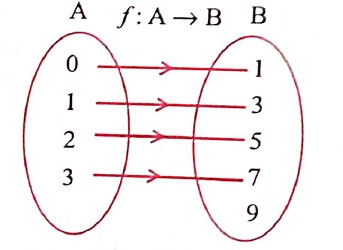
f(x) = 2x + 1
f(0)) = 2(0) + 1 = 1
f(1) = 2(1) + 1=3
f(2) = 2(2) + 1 = 5
f(3) = 2(3) + 1 = 7
(i) A set of ordered pairs.
f = {(0, 1), (1, 3), (2, 5), (3, 7)}
(ii) A table
| x | 0 | 1 | 2 | 3 |
| f(x) | 1 | 3 | 5 | 7 |
(ii) An arrow diagram
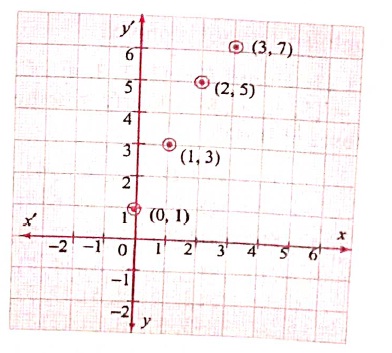
(iv) A Graph f = \(\{(x, f(x) / x \in A\}\)
= {(0, 1), (1, 3), (2, 5), (3, 7)}

10th Standard Syllabus & Materials
10th Standard
TN 10th English Prose - 2 - The Night the Ghost Got in Important Questions And Answers Study Material - QB365 Set A
NEW10th Standard
TN 10th English Supplementary - 1 - The Tempest Important Questions And Answers Study Material - QB365 Set A
NEW10th Standard
TN 10th English Poem - 1 - Life Important Questions And Answers Study Material - QB365 Set A
NEW10th Standard
TN 10th English Prose - 1 - His First Flight Important Questions And Answers Study Material - QB365 Set A



Tamilnadu Stateboard 10th Standard Subjects
Tamilnadu Stateboard Standards





