
 100% FREE ACCESS
10th Standard Syllabus & Materials
10th Standard
TN 10th English Prose - 4 - The Attic Important Questions And Answers Study Material - QB365 Set A
NEW10th Standard
TN 10th English Supplementary - 3 - The Story of Mulan Important Questions And Answers Study Material - QB365 Set A
NEW10th Standard
TN 10th English Poem - 3 - I am Every Woman Important Questions And Answers Study Material - QB365 Set A
NEW10th Standard
TN 10th English Prose - 3 - Empowered Women Navigating The World Important Questions And Answers Study Material - QB365 Set A
NEW10th Standard
TN 10th English Supplementary - 2 - Zigzag Important Questions And Answers Study Material - QB365 Set A
NEW10th Standard
TN 10th English Poem - 2 - The Grumble Family Important Questions And Answers Study Material - QB365 Set A

Published on: 03/07/2021
QB365 provides detailed and simple solution for every Creative Questions in class 10 Maths Subject. It will helps to get more idea about question pattern in every Creative questions with solution.
Download Tamil Nadu 10th Standard Maths question papers, model tests, one-mark questions, important questions, and public exam papers in PDF format. Free study materials and answer keys for TN State Board students.
Questions + Answers key
Take MCQ Maths Test1.
In a right triangle ABC, right-angled at B, if tan A = 1, then verify that 2 sin A cos A = 1.
2.
Prove that \(\frac { sin\theta -cos\theta +1 }{ sin\theta +cos\theta -1 } =\frac { 1 }{ sec\theta -tan\theta } \) using the identity sec2θ= 1+ tan2θ.
3.
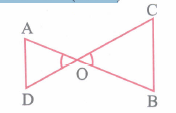
In figure OA· OB = OC·OD
Show that \(\angle A=\angle C\ and\ \angle B=\angle D\)
4.
Find the standard deviation of 30, 80, 60, 70, 20, 40, 50 using the direct method.
5.
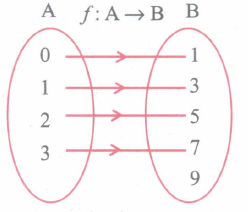
Let A = {0, 1, 2, 3} and B = {1, 3, 5, 7, 9} be two sets. Let f : A \(\rightarrow\)B be a function given by f(x) = 2x + 1. Represent this function as an arrow .
6.
Prove that the equation x2(a2+b2)+2x(ac+bd)+(c2+ d2) = 0 has no real root if ad≠bc.
7.
Using quadratic formula solve the following equations.9x2-9(a+b)x+(2a2+5ab+2b2)=0
8.
Solve the following system of linear equations in three variables.
x + y + z = 6; 2x + 3y + 4z = 20;
3x + 2y + 5z = 22
9.
Find the LCM and HCF of 6 and 20 by the prime factorisation method.
10.
Use Euclid's algorithm to find the HCF of 4052 and 12756.
11.
If A (-5, 7), B (-4, -5), C (-1, -6) and D (4, 5) are the vertices of a quadrilateral, find the area of the quadrilateral ABCD.
12.
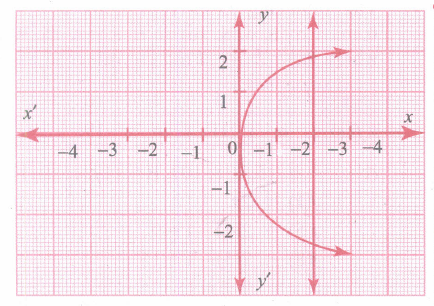
State whether the graph represent a function. Use vertical line test.
13.
Let A = {1,2, 3, 4} and B = {-1, 2, 3, 4, 5, 6, 7, 8, 9, 10, 11, 12} Let R = {(1, 3), (2, 6), (3, 10), (4, 9)} \(\subseteq \) A x B be a relation. Show that R is a function and find its domain, co-domain and the range of R.
14.
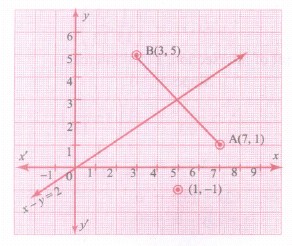
Find a relation between x and y such that the point (x, y) is equidistant from the points (7, 1) and (3, 5).
1.
In ABC, tan A = \(\frac{BC}{AB}\) = 1
BC = AB
Let AB = BC = k, where k is a positive number
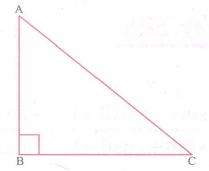
Now, AC = \(\sqrt { { AB }^{ 2 }+{ BC }^{ 2 } } \)
= \(\sqrt { { (k) }^{ 2 }+{ (k) }^{ 2 } } =k\sqrt { 2 } \)
Therefore,
\(sinA=\frac { BC }{ AC } =\frac { 1 }{ \sqrt { 2 } } \) and
\(cosA=\frac { AB }{ Ac } =\frac { 1 }{ \sqrt { 2 } } \)
So, \(2sinAcosA=2\left[ \frac { 1 }{ \sqrt { 2 } } \right] \left[ \frac { 1 }{ \sqrt { 2 } } \right] =1\), which is the required value
2.
Since we will apply the identity involving sec θ and tan θ, let us first convert the LHS (of the identity we need to prove) in terms of sec θ and tan θ by dividing numerator and denominator by cos θ.
LHS = \(\frac { sin\theta -cos\theta +1 }{ sin\theta +cos\theta -1 } =\frac { tan\theta -1+sec\theta }{ tan\theta +1-sec\theta } \)
= \(\frac { (tan\theta +sec\theta )-1 }{ (tan\theta -sec\theta )+1 } \)
= \(\frac { \{ (tan\theta +sec\theta )-1\} (tan\theta -sec\theta ) }{ \{ tan\theta -sec\theta )+1\} (tan\theta -sec\theta ) } \)
= \(\frac { ({ tan }^{ 2 }\theta -{ sec }^{ 2 }\theta )-(tan\theta -sec\theta ) }{ (tan\theta -sec\theta +1)(tan\theta -sec\theta ) } \)
= \(\frac { -1-tan\theta +sec\theta }{ (tan\theta -sec\theta +1)(tan\theta -sec\theta ) } \)
= \(\frac { -1 }{ tan\theta -sec\theta } \)
= \(\frac { 1 }{ sec\theta -tan\theta } \)
3.
OA· OB = OC . OD (Given)
so, \(\cfrac { OA }{ OC } =\cfrac { OD }{ OB } \)
Also we have 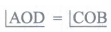
(vertically opposite angles) ...(2)
From (1) and (2)
\(\Delta AOD\sim \Delta COB\)( SAS similarity criterion)
So

(corresponding angles of similar triangles)
4.
| x | x2 |
| 30 | 900 |
| 80 | 6400 |
| 60 | 3600 |
| 70 | 4900 |
| 20 | 400 |
| 40 | 1600 |
| 50 | 2500 |
| Σx = 350 | Σx2 = 20300 |
σ =\(\sqrt { \frac { \Sigma x^{ 2 } }{ n } -\left( \frac { \Sigma x }{ n } \right) ^{ 2 } } \)
=\(\\ \sqrt { \frac { 20300 }{ 7 } -\left( \frac { 350 }{ 7 } \right) ^{ 2 } } \)
=\(\sqrt { 400 } \) = 20
5.
An arrow diagram
6.
D= b2-4ac
⇒ 4(ac + bd)2 - 4(a2 + b2)(c2 + d2)
⇒ 4[(ac + bd)2 - (a2 + b2)(c2 + d2)]
⇒ 4(a2c2 + b2d2 + 2acbd - a2c2b2c2 - a2d2 - b2d2]
⇒ 4[2acbd - a2d2 - b2c2]
⇒ 4[a2d2 + b2c2 - 2adbc]
⇒-4[ ad - bc]2
We have ad≠ bc
∴ ad- be of 0
⇒ (ad - bc)2 > 0
⇒ 4(ad - bc)2 < 0 ⇒ D < 0
Hence the given equation has no real roots.
7.
9x2-9(a+b)x+(2a2+5ab+2b2)=0
Comparing this with ax2 + bx + c = O.
a =9
b = -9(a + b)
c = (2a2 + 5ab + 2b2)
∴ ∆=B2-4AC
⇒ 81(a+b)2-36(2a2+5ab+2b2)
⇒ 9a2 + 9b2 - 18ab
⇒ 9(a - b)2> 0
∴ the roots are real and given by
\(\beta =\frac { -B-\sqrt { D } }{ 2A } =\frac { 9(a+b)+3(a-b) }{ 18 } \)
\(=\frac { 12a+6b }{ 18 } =\frac { 2a+b }{ 3 } \)
\(\beta =\frac { -B-\sqrt { D } }{ 2A } =\frac { 9(a+b)+3(a-b) }{ 18 } \)
\(=\frac { 6a+12b }{ 18 } =\frac { a+2b }{ 3 } \)
8.
x + y + z = 6 ....(1)
2x + 3y + 4z = 20 ...(2)
3x + 2y + 5z = 22 ....(3)
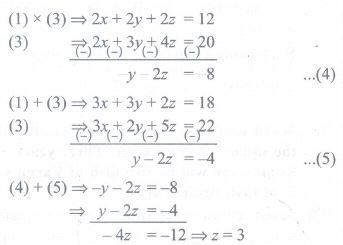
Sub. z = 3 in (5) ⇒ y - 2(3) =-4
y=2
Sub. y = 2, z = 3 in (1), we get
x+2+3=6
x=1
x= 1,y = 2, z = 3
9.
We have 6 = 21 x 31 and
20 = 2 x 2 x 5 = 22 x 51
You can find HCF (6, 20) = 2 and LCM (6, 20) = 2 x 2 x 3 x 5 = 60.
As done in your earlier classes. Note that HCF (6, 20) = 21 = product of the smallest power of each common prime factor in the numbers.
LCM (6, 20) = 22 x 31 x 51 = 60.
= Product of the greatest power of each prime factor, involved in the numbers.
10.
Since 12576 > 4052 we apply the division lemma to 12576 and 4052, to get
12576 = 4052 x 3 + 420.
Since the remainder 420 ≠ 0, we apply the division lemma to 4052
4052 = 420 x 9 + 272.
We consider the new divisor 420 and the new remainder 272 and apply the division lemma to get
420 = 272 x 1 + 148, 148 ≠ 0
∴ Again by division lemma
272 = 148 x 1 + 124, here 124 ≠ 0
∴ Again by division lemma
148 = 124 x 1 + 24, Here 24 ≠ 0
∴ Again by division lemma
124 = 24 x 5 + 4, Here 4 ≠ 0
∴ Again by division lemma
24 = 4 x 6 + 0.
The remainder has now become zero. So our procedure stops. Since the divisor at this stage is 4.
∴ The HCF of 12576 and 4052 is 4.
11.
By joining B to D, you will get too triangles ABD and BCD.
Now, the area of ΔABD
=\(\frac { 1 }{ 2 } \)[ -5(-5 - 5) + (-4)(5 -7) + 4(7 + 5)]
=\(\frac { 1 }{ 2 } \)(50 + 8 + 48)
=\(\frac { 106 }{ 2 } \) = 53 square units.
Also, the area of ΔBCD
=\(\frac { 1 }{ 2 } \) = [-4(-6 - 5) - 1(5 + 5) + 4(-5 + 6)]
=\(\frac { 1 }{ 2 } \)(44 - 10 + 4)
= 19 square units.
So, the area of quadrilateral ABCD
= 53 + 19 = 72 square units.
12.
It is not a function as the vertical line PQ cuts the graph at two points
13.
Domain of R = {1,2,3,4}
Co-domain of R = B = {-1, 2, 3,4,5,6, 7, 9, 10, 11,12}
Range of R = {3, 6,10, 9}
14.
Let P(x, y) be equidistant from the points A (7, 1) and B (3, 5).
We are given that AP = BP. So, AP2 = BP2
(x - 7)2 + (y - 1)2 = (x - 3)2 + (y - 5)2
x2- 14x + 49 + y - 2y + 1 = x2- 6x + 9 + y -10y + 25
x - y = 2
Which is the required relation.

10th Standard Syllabus & Materials
10th Standard
TN 10th English Prose - 2 - The Night the Ghost Got in Important Questions And Answers Study Material - QB365 Set A
NEW10th Standard
TN 10th English Supplementary - 1 - The Tempest Important Questions And Answers Study Material - QB365 Set A
NEW10th Standard
TN 10th English Poem - 1 - Life Important Questions And Answers Study Material - QB365 Set A
NEW10th Standard
TN 10th English Prose - 1 - His First Flight Important Questions And Answers Study Material - QB365 Set A



Tamilnadu Stateboard 10th Standard Subjects
Tamilnadu Stateboard Standards





