
 100% FREE ACCESS
10th Standard Syllabus & Materials
10th Standard
TN 10th English Prose - 4 - The Attic Important Questions And Answers Study Material - QB365 Set A
NEW10th Standard
TN 10th English Supplementary - 3 - The Story of Mulan Important Questions And Answers Study Material - QB365 Set A
NEW10th Standard
TN 10th English Poem - 3 - I am Every Woman Important Questions And Answers Study Material - QB365 Set A
NEW10th Standard
TN 10th English Prose - 3 - Empowered Women Navigating The World Important Questions And Answers Study Material - QB365 Set A
NEW10th Standard
TN 10th English Supplementary - 2 - Zigzag Important Questions And Answers Study Material - QB365 Set A
NEW10th Standard
TN 10th English Poem - 2 - The Grumble Family Important Questions And Answers Study Material - QB365 Set A

Published on: 13/05/2022
QB365 provides detailed and simple solution for every book back questions in class 10 Maths subject.It will helps to get more idea about question pattern in every book back questions with solution.
latest Book back QuestionsDownload Tamil Nadu 10th Standard Maths question papers, model tests, one-mark questions, important questions, and public exam papers in PDF format. Free study materials and answer keys for TN State Board students.
Questions + Answers key
Take MCQ Maths Test1.
D is the mid point of side BC and AE \(\bot \) BC. If BC = a, AC = b, AB = c, ED = x, AD = p and AE = h, prove that
\({ b }^{ 2 }={ p }^{ 2 }+ax+\frac { { a }^{ 2 } }{ 4 } \)
2.
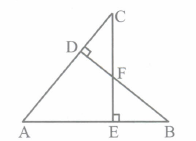
In the figure, if BD\(\bot \)AC and CE \(\bot \) AB, prove that
(i) \(\Delta AEC\sim \Delta ADB\)
(ii) \(\frac { CA }{ AB } =\frac { CE }{ DB } \)
3.
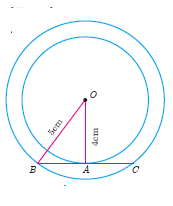
If radii of two concentric circles are 4 cm and 5 cm then find the length of the chord of one circle which is a tangent to the other circle
4.
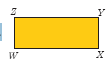
In the rectangle WXYZ, XY+YZ = 17 cm, and XZ + YW = 26 cm .Calculate the length and breadth of the rectangle
5.
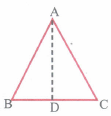
Check whether AD is bisector \(\angle\)A of \(\triangle\)ABC in each of the following AB = 5cm, AC = 10cm, BD = 1.5cm and CD = 3.5cm
6.
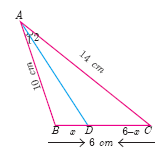
In the Figure, AD is the bisector of \(\angle\)BAC, if A = 10 cm, AC = 14 cm and BC = 6 cm. Find BD and DC.
7.
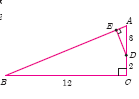
In the adjacent figure, \(\triangle\)ABC is right angled at C and DE\(\bot \) AB. Prove that \(\triangle\)ABC~\(\triangle\)ADE and hence find the lengths of AE and DE.
8.
A vertical stick of length 6 m casts a shadow 400 cm long on the ground and at the same time a tower casts a shadow 28 m long. Using similarity, find the height of the tower.
9.
Check whether the triangles are similar and find the value of x.
(i)
.png)
(ii)
.png)
10.
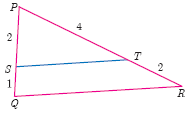
Show that \(\triangle\) PST~\(\triangle\) PQR
1.
From the figure, D is the mid point of BC.
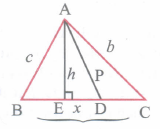
We have \(\angle A E D=90^{\circ}\)
Given BC = a, AC = b, AB = c, ED = x, AD = P and AE = h
In \(\triangle\)AEC, by Pythagoras theorem
AC2 = AE2 + EC2
AC2 = AE2 + (ED + DC)2
AC2 = AE2 + ED2 + DC2 + 2.E.D. DC
AC2 = (AE2 + ED2) + DC2 + 2 ED . DC
AC2 = AD2 + DC2 + 2 ED. DC
\(\mathrm{AC}^{2}=\mathrm{AD}^{2}+\left(\frac{1}{2} B C\right)^{2}+2\left(\frac{1}{2} B C\right) D E\)
[D is the mid point of BC, BD,= DC]
\( A C^{2} =A D^{2}+\mathrm{BC} \cdot \mathrm{DE}+\frac{1}{4} B C^{2} \ldots .(1) \)
\(\text { i.e., } b^{2} =\mathrm{P}^{2}+\mathrm{ax}+\frac{1}{4} a^{2} \)
\(\mathrm{~b}^{2} =\mathrm{p}^{2}+\mathrm{ax}+\frac{a^{2}}{4}\)
2.
\(\Delta AEC\quad \Delta ADB\)
\(\angle AEC=\angle ADB={ 90 }^{ 0 }\)
\(\angle C A E=\angle B A D\)
[common By AA similarity criteria]
\(\Delta AEC\sim \Delta ADB\)
(ii) Their corresponding sides are Proportional
\(\frac{C A}{A B}=\frac{C E}{D B}\)
Hence proved.
3.
OA = 4 cm, OB = 5 cm; also OA\(\bot \)BC.
OB2 = OA2 + AB2
52 = 42 + AB2 gives AB2 = 9
Therefore AB = 3 cm
BC = 2AB hence BC = 2 x 3 = 6 cm
4.
XY + CZ = 17cm
XZ + YW = 26cm
We know that diagonals if a rectangle bisect each other and the diagonals have equal length.
\(\therefore \text { Each diagonal }=\frac{26}{2}=13 \mathrm{~cm}\)
i.e., XZ = 13 cm and YW = 13 cm
Also given XY + YZ = 17 cm
Squaring on both sides (XY + YZ)2 = 172
\((\mathrm{XY})^{2}+(\mathrm{YZ})^{2}+2 \times(\mathrm{XY}) \times(\mathrm{YZ})=289\)
By Pythagoras theorem (XY)2 + (YZ)2 = XZ2
\(\therefore[\mathrm{XZ}]^{2}+2(\mathrm{XY}) \times(\mathrm{YZ})=289\)
132 + 2 x length x breadth = 289
2 x Area = 289 - 169
\(\text { Area }=\frac{289-169}{2}=\frac{120}{2}\)
The possible length and breadth are
(1,60) (2,30) (3,20) (4, 15), (5, 12) (6, 10).
In this pair the length and breadth should satisfy Pythagoras theorem for diagonal.
5,12 is the possible length and breadth.
5.
AB = 5 cm,
AC = 10 cm,
BD = 1.5 cm,
CD = 3.5 cm.
\( \frac{A B}{A C}=\frac{5}{10}=\frac{1}{2} \)
\(\frac{B D}{D C}=\frac{1.5}{3.5}=\frac{3}{7} \)
\(\frac{A B}{A C} \neq \frac{B D}{D C} \)
By the converse of the angle bisector theorem, AD is not a bisector of \(\angle\)A
6.
Let BD = x cm, then DC = (6 – x)cm
AD is bisector of\(\angle\) A
Therefore by Angle Bisector Theorem
\(\frac { AB }{ AC } =\frac { BD }{ DC } \)
\(\frac { 10 }{ 14 } =\frac { x }{ 6-x } \quad \frac { 5 }{ 7 } =\frac { x }{ 6-x } \)
So, 12x = 30 we get, \(x=\frac { 30 }{ 12 } =2.5\)
Therefore, BD = 2.5 cm, DC = 6−x = 6−2.5 = 3.5 cm
7.
8.
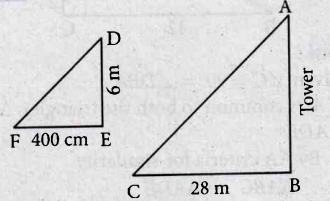
Let DE be the vertical stick and AB is the tower,
DE = 6 m, EF = 400 cm = 4 m, BC = 28 m
From DFE and ACB
Using similarity criteria
\(\frac{A B}{D E}=\frac{B C}{E F}\)
\(\frac{A B}{6}=\frac{28}{4} \)
\(A B=\frac{28 \times 6}{4}=42 \mathrm{~m} \)
Height of the tower = 42 m
9.
(i) In ABC and ADE <A is common
\(
\frac{A E}{E C}=\frac{2}{3 \frac{1}{2}}=\frac{\frac{2}{7}}{2}=\frac{2 \times 2}{7}=\frac{4}{7}
\)
\(\frac{A D}{D B}=\frac{3}{5}
\)
\(Here\ \frac{4}{7} \pm \frac{3}{5}
\)
\(\frac{A E}{E C} \neq \frac{A D}{D B}
\)
The corresponding sides are not proportional.
ABC and ADE are not similar
(ii) In CPQ and CAB <C is common
<PQC = 180o - 110o = 70o
[ <PQC and <PQB are liner pair of angles]
<ABC = 70o
<BAC = <QPC
[ sum of three angles of a triangle are 180]
<PCQ = 180o - (< QPC + 70o)
<ABC = <PQC = 70o
<C common and <BAC = <QPC
By AAA similarity criteria, <ABC <PQC
Corresponding sides are Proportional
\(\frac{A B}{P Q} =\frac{B C}{Q C}
\)
\(\frac{5}{\sqrt{x}} =\frac{6}{3}
\)
[BC = BQ + QC = 3 + 3 = 6]
\(x=\frac{5}{6} \times 3=2.5\)
x = 2.5
10.
In \(\triangle\)PST and \(\triangle\)PQR,
\(\frac { PS }{ PQ } =\frac { 2 }{ 2+1 } =\frac { 2 }{ 3 } ,\frac { PT }{ PR } =\frac { 4 }{ 4+2 } =\frac { 2 }{ 3 } \)
Thus, \(\frac { PS }{ PQ } =\frac { PT }{ PR } \) and \(\angle\)P is common
Therefore, by SAS similarity,
\(\triangle\) PST~\(\triangle\)PQR

10th Standard Syllabus & Materials
10th Standard
TN 10th English Prose - 2 - The Night the Ghost Got in Important Questions And Answers Study Material - QB365 Set A
NEW10th Standard
TN 10th English Supplementary - 1 - The Tempest Important Questions And Answers Study Material - QB365 Set A
NEW10th Standard
TN 10th English Poem - 1 - Life Important Questions And Answers Study Material - QB365 Set A
NEW10th Standard
TN 10th English Prose - 1 - His First Flight Important Questions And Answers Study Material - QB365 Set A



Tamilnadu Stateboard 10th Standard Subjects
Tamilnadu Stateboard Standards





