
 100% FREE ACCESS
10th Standard Syllabus & Materials
10th Standard
TN 10th English Prose - 4 - The Attic Important Questions And Answers Study Material - QB365 Set A
NEW10th Standard
TN 10th English Supplementary - 3 - The Story of Mulan Important Questions And Answers Study Material - QB365 Set A
NEW10th Standard
TN 10th English Poem - 3 - I am Every Woman Important Questions And Answers Study Material - QB365 Set A
NEW10th Standard
TN 10th English Prose - 3 - Empowered Women Navigating The World Important Questions And Answers Study Material - QB365 Set A
NEW10th Standard
TN 10th English Supplementary - 2 - Zigzag Important Questions And Answers Study Material - QB365 Set A
NEW10th Standard
TN 10th English Poem - 2 - The Grumble Family Important Questions And Answers Study Material - QB365 Set A

Published on: 12/06/2021
QB365 provides detailed and simple solution for every book back questions in class 10 Maths subject.It will helps to get more idea about question pattern in every book back questions with solution.
Download Tamil Nadu 10th Standard Maths question papers, model tests, one-mark questions, important questions, and public exam papers in PDF format. Free study materials and answer keys for TN State Board students.
Questions + Answers key
Take MCQ Maths Test1.
Converse of Angle Bisector Theorem
2.
Basic Proportionality Theorem (BPT) or State and prove Thales theorem?
3.
An Emu which is 8 feet tall is standing at the foot of a pillar which is 30 feet high. It walks away from the pillar. The shadow of the Emu falls beyond Emu. What is the relation between the length of the shadow and the distance from the Emu to the pillar?
4.
A man whose eye-level is 2 m above the ground wishes to find the height of a tree. He places a mirror horizontally on the ground 20 m from the tree and finds that if he stands at a point C which is 4 m from the mirror B, he can see the reflection of the top of the tree. How height is the tree?
5.
Two trains leave a railway station at the same time. The first train travels due west and the second train due north. The first train travels at a speed of 20 km/hr and the second train travels at 30 km/hr. After 2 hours, what is the distance between them?
6.
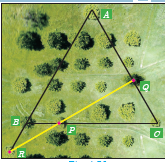
In a garden containing several trees, three particular trees P, Q, R are located in the following way, BP = 2 m, CQ = 3 m, RA = 10 m, PC = 6 m, QA = 5 m, RB = 2 m, where A, B, C are points such that P lies on BC, Q lies on AC and R lies on AB. Check whether the trees P, Q, R lie on a same straight line.
7.
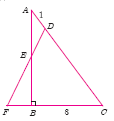
In Fig, ABC is a triangle with \(\angle\)B=90o, BC=3cm and AB=4 cm. D is point on AC such that AD=1 cm and E is the midpoint of AB. Join D and E and extend DE to meet CB at F. Find BF.
8.
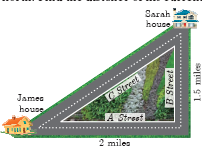
There are two paths that one can choose to go from Sarah’s house to James house. One way is to take C street, and the other way requires to take B street and then A street. How much shorter is the direct path along C street? (Using figure).
9.
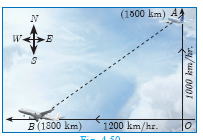
An Aeroplane after take off from an airport and flies due north at a speed of 1000 km/hr. At the same time, another aeroplane leaves the same airport and flies due west at a speed of 1200 km/hr. How far apart will be the two planes after 1½ hours?
1.
Statement
If a straight line through one vertex of a triangle divides the opposite side internally in the ratio of the other two sides, then the line bisects the angle internally at the vertex.
Proof
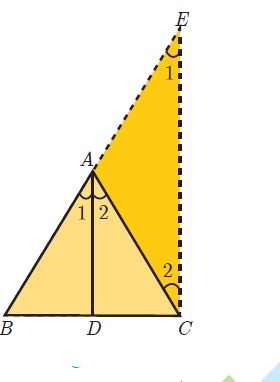
Given : ABC is a triangle. AD divides BC in the ratio of the sides containing the angles \(\angle\)A to meet BC at D.
That is \(\frac{A B}{A C}=\frac{B D}{D C}\)
To prove : AD bisects \(\angle\)A i.e. \(\angle\)1 = \(\angle\)2
Construction : Draw CE \(\|\)DA . Extend BA to meet at E.
| No | Statement | Reason |
|---|---|---|
| 1. | \(\text { Let } \angle B A D=\angle 1 \text { and } \angle D A C=\angle 2\) | Assumption |
| 2. | \(\angle B A D=\angle A E C=\angle 1\) | Since DA\(\|\)CE and AC is transversal, corresponding angles are equal |
| 3. | \(\angle D A C=\angle A C E=\angle 2\) | Since DA\(\|\)CE and AC is transversal, Alternate angles are equal |
| 4. | \(\frac{B A}{A E}=\frac{B D}{D C} \ldots(2)\) | In \(\triangle\)BCE by Thales theorem |
| 5 | \(\frac{A B}{A C}=\frac{B D}{D C}\) | From (1) |
| 6 | \(\frac{A B}{A C}=\frac{B A}{A E}\) | From (1) and (2) |
| 7 | AC = AE … (3) | Cancelling AB |
| 8 | \(\angle\)1 = \(\angle\)2 | \(\triangle\)ACE is isosceles by (3) |
| 9 | AD bisects \(\angle\)A | Since, \(\angle\)1 = \(\angle\)BAD = \(\angle\)2 = \(\angle\)DAC . Hence proved |
2.
Statement
A straight line drawn parallel to a side of triangle intersecting the other two sides, divides the sides in the same ratio.
Proof
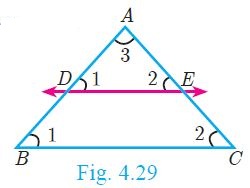
In \(\Delta ABC\) ,D is a point on AB and E is a point on AC
To prove : \(\cfrac { AD }{ DB } =\cfrac { AE }{ EC } \)
Construction: Draw a line DE || BC
| No. | Statement | Reason |
| 1. | \(\angle ABC=\angle ADE=\angle 1\) | Corresponding angles are equal because DE || BC |
| 2. | \(\angle ACB=\angle AED=\angle 2\) | Corresponding angles are equal because DE || BC |
| 3. | \(\\ \angle DAE=\angle BAC=\angle 3\) | Both triangles have a common angle |
| 4. | \(\Delta ABC\sim \Delta ADE\) | By AAA similarity |
| \(\frac { AB }{ AD } =\frac { AC }{ CE } \) | Corresponding sides are proportional | |
| \(\frac { AD+DB }{ AD } =\frac { AE+EC }{ AE } \) | Split AB and AC using the points D and E. | |
| \(1+\frac { DB }{ AD } =1+\frac { EC }{ AE } \) | On simplification | |
| \(\frac { DB }{ AD } =\frac { EC }{ AE } \) | Cancelling 1 on both sides | |
| \(\frac { AD }{ DB } =\frac { AE }{ EC } \) | Taking reciprocals | |
| Hence proved |
3.
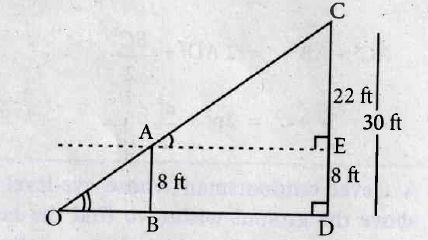
Let AB be the emu = 8 ft
CD be the pillar = 30 ft
OB be the shadow, BD be the distance between the pillar and the emu.
Draw AE || OD at a distance of 8 ft from OD.
Now, \( \angle C A E=\angle A O B \) [corresponding angles]
\(\angle O B A=\angle A E C=90^{\circ}\)
By AA similarity criteria
\( \triangle C E A \sim \triangle A B O \)
\(\frac{C E}{A B} =\frac{E A}{B O} \)
\(\frac{22}{8} =\frac{B D}{O B} \quad[\because \mathrm{EA}=\mathrm{BD}] \)
\(\frac{11}{4} =\frac{\text { distance }}{\text { shadow }} \)
\(\text { Shadow } =\frac{4}{11} \times \text { distance }\)
4.
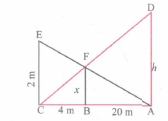
Let CP be the man whose eye level is 2 m above the ground
AT be the height of the tree
In triangles \(\triangle C B P \text { and } \triangle A B T\)
\(\angle C=\angle A=90^{\circ}\)
Since \(\mathrm{CA} \perp \mathrm{PC} \text { and } \mathrm{CA} \perp \mathrm{TA}\)
\(\angle C B P=\angle A B T \text { as } \angle C B P\) is the angle of reflection and \(\angle\)ABT is the angle of incident.
By AA similarity criteria
\( \triangle C B P \sim \triangle A B T \)
\(\therefore \ \frac{C B}{A B} =\frac{B P}{B T}=\frac{C P}{A T} \)
\(\frac{C B}{A B} =\frac{C P}{A T} \)
\(\frac{4}{20} =\frac{2}{A T} \)
\(\mathrm{AT} =\frac{2 \times 20}{4}=10 \mathrm{~m}\)
Height of the tree is 10 m.
5.
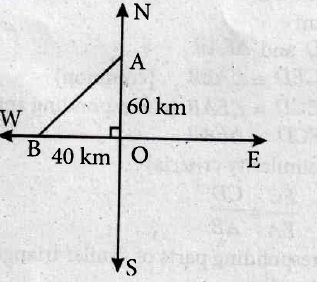
Distance travelled by the first train in 2 hours
= 2 x 20 = 40km
Distance travelled by the second train in 2 hours
= 2 x 30 = 60km
Let the distances are represents by OB and OA respectively
Now applying Pythagoras theorem,
Distance between the trains after 2 hours is AB.
we have AB2 = OA2 + OB2 = 602 + 402
= 3600 + 1600
= 5200
\( A B =\sqrt{5200} \)
\(=\sqrt{2^{2} \times 2^{2} \times 5 \times 5 \times 13} \)
\(=2^{2} \times 5 \sqrt{13} \)
\(=20 \sqrt{13} \mathrm{~km}\)
Distance between the trains after 2 hrs
\(=20 \sqrt{13} \mathrm{~km}\)
6.
By Menelaus' Theorem, the trees P, Q, R will be collinear (lie on same straight line)
If \(\frac { BP }{ PC } \times \frac { CQ }{ QA } \times \frac { RA }{ RB } \)
Given BP = 2 m, CQ = 3 m, RA = 10 m, PC = 6 m, QA = 5 m and RB = 2 m
Substituting these values in (1) we get,
\(\frac { BP }{ PC } \times \frac { CQ }{ QA } \times \frac { RA }{ RB } =\frac { 2 }{ 6 } \times \frac { 3 }{ 5 } \times \frac { 10 }{ 2 } =\frac { 60 }{ 60 } \)
Hence the trees P, Q, R lie on a same straight line.
7.
Consider\(\triangle\)ABC. Then D, E and F are respective points on the sides CA, AB and BC. By construction D, E, F are collinear
By Menelaus’ theorem \(\frac { AE }{ EB } \times \frac { BF }{ FC } \times \frac { CD }{ DA } =1\)
By assumption, AE = EB = 2, DA = 1 and
FC = FB + BC = BF + 3
By Pythagoras theorem,AC2=AB2+BC2=16+9=25. Therefore AC=5
and So, CD = AC – AD = 5 – 1 = 4.
Substituting the values of FC, AE, EB, DA, CD in (1)
we get, \(\frac { 2 }{ 2 } \times \frac { BF }{ BF+3 } \times \frac { 4 }{ 1 } =1\)
4BF=BF+3
4F-BF=8 therefore BF=1
8.
Let Sarah's house is at A and James's house is at 'B' from the picture.
Distance between Sarah's house to James house through Street B and C
= 1.5 miles + 2 miles = 3.5 miles
Distance through street C is AC2 = AB2 + BC2
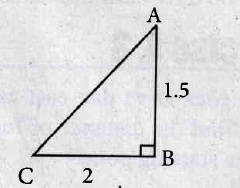
AC2 = = (1.5)2 + (2),
= 2.25 + 4
= 6.25
\(A C=\sqrt{6.25}=2.5\)
AC = 2.5 miles
Difference between two paths = 3.5 - 2.5 = 1 mile
Direct path along C street is 1 mile shorter
9.
Let the first aeroplane starts from O and goes upto A towards north, (Distance=Speed × time)
where \(OA=\left( 100\times \frac { 3 }{ 2 } \right) km=1500km\)
Let the second aeroplane starts from O at the same time and goes upto B towards west,
where \(OB=(1200\times \frac { 3 }{ 2 } )=1800km\)
The required distance to be found is BA.
In right angled triangle AOB, AOB, AB2 = OA2 + OB2
AB2 = (1500)2 + (1800)2 = 1002 (152 +182)
= 1002 x 549 = 1002 x 9 x 61
\(AB=100\times 3\times \sqrt { 61 } =300\sqrt { 61 } kms.\)

10th Standard Syllabus & Materials
10th Standard
TN 10th English Prose - 2 - The Night the Ghost Got in Important Questions And Answers Study Material - QB365 Set A
NEW10th Standard
TN 10th English Supplementary - 1 - The Tempest Important Questions And Answers Study Material - QB365 Set A
NEW10th Standard
TN 10th English Poem - 1 - Life Important Questions And Answers Study Material - QB365 Set A
NEW10th Standard
TN 10th English Prose - 1 - His First Flight Important Questions And Answers Study Material - QB365 Set A



Tamilnadu Stateboard 10th Standard Subjects
Tamilnadu Stateboard Standards





