
 100% FREE ACCESS
10th Standard Syllabus & Materials
10th Standard
TN 10th English Prose - 4 - The Attic Important Questions And Answers Study Material - QB365 Set A
NEW10th Standard
TN 10th English Supplementary - 3 - The Story of Mulan Important Questions And Answers Study Material - QB365 Set A
NEW10th Standard
TN 10th English Poem - 3 - I am Every Woman Important Questions And Answers Study Material - QB365 Set A
NEW10th Standard
TN 10th English Prose - 3 - Empowered Women Navigating The World Important Questions And Answers Study Material - QB365 Set A
NEW10th Standard
TN 10th English Supplementary - 2 - Zigzag Important Questions And Answers Study Material - QB365 Set A
NEW10th Standard
TN 10th English Poem - 2 - The Grumble Family Important Questions And Answers Study Material - QB365 Set A

Published on: 13/05/2022
QB365 provides detailed and simple solution for every book back questions in class 10 Maths subject.It will helps to get more idea about question pattern in every book back questions with solution.
latest Book back QuestionsDownload Tamil Nadu 10th Standard Maths question papers, model tests, one-mark questions, important questions, and public exam papers in PDF format. Free study materials and answer keys for TN State Board students.
Questions + Answers key
Take MCQ Maths Test1.
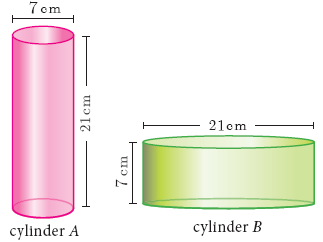
For the cylinders A and B
(i) find out the cylinder whose volume is greater.
(ii) verify whether the cylinder with greater volume has greater total surface area.
(iii) find the ratios of the volumes of the cylinders A and B.
2.
Find the volume of the iron used to make a hollow cylinder of height 9 cm and whose internal and external radii are 21 cm and 28 cm respectively
3.
The volume of a cylindrical water tank is 1.078 x 10⁶ litres. If the diameter of the tank is 7m, find its height.
4.
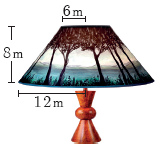
The frustum shaped outer portion of the table lamp has to be painted including the top part. Find the total cost of painting the lamp if the cost of painting 1 sq.cm is Rs. 2.
5.
The internal and external diameters of a hollow hemispherical vessel are 20 cm and 28 cm respectively. Find the cost to paint the vessel all over at Rs. 0.14 per cm2.
6.
A girl wishes to prepare birthday caps in the form of right circular cones for her birthday party, using a sheet of paper whose area is 5720 cm2, how many caps can be made with radius 5 cm and height 12 cm.
7.
A right angled triangle PQR where ∠Q = 90o is rotated about QR and PQ. If QR = 16 cm and PR = 20 cm, compare the curved surface areas of the right circular cones so formed by the triangle.
8.
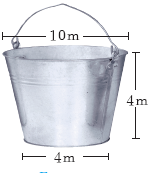
An industrial metallic bucket is in the shape of the frustum of a right circular cone whose top and bottom diameters are 10 m and 4 m and whose height is 4 m. Find the curved and total surface area of the bucket.
9.
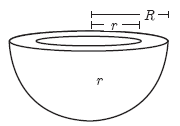
The internal and external radii of a hollow hemispherical shell are 3 m and 5 m respectively. Find the T.S.A. and C.S.A. of the shell.
10.
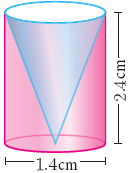
From a solid cylinder whose height is 2.4 cm and diameter 1.4 cm, a conical cavity of the same height and base is hollowed out. Find the total surface area of the remaining solid.
1.
Volume of cylinder = \(\pi\)r2h cu. units
Volume of cylinder \(A=\frac { 22 }{ 7 } \times \frac { 7 }{ 2 } \times \frac { 7 }{ 2 } \times 211\)
= 808.5cm3
Volume of cylinder B \(=\frac { 22 }{ 7 } \times \frac { 21 }{ 2 } \times \frac { 21 }{ 2 } \times 7\)
= 2425.5 cm3
Therefore, volume of cylinder B is greater than volume of cylinder A.
(ii) T.S.A. of cylinder = 2\(\pi\)r(h + r) sq. units
T.S.A. of cylinder \(A=2\times\frac { 22 }{ 7 } \times \frac { 7 }{ 2 } \times (21+3.5)\) = 539 cm2
T.S.A. of cylinder \(B=2\times \frac { 22 }{ 7 } \times \frac { 21 }{ 2 } \times (7+10.5)\) = 1155 cm2
Hence verified that cylinder B with greater volume has a greater surface area.
(iii) \(\frac { Volume\ of\ cylinderA }{ Volume\ of\ cylinder\ B } =\frac { 808.5 }{ 2425.5 } =\frac { 1 }{ 3 } \)
Therefore, ratio of the volumes of cylinders A and B is 1:3.
2.
Let r, R and h be the internal radius, external radius and height of the hollow cylinder respectively.
Given that, r = 21cm, R = 28 cm, h = 9 cm
Now, volume of hollow cylinder = \(\pi\)(R2 − r2)h cu. units
\(=\frac { 22 }{ 7 } \left( { 28 }^{ 2 }-21^{ 2 } \right) \times 9\)
\(=\frac { 22 }{ 7 } (784-441)\times 9=9702\)
Therefore, volume of iron used = 9702 cm3
3.
Let r and h be the radius and height of the cylinder respectively.
Given that, volume of the tank = 1.078 x 106 = 1078000 litre
1078 m3 (since 1l = \(\frac{1}{1000}m^3\))
diameter = 7m gives radius = \(\frac{7}{2}\)m
volume of the tank = \(\pi\)r h 2 cu. units
1078 = \(\frac { 22 }{ 7 } \times \frac { 7 }{ 2 } \times \frac { 7 }{ 2 } \times h\)
Therefore, height of the tank is 28 m
4.
From the figure
r = 6 cm
R = 12 cm
h = 8 cm
\(l =\sqrt{h^{2}+(\mathrm{R}-\mathrm{r})^{2}} \)
\(=\sqrt{8^{2}+(12-6)^{2}} \)
\(=\sqrt{64+36} \)
\(=\sqrt{100}=10 \mathrm{~cm} \)
Area to be painted = C.S.A + area of top circular region
\(=\pi(R+r) l+\pi r^{2} \)
\(=\frac{22}{7}(12+6)(10)+\frac{22}{7}(6)^{2} \)
\(=\frac{22}{7}(180)+\frac{22}{7}(36) \)
\(=\frac{22}{7}(180+36) \)
\(=\frac{22}{7}(216)=\frac{4752}{7}=678.86 \)
Cost of painting per sq. cm = Rs. 2
Total cost = 678.86 x 2 = Rs. 1357.72
5.
Internal diameter = 20 cm
External diameter = 28 cm
Internal radius = 10 cm
External radius = 14 cm
Total surface area \(=\pi\left(3 \mathrm{R}^{2}+\mathrm{r}^{2}\right) \text { sq. units } \)
\(=\frac{22}{7}\left(3(14)^{2}+(10)^{2}\right) \)
\(=\frac{22}{7}[588+100] \)
\(=\frac{22}{7} \times 688 \)
\(=\frac{15136}{7} \mathrm{~cm}^{2} \)
Cost of painting per sq.cm = Rs 0.14
Total cost \(=\frac{15136}{7} \times 0.14\)
= Rs. 302.72
6.
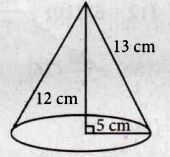
Area of the paper = 5720 cm2
Given radius of birthday cap r = 5 cm
height of birthday cap 'h' = 12 cm
slant height \(l=\sqrt{h^{2}+r^{2}} \)
\(=\sqrt{12^{2}+5^{2}}=\sqrt{144+25} \)
\(=\sqrt{169} \ =13 \mathrm{~cm} \)
CSA of conical cap = \(\pi r l\) sq. units
\(=\frac{22}{7} \times 5 \times 13=\frac{1430}{7}\)
Number of birthday caps
\(=\frac{\text { Area of paper sheet }}{\text { CSA of conical cap }} \)
\(=\frac{5720}{1430} \times 7=28 \text { caps } \)
7.
Right triangle PQR, right angled at Q and
PR = 20 cm, QR = 16 cm
PQ2 = PR2 - QR2
= (20)2 - (16)2
= 400 - 256 = 144
PQ = 12 cm
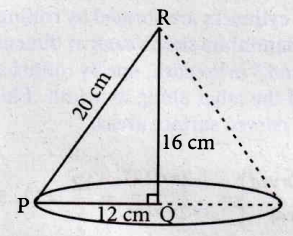
When right triangle PQR, rotates about QR, a right circular cone is formed with PQ = 12 cm as base radius and PR = 20 cm as
slant height.
C.S.A of the Cone = \(\pi r l\) sq. units
\(=\frac{22}{7} \times 12 \times 20=754.29 \mathrm{~cm}^{2}\)
When right triangle PQR, rotates about PQR, a right circular cone is formed with
QR = 16 cm as base radius and PR = 20 cm as slant height
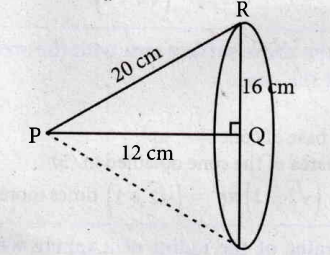
C.S.A of the Cone \(=\pi r l \text { sq.units } \)
\(=\frac{22}{7} \times 16 \times 20 \)
= 1005.71 cm2
Hence, C.S.A of the cone when rotates about PQ is larger.
8.
Let h, l, R and r be the height, slant height, outer radius and inner radius of the frustum.
Given that, diameter of the top = 10 m; radius of the top R = 5 m.
diameter of the bottom = 4 m; radius of the bottom r = 2 m, height h = 4 m
Now, \(l=\sqrt { { h }^{ 2 }+\left( R-{ r } \right) ^{ 2 } } \)
\(=\sqrt { { 4 }^{ 2 }+(5-2)^{ 2 } } \)
\(l=\sqrt { 16+9 } =\sqrt { 25 } =5m\)
Here, C.S.A. = \(\pi\)(R + r)l sq. units
\(\frac { 22 }{ 7 } (5+2)\times 5={ 110m }^{ 2 }\)
T.S.A. = \(\pi\)(R + r)l + \(\pi\)R2 + \(\pi\)r2 sq. units
\(\frac { 22 }{ 7 } \left[ (5+2)5+25+4 \right] =\frac { 1408 }{ 7 } =201.14\)
Therefore, C.S.A. = 110 m2 and T.S.A. = 201.14 m2
9.
Let the internal and external radii of the hemispherical shell be r and R
respectively.
Given that, R = 5 m, r = 3 m
C.S.A. of the shell = 2\(\pi\)(R2 + r2) sq. units
\(=2\times \frac { 22 }{ 7 } \times \left( 25+9 \right) =213.71\)
T.S.A. of the shell = \(\pi\)(3R2 + r2) sq. units
\(=\frac { 22 }{ 7 } (75+9)=264\)
Therefore, C.S.A. = 213.71 m2 and T.S.A. = 264 m2.
10.
Let h and r be the height and radius of the cone and cylinder.
Let l be the slant height of the cone.
Given that, h = 2.4 cm and d = 1.4 cm ; r = 0.7 cm
Here, total surface area of the remaining solid} C.S.A. of the cylinder + C.S.A. of the cone + area of the bottom
= 2\(\pi\)rh + \(\pi\)rl + \(\pi\)r2 sq.units
Now, \(\\ \\ l=\sqrt { { r }^{ 2 }+{ h }^{ 2 } } =\sqrt { 0.49+5.76 } =\sqrt { 6.25 } =2.5cm\)
Area of the remaining solid = 2\(\pi\)rh + \(\pi\)rl + \(\pi\)r2 sq.units
= \(\pi\)r(2h + l + r)
\(\frac { 22 }{ 7 } \times 0.7\times [(2\times 2.4)+2.5+0.7]\)
Therefore, total surface area of the remaining solid is 17.6 m2

10th Standard Syllabus & Materials
10th Standard
TN 10th English Prose - 2 - The Night the Ghost Got in Important Questions And Answers Study Material - QB365 Set A
NEW10th Standard
TN 10th English Supplementary - 1 - The Tempest Important Questions And Answers Study Material - QB365 Set A
NEW10th Standard
TN 10th English Poem - 1 - Life Important Questions And Answers Study Material - QB365 Set A
NEW10th Standard
TN 10th English Prose - 1 - His First Flight Important Questions And Answers Study Material - QB365 Set A



Tamilnadu Stateboard 10th Standard Subjects
Tamilnadu Stateboard Standards





