
 100% FREE ACCESS
10th Standard Syllabus & Materials
10th Standard
TN 10th English Prose - 4 - The Attic Important Questions And Answers Study Material - QB365 Set A
NEW10th Standard
TN 10th English Supplementary - 3 - The Story of Mulan Important Questions And Answers Study Material - QB365 Set A
NEW10th Standard
TN 10th English Poem - 3 - I am Every Woman Important Questions And Answers Study Material - QB365 Set A
NEW10th Standard
TN 10th English Prose - 3 - Empowered Women Navigating The World Important Questions And Answers Study Material - QB365 Set A
NEW10th Standard
TN 10th English Supplementary - 2 - Zigzag Important Questions And Answers Study Material - QB365 Set A
NEW10th Standard
TN 10th English Poem - 2 - The Grumble Family Important Questions And Answers Study Material - QB365 Set A

Published on: 13/05/2022
QB365 provides detailed and simple solution for every book back questions in class 10 Maths subject.It will helps to get more idea about question pattern in every book back questions with solution.
latest Book back QuestionsDownload Tamil Nadu 10th Standard Maths question papers, model tests, one-mark questions, important questions, and public exam papers in PDF format. Free study materials and answer keys for TN State Board students.
Questions + Answers key
Take MCQ Maths Test1.
The King, Queen and Jack of the suit spade are removed from a deck of 52 cards. One card is selected from the remaining cards. Find the probability of getting
(i) a diamond
(ii) a queen
(iii) a spade
(iv) a heart card bearing the number 5.
2.
If the range and coefficient of range of the data are 20 and 0.2 respectively, then find the largest and smallest values of the data.
3.
In a class of 35, students are numbered from 1 to 35. The ratio of boys to girls is 4 : 3. The roll numbers of students begin with boys and end with girls. Find the probability that a student selected is either a boy with prime roll number or a girl with composite roll number or an even roll number.
4.
In a town of 8000 people, 1300 are over 50 years and 3000 are females. It is known that 30% of the females are over 50 years. What is the probability that a chosen individual from the town is either a female or over 50 years?
5.
Two dice are rolled once. Find the probability of getting an even number on the first die or a total of face sum 8.
6.
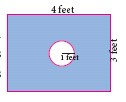
Some boys are playing a game, in which the stone thrown by them landing in a circular region (given in the figure) is considered as win and landing other than the circular region is considered as loss. What is the probability to win the game?
7.
Three fair coins are tossed together. Find the probability of getting
(i) all heads
(ii) atleast one tail
(iii) at most one head
(iv) at most two tails
8.
Two unbiased dice are rolled once. Find the probability of getting
(i) a doublet (equal numbers on both dice)
(ii) the product as a prime number
(iii) the sum as a prime number
(iv) the sum as 1
9.
The temperature of two cities A and B in a winter season are given below.
| Temperature of city A (in degree Celsius) | 18 | 20 | 22 | 24 | 26 |
| Temperature of city B (in degree Celsius) | 11 | 14 | 15 | 17 | 18 |
Find which city is more consistent in temperature changes?
10.
The consumption of number of guava and orange on a particular week by a family are given below.
| Number of Guavas | 3 | 5 | 6 | 4 | 3 | 5 | 4 |
| Number of Oranges | 1 | 3 | 7 | 9 | 2 | 6 | 2 |
Which fruit is consistently consumed by the family?
1.
King spade, Queen spade, Jack spade are removed
∴ total number of cards = 52 - 3 = 49.
(i) Probability (diamond)= \(\frac { 13 }{ 49 } \)
(ii) Probability (queen) \(\frac { 4-1 }{ 49 } =\frac { 3 }{ 49 } \)
(iii) Probability (spade) = \(\frac { 13-3 }{ 49 } =\frac { 10 }{ 49 } \)
(iv) Probability (heart bearing number 5) = \(\frac { 13-5 }{ 49 } =\frac { 8 }{ 49 } \)
2.
Range = L- S = 20
Co-efficient of range = \(\frac { L-S }{ L+S } \) = 0.2
L - S = 20 ...(1)
L - S = 0.2(L + S)
(L + S) 0.2 = 20 ...(2)
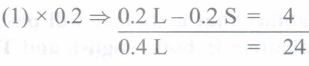
L = \(\frac{24}{0.4}\) = 60
Substitute L = 60 in (1)
60 - S = 20
-S = 20 - 60 =-40
S = 40
∴ The largest is 60, the smallest is 40°.
3.
Total students = 35
n(S) = 35
Boys : girls = 4 : 3
Let the number of boys = 4x
and number of girls = 3x
4x + 3x = 35
7x = 35
\(x=\frac{35}{7}=5\)
Number of boys = 4 x 5 = 20
Number of girls = 3 x 5 = 15
Boys are numbered = {1, 2,3,4,5,6,7,8, 9,10, 11, 12,13, 14, 15,16, 17, 18,19, 20}
Girls are numbered = {21, 22,23, 24, 25, 26,27 , 29, 29, 30, 31, 32, 33, 34, 35}
Let A be the event of getting a boy with prime roll number.
A = {2, 3, 5, 7, 11, 13, 17, 19}
n(A) = 8
\(\mathrm{P}(\mathrm{A})=\frac{n(\mathrm{~A})}{n(\mathrm{~S})}=\frac{8}{35}\)
Let B be the event of getting a girl with composite roll number
B = {21, 22, 24, 25, 26, 27, 28, 30, 32, 33, 34,35}
n(B) = 12
\(\mathrm{P}(\mathrm{B})=\frac{n(\mathrm{~B})}{n(\mathrm{~S})}=\frac{12}{35}\)
Let C be the event of getting an even roll number
C = {2, 4, 6,8, 10, 12, 14, 16, 19, 20, 22, 24, 26, 29, 34, 32, 34}
n(C) = 17
\(\mathrm{P}(\mathrm{C})=\frac{n(\mathrm{C})}{n(\mathrm{~S})}=\frac{17}{35}\)
Since A and B are mutually exclusive events
P(A n B) = 0
B n C = {22, 24, 26, 29, 30, 32, 34}
n ( B n C ) = 7
\(P(B \cap C) =\frac{n(B \cap C)}{n(\mathrm{~S})}=\frac{7}{35}
\)
\(A \cap C =\{2\}
\)
\(\mathrm{n}(A \cap C) =1
\)
\(P(A \cap C) =\frac{n(A \cap C)}{n(S)}=\frac{1}{35}
\)
\(P(A \cap B \cap C) =0[\because n(A \cap B)=0]
\)
\(P(A \cup B \cup C)=P(A)+P(B)+P(C)-
P(A \cap B)-P(B \cap C)-P(A \cap C)
+ P(A \cap B \cap C)
\)
\(=\frac{8}{35}+\frac{12}{35}+\frac{17}{35}-0-\frac{7}{35}-\frac{1}{35}+0
\)
\(=\frac{8+12+17-7-1}{35}=\frac{29}{35}
\)
Required probabiliry = \(\frac{29}{35}\)
4.
Total number of people = 8000
n(S) = 8000
Let A be the event of selecting a female
Number of females n(A) = 3000
\(\mathrm{P}(\mathrm{A})=\frac{n(A)}{n(S)}=\frac{3000}{8000}\)
Let 'B' be the event of selecting an individual as over 50 years.
Number of people who are over 50 years = 1300
n(B) = 1300
\(\mathrm{P}(\mathrm{B}) =\frac{n(\mathrm{~B})}{n(S)}=\frac{1300}{8000}
\)
\(\mathrm{n}(\mathrm{A} \cap \mathrm{B}) =30 \% \text { of } 3000
\)
\(\mathrm{n}(\mathrm{A} \cap \mathrm{B}) =\frac{30}{100} \times 3000=900
\)
\(\mathrm{P}(\mathrm{A} \cap \mathrm{B}) =\frac{n(A \cap B)}{n(S)}=\frac{900}{8000}
\)
\(\mathrm{P}(\mathrm{A} \cup \mathrm{B}) =\mathrm{P}(\mathrm{A})+\mathrm{P}(\mathrm{B})-\mathrm{P}(\mathrm{A} \cap \mathrm{B})
\)
\(\mathrm{P}(\mathrm{A} \cup \mathrm{B}) =\frac{3000}{8000}+\frac{1300}{8000}-\frac{900}{8000}
\)
\(\mathrm{P}(\mathrm{A} \cup \mathrm{B}) =\frac{3000+1300-900}{8000}
\)
\(=\frac{3400}{8000}=\frac{17}{40}
\)
Probability that a chosen individual is either female or over 50 years is \(\frac{17}{40}\)
5.
When two dice are rolled once, the Sample space
S = \(\left\{ \begin{matrix} (1,1) \\ (2,1) \\ \begin{matrix} (3,1) \\ (4,1) \\ \begin{matrix} (5,1) \\ (6,1) \end{matrix} \end{matrix} \end{matrix}\begin{matrix} (1,2) \\ (2,2) \\ \begin{matrix} (3,2) \\ (4,2) \\ \begin{matrix} (5,2) \\ (6,2) \end{matrix} \end{matrix} \end{matrix}\begin{matrix} (1,3) \\ (2,3) \\ \begin{matrix} (3,3) \\ (4,3) \\ \begin{matrix} (5,3) \\ 6,3) \end{matrix} \end{matrix} \end{matrix}\begin{matrix} (1,4) \\ (2,4) \\ \begin{matrix} (3,4) \\ (4,4) \\ \begin{matrix} (5,4) \\ (6,4) \end{matrix} \end{matrix} \end{matrix}\begin{matrix} (1,5) \\ (2,5) \\ \begin{matrix} (3,5) \\ (4,5) \\ \begin{matrix} (5,5) \\ (6,5) \end{matrix} \end{matrix} \end{matrix}\begin{matrix} (1,6) \\ (2,6) \\ \begin{matrix} (3,6) \\ (4,6) \\ \begin{matrix} (5,6) \\ (6,6) \end{matrix} \end{matrix} \end{matrix} \right\} \)
n(S) = 36
Let 'A' be the event of getting an even number on the first die.
\(A=\left\{ \begin{matrix} (2,1), & (2,2), & \begin{matrix} (2,3), & (2,4), & \begin{matrix} (2,5), & (2,6) \end{matrix} \end{matrix} \\ (4,1), & (4,2), & \begin{matrix} (4,3), & (4,4), & \begin{matrix} (4,5), & (4,6) \end{matrix} \end{matrix} \\ (6,1), & (6,2), & \begin{matrix} (6,3), & (6,4), & \begin{matrix} (6,5), & (6,6) \end{matrix} \end{matrix} \end{matrix} \right\} \)
n(A) = 18
\(P(A)=\frac { n(A) }{ n(S) } =\frac { 18 }{ 36 } \)
Let B be the event of getting total face sum 8.
B = {(2, 6), (3,5), (4, 4), (5, 3), (6, 2)}
n(B) = 5
\(P(A)=\frac { n(B) }{ n(S) } =\frac { 5 }{ 36 } \)
(A ∩ B) = {(2, 6), (4,4), (6, 2)}
n(A ∩ B) = 3
p(A ∩ B) = \(\frac{(A∩B)}{n(S)}=\frac{3}{36}\)
∴ P(A U B) = P(A) + P(B)+ P(A ∩ B)
\( =\frac{18}{36}+\frac{5}{36}-\frac{3}{36} \)
\(\mathrm{P}(A \cup B)=\frac{18+5-3}{36}=\frac{23-3}{36}=\frac{20}{36}=\frac{5}{9} \)
Probability of getting even number in the first die or a total face sum 8 is \(\frac{5}{9} .\)
6.
Area of the rectangle = (length x breadth) square units
= 4 x 3 square feet
n(S) = 12 square feet
Area of the circle = \(\pi r^{2}\) square units
= \(\pi(1)^{2}\) square feet
= \(\pi\) square feet
Let A be the event of winning the game, then n(A) = \(\pi\)
Probability of winning the game = \(\frac{n(A)}{n(S)}=\frac{\pi}{12}\)
\(=\frac{3.14}{12}=\frac{1.57}{6}=\frac{157}{600}\)
7.
When three fair coins are tossed together, the sample space
S = {(HHH), (THH), (HTH),(HHT), (TTH), (THT), (HTT), (TTT)}
N(s) = 8
(i) Let A be the event of getting all heads
A = {HHH}
n(A) = 1
\(P(A)=\frac{n(A)}{n(S)}=\frac{1}{8}\)
(ii) Let B be the event of getting atleast one tail
B = {HHT, HTH, HTT, THH, THT, TTH, TTT}
n(B) = 7
\(\mathrm{P}(\mathrm{B})=\frac{n(B)}{n(S)}=\frac{7}{8}\)
(iii) Let C be the event of getting at most one head
C = {HTT, THT, TTH, TTT}
n(C) = 4
\(\mathrm{P}(\mathrm{C})=\frac{n(C)}{n(S)}=\frac{4}{8}=\frac{1}{2}\)
(iv) Let D be the event of getting at most two tails
P = {HHH, HHT, HTH, HTT, THH, THT, TTH}
n(D) = 7
\(\mathrm{P}(\mathrm{D})=\frac{n(D)}{n(S)}=\frac{7}{8}\)
8.
When two unbiased dice are rolled, the Sample Space
s = {(1, 1) (1, 2) (r,3) (1,4) (1,5) (1,6)
(2, 1) (2,2) (2, 3) (2, 4) (2,5) (6, 6)
(3, 1) (3,2) (3, 3) (3, 4) (3, 5) (3, 6)
(4, 1) (4,2) (4,3) (4,4) (4, 5) (4,6)
(5, 1) (5,2) (5,3) (5,4) (5,5) (6,6)
(6, 1) (6,2) (6, 3) (6,4) (6, 5) (6, 6)}
n(S) = 36
(i) Let A be the event of getting a doublet
A = {( 1, 1) (2,2) (3,3) (4, 4) (5, 5) (6, 6)}
n(A) = 6
\(\mathrm{P}(\mathrm{A})=\frac{n(A)}{n(S)}=\frac{6}{36}=\frac{1}{6}\)
(ii) Let B be the event of getting the product as a prime number.
B = {(1,2) (1,3) (1, 5) (2,1) (3, 1) (5, 1)}
n(B) = 6
\(P(B)=\frac{6}{36}=\frac{1}{6}\)
(iii) Let C be the event of getting the sum as a prime number.
c = {(1, 1) ( 1, 2) (1, 4) ( 1, 6) (2, 1) (2, 3) (2, 5) (3,2) (3, 4) (4, 1) (4,3) (5,2) (5,6) (6, 1) (6,5)}
n(C) = 15
\(\mathrm{P}(\mathrm{C})=\frac{n(C)}{n(S)}=\frac{15}{36}=\frac{5}{12}\)
(iv) Let D be the event of getting the sum as 1. Since it is an impossible event.
n(D) = 0 and P(D) = g
9.
| City A | City B | ||||
|---|---|---|---|---|---|
| x1 | \({ d }_{ 1 }=x-\bar { x } \) | \({ d }_{ 1 }^{ 2 }\) | x1 | \(d=x-\bar { x } \) | \({ d }_{ 1 }^{ 2 }\) |
| 18 | -4 | 16 | 11 | -4 | 16 |
| 20 | -2 | 4 | 14 | -1 | 1 |
| 22 | 0 | 0 | 15 | 0 | 0 |
| 24 | 2 | 4 | 16 | 3 | 4 |
| 26 | 4 | 16 | 18 | 3 | 9 |
| 110 | 0 | 40 | 75 | 20 | |
\(\bar { { x }_{ 1 } } =\frac { { \Sigma x }_{ 1 } }{ n } \)
= \(\frac { 110 }{ 5 } \)
= 22
\({ \sigma }_{ 1 }=\sqrt { \frac { { \Sigma d }_{ 1 }^{ 2 } }{ n } } \)
= \(\sqrt { \frac { 40 }{ 5 } } \)
= \(\sqrt { 8 } \)
\(\bar { { x }_{ 2 } } =\frac { { \Sigma x }_{ 1 } }{ n } \)
= \(\frac { 75 }{ 5 } \)
= 15
\({ \sigma }_{ 2 }=\sqrt { \frac { { \Sigma d }_{ 2 }^{ 2 } }{ n } } \)
= \(\sqrt { \frac { 20 }{ 5 } } \)
= \(\sqrt { 4 } \)
= \(2\sqrt { 2 } \)
\(CV_{ 1 }=\frac { { { \sigma }_{ 1 } } }{ { x }_{ 1 } } \times 100\)
= \(\frac { 2.83 }{ 22 } \times 100\)
= 12.86
\({ CV }_{ 2 }=\frac { { \sigma }_{ 2 } }{ \bar { { x }_{ 2 } } } \times 100\)
= \(\frac { 2 }{ 15 } \times 100\)
= 13.33
\(\therefore\)Co-efficient of variation of City A is less than C.V of City B.
\(\therefore\) City A is more consistent.
10.
First we find the coefficient of variation for guavas and oranges separately.
Number of guavas, n=7
| xi | xi2 |
| 3 | 9 |
| 5 | 25 |
| 6 | 36 |
| 4 | 16 |
| 3 | 9 |
| 5 | 25 |
| 4 | 16 |
| Σxi=30 | Σxi2=136 |
Mean \(\bar { { x }_{ 1 } } \)=\(\frac { 30 }{ 7 } \)=4.29
Standard deviation σ1=\(\sqrt { \frac { \Sigma { x }_{ i }^{ 2 } }{ n } -\left( \frac { { \Sigma x }_{ i } }{ n } \right) ^{ 2 } } \)
σ1=\(\sqrt { \frac { 136 }{ 7 } -\left( \frac { 30 }{ 7 } \right) ^{ 2 } } =\sqrt { 19.43-18.40 } \) ≃ 1.01
Coefficient of variation for guavas
C.V1=\(\frac { { \sigma }_{ 1 } }{ \bar { { x }_{ 1 } } } \times 100\)% = \(\frac { 1.01 }{ 4.29 } \) x 100% =23.54%
| xi | xi2 |
| 1 | 1 |
| 3 | 9 |
| 7 | 49 |
| 9 | 81 |
| 2 | 4 |
| 6 | 36 |
| 2 | 4 |
| Σxi=30 | Σxi2=184 |
Number of oranges n=7
Mean \(\bar { { x }_{ 2 } } \)=\(\frac { 30 }{ 7 } \)=4.29
Standard deviation σ1=\(\sqrt { \frac { \Sigma { x }_{ i }^{ 2 } }{ n } -\left( \frac { { \Sigma x }_{ i } }{ n } \right) ^{ 2 } } \)
σ2=\(\\ \sqrt { \frac { 184 }{ 7 } -\left( \frac { 30 }{ 7 } \right) ^{ 2 } } =\sqrt { 26.29-18.40 } \)=2.81
Coefficient of variation for oranges
C.V1=\(\frac { { \sigma }_{ 2 } }{ \bar { { x }_{ 2 } } } \) x 100% = \(\frac { 2.81 }{ 4.29 } \) x 100% = 65.50%
CV1=23.54%, CV2=65.50%. Since, C.V1 < C.V2, we can conclude that the consumption of guavas is more consistent than oranges.

10th Standard Syllabus & Materials
10th Standard
TN 10th English Prose - 2 - The Night the Ghost Got in Important Questions And Answers Study Material - QB365 Set A
NEW10th Standard
TN 10th English Supplementary - 1 - The Tempest Important Questions And Answers Study Material - QB365 Set A
NEW10th Standard
TN 10th English Poem - 1 - Life Important Questions And Answers Study Material - QB365 Set A
NEW10th Standard
TN 10th English Prose - 1 - His First Flight Important Questions And Answers Study Material - QB365 Set A



Tamilnadu Stateboard 10th Standard Subjects
Tamilnadu Stateboard Standards





