
 100% FREE ACCESS
10th Standard Syllabus & Materials
10th Standard
TN 10th English Prose - 4 - The Attic Important Questions And Answers Study Material - QB365 Set A
NEW10th Standard
TN 10th English Supplementary - 3 - The Story of Mulan Important Questions And Answers Study Material - QB365 Set A
NEW10th Standard
TN 10th English Poem - 3 - I am Every Woman Important Questions And Answers Study Material - QB365 Set A
NEW10th Standard
TN 10th English Prose - 3 - Empowered Women Navigating The World Important Questions And Answers Study Material - QB365 Set A
NEW10th Standard
TN 10th English Supplementary - 2 - Zigzag Important Questions And Answers Study Material - QB365 Set A
NEW10th Standard
TN 10th English Poem - 2 - The Grumble Family Important Questions And Answers Study Material - QB365 Set A

Published on: 13/05/2022
QB365 provides detailed and simple solution for every Book back Questions in class 10 Science Subject. It will helps to get more idea about question pattern in every book back questions with solution.
latest Book back QuestionsDownload Tamil Nadu 10th Standard Science question papers, model tests, one-mark questions, important questions, and public exam papers in PDF format. Free study materials and answer keys for TN State Board students.
Questions + Answers key
Take MCQ Science Test1.
A source and listener are both moving towards each other with a speed v/10 where v is the speed of sound. If the frequency of the note emitted by the source is f, what will be the frequency heard by the listener?
2.
A source producing a sound of frequency 500 Hz is moving towards a listener with a velocity of 30 m s–1. The speed of the sound is 330 m s–1. What will be the frequency heard by listener?
3.
What is an echo?
a) State two conditions necessary for hearing an echo.
b) What are the medical applications of echo?
c) How can you calculate the speed of sound using echo?
4.
What is mean by reflection of sound? Explain:
a) reflection at the boundary of a rarer medium
b) reflection at the boundary of a denser medium
c) Reflection at curved surfaces
5.
When sound is reflected from a distant object, an echo is produced. Let the distance between the reflecting surface and the source of sound remain the same. Do you hear an echo sound on a hotter day? Justify your answer.
1.
When source and listener are both moving towards each other, the apparent frequency is
\(n'=\left( \frac { v+{ v }_{ 1 } }{ v-{ v }_{ s } } \right) n\)
\(n'=\left( \frac { v+\frac { v }{ 10 } }{ v-\frac { v }{ 10 } } \right) n\)
\(n'=\frac { 11 }{ 9 } .f\)
= 1.22f
2.
When the source is moving towards the stationary listener, the expression for apparent frequency is
\(n'=\left( \frac { v }{ v-{ v }_{ s } } \right) n\)
\(n'=\left( \frac { 330 }{ 330-30 } \right) \times 500\)
= 550 Hz
3.
Echo:
(i) An echo is the sound reproduced due to the reflection of the original sound from various rigid surfaces such as walls, ceilings, surfaces of mountains, etc.
a) Conditions necessary for hearing echo:
(i) The persistence of hearing for human ears is 0.1 second.
(ii) This means that you can hear two sound waves clearly, if the time interval between the two sounds is at least 0.1 s.
(iii) Thus, the minimum time gap between the original sound and an echo must be 0.1 s.
(iv) The above criterion can be satisfied only when the distance between the source of sound and the reflecting surface would satisfy the following equation:
\(\text { Velocity } =\frac{\text { distance travelled by sound }}{\text { time taken }} \)
\(v =\frac{2 d}{t} \)
\(d =\frac{v t}{2}\)
since, t = 0.1 second, then \(\mathrm{d}=\frac{331}{0.20}=\frac{\mathrm{v}}{20}\)
(v) Thus the minimum distance required to hear an echo is 1 / 20th part of the magnitude of the velocity of sound in air.
(vi) If you consider the velocity of sound as 344 ms-1, the minimum distance required to hear an echo is 17.2 m.
b) Applications of echo:
(i) The principle of echo is used in obstetric ultrasonography, which is used to create real-time visual images of the developing embryo or fetus in the mother's uterus.
(ii) This is a safe testing tool, as it does not use any harmful radiations.
c) Calculation of speed of sound:
(i) The sound pulse emitted by the source travels a total distance of 2d while travelling from the source to the wall and then back to the receiver.
(ii) The time taken for this has been observed to be 't'. Hence, the speed of sound wave is given by
\(\text { Speed of Sound }=\frac{\text { distance travelled }}{\text { time taken }}=\frac{2 \mathrm{d}}{\mathrm{t}}\)
4.
Reflection of sound waves:
(i) When sound waves travel in a given medium, and strikes the surface of another medium, they can bounce back into the first medium.
(ii) This phenomenon is known as reflection.
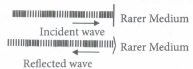
a) Reflection at the boundary of a rarer medium:
(i) Consider a wave travelling in a solid medium striking on the interface between the solid and the air.
(ii) The compression exerts a force F on the surface of the rarer medium.
(iii) As a rarer medium has smaller resistance for any deformation, the surface of separation is pushed backwards (Figure).
(iv) As the particles of the rarer medium are free to move, a rarefaction is produced at the interface.
(v) Thus, a compression is reflected as a rarefaction and a rarefaction travels from right to left.
b) Reflection at the boundary of a denser medium
(i) A longitudinal wave travels in a medium in the form of compressions and rare factions.
(ii) Suppose a compression travelling in air from left to right reaches a rigid wall. The compression exerts a force F on the rigid wall.
(iii) In turn, the wall exerts an equal and opposite reaction R = - F on the air molecules. This results in a compression near the rigid wall.
(iv) Thus, a compression travelling towards the rigid wall is reflected back as a compression. That is, the direction of compression is reversed.
c) Reflection of sound in plane and curved surfaces:
(i) When sound waves are reflected from curved surfaces, the intensity of reflected waves is changed.
(ii) When reflected from a convex surface, the reflected waves are diverged out and the intensity is decreased.
(iii) When sound is reflected from a concave surface, the reflected waves are converged and focused at a point. So the intensity of reflected waves is concentrated at a point.
(iv) Parabolic surfaces are used when it is required to focus the sound at a particular point.
(v) Hence, many halls are designed with parabolic reflecting surfaces.
(vi) In elliptical surfaces, sound from one focus will always be reflected to the other focus no matter where it strikes the wall.
5.
(i) An echo is heard when the time for the reflected sound is heard after 0.1 s.
(ii) Time taken = Total distance / Velocity.
(iii) On a hotter day, the velocity of sound is more. If the time taken by echo is less than 0.1 s, it will not be heard.

10th Standard Syllabus & Materials
10th Standard
TN 10th English Prose - 2 - The Night the Ghost Got in Important Questions And Answers Study Material - QB365 Set A
NEW10th Standard
TN 10th English Supplementary - 1 - The Tempest Important Questions And Answers Study Material - QB365 Set A
NEW10th Standard
TN 10th English Poem - 1 - Life Important Questions And Answers Study Material - QB365 Set A
NEW10th Standard
TN 10th English Prose - 1 - His First Flight Important Questions And Answers Study Material - QB365 Set A



Tamilnadu Stateboard 10th Standard Subjects
Tamilnadu Stateboard Standards





