
 100% FREE ACCESS
10th Standard Syllabus & Materials
10th Standard
TN 10th English Prose - 4 - The Attic Important Questions And Answers Study Material - QB365 Set A
NEW10th Standard
TN 10th English Supplementary - 3 - The Story of Mulan Important Questions And Answers Study Material - QB365 Set A
NEW10th Standard
TN 10th English Poem - 3 - I am Every Woman Important Questions And Answers Study Material - QB365 Set A
NEW10th Standard
TN 10th English Prose - 3 - Empowered Women Navigating The World Important Questions And Answers Study Material - QB365 Set A
NEW10th Standard
TN 10th English Supplementary - 2 - Zigzag Important Questions And Answers Study Material - QB365 Set A
NEW10th Standard
TN 10th English Poem - 2 - The Grumble Family Important Questions And Answers Study Material - QB365 Set A

Published on: 05/07/2021
QB365 provides detailed and simple solution for every
Creative Questions in class 10 Science Subject. It will helps to get more idea about question pattern in everyCreative questions with solution.
Download Tamil Nadu 10th Standard Science question papers, model tests, one-mark questions, important questions, and public exam papers in PDF format. Free study materials and answer keys for TN State Board students.
Questions + Answers key
Take MCQ Science Test1.
Write the conditions for No Doppler effect.
2.
Tabulate the expression for apparent frequency due to Doppler effect.
3.
Explain Doppler effect.
4.
Write the applications of Reflection of Sound.
5.
How to measuring velocity of sound by echo method.
1.
Under the following circumstances, there will be no Doppler effect and the apparent frequency as heard by the listener will be the same as the source frequency.
i) When source (S) and listener (L) both are at rest.
ii) When S and L move in such a way that distance between them remains constant.
iii) When source S and L are moving in mutually perpendicular directions.
iv) If the source is situated at the center of the circle along which the listener is moving.
2.
| Case No. | Position of source and listener | Note | Expression for apparent frequency |
| (i) | a) Both source and listener move. b) They move towards each other. |
a) Distance between source and listener decreases. b) Apparent frequency is more than actual frequency. |
\(n^{\prime}=\left(\frac{v+v_{L}}{v-v_{s}}\right) n\) |
| (ii) | a) Both source and listener move. b) They move away from each other. |
a) Distance between source and listener increases. b) Apparent frequency less than actual frequency. c) VS and VL become opposite to that in case-1. |
\(n^{\prime}=\left(\frac{v-v_{L}}{v+v_{s}}\right) n\) |
| (iii) | a) Both source and listener move. b) They move one behind the other. c) Source follows the listener. |
a) Apparent frequency depends on the velocities of the source and the listener. b) VS becomes opposite to that in case-2. |
\(n^{\prime}=\left(\frac{v-v_{L}}{v-v_{s}}\right) n\) |
| (iv) | a) Both source and listener move. b) They move one behind the other. c) Listener follows the source. |
a) Apparent frequency depends on the velocities of the source and the listener. b) VS and VL become opposite to that in case-3. |
\(n^{\prime}=\left(\frac{v+v_{L}}{v+v_{s}}\right) n\) |
| (v) | a) Source at rest. b) Listener moves towards. |
a) Distance between source and listener decreases. b) Apparent frequency is more than actual frequency. c) VS=0 in case-1. |
\(n^{\prime}=\left(\frac{v+v_{L}}{v}\right) n\) |
| (vi) | a) Source at rest. b) Listener moves towards the source. |
a) Distance between source and listener increases . b) Apparent frequency is less than actual frequency. c) VS = 0 in case-2. |
\(n^{\prime}=\left(\frac{v-v_{L}}{v}\right) n\) |
| (vii) | a) Listener at rest. b) Source moves towards the listener. |
a) Distance between source and listener decreases. b) Apparent frequency is more than actual frequency. c) VL = 0 in case-1. |
\(n^{\prime}=\left(\frac{v}{v-v_{s}}\right) n\) |
| (viii) | a) Listener at rest b) Source moves towards the listener |
a) Distance between source and listener increases b) Apparent frequency is less than actual frequency c) VL =0 in case-2 |
\(n^{\prime}=\left(\frac{v}{v+v_{s}}\right) n\) |
3.
The frequency of the sound as received by a listener is different from the original frequency produced by the source whenever there is a relative motion between the source and the listener. This is known as Doppler effect This relative motion could be due to various possibilities as follows:
i) The listener moves towards or away from a stationary source.
ii) The source moves towards or away from a stationary listener.
iii) Both source and listener move towards or away from one other.
iv) The medium moves when both source and listener are at rest
For simplicity of calculation, it is assumed that the medium is at rest. That is the velocity of the medium is zero.
Let S and L be the source and the listener moving with velocities vS and vL respectively. Consider the case of source and listener moving towards each other As the distance between them decreases, the apparent frequency will be more than the actual source frequency.
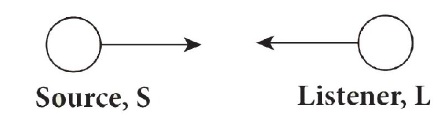
Let n and n' be the frequency of the sound produced by the source and the sound observed by the listener respectively. Then, the expression for the apparent frequency n' is n' = v + vL v - vS n.
Here, v is the velocity of sound waves in the given medium. Let us consider different possibilities of motions of the source and the listener. In all such cases, the expression for the apparent frequency.
4.
Sound board:
These are basically curved surfaces (concave), which are used in auditoria and halls to improve the quality of sound. This board is placed such that the speaker is at the focus of the concave surface. The sound of the speaker is reflected towards the audience thus improving the quality of sound heard by the audience.
Ear trumpet:
Ear trumpet is a hearing aid, which is useful by people who have difficulty in hearing. In this device, one end is wide and the other end is narrow. The sound from the sources fall into the wide end and are reflected by its walls into the narrow part of the device. This helps in concentrating the sound and the sound enters the eardrum with more intensity. This enables a person to hear the sound better.
Megaphone:
A megaphone is a horn-shaped device used to address a small gathering of people. Its one end is wide and the other end is narrow. When a person speaks at the narrow end, the sound of his speech is concentrated by the multiple reflections from the walls of the tube. Thus, his voice can be heard loudly over a long distance.
5.
Apparatus required:
A source of sound pulses, a measuring tape, a sound receiver, and a stop watch.
Procedure:
i) Measure the distance ‘d’ between the source of sound pulse and the reflecting surface using the measuring tape.
ii) The receiver is also placed adjacent to the source. A sound pulse is emitted by the source.
iii) The stopwatch is used to note the time interval between the instant at which the sound pulse is sent and the instant at which the echo is received by the receiver. Note the time interval as ‘t’.
iv) Repeat the experiment for three or four times. The average time taken for the given number of pulses is calculated.

10th Standard Syllabus & Materials
10th Standard
TN 10th English Prose - 2 - The Night the Ghost Got in Important Questions And Answers Study Material - QB365 Set A
NEW10th Standard
TN 10th English Supplementary - 1 - The Tempest Important Questions And Answers Study Material - QB365 Set A
NEW10th Standard
TN 10th English Poem - 1 - Life Important Questions And Answers Study Material - QB365 Set A
NEW10th Standard
TN 10th English Prose - 1 - His First Flight Important Questions And Answers Study Material - QB365 Set A



Tamilnadu Stateboard 10th Standard Subjects
Tamilnadu Stateboard Standards





